Table of Contents
What Does a Doctor’s Journey Look Like?
Scroll HereHow Many Years Does It Take to Become a Doctor in India?
Scroll HereStep-by-Step Process to Become a Doctor in India
Scroll HereStep 1: Planning from School (Classes 9–12)
Scroll HereStep 2: Understanding NEET-UG — The Entrance Examination
Scroll HereStep 3: Pursuing the 5.5-Year MBBS Course in India
Scroll HereStep 4: Internship and Medical Registration to Practise
Scroll HereStep 5: Postgraduate Studies and Specialisation
Scroll HereBonus Step: Skills, Mindset and Lifestyle of a Doctor
Scroll HereWhat If You Don’t Clear NEET?
Scroll HereAn Alternative Route: MBBS Abroad
Scroll HereFrequently Asked Questions
Scroll HereHow many years does it take to become a doctor in India?
Scroll HereCan I become a doctor without NEET?
Scroll HereWhat is the minimum percentage in Class 12 for MBBS?
Scroll HereIs there an age limit for MBBS admission in India?
Scroll HereWhat is NExT and will it replace NEET-PG?
Scroll HereHow much does an MBBS cost in India?
Scroll HereCan I practise in India with a foreign MBBS degree?
Scroll HerePlan Your Route to Becoming a Doctor
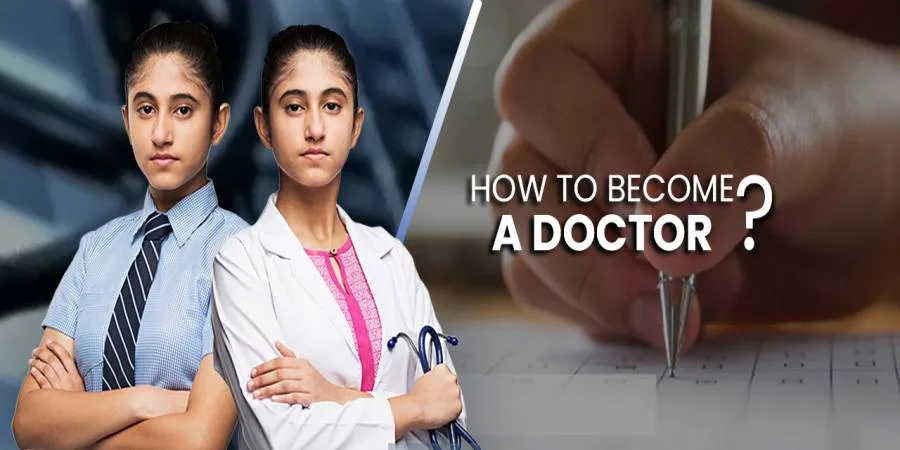
Scroll HereIf you are wondering how to become a doctor in India, the short answer is a long but well-defined route. You complete Classes 11 and 12 with physics, chemistry and biology (PCB), clear the NEET-UG entrance examination, earn an MBBS degree over 5.5 years, and then register with the National Medical Commission (NMC) or your State Medical Council before you can legally practise. This guide walks through every stage in order, with the eligibility rules, timelines and costs you need to plan for.
What Does a Doctor’s Journey Look Like?
The path is more structured than most students expect, and it begins in school. Students take the PCB stream in higher secondary (Classes 11 and 12) and must finish Class 12 with at least 50% aggregate marks in PCB if they belong to the general category, or 40% if they belong to a reserved category (SC/ST/OBC). Candidates with benchmark disabilities in the general category need 45%. After Class 12, every medical aspirant has to qualify in NEET-UG.
After NEET, students enter a recognised medical institution through counselling, complete a 5.5-year MBBS programme (4.5 years of academic and clinical study plus a one-year compulsory internship), and then obtain registration to practise by meeting the licensing requirements set by the NMC. Many go on to postgraduate study (MD/MS or DNB) for a specialisation, which adds at least another three years.
The route in one line: PCB in Classes 11–12 → NEET-UG → 5.5-year MBBS → Compulsory internship → Registration with the NMC or State Medical Council → MD/MS or DNB (optional).
How Many Years Does It Take to Become a Doctor in India?
From the first day of Class 11 to your first day as a registered practitioner is roughly seven and a half years. Specialisation extends it further.
| Stage | Duration | Cumulative time |
|---|---|---|
| Classes 11 and 12 with PCB | 2 years | 2 years |
| NEET-UG preparation and attempt (usually overlaps with Class 12) | — | 2 years |
| MBBS academic and clinical study | 4.5 years | 6.5 years |
| Compulsory Rotatory Medical Internship (CRMI) | 1 year | 7.5 years |
| Registration with the NMC or State Medical Council | A few weeks to a few months | ~7.5 years |
| MD / MS / DNB specialisation (optional) | 3 years | ~10.5 years |
| DM / MCh super-speciality (optional) | 3 years | ~13.5 years |
Step-by-Step Process to Become a Doctor in India
Here is the full process in sequence, starting from the school years, when the real planning begins.
Step 1: Planning from School (Classes 9–12)
Your preparation effectively starts the moment you choose your stream in Class 10, because you must complete 10+2 (or an equivalent qualification) with physics, chemistry and biology or biotechnology, along with English, from a recognised board. Students who are clear about medicine often begin planning as early as Class 9.
Per the NMC regulations and the annual NEET information bulletin, general category students need at least 50% aggregate marks in PCB, SC/ST/OBC students need 40%, and general category candidates with benchmark disabilities need 45%. Many students begin structured NEET preparation in Class 11, since the syllabus is drawn directly from the NCERT science curriculum — you can plan around the NEET syllabus and the chapter-wise weightage to prioritise high-yield topics. If you are still weighing your options at this stage, it is worth reading about the wider range of medical courses after 12th.
Step 2: Understanding NEET-UG — The Entrance Examination
The National Eligibility cum Entrance Test – Undergraduate (NEET-UG) is the single official gateway to an MBBS seat in India. It is mandatory for almost all MBBS seats across government, private and deemed institutions, so qualifying is not optional — and scoring well above the cut-off is what secures a seat at a well-regarded college.
According to the NEET-UG information bulletin and NMC communications, candidates must have completed or be appearing for Class 12 with PCB and English, and must be at least 17 years of age as on 31 December of the year of admission. There is no upper age limit for appearing in NEET-UG.
An important clarification: NEET-UG qualification is decided by percentile, not by percentage of marks. Your percentile reflects how you performed relative to every other candidate that year, which is why the equivalent mark cut-off changes annually.
| Category | NEET-UG qualifying criterion |
|---|---|
| General / General-EWS | 50th percentile |
| SC / ST / OBC | 40th percentile |
| General-PwD | 45th percentile |
| SC / ST / OBC-PwD | 40th percentile |
Qualifying and getting a seat are two different things. For a realistic picture, look at the marks required in NEET for MBBS and the typical cut-off for government medical colleges, and check the current NEET registration, eligibility and syllabus details before you apply.
Not sure where your NEET score lands? Check the colleges you can realistically target before counselling opens — or estimate your rank first with the NEET Rank Predictor.
Yes. NEET-UG is the single entrance test for MBBS and BDS admission across all government, private and deemed colleges in India. It is also required for Indian students who study MBBS abroad and later want to practise in India.
The qualifying percentile — 50th for General and EWS, 40th for SC, ST and OBC — only makes you eligible for counselling. The admission cut-off is the score at which seats actually close in a given college, and it is usually far higher, especially for government colleges.
There is no limit on the number of attempts and no upper age limit. You only need to be at least 17 years old as on 31 December of the year of admission.
Step 3: Pursuing the 5.5-Year MBBS Course in India
After qualifying in NEET-UG, you must take part in MCC or state counselling to secure admission, in line with the NMC’s Graduate Medical Education Regulations. Once you have a seat, you enter the MBBS programme itself — the core academic requirement for practising medicine in India.
An MBBS in India runs for 5.5 years: 4.5 years of academic study and clinical exposure, followed by a 12-month compulsory internship in NMC-recognised hospitals. The curriculum covers pre-clinical subjects (anatomy, physiology, biochemistry), para-clinical subjects (pathology, pharmacology, microbiology, forensic medicine) and clinical rotations in the final phase across medicine, surgery, obstetrics and gynaecology, paediatrics, orthopaedics, ENT, ophthalmology and community medicine. If you want a closer look at what the first year actually involves, see our breakdown of MBBS first-year subjects.
Seat availability is the real constraint. As per the NMC seat matrix for 2026, India has 1,36,939 MBBS seats — you can see the full state-wise breakdown in our guide to the total MBBS seats in India.
Cost varies enormously depending on the type of college, and it is the single biggest factor in most families’ decisions. The figures below are indicative total course costs; always verify against the latest fee notification for the specific college.
| Type of institution | Indicative total course fee | What determines a seat |
|---|---|---|
| Government medical college | Lowest cost bracket | Very high NEET score; state and All India quota counselling |
| Private medical college | Substantially higher | NEET qualification plus counselling; management and NRI quotas cost more |
| Deemed university | Highest domestic bracket | NEET qualification plus MCC deemed counselling |
| MBBS abroad (NMC-approved) | Typically between government and private India | NEET qualification plus university eligibility |
For current figures, see our detailed breakdowns of the cost of MBBS in India and the top private medical colleges in India.
Government colleges charge the least and demand the highest NEET scores. Private colleges sit in the middle, with management and NRI quota seats priced higher. Deemed universities are the most expensive and admit students through MCC deemed counselling.
No. MBBS has no specialisation — every student follows the same curriculum. Your speciality is decided later, through the postgraduate entrance examination and counselling for MD, MS or DNB.
You get supplementary attempts as per NMC regulations. Repeated failures can add a year to the course, which is why the 5.5-year timeline assumes a clear run without any backlogs.
Step 4: Internship and Medical Registration to Practise
Every MBBS student must complete a mandatory one-year Compulsory Rotatory Medical Internship (CRMI) under NMC guidelines. During the internship you rotate through departments, work directly with patients under supervision, and build hands-on clinical skills in history taking, examination, procedures and emergency care. Interns receive a monthly stipend, which varies widely by state — see our comparison of the MBBS internship stipend across India. Completing this internship is non-negotiable if you intend to practise.
Once you have completed the MBBS degree and the internship at an NMC-recognised institution, you become eligible for registration with the National Medical Commission or the relevant State Medical Council, which gives you the legal licence to practise as a medical practitioner in India.
The NMC has also notified a National Exit Test (NExT) framework, intended to serve as both a licensing examination and a postgraduate entrance examination. Its implementation has been deferred more than once, so check the NMC’s latest notification for the current status before planning around it.
Step 5: Postgraduate Studies and Specialisation
An MBBS degree is not the end of the road for most doctors. After MBBS you can appear for national-level PG entrance examinations to enter MD, MS or DNB programmes in fields such as internal medicine, general surgery, paediatrics, anaesthesia and radiology. Our guide to PG courses after MBBS covers the options in detail.
These postgraduate courses usually run for three years and combine intensive clinical training with research and a thesis in the chosen speciality. After specialising, some doctors pursue DM or MCh super-speciality qualifications or fellowships, while others move into teaching hospitals, private practice, public health or health administration. If you are weighing the alternatives, including non-clinical routes, read what to do after MBBS.
Bonus Step: Skills, Mindset and Lifestyle of a Doctor
Clearing exams and collecting degrees is only part of it. A successful doctor needs strong communication skills, empathy, patience, the stamina to handle long working hours and emotionally difficult situations, and a genuine willingness to keep learning.
Because treatment standards and health regulations keep evolving, staying current with guidelines, research and protocols is a career-long obligation rather than a phase. The training is demanding, but it is manageable if you plan your finances carefully, protect your mental health and build a support system early.
What If You Don’t Clear NEET?
Not qualifying in NEET is common, and it does not end a career in healthcare. Several allied and alternative routes lead to clinical practice or to well-paid roles in the medical field — BDS, BAMS, BHMS, BPT, nursing, pharmacy, biotechnology and a range of paramedical and allied health sciences programmes among them.
Two useful starting points: our guide to how to become a doctor without MBBS, and a wider look at career options if you are not able to clear NEET. Repeating NEET the following year is also a legitimate choice, since there is no upper age limit and no cap on attempts.
An Alternative Route: MBBS Abroad
Many Indian students also look at MBBS abroad. Each year more than 20 lakh candidates appear for NEET-UG, competing for 1,36,939 MBBS seats — and a large share of those seats sit in private and deemed colleges at fee levels most families cannot fund. Industry estimates suggest tens of thousands of Indian students travel overseas for medical education every year as a result.
Studying medicine abroad offers exposure to different healthcare systems, modern clinical infrastructure and an international peer group. It is not a shortcut, though: NEET qualification is still mandatory for Indian students who intend to return and practise in India, and the quality of universities varies widely. Start with our guide to the best country for MBBS for Indian students, then check the MBBS abroad eligibility criteria, the NEET marks required for MBBS abroad, and the official list of NMC-approved medical colleges abroad.
If you plan to return to India, you must understand the Foreign Medical Graduate Licentiate (FMGL) Regulations, 2021, notified by the NMC in the Gazette of India. These set out the course duration, medium of instruction, clinical training and internship conditions your foreign degree must satisfy to be recognised in India, and they require you to clear the screening examination. Read more on how to prepare for FMGE and on whether you can practise in India after an MBBS from abroad.
Yes, if you intend to return to India. NEET qualification is mandatory for Indian students to sit the screening examination and register under the Foreign Medical Graduate Licentiate Regulations, 2021.
Verify the university against the NMC approved list, and confirm that the course duration, medium of instruction, clinical training and internship structure meet the FMGL Regulations — before you pay any admission fee.
For most families, yes. NMC-approved universities abroad typically cost less than private and deemed colleges in India, though you should add living costs, travel and FMGE preparation to the comparison before deciding.
Missed a government seat, or facing private fees you cannot manage? Compare NMC-approved options by fees, eligibility and FMGE outcomes before counselling closes.
Frequently Asked Questions
How many years does it take to become a doctor in India?
About 7.5 years from the start of Class 11 to registration: two years of Classes 11 and 12, then 5.5 years of MBBS (4.5 years of study plus a one-year internship). Adding an MD, MS or DNB specialisation takes the total to roughly 10.5 years, and a DM or MCh super-speciality to around 13.5 years.
Can I become a doctor without NEET?
Not for an MBBS or BDS degree in India — NEET-UG is mandatory, and it is also required for Indian students who study MBBS abroad and want to practise in India. You can, however, enter healthcare through BAMS, BHMS, BPT, nursing, pharmacy and various allied health sciences routes, some of which do not require NEET.
What is the minimum percentage in Class 12 for MBBS?
General category candidates need at least 50% aggregate in physics, chemistry and biology. SC, ST and OBC candidates need 40%, and general category candidates with benchmark disabilities need 45%. English is also compulsory.
Is there an age limit for MBBS admission in India?
You must be at least 17 years old as on 31 December of the year of admission. There is no upper age limit for appearing in NEET-UG, and no restriction on the number of attempts.
What is NExT and will it replace NEET-PG?
The National Exit Test is an NMC-notified framework intended to work as both a licensing examination for MBBS graduates and a postgraduate entrance examination. Its rollout has been deferred more than once, so confirm the current position on the NMC website before planning around it.
How much does an MBBS cost in India?
Government medical colleges are by far the cheapest, deemed universities the most expensive, and private colleges sit in between, with management and NRI quota seats costing considerably more. Because fees are revised regularly and vary by state, check the current fee notification for each college you are considering.
Can I practise in India with a foreign MBBS degree?
Yes, provided your degree and university meet the Foreign Medical Graduate Licentiate Regulations, 2021, and you clear the screening examination and complete the required internship in India. Verify that your university appears on the NMC-approved list before you enrol, not after.
Plan Your Route to Becoming a Doctor
Knowing how to become a doctor is one thing; executing the plan is another. The route to an MBBS is competitive, expensive and long — but it is entirely navigable with the right plan. The students who struggle are usually the ones who leave counselling strategy, budgeting and backup options until after the results are out.
Talk to a counsellor before you decide. Share your NEET score, budget and preferred destination, and our expert consultants will map out your realistic options in India and abroad — including NMC compliance, FMGE implications and total cost of study.