GRE Exam

GRE Exam

Overview

The Graduate Record Examination, sometimes known as the GRE is an approved test that is frequently needed for admission to graduate-level courses in both the Study in USA and Canada. The Educational Testing Service, sometimes known simply as ETS, is the organization in charge of it. A sizable number of educational institutions, including hundreds of universities and colleges, have accepted it on a global scale. 

The three most important parts of the GRE are the Analytical Writing, Quantitative Reasoning, and Verbal Reasoning tests. The GRE may be taken as a computer-delivered exam all year round in the majority of nations across the globe. On the other hand, the examination may be taken in the form of a paper-delivered exam up to three times a year in countries where computer-delivered testing is not accessible. The total time of the exam is around 3 hours and 45 minutes.

The GRE General Test is administered by computer and includes one Analytical Writing part with two assignments, two Verbal Reasoning sections, and two Quantitative Reasoning sections. There is also an anonymous, unscored portion and maybe a research section. The sequence in which these parts appear is subject to change.

Admissions or fellowship committees use the GRE score to enhance undergraduate records and other criteria for graduate-level studies. Because the contents of the test might vary over time, you should constantly check the most current information on the official GRE or ETS website.

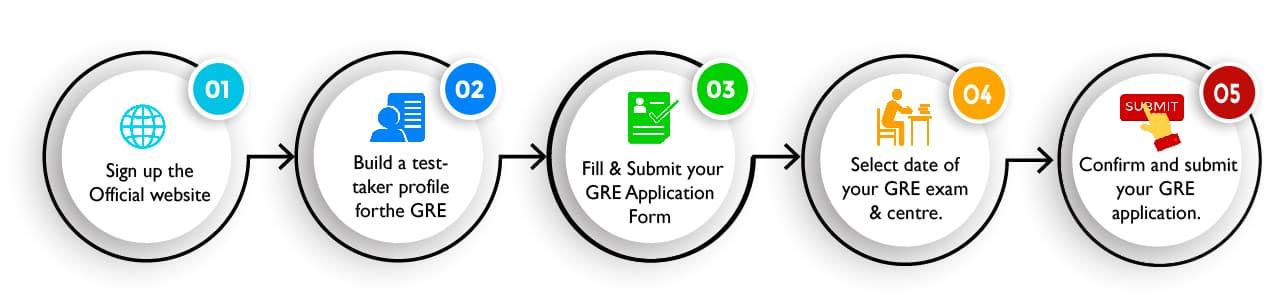
Registration

The Graduate Record Examination (GRE) is available in more than 160 countries at more than 1,000 test centers, or students may choose to take the test online from the convenience of their own homes.
Registration

Eligibility Criteria

Graduate Record Examination (GRE) takers are not held to any academic standards by the Educational Testing Service (ETS), which creates and administers the exams.

The following are some basic guidelines:

  • Age: ETS has declared no age restriction for taking the GRE exam.

  • Educational Background: This exam is open to students from any discipline or background (such as science, the arts, or commerce). Graduate students, on the other hand, generally take the GRE, and certain courses may require a particular undergraduate degree or coursework.

  • Nationality:  All nations are welcome to take the GRE. Non-U.S. nationals require their current passport as identification.

  • Several Attempts: Five attempts at the GRE are allowed during a 12-month period that starts from the first time you take the exam. The testing window is every 21 days. Always check the official GRE website or contact the ETS directly for the most up-to-date information, since regulations and criteria sometimes change. Certain graduate courses may also have their own particular GRE score criteria, so check with the universities you're interested in as well.

Exam Pattern

The GRE test structure includes Analytical Writing (one section of two challenges), Verbal Reasoning (two sections of 20 questions each), and Quantitative Reasoning (two sections of 20 questions each). The GRE test, which is now just under 4 hours long, will be reduced to just under 2 hours beginning September 22, 2023, according to ETS, the GRE exam's administering authority.

The GRE General Test will be reduced to 26 questions in Verbal and Quantitative Reasoning and one essay in Analytical Writing beginning on September 22, 2023. With this new modification, the GRE test (about 2 hours) will be shorter than the GMAT exam (3 hours, 7 minutes).
 

Sections

GRE Exam Pattern (current)

GRE Exam Pattern ( wef September 22, 2023)

GRE Analytical Writing

1 section, 2 essay tasks
60 minutes

1 section, 1 essay task
30 minutes

GRE Quantitative Reasoning

2 sections, 40 questions

70 minutes

2 sections, 27 questions total

47 minutes

GRE Verbal Reasoning

2 sections, 40 questions

60 minutes

2 sections, 27 questions total

41 minutes

Unscored Section

Varies

N/A

Research

Varies

N/A

Total GRE Duration

3 hours 45 minutes

1 hour 58 minutes


Individuals should be aware that, although the GRE exam pattern is accessible in both computer-based and paper-based modes, individuals taking the GRE test from India may only appear in the computer-based module. GRE Exam Pattern  Dates  in india  as April 7, 2024, through April 20, 2024.

The GRE paper-based module is only available in locations where computer access is restricted. Know explains how the GRE formats vary from one another.

Exam Syllabus

Quantitative Reasoning

They evaluates your knowledge of the most basic arithmetic, algebra, geometry, probability, and statistics principles, as well as your capacity to analyse quantitative data. It is specific structure and content of the GRE may vary over time; therefore, the most up-to-date information may be found on the official ETS website. These examinations have their own syllabuses.

Verbal Reasoning

Assessing and drawing conclusions from discourse, reasoning with limited information, understanding literal, figurative, and authorial intent, selecting and highlighting key points, distinguishing between major and minor points, summarising text, understanding the structure of a text, understanding the meanings of words, sentences, and entire texts, and understanding relationships between words and concepts are all tested here.

Analytical Writing

This part assesses your ability to explain difficult concepts clearly and effectively, to back up ideas with relevant explanations and examples, to investigate assertions and supporting evidence, to maintain a well-focused, cohesive conversation, and to govern aspects of standard written English.

Quantitative Reasoning

They evaluates your knowledge of the most basic arithmetic, algebra, geometry, probability, and statistics principles, as well as your capacity to analyse quantitative data. It is specific structure and content of the GRE may vary over time; therefore, the most up-to-date information may be found on the official ETS website. These examinations have their own syllabuses.

Verbal Reasoning

Assessing and drawing conclusions from discourse, reasoning with limited information, understanding literal, figurative, and authorial intent, selecting and highlighting key points, distinguishing between major and minor points, summarising text, understanding the structure of a text, understanding the meanings of words, sentences, and entire texts, and understanding relationships between words and concepts are all tested here.

Analytical Writing

This part assesses your ability to explain difficult concepts clearly and effectively, to back up ideas with relevant explanations and examples, to investigate assertions and supporting evidence, to maintain a well-focused, cohesive conversation, and to govern aspects of standard written English.

Exam Date

As of my most recent update, the GRE General Test is accessible year-round at Prometric test centers, as well as on particular days at other testing sites outside of the Prometric test center network.

You should be able to register for the exam at any time; however, availability varies based on region and time of year.

Please visit the official GRE website or contact Educational Testing Service (ETS), the organization that administers the GRE, for the most accurate and up-to-date information.

Test Centers

Test Centers

As most students are aware, the GRE General Test is accessible at the GRE Test Centres listed below, as well as at home by selecting the GRE at Home, which is the GRE General Test from the convenience of your own home.

Top GRE Test Centres in India in 2025

Ahmedabad,  Allahabad, Bengaluru, Chennai, Chandigarh, Coimbatore, Gurgaon, Hyderabad, Kolkata, Mysore, Mumbai, New Delhi, Pune, Trivandrum

Result Statistics

As previously stated, the ETS has not established a specific cutoff for the GRE. Every year, nearly 500,000 applicants from 160 countries take the GRE General Test at 1,000 test locations. Over 1,200 business institutions worldwide accept GRE scores for graduate degrees.


GRE Total Marks
 

GRE Sections

Minimum Scores

Maximum Scores

Analytical Writing

0

6

Verbal Reasoning 

130

170

Quantitative Reasoning 

130

170

Total marks

260

340

Related Blogs

Masters in Cyber Security in UK: Top Universities, Fees, Scholarships, Jobs & More!
16JAN

Masters in Cyber Security in UK: Top Universities, Fees, Scholarships, Jobs & More!

Do you want to build essential foundation skills while gaining hands-on experience using the latest technologies and learning industry case studies? Is it your long-cherished dream to prepare yourself for real-world career success in the cybersecurity field? If you say ‘yes’, then a masters in Cyber Security in UK can be your choice.

This master’s course is an ideal study path for undergraduates who already possess a good foundation in computer science. A masters in Cyber Security in UK (MSc) programme aims to provide you with the skills, knowledge, and practical-based expertise to evaluate, design and build robust computer security systems which protect networks as well as data from terrorist attacks or cybercrime.

Why Study Masters in Cyber Security in UK?

You might have decided to pursue a PG in cybersecurity, but have questions about why to study masters in cyber security in UK. Let’s answer your question first. Why the UK and why a cybersecurity course in the UK?

Key Benefits

There are many key benefits of pursuing Masters in Cyber Security in UK for Indian Students. This MSc program in cybersecurity in the United Kingdom is available with an optional 1-year industry placement. If you choose this option, it will give you additional industrial experience by applying your skills and knowledge you have learnt in real-world settings.

This master’s programme is actually a computer science programme, which will provide you with a specialisation combining practical skills and expertise in identifying as well as critically evaluating vulnerabilities and cybersecurity threats.

The most advanced topics included in this course are: risk assessment of the distributed systems security, information security, digital forensics, cyber operations, penetration testing, management and compliance.

Masters in Cyber Security in UK is taught by the highly-regarded and long-established computer science department in each University with strong links to business and industry.

You will have access to world-class institutions, industry-focused curriculum and strong industry connections with the organisations of repute, such as GCHQ and NCSC.

High career prospects, including a lucrative pay package, are the other things for which international students want to study masters in cyber security in UK.

Upon completion of your graduation, you will be eligible to apply for a 2-year PG visa with the Graduate Route.

You will also benefit from the University’s academic support hub, which aims to help you build your employability as well as academic skills.

Top Universities in UK are equipped with industry leaders and mentors who provide students with pastoral support, career and vocational guidance to become successful individuals in their personal and professional lives.

In a nutshell, high-quality education, industry-relevant curriculum, strong industry connections, career growth, post-study work opportunity, practical facilities, world-class faculty, faster career entry, specialised skills and leadership training are some of the things that set the United Kingdom apart from other nations to study Master's in Cybersecurity.

Top Universities for Master's in Cyber Security in UK

The demand for Cybersecurity professionals is growing by leaps and bounds, so it is expected to be a stable and potentially lucrative career with a high pay package in the next few years. Studies showed it can lead to higher earning potential compared to those with only a general bachelor's degree in IT or Computer Science. Let’s have a look at the top Universities for Master's in Cyber Security in UK.

University

Average Tuition Fee

UK Rank

World Rank

Imperial College London

£41,750

1

2

University College London

£31,100

4

9

University of Warwick

£33,340

10

69

University of Southampton

£32,300

14

80

University of Birmingham

£31,410

11

82

King’s College London

£35,244

7

169

University of York

£27,200

5

141

Lancaster University

£26,985

8

206

Queen’s University Belfast

£23,150

18

292

Swansea University

£20,900

32

101

Eligibility Criteria for Masters in Cyber Security in UK

To be eligible for a Masters in Cyber Security in the UK, you need an undergraduate or bachelor's degree. Typically, you need a 2:2 or higher in any of the fields, like Computer Science, Information Technology, or Engineering. You also need English language proficiency, for example, IELTS 6.0-6.5, with no component lower than 5.5 or 6.0, and supporting documents like a Statement of Purpose, reference letters, and a resume or curriculum vitae. If you show TOEFL, then it is usually within the 80-92 range.

Some universities may ask for professional experience for a few years in the same or related domain, but it is not always mandatory. This is required for candidates with little or no core CS or IT background.

Duration of the Course

A master’s degree in the UK is typically a one-year programme. If you want to pursue it on a part-time basis, then it can be 2 years long. Although some programmes offer a longer placement year option. This is an application for a master’s programme in cybersecurity in the UK. Also, the specific duration of the course may vary by the University, so it is important to check the individual requirements. Here is the typical course duration for a masters in Cyber Security in UK.

  • Full-Time: Most full-time MSc programs in cybersecurity are designed to be completed in 1 academic year.
  • Part-Time: Part-time options usually extend the course duration to 2 years.
  • With Placement: Some universities, like Nottingham Trent University, offer a 2-year full-time degree programme in cyber security with an integrated 1-year placement that can also be a 2-year part-time option.

Tuition Fees for Masters in Cyber Security in UK

Tuition fees for a Master's in Cyber Security programme in the United Kingdom vary significantly. It ranges between £15,000 and £35,000 per year or more in some universities for international students. The tuition fees for a master’s programme in the UK depend on several factors, such as the university ranking, location, like London or an out-of-town location, as well as specific curriculum design, which influences the cost.

Scholarships for Masters in Cyber Security in UK

A range of scholarships for masters in Cyber Security in UK are offered by top Universities, organisations and the government. You need to apply for each scholarship carefully after verifying your eligibility and the possibility of obtaining one. Here are some of the top scholarships available for master’s students in Cyber Security in the UK for international students.

Name of the Scholarship

Amount or Benefit Offered

Description

Commonwealth Master’s Scholarships

Full tuition fees, return airfare, and monthly stipend

For students from eligible low- or middle-income Commonwealth countries

Chevening Scholarships

Full tuition fees, living allowance, and return flights.

UK Government’s global scholarship for leadership & future impact

Marshall Scholarships

GBP 30,000 to GBP 38,000 per year

For US citizens to study at the graduate level in the UK

Rhodes Scholarship

Full course fees at Oxford, a living stipend of approximately GBP 19,000 per year

Prestigious scholarship offered to international students

DeepMind Scholarships

Tuition fees, living allowance, and conference travel grant.

Offered to students pursuing cybersecurity, ML, AI or CS

Commonwealth-Funded Awards

Similar to the main Commonwealth Scholarships

For students from eligible Commonwealth countries

Scope of the Masters in Cyber Security in UK

The scope after completing a master’s in cybersecurity in the United Kingdom is huge. You will have a great career prospect with unlimited growth and endless opportunities. Here are some of the top jobs available after completing a master's in Cyber Security inthe UK.

Job Role

Average Salary in GBP

Description of Job

Cybersecurity Analyst

40,000 – 55,000

Protects systems and networks by detecting, monitoring, and responding to cyber threats.

Information Security Manager

55,000 – 75,000

Manages security policies, audits, and compliance to safeguard organisational data.

Penetration Tester

45,000 – 65,000

Simulates cyberattacks to identify system vulnerabilities before criminals exploit them.

Security Architect

65,000 – 90,000

Designs and builds secure IT infrastructures to prevent breaches and data theft.

Chief Information Security Officer

90,000 – 130,000

Senior executive overseeing the overall information security strategy of an organisation.

Post-Study Work Opportunities

There are post-study work opportunities in the United Kingdom for international students after completing a master's degree in Cyber Security. Here are the opportunities you can explore.

You can apply for a Graduate Route, which is also called a post-study work visa, valid for 2 years. This visa type will allow you to work in any sector with any skills without getting a sponsorship.

You can also apply for the skilled worker pathway visa, after or during your Graduate Route stay. In this case, you will be required to have a full-time job from a UK company or a sponsorship to work and stay in the UK.

Endnote

Pursuing a Master's in Cyber Security in the UK is more than just an academic decision. Yes, you heard it right, because it is an investment for your bright future. With bespoke education, excellent infrastructure, world-class universities, outstanding research facilities, and robust industry collaborations, the United Kingdom offers not only an ideal environment to build technical expertise, but also to open up practical-based learning. Adding to it, the post-study work opportunities in the UK, a globally recognised qualification and the most sought-after profession, so it becomes clear why the United Kingdom is one of the top destinations for aspiring cyber security specialists.

Choosing the UK for studying your master's in Cyber Security course is not just about education, it is about positioning your career at the centre of a rapidly evolving cyber security landscape.

If you still have questions about what to do and how to proceed further, you can talk to Education Vibes, one of the most trusted study abroad consultants, who is here to clear your doubts. We will push you forward to become a qualified Cyber Security Specialist, obtaining a masters in Cyber Security in UK. Call us today!

January Intake in UK 2026 – A Complete Guide for International Students
28NOV

January Intake in UK 2026 – A Complete Guide for International Students

The January intake in UK 2026 is approaching quickly, and all students are advised to tighten their belts and prepare for their overseas education journey now! Some of you might not be aware of the January intake, or what intakes mean at all anyway. If you are an international student planning to study in the UK but missed the fall semester deadline, or if you need some extra time to prepare for the application process, the January intake is right for you.

While the September intake is usually the traditional and the largest time period for admission applications rolling in the UK universities, the January intake in UK is also something that students are increasingly getting familiar with, and choosing it for strategic planning to start their academic journey later in the academic year. We shall look at this comprehensive guide, covering important details, including the application process and discussing the significance of the intakes, so you can make informed and smart decisions.

What is the January Intake in UK? A Brief Introduction

The January intake in UK 2026 will be the second major intake for all international students to apply for admission in their respective courses at desired universities. The UK higher education system offers multiple “points” of entry to its universities throughout the academic year. Take January as one of those points; the primary points/intake are in September or October, depending on the particular university and its academic program.

For students who generally wonder what is the January intake in UK universities is, it is the second intake where semesters begin in January or February. Sometimes it is also known as the “Spring Intake”, but be aware that the January intake in UK does not offer any indifference to the general process. The quality of education, curriculum structure and degree from the university, all of it remains the same as it will be in the September intake. However, the number of choices for the university and its courses becomes limited.

Why Choose the January Intake in UK 2026?

Picking up from the last statement in the previous section, why should anyone pick this intake? Is it beneficial to international students? Here are some reasons why choose the January intake in UK 2026 for international students:

  • The January intake in UK 2026 offers additional preparation for the application process. You can improve your IELTS scores, gain the required work experience, or find the financial assistance you need for your studies.
  • The competition is less in the January intake, because the volume of applicants is generally lower compared to the September intake, which offers higher chances of admission (even for competitive academic programs).
  • The January intake offers a smaller class size compared to the September intake. Some universities observe this phenomenon, which offers a more personalised attention from the faculty (only in the initial phases of a course).

Final Consideration: Is January Intake Good for International Students?

So, is January intake in UK 2026 good for all international students? The simple answer is yes, the January intake is good for international students, as it provides a better time window with all the same qualities and experience to study in UK, except for some disadvantages. Being aware of these disadvantages will be important for you to determine, January intake is good for international students. Here is a quick list of these:

  • Desired courses might not be available for applicants
  • Orientation week might be less exciting (or grander for you)
  • On-campus accommodation might be limited

Top Universities Offering January Intake in UK 2026

If you are looking for the list of universities for the January intake in UK 2026, then you should wait for the finalised list of universities. However, there are universities which are known for their January intake and programs. Looking at the previous records in the UK, the universities associated with the Russell Group and some of the modern/new universities offer the flexibility of the January intake. Here are some of the examples for the top universities offering January intake in UK 2026:

  • Queen Mary University of London
  • Coventry University
  • University of Greenwich
  • Brunel University London
  • University of Westminster
  • Oxford Brookes University

Popular Courses Available for January Intake in UK 2026

A major drawback of the January intake in UK 2026 is that it offers a limited number of courses for students to apply for admission, when compared to the September intake, which has more options. However, there are some high-demand fields to learn about the popular courses available for January intake in UK 2026, which include the following:

  • Business and Management (MBA, MSc Management, Marketing, Finance)
  • Computer Science and IT (Data Science, Cyber Security, Software Engineering)
  • Engineering (Civil, Mechanical, Electronic)
  • Law (LLM)
  • Nursing and Healthcare Management

January Intake in UK 2026: Application Timeline

Ready for the January intake in UK 2026? Plan it well so you do not miss out on anything. Without wasting any precious time of yours, below is a basic representation of the January intake in UK 2026: Application Timeline.

  1. April-June (Research) - Shortlist universities and check courses available.
  2. July-August (Application) - Prepare for tests, craft SOP or other documents to support your application, and submit.
  3. September-October (Offer) - Fulfil any pending application requirements, and receive conditional or unconditional offers.
  4. October-November (Acceptance & CAS) - Accept the offer by paying the tuition fee, and get a Confirmation of Acceptance for Studies (CAS) to use it for the visa application.
  5. November-December (Visa) - Apply for a UK student visa and arrange accommodation.

How to Apply for the January Intake in UK 2026: Basic Information

Applying for a January intake in UK 2026 will also differ based on the level of degree you want. While the exact process differs based on this level, apply through the university's official online application portal. For undergraduate applicants, some universities accept direct applications for the January intake, but many use the UCAS (Universities and Colleges Admissions Service) for the enrolment process. Check with your specific university portal to see which method is available for the January intake. Learn more about how to apply for the January intake in UK 2026 from our foreign educational consultants.

Eligibility Requirements and Documents Required for the January Intake in the UK

January intake in UK 2026 will be a success if you meet the requirements and keep your documents up to date for the application.

Eligibility

The exact eligibility requirements will vary depending on the particular university and course level, but here are two basic eligibility requirements for January intake in UK 2026:

  • Required GPA from the previous studies (high school or undergraduate equivalent)
  • An IELTS score of at least 6.0-7.0, or equivalent in TOEFL or PTE

Documents

Here are the generally accepted documents required for January intake in UK 2026:

  • Valid Passport
  • Academic Transcripts and Certificates
  • English Language Proficiency Tests Scorecards
  • Statement of Purpose (SOP)
  • Letters of Recommendation (LORs)
  • Updated CV

What is the Cost of Studying? Are There Any Scholarships Available to Apply for?

Understand the costs for studying in the January intake in UK 2026, so you can be financially prepared and have a better idea about what to do. In any case, if you need financial aid, there are scholarships available for eligible applicants.

Cost

The cost of studying in the UK - January intake 2026 is generally similar to what you pay for the September intake. Always check the official website of the UK government for the latest information on the cost required for your study. Here is an overview of the two main factors you need to pay for your education:

  • Tuition Fees

£13,000-25,000 per year for international students (or more depending upon the degree level and particular course)

  • Cost of Living

Approximately £1,400 per month (in London) and £1,000 per month (outside London) for the first nine months of the January intake in UK 2026

Scholarships

There are scholarships for January intake in UK 2026 for students who want financial assistance. While the scholarships available are limited for the January intake, government scholarships (like Chevening) are available, along with some of the universities offering bursaries, merit scholarships, and discounts on the basis of their departments. Get in touch with us for details on an overseas education loan.

UK Student Visa Process for January Intake 2026

There is absolutely no difference in the visa process for the January intake in UK 2026. The visa process requires a student to apply for a student visa (called “Student Route” in the United Kingdom) and pay for the application, while submitting the required documentation (which includes all the documents used in the admission process, along with the conditional/unconditional letter from the university and financial statements). Here are some major steps that students are not aware of as part of the UK Student Visa Process for January Intake 2026:

  • Ensure you have the CAS from the university before applying for the visa.
  • Show sufficient funds for the first year and living abroad in the United Kingdom.
  • A tuberculosis test might be required to obtain proof of a negative infection.
  • Pay for the Immigration Health Surcharge (IHS) to access the NHS during studies.

Final Thoughts

Applying for the January intake in UK 2026 is a very good way for all the international students who need to apply for the courses that they previously missed out on, and for those students who want additional time off to prepare for their studies abroad. Always remember to check for the specific deadline for your desired courses and universities, and keep in mind that without showing bank details for at least 28 days, you won’t get a student visa for your higher education in the UK. Last but not least, a compelling statement of purpose (SOP) will help you to find admission for your desired course and university experience.

Want more tips to increase your chances of admission to the UK universities? Need a financial advisor or other qualified professionals to guide you through the journey of learning in the UK? Book a free consultation today at Education Vibes!

MBA Salary in UK: Specialisation, Salary By Industry, Scope & ROI in 2025
30SEP

MBA Salary in UK: Specialisation, Salary By Industry, Scope & ROI in 2025

Investing in an MBA degree in the United Kingdom can be a prime concern for your higher studies abroad. Your step will ensure your career prospects and identify what your MBA salary in UK will be. Yes, pursuing an MBA in one of the top Universities in the United Kingdom can be proven to be transforming for your career because you study in a country that is marked by global excellence in management education. Before you move on, you should know the job prospects and the average MBA salary in UK.

In this blog, we will cover all important post-study aspects of your management studies, like salary after MBA, jobs, factors influencing your salary, top recruiters for MBA graduates in UK, tips to maximise your salary, and much, much more.

Major Topics Covered

  • Why Pursue An MBA in UK?

  • Average MBA Salary in UK
  • MBA Salary By Specialisation
  • MBA Salary By Industry
  • Factors Influencing MBA Salary
  • Tips To Maximise Your MBA Salary

Let’s move on…….

Why Pursue An MBA in UK?

It is currently trending to study for an MBA, a master’s qualification in business management and administration. But before you move on, you should be aware of what it means to your career, and what an MBA salary per month is, especially in your country when you get your degree from the UK and return to your homeland.

So why an MBA in UK? ……. See it is not a general postgraduate degree. It is a professional qualification in business management and administration. An MBA career is diverse, so the salary is higher than that of other graduates. An MBA degree from the UK will improve your employability and enrich your career growth. A range of top business schools in the United Kingdom offer this programme, but you should be extremely careful in choosing not only a business school/University, but also your placement and MBA salary in UK per month. Many international students are now choosing to study in the UK, which is why you are choosing; it shouldn’t be like this. Let’s explore why UK? Why not other nations for studying an MBA programme?

  1. Shorter Programme Duration - An MBA in UK is usually shorter than in other countries. Most MBA degrees offered by UK Universities are of a 1-year duration. It means you save 1-year to complete the same degree, and sooner jump into the professional world.
  2. Affordable Tuition Fees – The shorter course duration means less spending on tuition fees. For Tier 2 and 3 universities, the average tuition fees for studying an MBA in UK range between GBP 20,000 and GBP 60,000, which is equivalent to INR 21 to 65 lakh.
  3. Availability of Scholarship – A bunch of scholarships are available for international students pursuing an MBA in UK, like Chevening Scholarship, Commonwealth Scholarship, Felix Scholarship, Inlaks Scholarship, and university-specific scholarships, to name some. These scholarships can reduce the cost of your studying and living in the UK.
  4. Industry Links – Business schools and Universities in the UK have a strong connection with industry and business leaders. This enables students to get in touch with professionals working in the current industry, entrepreneurs and managers. This helps them get to know about the current trends, business and industries.
  5. Increases Credibility – Having an MBA degree from the UK increases your business credibility. An MBD degree is prestigious, but earning it from the UK increases multifold.
  6. Experience a culture – Studying an MBA in UK, a country known for its culture and heritage, blends with long-held traditions, historical influences and modern ideologies, giving you a global experience. It will also enhance your concepts in commerce and business, because the UK is a hub of top industries and commerce.

What Is The Average MBA Salary in UK?

The average MBA salary in UK typically falls between GBP 55,000 and GBP 95,000, though the MBA salary per month can vary significantly based on the business school/University, tier, work experience, and one’s chosen industry. Graduates from top-tier business schools, like University of Oxford (Saïd Business School), University of Cambridge (Judge Business School), and Imperial College Business School, to name a few, often earn around GBP 85,000 to GBP 95,000 or higher. Here is a list of business schools, where the average salary of MBA graduate can be:

  • MBA graduates from Cambridge Judge Business School usually earn on average GBP 73,985
  • MBA graduates from the London Business School report an average salary of GBP 99,333
  • MBA graduates from Manchester Alliance Business School often earn between GBP 47,204 and GBP 106,112

Some sources said that salary after an MBA depends on one’s skills, knowledge, and industry experience. Normally, graduates with previous management experience earn higher than the fresher. It is also seen that some MBAs earn double the amount of a UG business degree, almost 55 per cent higher than the general PG degree holders.

Jobs After MBA and Salary

The MBA salary in UK is huge. Because management is an interdisciplinary field, you not only learn the fundamentals of business management, but also learn a variety of subjects, like operations, logistics, supply chain, marketing, sales, human resources, finance, accounting, and leadership. This helps make the MBA scope and salary huge in various ways. After completing an MBA in UK with a couple of years of experience, your salary can go up to GBP 170,000 or more in high-paying roles, such as investment banking, consulting, or business leadership etc. Here are the top jobs after MBA and salary at a glance.

Job Role

Average Salary in GBP Per Year

Management Consultant

65,000 – 95,000

Investment Banker

80,000 – 120,000

Marketing Manger

45,000 – 70,000

Operations Manager

40,000 – 65,000

Financial Analyst

40,000 – 60,000

Business Development Manager

42,000 – 68,000

Project Manager

45,000 – 75,000

MBA Salary By Specialisation

Some specialisations command higher salaries after an MBA in UK than others. Also, there are specialist management programmes offered by various top business schools, and if you have a specific career path, pursue the programme that aligns perfectly with your career goals. Also, when it comes to earning potential, here are some of the specialisations that offer higher salaries than others: a clear edge:

  • Finance and Banking – An investment banker or finance manager typically earn an average salary of GBP 40,286.
  • Business Consulting – A business consultant can reach up to GBP 170,000 per year.
  • Market Research – Professionals who are in marketing or market research can earn a salary of GBP 50,307.

MBA Salary By Industry in UK

MBA salary in UK varies significantly by industry, with finance and banking, business consulting, market research, and technology. These are some of the industries that offer the highest compensation to UK MBA graduates. While some other sectors, such as healthcare and hospitality, tourism, operations, logistics, and supply chain management unique career paths. Here is a breakdown of MBA salary by industry in UK:

Industry

Average Pay in GBP

Consulting

85,000 or more

Finance

80,000 or more

Technology

95,000 or more

Healthcare

47,616 or more

Energy

45,500 or more

Hospitality and Tourism

58,694 or more

Factors Influencing MBA Salaries in UK

Though various factors influence the MBA salary in UK. They are:

  1. Experience: MBA graduates with a couple of years of experience normally get higher salaries than fresh graduates.
  2. Location: MBA graduates in London normally get higher salaries than in other cities, although it is reflected in London’s higher cost of living.
  3. Specific Role: Role is one of the most important factors to consider when we talk about the salary of an MBA in UK. Positions/job roles like Management Consultant or Product Manager, Investment Banker or Market Analyst typically earn higher than other positions.

Top Recruiters for MBA Graduates in UK

When it comes to attractive jobs in the UK after an MBA, many top companies stand out. These companies are mostly mid and large-scale companies that recognise the value of MBA graduates. They actively seek management skills and expertise to drive their business strategies forward. Some of them are:

  • McKinsey & Company: A global management consulting firm.
  • Bain & Company: A prestigious management consulting firm.
  • The Boston Consulting Group (BCG): A global leader in strategic consulting services.
  • PricewaterhouseCoopers (PwC): One of the "Big Four" accounting firms.
  • Unilever: A multinational consumer goods company.
  • Amazon: Known for its dynamic business operations.

Tips to Maximise Your MBA Salary in UK

To maximise your MBA salary in UK after you complete your degree, there are a few things to keep in mind. Here they are:

  • Choose a high-demand specialisation
  • Select a reputable business school
  • Focus on specific industry goals
  • Gain relevant work experience
  • Develop a multi-faceted skillset
  • Pursue ongoing professional development
  • Strengthen your professional network
  • Use recruitment events strategically
  • Optimise your professional presence

Return on Investment (ROI) of an MBA in UK

The return on investment (ROI) after an MBA in UK is generally positive. The MBA graduates experience increased earning potential. In the starting, they can earn a salary up to GBP 70,400, which is normally higher than that of the general postgraduate degree holders. Graduates often get accelerated career advancement, especially into leadership roles. Furthermore, the return on investment includes non-monetary benefits, such as global networking opportunities and exposure, as well as improved career satisfaction. Also, the actual ROI depends on factors, like cost of tuition and living expenses, reputation of the business school and placement.

To calculate the ROI after an MBA in UK, the basic formula is (Net gain from MBA/MBA cost) x 100

Some factors influence MBA salary in UK, such as:

  • Reputation of business school
  • Career services and placements
  • Global networking and exposure
  • Field study

Putting It All Together

Your MBA salary in UK depends on the specialisation you opted for in your management studies, the University you graduated from, and the experience you hold. The salary for an MBA in the UK depends on previous experience. If you are experienced in any management domain with an MBA from the UK, then you can accept a much higher salary than that of a fresher. AS we have discussed here in this blog, top recruiters, like McKinsey & Company, Bain and Company, or the BCG, offer higher salaries than other companies, because they are global companies of repute. Though the return on investment is good for a fresher as well. So, if you plan to study an MBA from one of the top Universities in the UK, you can ask for help from Education Vibes, one of the leading and most trusted study abroad consultants.

LLM in UK: Top Universities, Fees, Eligibility & Career Scope for 2026
24JAN

LLM in UK: Top Universities, Fees, Eligibility & Career Scope for 2026

LLM (Master of Laws) is a one-to-two-year postgraduate academic degree designed for law graduates or legal professionals to gain advanced, specialised knowledge in specific fields like international, tax, or corporate law. When we highlight the foremost choice of international students for an LLM degree, the LLM in UK stands out as the best pick. The UK is home to most of the oldest and most prestigious law schools, and it provides globally recognised one-year LLM programmes, specialised curricula, and strong career prospects.

This guide to an LLM degree in the UK will cover top universities, fees, eligibility criteria, scholarships, the admission process, and career prospects after graduation.

What Is An LLM?

Master of Laws, or LLM, is a PG law program. An LLM degree allows students or legal professionals to attain advanced knowledge in a specialised area of legal studies. The LLM degree differs from the basic law degree (LLB or JD) as it provides specialised scopes to prosper in the fields, including international law, corporate law, intellectual property, and environmental law. Employers, law firms, and international organisations highly value this degree during hiring processes.

The LLM not only hones legal expertise but also expands career opportunities in the global sphere. Candidates who are thinking of pursuing an LLM will, no doubt, add an edge to their legal career.

Why Study LLM in the UK?

There are various reasons to study LLM in the UK. Let’s have a look.

  • Globally Recognised Universities: Students get opportunities to study at top UK law schools like Oxford, LSE, King’s College London, and Cambridge.
  • One-Year Law Program: Most UK law schools provide a Law degree with a 12-month duration. It is both time and cost-saving.
  • Myriad Options for Specialisation: Study in UK law degree comes with specialisation options. Whether you want to go with commercial law or human rights, you will have the option to tailor your degree.
  • Global Recognition & Reach: An LLM degree from the UK is highly recognised globally. It provides ample chances to boost a career in the international arena.
  • Post-Study Work Visa: Eligible graduates can apply for the UK Graduate Route Visa (2 years) after completion.

Eligibility Criteria for LLM in the UK

Here is what a student is required to study for an LLM in the UK.

  • Academic Qualification: A recognised LLB or equivalent law degree (3-year or 5-year).
  • Minimum Marks:
    • Top universities: 60–65% or equivalent
    • Other universities: 55–60%
  • English Language Proficiency:
    • IELTS: 6.5–7.0 overall
    • TOEFL / PTE accepted (varies by university)
  • Work Experience: It is not always mandatory. But if a student has it, it will provide them with an advantage.
  • Documents Required:
    • Statement of Purpose (SOP)
    • Academic or professional references
    • CV/resume
    • Writing sample (for research-oriented LLMs

Top Universities for LLM in the UK

An LLM in the UK is usually studied once you have gained an LLB degree. An LLM is actually diverse compared to other master’s courses in legal studies. It is only available to you if you have completed a bachelor’s degree in law in any field, and also available to you if you pursue a compressed bachelor’s plus master’s program in law. Normally, you don’t need a valid GMAT score or its equivalent to study this program. Having around 60 per cent or more marks in your bachelor’s degree in law is enough to apply for an LLM in the UK. Let’s explore the top Universities for studying an LLM program in the United Kingdom.

University

Avg. Tuition (GBP)

Rank in the UK

World Rank

University of Cambridge

£37,500

1

3

University of Oxford

£41,480

2

11

London School of Economics & Political Science

£34,128

3

7

University College London

£32,100

4

14

King’s College London

£30,500

5

15

University of Edinburgh

£31,500

6

20

Queen Mary University of London

£31,500

7

38

Note: Rankings are based on publicly available data and information from official websites, industry reports, and reputable third-party sources.

Cost of Studying LLM in the UK

An LLM in the UK costs between £20,000 and £40,000 per year in tuition, with top-tier law schools potentially charging more. The living cost per month can be between £1,200 and £1,700, which includes accommodation, travel, and utilities. Though the total cost varies significantly based on the university or law school, as well as the location you choose to stay, and the specific specialisation. The best part is that you can avail of a scholarship to study an LLM program in the UK.

Note: Fees are indicative annual tuition fees for international (Non-EU) students and may vary by specialisation and year of intake.

Specialisations in LLM Programs in the UK

A variety of specialisations is available for LLM (Master of Laws) in the UK. It depends on your career goal and your choice; you can choose one of the following specialisations in a master’s in law program.

  • Corporate & Commercial Law
  • Intellectual Property Law
  • Human Rights Law
  • International Law
  • Technology/IT Law
  • Banking & Finance Law
  • Criminal Law
  • Environmental & Energy Law
  • Public Law
  • Maritime Law
  • Medical Law
  • Family Law
  • Dispute Resolution

Top Scholarships for LLM in the UK

Since an LLM in the UK is a big investment for Indian and international students. You can apply for a scholarship to reduce the cost of studying a master’s in law in the United Kingdom. Here are the top scholarships for LLM in the UK.

No.

Name of the Scholarship

Amount Offered

1

Chevening Scholarship

Full tuition + airfare + living expenses

2

GREAT Scholarships for Justice and Law

£10,000 towards tuition

3

Clarendon Fund

Covers full fees + living expenses

4

Bosco Tso & Emily Ng Scholarship

£22,500

5

Tercentenary Awards for Excellence

£5,000 towards tuition

Important: Most scholarships are merit-based, and early applications significantly improve chances.

Application Process for LLM in the UK

To apply for an LLM in the UK, you will have to go through a rigorous application process. You must complete the application process online by visiting the university admission portal. Also, you should provide the educational testimonials and the initial fee required. You need a personal statement describing why you are applying for an LLM program in the United Kingdom, letters of recommendation, a Curriculum Vitae, and potentially a proof of English proficiency, such as IELTS, TOEFL, PTE, etc.

Job Opportunities After LLM in the UK

Upon completion of an LLM in the UK, you will have a global legal career with unlimited potential, growth and endless career opportunities. You can pursue diverse career paths in fields like corporate law, intellectual property, human rights, and finance, working as a solicitor, barrister, legal advisor, or in-house counsel for companies. Here are the top career choices for Indian and international law students.

Job Title

Average Salary in GBP

Barrister

£21,000 – £200,000

Solicitor

£25,000 – £100,000

In-House / Corporate Lawyer

£40,000 – £90,000

Legal Advisor / Consultant

£38,000 – £60,000

Paralegal / Legal Executive

£20,000 – £40,000

Note: Salary figures are indicative estimates based on graduate outcomes, industry surveys, and available employment data. True pay may vary based on the candidate’s experience, location, and designation.

Post-Study Work Opportunities

After completing an LLM in the UK, international students can apply for a post-study work visa across multiple fields, including corporate advisory, compliance, and international law, which allows them to stay and work in the UK for up to two years. This enables graduates to gain professional experience in legal, compliance, and corporate roles.

Is an LLM in the UK Worth It?

The answer is unequivocally yes, it is worth it. In fact, most legal firms hire law graduates with an LLM degree from one of the top universities or law schools in the UK. These are presumably the global law firms having offices all over the country or the world. An ideal CV would have a mix of work experience and strong academic qualifications, with an LLM degree in the UK being desirable. If you haven’t had any legal work experience, it is possible a great degree to start a career in law with a better pay package.

If you still have questions about LLM in the UK, or if it is a good option for your career, or if you are not sure which University to choose, look no further than contacting Education Vibes today. We are here to help you with your queries on the LLM degree program in the United Kingdom!

Masters in France: Top Universities, Fees & Eligibility in 2025
01AUG

Masters in France: Top Universities, Fees & Eligibility in 2025

Pursuing a Masters in France is no doubt an excellent choice for Indian students seeking a high-standard education in a vibrant, multicultural environment. France not only offers world-class curriculum and specialised programs, but also offers excellent student support. If you study abroad in France, rest assured, you will have a global career with unlimited potential and growth. Universities in France are globally recognised for their teaching methods, industry connections, and innovative approaches. If you have doubts in mind whether an MS in France for Indian students is a great option or not, this blog post could be your great help.

What Makes France The Best Destination for Studying An MS Program?

France is considered one of the highly cultured destinations on the globe. French people are highly classy. Being a multi-cultural country, France has earned a name for its high-standard education, amicable people, and diverse exposure in almost all major disciplines. There must be some key advantages if you study abroad in France. Here are the top reasons why, as an Indian student, you should choose France for your master’s studies.

  • France is the 1st nation that signed a mutual agreement with India.
  • Almost 500 French companies in India are looking for master's degree holders from top French Universities.
  • Over five hundred top scholarships or financial assistance are available for meritorious Indian students who wish to study in France.
  • France is known for its diversity and richness, which makes the country easy to find an educational program that suits your career objectives and background.
  • MS in France for indian students is professionally oriented that combining theoretical and practical-based learning, and the use of professional tools in real-world settings.
  • French Universities offer 1000-plus English-taught programs for international students.
  • It is the largest Francophone country on earth and the 4th largest for international students.
  • Studying in France for indian students can be the best choice, because they can learn French, an official language of France and over 30 countries across 5 continents, so the scope is huge.
  • France topped for its research and innovation with over 64 Nobel prizes and 12 Fields Medals.
  • A safe and sound country for young businessmen, creative people, and innovators.

Master's in France for Indian Students: Eligibility

To pursue a Master’s or MS degree in France, you typically need a relevant undergraduate or a Bachelor's degree with 1st class marks, and demonstrate English proficiency for the English-taught programmes. This sometimes includes a minimum GPA, work experience (not always mandatory), and often standardised test scores, such as GMAT/GRE, for certain master’s programs. Here is the detailed eligibility criteria to study in France for Indian students:

  • A Bachelor's degree or its equivalent qualification from a recognised academic institution is generally required. Most universities ask for a minimum GPA of 55% to 60% or equivalent, but top-ranked programs may have higher standards of GPA requirements.
  • You need to show English language proficiency for English-taught programs, such as IELTS (6.0-7.0) or TOEFL (80-100) scores.
  • A B2 level French language proficiency, such as DELF/DALF/TCF, is required. Some French institutions accept a Medium of Instruction (MOI) letter as an alternative to show your language proficiency.
  • Some master’s courses in France, particularly in business management, accounting and finance, and marketing management, may require GMAT (550-730) or GRE scores.
  • Work experience is desirable but not always mandatory, though some master’s programs, especially in specialised fields, may favour candidates with prior work experience.

MS in France for indian students: Tuition Fees

Tuition fees at most public universities are much lower than in other EU countries. Though they may be variable, depending on one’s chosen course level. Since the French government subsidises its education, the average fees for a Master's in France are around 260 EUR/year. Also, students are required to pay a fee for contribution to campus and student life of Euro 91.

The cost of studying at great schools and establishments is higher than at public universities in France. As an international student, you may be required to pay more at France’s highly selective grandes écoles as well as grands établissements. The fees are comparatively higher in these institutions, and go up to Euro 10,000 per year.

On the other hand, private universities in France offer master’s programmes at higher costs. The tuition fees start at Euro 1,500 and go up to Euro 20,000 annually. The tuition fees at French Business Schools are higher, where it goes from Euro 5,000 to 30,000 annually.

Tuition Fees for Top MS Programs in France

Top MS Courses in France

Average Tuition Fees

Computer Science and Engineering

€243 to €16,200

Data Science

€150 to €10,000

Business and Management

€243 to €28,600

Finance

€243 to €15,000

Environmental Science

€3,000 to €12,000

Engineering

€243 to €16,200

Artificial Intelligence

€1000 to €20,000

Master's in France: Explore Top Universities in 2025

Top French universities not only stand out due to their strong focus on research, innovative curriculum and teaching methods, but also for their rich cultural environment and excellent student support. These are some of the reasons why a majority of Indian and international students choose to study a Master's in France. Universities in France are known for academic excellence, especially in the domains of science, technology, nursing, and medicine, and also offer a blend of French and English-taught courses.

More so, French institutions provide access to a world-renowned education system, sometimes at a relatively affordable cost. These are also some of the reasons why MS in France for indian students is getting popular day by day. Here are the top public Universities that offer a range of Master's degrees in France.

University

Average tuition fees in Euro

Rank in France

World Rank (THE) 2025

Top Courses

PSL University (Paris Sciences & Lettres)

€243

1

43

Physics, Engineering, Social Science

Université Paris‑Saclay

€243

2

64

Social Science, Engineering, Economics

Institut Polytechnique de Paris

€13,000 – €21,750

3

71

Computer Science, Engineering, Mathematics

Sorbonne University

€243

4

76

Medicine, Engineering, Law

Université Paris Cité

€243

5

152

Biomedical Science, Social Science, Law

École Normale Supérieure de Lyon

€243

6

251

Arts and Humanities, Engineering, Management

Université de Montpellier

€243

7

351

Nursing, Medicine, Pharmacy

Cost of Living in France for Indian Students

The cost of living varies across cities in France for Indian students. It typically ranges between €800 and €1,400, equivalent to between 72,000 and 1.26 lakh per month. This cost covers food, transportation, and accommodation, as well as other daily expenses. Besides other top cities, like Lyon, Lille, and Toulouse, Paris is the most expensive, and the cost of living is 30-40% higher than in other cities.

Career Prospects After Completing a Master's in France

Completing a Master's in France offers bespoke career prospects for Indian students, especially in high-demand sectors, such as engineering, technology, and management. France not only provides a supportive environment for international students to find jobs but also potentially helps them with post-study work permits.

Key Industries and Opportunities

  • Engineering

  • Artificial Intelligence
  • Data Science
  • Management
  • Healthcare
  • Nursing
  • Hospitality

Return On Investment

A master's degree holder in France, especially an engineering or management graduate, can expect a pay scale of €35,000 to €50,000 per year. Top specialisations, such as software, civil, electrical engineering, finance, marketing, healthcare and nursing, can lead to higher salaries, especially in tech hubs like Paris and Lyon.

Last, but not least, studying a masters in France will be more affordable than studying in other top countries, like the United Kingdom, the United States, Canada, and Australia. To welcome more and more students, both public and private institutions have increased the number of English-taught programmes for international students. Now, it has also become one of the most sought-after countries for Indian students who want to study MS programs.

How can Education Vibes help you in studying an MS in France?

Education Vibes, one of the leading study abroad consultants, can be the right mentor to suggest the best Universities to study a master’s in France. We can help you with the following:

  • Choose the best master’s degree in France with the right university according to your career objective and budget.
  • Get counselling and advice from our expert counsellors who can help you with all the steps in your study abroad journey.
  • Recommendation of the right MS course and the university can put you on the right path to success.
  • Guide and help you in writing a compelling Statement of Purpose.

Want to ask questions about studying an MS in France? Call us now!

Masters in Psychology UK: Top Universities, Fees & Admission in 2025
31JUL

Masters in Psychology UK: Top Universities, Fees & Admission in 2025

Psychology is the scientific study of the mind and behaviour, and has become one of the most popular courses for students in recent years. Due to an increase in mental health awareness and a high demand for psychological knowledge in many fields, studying a Masters in Psychology UK is a perfect program for creating a great impact on individuals and society positively. The United Kingdom is home to many globally ranked universities that offer strong academic education, industry connections, and advanced infrastructure. These universities become a suitable choice to study abroad and complete a master’s degree in multiple courses, including Psychology.

A UK postgraduate degree in psychology can help you secure multiple job opportunities, whether you look to be a clinical psychologist, researcher, counsellor, organisational psychologist, or seek a career in education. This blog will cover multiple elements of a Master's in Psychology in the UK, from top universities and admission requirements to career opportunities and advice for international students.

Masters in Psychology in UK

A Master's in Psychology in the UK is a graduate degree that provides students with strong academic and practical training in various fields of psychology. The duration of the course is 1 year for a full-time course and 2 years for a part-time course to complete. This master’s course in Psychology covers some necessary modules like Research methods, cognitive psychology, developmental psychology, etc. Completing this master's degree allows international students to apply for the Graduate Route visa to work in the UK for 2 years.

Why Study Masters in Psychology in UK?

The United Kingdom is home to many globally ranked universities that are renowned for their psychology courses in the world. Top universities like the University of Oxford, the University of Cambridge, the University College London, King’s College London, and the University of Edinburgh are listed among the top universities in UK for psychology. These universities are known for their world ranking as well as for psychological research, neuroscience, and mental health innovation. Mentioned below are the major reasons to study a Masters in Psychology in UK for international students:

  • A Master's in Psychology degree from a UK university is recognised globally
  • Courses in Psychology inthe UK are accredited by the British Psychological Society
  • The United Kingdom focuses on research and gives students access to advanced laboratories and projects.
  • Completing a master's degree in Psychology provides the opportunity to become a licensed psychologist, counselor, or researcher
  • Studying in multiple environments helps students in a better understanding of behaviour across cultures, enhancing both personal and academic development.

Courses to Study Masters in Psychology in UK

Students have the option to select from different specialised and general psychology degrees based on their educational background and career goals. Below are some of the most common programs:

  • MSc Psychology (Conversion): This is the perfect program for individuals without a psychology background. It provides a strong foundational knowledge required for further specialisation or professional practice.
  • MSc Clinical Psychology: This master's course in Psychology focuses on diagnosing and treating mental health conditions.
  • MSc Educational Psychology: Prepares students to work in schools or educational settings, helping children with learning difficulties and behavioural issues.
  • MSc Forensic Psychology: This master's program will analyse the combination of psychology and the legal system, frequently resulting in professions within criminal justice or law enforcement.
  • MSc Health Psychology: This specialisation helps in exploring the impact of psychological, social, and biological factors on health and disease.

Masters in Psychology in UK Requirements

International students must meet the entry requirements to get admission into universities in the UK to study a master’s degree in Psychology. Check below the general requirements to study Masters in Psychology in UK:

  • Complete a bachelor’s degree in psychology (often 2:1 or higher).
  • Meet the English proficiency requirements by submitting an IELTS or TOEFL score.
  • Submit a Statement of Purpose and Letters of Recommendation.
  • An updated resume or CV is required.
  • Work/Volunteer Experience (optional but advantageous)

Documents Required for International Students

Applicants who wish to study a Masters in Psychology in UK will need to submit the following documents to fulfil the admission procedure:

  • Recent passport-size photograph
  • A valid passport
  • Updated resume or CV
  • Letter of Recommendation (number varies as per specialisation)
  • Statement of Purpose
  • Academic transcripts
  • English Language Proficiency Tests, such as the IELTS and TOEFL
  • Proof of work experience, if applicable

Masters in Psychology in UK Tuition Fees

The tuition fees for studying Masters in Psychology in UK vary between £20,000 and £40,000 for international students which depends on the university. To manage the tuition fees, top UK universities offer multiple scholarships to students based on their academic excellence. Mentioned below are some of the popular scholarships in UK for international students:

  • Chevening Scholarships
  • Commonwealth Master’s Scholarships
  • University-specific merit awards
  • GREAT Scholarships

Top Universities for Masters in Psychology in UK 2026

There are over 350 universities in the world for Psychology ranked by QS World University Ranking by Subjects in 2025, among which approximately 43 universities are located in the United Kingdom. Out of the top universities for Psychology in UK, the University of Oxford is at the top in the UK and ranks #2 in the world. Mentioned below is the list of top universities to study Masters in Psychology in UK for international students:

Top Universities in UK for Psychology

QS Ranking in 2025

University of Oxford

2

University of Cambridge

4

UCL

6

King's College London

18

The London School of Economics and Political Science (LSE)

19

The University of Edinburgh

30

The University of Manchester

50

University of Bath

74

University of Bristol

74

The University of Warwick

80

Career Opportunities After a Masters in Psychology in UK

Completing a master's degree in the UK, particularly in Psychology, provides multiple career opportunities for graduates across different fields, such as mental health, education, human resources, research, and social services. Graduates of this program can get the opportunity to earn between £25,000 and £40,000 per year, as per the job profile and experience. Graduates can pursue roles such as:

  • Clinical Psychologist
  • Health Psychologist
  • Forensic Psychologist
  • Educational Psychologist
  • Occupational Psychologist
  • Counsellor or Psychotherapist
  • Mental Health Practitioner
  • Research Assistant or Analyst
  • Human Resources or Organisational Consultant
  • Public Health Advisor
  • Academic or Lecturer

Tips For International Students

International students who are planning to study a master’s course in Psychology must apply for admission before the application deadline of UK universities. Must check the list of documents required for completing the admission application. They must also prepare their finances to manage their study and living expenses in the UK. Applicants must check the list of scholarships available in the UK for international students; these are the best way to manage their financial situation. At last, students are advised to join international student communities, university societies, attend cultural events, and connect with the alumni network to make strong connections.

Conclusion

Studying a Masters in Psychology UK is a perfect way to know more about human behaviour, contributing to mental health, and create a physical difference in the world. The United Kingdom provides the perfect environment for international students who wish to study a master's degree in psychology. This master's degree will provide you with the skills and recognition required to succeed in today’s competitive environment.

Call to Action

Are you ready to start your master’s degree in Psychology in the UK?

Connect with Education Vibes today and meet our Study Abroad experts to get details about the top universities, their admission process, requirements, and more. They also help you in arranging your visa and turn your dream into a reality.

Masters in Canada: Top Universities, Cost, Duration & Work Permit in 2026
13FEB

Masters in Canada: Top Universities, Cost, Duration & Work Permit in 2026

A Masters in Canada offers internationally recognised education, affordable tuition fees, and post-study work opportunities. It has many top educational institutes that provide courses at lower costs as compared to the United Kingdom, the United States and others. As per the 2026 Times Higher Education ranking, six universities in Canada have secured a rank among the world’s top 150 institutes, reflecting their quality education. Most of the universities are famous for their research impact and alignment with the global academic standards. Selecting these academic institutes will give the students a competitive edge in the international job market. Not only that, there is a strong support group and an active multicultural community for additional guidance.

Why Choose Canada for a Master’s Degree?

Canadian universities offer industry-demanded postgraduate courses. You’ll be able to study in academic institutes that are globally recognised and famous for research. Apart from a better quality of life, it has a bunch of warm people who will ensure your comfort in a foreign country. Let’s see why a Masters Degree in Canada is beneficial for an Indian student.

  • World-class education with globally ranked universities and cutting-edge research facilities.
  • Affordable tuition fees and living costs compared to other top study-abroad destinations.
  • Post-graduation work permit in Canada (PGWP) allows up to 3 years of work experience.
  • Pathway to permanent residency through student-friendly immigration policies.
    A multicultural and inclusive society offering a safe and welcoming environment.
  • High demand for skilled graduates across sectors like technology, healthcare, and finance.

Popular Master's Programs in Canada

Canada is worth studying PG courses at affordable costs. After completing a master's in Canada, the average salary for a PG degree holder in Canada ranges between CAD 76,000 and CAD 110,000 (₹55- ₹66 lakhs). The top fields where Canada provides Masters are as follows:

STEM and Technology

  • Information Technology
  • Data Analytics
  • Programming

Management

  • Masters of Business Administration (MBA)
  • Financial Technology
  • Logistics and Supply Chain Management

Healthcare Sciences

  • Nursing
  • Public Health
  • Pharmacy & Pharmaceutical Sciences

Other popular postgraduate courses in Canada include: Project Management in Information Technology, Sports Business Management, Procurement Management, and Advanced Manufacturing Management.

Top Universities for Master's in Canada

In Canada, you are given the opportunity to enrol in three types of post-graduate programs - university degrees, co-op programs and PG Diplomas. Let’s see the universities that offer these programs to international students.

  1. Globally Recognised and Top-Tier Research Institutes

If you want to pursue a PHD in the future or want positions in the top managerial levels, then good academic knowledge is important. The following are the full-time programs in Canada for post-graduate studies, ranking among the best universities worldwide.

Name of University

Top Master’s Courses

Why is it preferred?

University of Toronto

Law, Nursing, Artificial Intelligence

Top institutes of Canada

University of British Columbia

Information and Technology (IT), Data Analytics, Sustainability

Job opportunities in the global market with top positions

McGill University

Humanities, Medicine, MBA

Located in Montreal and is an elite institution with strong academic reputation

McMaster University

Engineering, Health Sciences

Famous for innovation in the medical field. Inculcated the concept of problem based learning.

2. Technology and STEM Universities

Tech universities in Canada offer to international students the co-up programs by which they can get placement opportunities, just after the completion of their degrees. Students will also get an option of on-the-job training in the initial stages of their curriculum. Here’s a list of universities offering the same:

Name of University

Top Courses

Why is the Best Choice?

University of Alberta

Petroleum Engineering, Artificial Intelligence, Public Health

Affordable tuition fees and scholarship options, strong AI and machine learning driven programs

University of Waterloo

Mathematics, Engineering

Gives amazing job opportunities in Silicon Valley

University of Calgary

Data Science, Cloud Computing

High-demand area for technical post-graduates

Queen’s Smith School of Business

Business, Health Studies

Strong alumni network and warm student experience

3. Specialised Learning Colleges

Designated Learning Institutions (DLIs) offer Post-Graduate Diploma courses to international students that are job-oriented and meet the demands of the Canadian job market.

Names of Colleges

Top Courses

Specialities

Algonquin College

Management, Accounting

Training Opportunities, strong government networks

Fanshawe College

Embedded Systems, Electronics and Communication

Best placement opportunity in the city of Canada

Durham College

Nursing, Business and Health Sciences

Competitive fees structure with good practical training options

Centennial College

Mass Communication, Hospitality Services

People from multicultural backgrounds

Cost of Studying in Canada

Here are some of the examples of the universities that offer Master’s in Canada to Indian students.

As per Edu Canada, the average tuition fees for Masters in Canada for international students is around $21,100 or 28000 CAD (₹18 lakhs) per year. This fee is comparatively less than in countries like the USA, the UK, France and Australia.

  • Trent University: CAD 27,000–29,500 (₹17 lakhs- ₹19 lakhs)
  • Dalhousie University: CAD 16,000–49,000 (₹10 lakhs- 33 lakhs)
  • Ontario Tech University: CAD 37000 (₹25 lakhs)

Some affordable universities in Canada for MS for Indian and international master's degree aspirants include: the University of Victoria, the University of British Columbia, McMaster University, Carleton University, and the University of Ottawa.

(Note: The tuition fees of these universities based in Canada can be altered; please always refer to the original website for accurate information.)

Duration of Master's Courses in Canada

Most of the Masters Program in Canada can be completed within 1-2 years but it depends on the course structure. A few renowned universities also offer 1-year master's programs in Canada. The best thing is – your master’s program in Canada includes a practicum, research paper, thesis, and/or course-based content.

Admission Requirements for Master's in Canada

Normally, the application process for a master’s in Canada depends on the eligibility of the bachelor’s programme. Here is the admission/application process to get admission for a master’s programme in Canada at one of the top Universities.

  • Application: Submit an online application with the required documents. The application fees will range from 100-150 CAD and are usually non-refundable.
  • English proficiency test: Provide proof of English language proficiency, such as IELTS or TOEFL. As per the information in the British Council, the general IELTS Requirement is 6 overall in IELTS Academic and 7 in IELTS Training Score.
  • GMAT or GRE score: Submit your Graduate Management Admissions Test (GMAT) or Graduate Record Examinations (GRE) score
  • Statement of intent: Write a statement that introduces yourself to the admissions committee and explains your unique qualities. For many of the courses, a research proposals are asked by the universities, especially for PhD and Masters in Social Sciences Courses.
  • Recommendation letters: Provide one or more recommendation letters to show your academic references.
  • Interview: Prepare for an interview by researching common questions and practising your responses. This is common for degrees like MBA, Medical Degrees and various others.
  • Work experience: Provide relevant work experience, if applicable.
  • GPA: Provide your GPA, which may vary by university.
  • Bachelor's degree: Provide a bachelor's degree from a recognised university. Generally, a 4-year undergraduate degree is valid; however, a 3-year degree is also acceptable if there are exceptional work experiences.

Scholarships for Master's in Canada

Top universities in Canada offer various scholarships or financial aid for international students to study a master’s programme. Here are some of the renowned institutes that offer top scholarship programs for Indian and international master's degree aspirants. Let’s explore!

Universities/Institutes/Authorities

Name of the Scholarships

Amount Offered

Nature of Scholarship

University of British Columbia (Sauder)

Regional Top Talent Scholarships

CAD 10,000 - Full Tuition

Merit-Based and Competitive

Canadian Government

Vanier Canada Graduate Scholarship

CAD 50,000 per year for 3 years

Highly Competitive

Government of Ontario & Participating Universities

Ontario Graduate Scholarship

CAD 15,000 per year

Merit-Based and Competitive

University of Manitoba

University of Manitoba Graduate Fellowship

CAD 14,000 per year

Merit Based

University of British Columbia

UBC Graduate Global Leadership Fellowship

CAD 18,200 per year plus tuition

Merit-Based and Competitive

University of Waterloo

University of Waterloo Master's Awards of Excellence

CAD 2,500 per term

Merit-Based

Post-Graduate Work Permit in 2026

The PGWP Work Permit is an open work permit for international students to gain professional experience in Canada. If you want to pursue Masters in Canada, then this permit will give you several advantages outlined below:

  1. 3 Years Job Expertise: The PGWP duration depends on program length and eligibility criteria set by IRCC. While the general rule is that with your 8 months Masters Program, you will be able to apply for this work permit in Canada for 3 years and gain professional experience.
  2. Exemption from the Field of Academic Study: Students pursuing Masters or PhD in Canada can apply for PGWP, regardless of any field of study.

The Eligibility Criteria to apply for PGWP in 2026

  • Your IELTS Score should be more than 6.0

  • Graduated from a post-graduate diploma college or DLI that is under PGWP
  • Within 180 of receiving the final marksheet, you can apply for PGWP.

Step by Step Process of Canada Visa Process

Step 1: Get Your Acceptance Letter

The first step will be to take the offer letter from the Designation Learning Institution (DLI) or other universities where you have applied. .

Step 2: Display Your Financial Security

To study in Canada, you need to get a Guaranteed Investment Certificate (GIC) by keeping a sum of money in Canadian banks. This ensures the government that you have financial security, this has increased to CAD 22,895, that should be paid and shown for visa enrolment.

Step 3: Online Application through IRCC Portal

Apply for the student permit online through the Immigration, Refugees, Citizenship Canada (IRCC) Website. Attach the scanned copies of your passport, Letter of Acceptance (LOA), and other financial information.

Step 4: Give Medical Exams and Biometrics

Give your medical examination to IRCC approved physicians before the submission of the application. Visit the VFS global centre for the completion of your biometrics.

Step 5: Get Port of Entry (POE) Letter

In case your visa gets approved, you will get a letter called the Port of Entry (POE) Letter that you can show in Canada after landing in the airport.

(Note: The PhD and Masters Degree aspirants will not have to show the Provincial Attestation Letter (PAL) to enrol for a visa. This was mandatory before 2026, but now is only applicable for undergraduate programs.)

If you plan to study post-graduation in a developed nation, Masters in Canada could be a top choice. Top Universities in Canada offer many PG degree courses, ranging from 1 year to 2 years. The return on investment is also very good. The cost is comparatively less than the UK or the USA, ensuring a steady Return on Investment (ROI). After completing the program, you can work anywhere you like and will have global exposure with unlimited potential and growth!

Get high-paid jobs with a Post-Graduation Work Permit, which helps you stay back and explore a lucrative career after your master’s in Canada.

For Indian students who need guidance regarding the visa process and university selection, Education Vibes brings to you a team of experienced professionals who will guide you throughout the journey. Connect with us today at and get specialised mentoring.

Masters in Computer Science in Germany: Top Universities, Jobs, Salary, Career, ROI & More!
04APR

Masters in Computer Science in Germany: Top Universities, Jobs, Salary, Career, ROI & More!

Germany is a fully embraced country that is increasing its demand for IT and CS courses. If you want to study computer science abroad, Study In Germany. Out of all European Union countries, Germany is one of the most developed nations. Bespoke technical education at affordable tuition fees set German Universities apart from others. An Masters in Computer Science in Germany is a sought-after choice for many study-abroad aspirants.

Germany’s reputation as a technology hub, world-class Universities, and global exposure attract international students. The masters in computer science in Germany is one of the most popular for many reasons. The program’s demand on technology offers graduates a vast career options. Let’s see what sets computer science master's programs in Germany apart from others.

Study MS in computer science in Germany at affordable tuition fees of EURO 0 TO EURO 3,000. Study at universities in the top 50 global ranks. Almost 90% of graduates are employed after graduation with strong industry ties.

What Makes the Best Universities in Germany for Masters in Computer Science Apart?

In Germany, you’ll find high-standard Computer Science, Information Technology, and Engineering programs. The programs last around 2 years. Also, Public universities usually have zero or low tuition fees. Let’s see why study MS in computer science in Germany.

Germany is the first choice for affordable education. Most Public universities offer low or zero tuition fees. It makes Germany one of the most cost-effective Study Abroad destinations.

You can study computer science for a master's degree in Germany at world-class Universities. The country is home to 6+ top-ranked universities in the global top 100 for Computer Science.

German Universities have strong industry connections. They are collaborated with global tech giants like SAP, Siemens, BMW, etc.

The top universities in Germany for master's in computer science have high employability. Over 90% of Computer Science graduates find jobs within 3-4 months. The German IT sector is booming. Still, it needs 100,000+ skilled professionals annually.

If you study in Germany, you see cutting-edge research & innovation. You will have access to Artificial intelligence, Cybersecurity, and high-end Robotics labs in the world’s most advanced tech ecosystems.

Graduates or Masters in computer science in Germany get post-study work opportunities. They can work up to 18 months on the job search visa. They can also apply for a transition to an EU Blue Card for long-term work.

Top Universities in Germany for Masters in Computer Science Program

German Universities have earned a name for bespoke education, global curriculum, and affordable tuition fees. Some master's in computer science programs in Germany are free for domestic and international students. Here are the top universities:

University

Avg. Tuition Fees

Rank in Germany

World Rank

Technical University of Munich

EURO 258 per semester

1

28

Ludwig Maximilian University of Munich

EURO 300 per semester

2

50

Heidelberg University

EURO 1,500 per semester

3

84

RWTH Aachen University

EURO 1,095 per semester

4

99

Karlsruhe Institute of Technology

EURO 1,500 per semester

5

102

Humboldt University of Berlin

EURO 685–1,000 per semester

6

126

Technical University of Berlin

EURO 258 per semester

7

147

University of Freiburg

EURO 1,500 per semester

8

212

University of Stuttgart

EURO 1,500 per semester

9

312

University of Hamburg

EURO 335 per semester

10

191

MS in Computer Science Documents Required for Germany

The eligibility criteria for studying an MS in Computer Science in Germany are as follows:

Academic Requirements

  • A bachelor’s degree in Computer Science, IT, or a related field

  • A minimum CGPA of 7.0–8.0 (on a 10-point scale) or equivalent

Language Proficiency: English Language Tests (Optional)

  • For English-taught programs: IELTS (6.5–7.0) or TOEFL (90–100)

  • German-taught programs: TestDaF (minimum TDN 4 in all sections)
  • DSH-2 or Goethe-Zertifikat C1/C2

GRE Requirement

  • Not mandatory for most top colleges or universities, but it may boost the application

Work Experience (Optional)

  • Some colleges or universities prefer candidates with internships or work experience in relevant fields

Entrance Tests (University-Specific)

  • TUM Assessment Test for Technical University of Munich

  • Some colleges or universities may conduct interviews or technical assessments

Application Documents

  • Academic transcripts and degree certificates

  • Statement of Purpose, Letters of recommendation-2-3 days
  • CV/Resume (highlighting relevant projects, internships, or work experience
  • Passport & Visa documents

APS Certificate (For Indian Students)

  • Compulsory requirement for Germany for Indian students from 2022 onwards for visa processing

Proof of Financial Resources

  • Blocked account with around EURO 11,208 per year 2025 and onwards for a student visa

Deadlines & Intakes

  • Winter Intake: October (Apply by April–July)

  • Summer Intake: April (Apply by October–January)

Scholarships to study Master's in Computer Science in Germany

German Universities offer a bunch of scholarships to international students. If you plan to study an MS in Computer Science in Germany, you can apply for scholarships. Here are the top scholarships to study master's in CS in German Universities. Let’s explore!

Name of the Scholarships

Description

Amount Granted

DAAD Scholarships

Offered by the German Academic Exchange Service for international students in various fields at all academic levels.

Monthly stipend of EURO 934 (graduates) or EURO 1,300 (doctoral) plus travel, insurance, and study costs.

Erasmus+ Program

EU-funded program supporting international mobility for students in Europe. Includes many partner universities in Germany.

Monthly grant of EURO 300–EURO 450, plus travel and insurance coverage.

Heinrich Böll Foundation Scholarships

For international students committed to environmental protection, social justice, or democracy. Available for all degree levels.

Up to EURO 934/month for Master's + possible family allowances; up to EURO 1,350/month for PhD students.

Konrad-Adenauer-Stiftung (KAS) Scholarship

For international students with strong political interests and academic excellence, mainly from developing countries

EURO 934/month for Master's students, up to EURO 1,200/month for doctoral candidates + allowances.

Friedrich Ebert Stiftung Scholarship

For socially and politically engaged international students with outstanding academic performance.

Up to EURO 934/month + health insurance + family and baby allowance if applicable.

Deutschlandstipendium (Germany Scholarship)

Merit-based scholarship funded jointly by the German government and private sector, open to all nationalities.

EURO 300/month for at least two semesters; can be extended depending on academic performance.

MS in Computer Science Jobs & Salaries for Germany

Graduates in computer science get high-paying jobs in Germany. Here are the top jobs and salaries for MS in computer science professionals. The salary may vary according to one’s experience, company size, and skills.

Job Title

Job Description

Avg. Annual Salary in EURO

Software Engineer

Design, develop, and maintain software applications and systems. Common in startups, tech firms, and MNCs.

EURO 55,000 – EURO 75,000

Data Scientist

Analyze complex data sets to help companies make data-driven decisions. Skills in machine learning and statistics are essential.

EURO 60,000 – EURO 85,000

AI/Machine Learning Engineer

Build intelligent systems using neural networks, NLP, and predictive modeling. In demand in automotive and fintech sectors.

EURO 55,000 – EURO 75,000

DevOps Engineer

Manage infrastructure, automate deployments, and ensure seamless integration between development and operations.

EURO 60,000 – EURO 80,000

Cybersecurity Analyst

Protect systems and networks from cyber threats. Popular in finance, government, and healthcare sectors.

EURO 55,000 – EURO 78,000

Cloud Solutions Architect

Design and implement scalable cloud computing solutions. Roles often found in enterprise IT and cloud service providers like AWS and Azure.

EURO 70,000 – EURO 95,000

IT Project Manager

Oversee the planning and execution of IT projects, ensuring timely delivery within budget. Combines tech expertise with leadership.

EURO 65,000 – EURO 90,000

Return On Investment

MS in computer science in Germany offers an excellent Return on Investment. Due to its low-cost education and high salaries, CS is a sought-after degree. Public universities in Germany charge approximately 3,000 euros per year. The additional living expense is of EURO 10,000 – EURO 12,000 annually. The total cost for 2 years program will be around EURO 25,000. Computer Science graduates earn an average salary of EURO 55,000 – EURO 90,000 per year. This allows them to recover their investment within 6–12 months of employment.

Final Takeaway

Studying for a Masters in Computer Science in Germany is an investment in your future. German universities earned a name for world-class education and global exposure. Germany offers a strong foundation for career growth. The cost of education in public universities is super low, combined with attractive job opportunities. You can work in fields like AI, Data Science, Cybersecurity, etc. You will experience an unmatched learning environment and gain skills to thrive in global tech markets.

It’s time to take your career to the next level with Education Vibes. Start your MS in Computer Science in Germany with us today!

Which Country MBBS Degree is valid in India?
10JUN

Which Country MBBS Degree is valid in India?

Pursuing an MBBS abroad facilitates medical aspirants to gain numerous and limitless advantages. This is the most preferred option among Indian medical aspirants these days. It allows students to study in the top countries that are highly developed and possess a better learning environment. It possesses ample medical universities that allow Indian aspirants to enhance their education quality at an affordable and feasible fee structure. It is popular due to its low living expenses and affordable fee structure. A foreign MBBS degree valid in India is valid if it follows all the NMC guidelines. Validity is a major concern among Indian students. They are allowed to gain better knowledge and medical degree validity of MBBS Abroad. These overseas universities follow NMC guidelines that make them accredited. We will discuss the validity of the Abroad MBBS degree.

A Glance Over the Foreign MBBS Degree Valid in India

The validity of MBBS abroad is an ultimate advantage for Indian students. While applying for an MBBS abroad admission, students must ensure to verify the education quality and validity of the university. The validity of any university can be simply examined through NMC guidelines.

If the particular country follows NMC Guidelines and so does its university, there is a high chance that the university would be globally valid and accredited. The university must also be accredited by global medical councils like UNESCO, WHO, WDOMS, etc. If the university is globally acknowledged and follows complete NMC Guidelines for MBBS Abroad mentioned in the Gazette of India in 2021.

Read NMC Guidelines for MBBS Abroad and Check the Validity

  • Students must not be older than seventeen years of age when applying for admission.
  • Don’t try to pursue an MBBS without NEET in Abroad, because the NEET is a compulsory entrance exam for every Indian student who wishes to practice medicine in India.
  • The course duration at the university must be a minimum of 54 + 12 months.
  • The MBBS course must include 19 major subjects.
  • The University is required to be acknowledged and must provide medical licenses to the students after course completion.

To get validity, students must first fulfil MBBS Abroad eligibility criteria as per NMC guidelines, which are given below.

  • Age = 17+ years
  • Academics = 10+2 with 50% score
  • Entrance Exam = National Eligibility cum Entrance Test

Countries that provide valid MBBS Abroad Degrees to Students

To attain the validity of the MBBS Abroad degree, students must complete their internship abroad and apply for the licensing exam. This enables students to gain better knowledge and valid MBBS Abroad degrees.

Russia, Georgia, Egypt, Kazakhstan, Kyrgyzstan, Nepal, Bangladesh, the USA, the UK and many more are the top countries to study mbbs abroad that are valid and allow Indian students to gain globally acknowledged education.

Philippines is the only country that does not follow the NMC Guidelines mentioned in 2021. From 2021, the Validity of Philippines MBBS Degree is restricted in India.

Conclusion

The validity of MBBS Abroad for Indian students is acknowledged because most of the medical universities abroad follow NMC guidelines. Countries like Russia, Georgia, Egypt, Italy, Vietnam, Kazakhstan, Kyrgyzstan, etc, have major globally recognized universities that enable students to gain valid MBBS degrees MBBS Abroad. They are allowed to pursue an internship in India and opt for their desired career options after studying MBBS abroad & only after qualifying for the FMGE exam. After completing MBBS and getting a license from abroad, students are allowed to apply for the FMGE exam. The students are required to qualify for the FMGE exam. Later, you can apply for an Indian internship in any hospital.

For better guidance and support to a valid MBBS Abroad support, students should book 1:1 Free Counselling now with Education Vibes. Our expert’s guidance will help you build a strong career and professional approach to your dreams.

Masters in New Zealand: Top Universities, Cost​, Courses & Scholarship in 2025
04MAR

Masters in New Zealand: Top Universities, Cost​, Courses & Scholarship in 2025

New Zealand is one of the emerging countries for studying Master of Science programs. Masters in New Zealand attract students worldwide. With world-class education, global exposure, top-class universities, and international job prospects, Study in New Zealand has become a great destination for international students.

This blog explores the advantages of studying for an MS in top New Zealand Universities, eligibility, tuition fees, duration of the program, top courses, career opportunities, and ROI. Read on!

Why Study For A Master's In New Zealand?

New Zealand is one of the countries that offers a world-class education system. New Zealand is known for its vibrant research environment and stunning landscapes. This makes it an ideal destination for postgraduate studies among international students, especially for MS programs. With globally recognized degrees and top-calls universities and a strong focus on innovation, international students benefit from high-standard education, diverse cultural experiences, and excellent career opportunities.

  • Globally Recognized Universities – Ranked among the top institutions worldwide.
  • High-Quality Education – Emphasis on research, innovation, and practical learning.
  • Post-Study Work Opportunities – Generous work visas for international graduates.
  • Affordable Tuition Fees – Competitive costs compared to other Western countries.
  • Safe and Peaceful Environment – Low crime rates and political stability.
  • Multicultural Society – Welcoming and inclusive atmosphere for international students.
  • Strong Research Opportunities – Cutting-edge research in various disciplines.
  • Flexible Work Rights – Students can work part-time while studying.
  • Excellent Quality of Life – Stunning natural landscapes and outdoor activities.
  • Pathway to Permanent Residency – Favorable immigration policies for skilled graduates.

New Zealand also provides an exceptional education system with bespoke career prospects and a high quality of life, making it a top choice for the MS courses worldwide.

Cost and Duration of Master’s in New Zealand

An MS in New Zealand typically costs between NZD 19,000 and NZD 29,000 per year. It takes between 18 months and 2 years to complete. Some top universities may offer 1-year master’s courses for international students with a Bachelor's (Honours) degree or a PG diploma.

MS in New Zealand Cost

The annual tuition fee for an MS in New Zealand is between NZD 19,000 and NZD 29,000. Also, the cost of living for international students ranges between NZD 13,000 and NZD 22,000 per year. This also includes food, transportation, accommodation, and other basic expenses.

MS in New Zealand Duration

An MS or a master's degree in New Zealand normally takes 18 months/1 year and 6 months to 2 years to complete.

Eligibility Criteria to Study for A Master’s in New Zealand

To be eligible for a Master's degree in New Zealand, especially for an MS program, you typically need a relevant Bachelor's degree with a strong academic record and demonstrate your English language proficiency through a test like IELTS, TOEFL, PTE, etc. Here are the Eligibility criteria to study for a Master’s in New Zealand

Criteria to study an MS in New Zealand

Requirements

Academic qualification

Bachelor's degree (typically with a minimum GPA of 2.5–3.0 or equivalent)

English language proficiency

IELTS: 6.5 overall (no band below 6.0) / TOEFL iBT: 90+ / PTE: 58+

Work Experience

Required for certain courses (e.g., MBA)

GRE or GMAT

Needed for some programs like MBA or specialized courses

Proof of Fund

Sufficient funds to cover tuition and living expenses

Student visa

Approved New Zealand student visa

Additional Requirements

Statement of Purpose (SOP), Letters of Recommendation (LORs), CV/Resume, Research Proposal (for research-based programs)

Top Universities in New Zealand for Master's Programs

New Zealand is one of the most trusted destinations for studying MS programs among international students. Here are some of the top universities in New Zealand for master’s that are well-known for bespoke education and global exposure.

Universities

Avg. Tuition Fees in NZD

Country Rank

World Rank

University of Auckland

50,810 NZD

1

65

University of Otago

48,785 NZD

2

214

Auckland University of Technology

43,700 NZD

3

412

University of Waikato

49,229 NZD

4

235

Victoria University of Wellington

42,020 NZD

5

244

University of Canterbury

43,365 NZD

6

261

Lincoln University

42,000 NZD

7

371

Massey University

66,150 NZD

8

239

If you want to study for an MS in New Zealand at a top public university, choose any one from the list mentioned. These are some of the top public universities in New Zealand for all times.

Top 10 Master’s courses in New Zealand

Universities in New Zealand, particularly public Universities in New Zealand, are renowned for MS programs. You can pursue a Master of Arts, Master of Commerce, Master of Science or Engineering, management, and various other courses. If you want to know about the various master’s courses in New Zealand, these are some of the best courses you can opt for. Let’s explore!

Universities

Master Courses

Annual Tuition Fees

World Rank By Subject

University of Auckland

Master of Arts in English

35,000

51

Victoria University of Wellington

Master of Arts in History

32,000

101

University of Otago

Master of Arts in Philosophy

30,000

151

University of Auckland

Master of Commerce in Accounting

36,000

100

University of Canterbury

Master of Commerce in Economics

33,000

150

University of Otago

Master of Commerce in Finance

34,000

201

University of Auckland

Master of Management

37,000

173

University of Otago

Master of Business Administration

38,000

67

University of Auckland

Master of Science in Computer Science

39,000

149

University of Otago

Master of Science in Chemistry

35,000

135

University of Canterbury

Master of Science in Physics

34,000

75

University of Auckland

Master of Engineering

40,000

73

University of Canterbury

Master of Mechanical Engineering

38,000

91

University of Waikato

Master of Engineering Practice

36,000

191

1 Year Masters Programs in New Zealand

New Zealand has several top universities that offer 1-year master's programs, including the University of Canterbury and Universal College of Learning. These are the top programs that are designed to help domestic and international students gain advanced qualifications in a shorter time frame. Here are the top universities that offer 1 year master's programs in New Zealand.

Top 3 Universities offering 1-year master’s programs

  • University of Canterbury
  • Universal College of Learning
  • The University of Auckland

Popular 1-year courses in New Zealand

  • Master of Business Administration (MBA)

  • Artificial Intelligence
  • Master of Science (MS)
  • Civil Engineering
  • Hotel Management
  • Accounting
  • Agriculture

Scholarships to study for an MS in New Zealand

Universities in New Zealand offer a range of scholarships for studying MS courses to domestic and international students. Here are some of the best 5 scholarships:

Scholarships

Amount Offered

Description

Manaaki New Zealand Scholarships

Fully funded, covering full tuition fees, living allowance of NZD 531 per week, establishment allowance of NZD 3,000

Offered by the New Zealand government to students from eligible countries,

University of Auckland International Student Excellence Scholarship

Up to NZD 10,000 towards tuition fees.

Designed to attract new international students of high caliber to enroll in undergraduate or postgraduate taught study

Victoria University of Wellington Tongarewa Scholarship

NZD 5,000 to NZD 10,000 towards tuition fees.

Celebrates the University's commitment to its international student community by offering scholarships to exceptional international students

University of Otago International Master's Research Scholarship

NZD 15,000 stipend per annum plus a tuition fee waiver.

Supports international students undertaking a thesis-based Master's degree at the University of Otago.

University of Waikato International Excellence Scholarship

Up to NZD 15,000 towards tuition fees.

Encouraging international students to study at the University of Waikato

Jobs and Career prospects for a master’s in New Zealand

Here are the top 5 jobs and career prospects one international student can expect after completing an MS in New Zealand:

Data Scientist

  • Designation: Data Scientist / Machine Learning Engineer
  • Average Salary: NZD 90,000 – NZD 120,000 per year

Finance Analyst

  • Designation: Financial Analyst / Investment Analyst
  • Average Salary: NZD 80,000 – NZD 110,000 per year

Environmental Consultant

  • Designation: Environmental Scientist / Sustainability Consultant
  • Average Salary: NZD 75,000 – NZD 100,000 per year

Healthcare Manager

  • Designation: Health Services Manager / Hospital Administrator
  • Average Salary: NZD 85,000 – NZD 115,000 per year

IT Project Manager

  • Designation: IT Project Manager / Business Analyst
  • Average Salary: NZD 100,000 – NZD 130,000 per year

Return on Investment After Studying for a Master's in New Zealand

The average salary one can expect after completing an MS in New Zealand is around NZD 60,000 to 70,000 per year. This salary boost improves the return on investment (ROI), making an MS degree financially viable despite tuition and living expenses.

The kew takeaway

Studying for an Masters in New Zealand offers exceptional career prospects. A graduate can expect to earn between NZD 80,000 and NZD 120,000 per year. The strong ROI, top-quality education, and global career prospects make New Zealand a smart choice!

Are you ready to take your MS career to the next step? Don’t hesitate to contact Education Vibes, one of the leading and most trusted study abroad consultants today, for expert guidance on university selection, scholarships, and visa processes.

Start your journey to success in New Zealand now. Look no further!

Frequently asked Questions

During the GRE exam, students are permitted to use a calculator; however, they are not permitted to bring their own calculators to the testing center. Those who are taking the exam on a computer have the option of using the calculator that is shown on the screen to complete the quantitative questions on the GRE.
Candidates need to be aware that the POWERPREP® practice tests developed by ETS are meant to assist students in their preparation for the GRE® General Test that is administered via computer. As a result, the GRE curriculum as well as the format of the test were considered while developing POWERPREP®.
When a student feels that they have adequately studied for their GRE test and are certain that they will get scores that are much higher than those necessary for admission, this is the ideal moment for the student to schedule their GRE exam. Two months before the deadline for admission to your first institution, experts recommend making your reservation for the Graduate Record Examination (GRE) as the optimal time to do so from the perspective of admissions. This would provide you with sufficient time to retake the GRE test in the event that you need to improve your marks on the GRE.
Candidates may anticipate that their results will be posted online anywhere between seven and ten days from the date of the examination.
Since the price of the GRE exam is already quite low in comparison to other standardised tests, the ETS does not provide any kind of discount on the GRE registration cost.
Because of the existing circumstances, a significant number of the test centers are operating at less than their maximum capacity. Candidates are strongly encouraged to visit the GRE's official website, where they may find a list of test centers that are currently operating and continue with the registration process.
To register for the GRE, those who are citizens of India will need to pay a fee of $228 USD. As was noted in the previous section, there is an extra fee associated with special requests such as late registrations and rescheduling of appointments.
If your GRE score is 325 or above, you should have no trouble gaining admission to the most prestigious universities.