PTE Exam

PTE Exam

Overview

Pearson Test of English i.e. PTE Exam in short is a highly competitive computer-based English language proficiency exam that assesses the reading, writing, speaking and listening skills of non-native English speakers. These four section tests are important for you, if you want to study abroad, especially in the English speaking countries. It is designed to be fair as well as impartial, providing an objective assessment of one’s English language skills. The test/exam is totally computer-based that eliminates any potential bias or subjectivity that may be present in human-assessed tests/exams.

One of the significant advantages of the PTE is the fast TAT for receiving test results. You can receive the test scores within 5 business days that is considerably faster compared to other English proficiency tests/exams available. This test is beneficial particularly for those who have tight deadlines for VISA applications or study abroad programs. They offers test-takers the convenience of choosing from different test dates throughout a year. In addition to that, there are countless test centers available worldwide, providing flexibility for students to take the test at a location that is convenient for them.

This comprehensive evaluation process ensures that your abilities in all areas are thoroughly tested. The test incorporates real-life scenarios and integrated tasks that assess your ability to use English in practical situations. The integrated approach helps gauge your ability to apply language skills in real-world contexts.

It is widely accepted by educational institutions, professional organizations, and governments all around the world. Many foreign universities and colleges recognize this test as proof of English language proficiency for the purpose of admission. Countries, like Australia, New Zealand, USA and the UK, accept the Pearson Test of English for the sake of VISA applications and immigration.

Registration

Step by step process of completing PTE Exam Registration.

Registration

Eligibility Criteria

The administrative institution of the PTE Academic Exam is the Pearson PLC Group doesn’t specify PTE exam eligibility criteria for individuals looking to appear for the PTE (Pearson Test of English) exam.

Age Limit

Minimum age: 16 years
Parent consent required: 16 - 18 years
Maximum age: No limit mentioned

Exam Qualifications

Minimum or maximum qualification: not mentioned by conducting body 

Eligible Countries

USA, Canada, UK, Australia, and New Zealand

Exam Pattern

The PTE Exam pattern is uniform all around the world that accepts the PTE test scores. What may actually vary is the cut-off marks. Here is the table that would give you a better understanding of the PTE test format. 

Category

Information

Eligibility

Application should be aged at least 18 years

Test Availability

Throughout the years

Duration

2 Hours

Examination

Consists of 20 unique questions

Speaking & Writing (54-67) minutes

Reading (29-30) minutes

Listening (33-43) minutes

Registration Formalities

Registration can be done online via the official PTE website

Charge

14,700 INR

Test Results & Score Scales

Results available in 48 hours, and sent to the test takers in 5 business days. The score ranges between 10-90

Exam Syllabus

Listening

  • Summarise Spoken Text: Listen to a recording and summarise it in writing.

  • MCQ, Choose Multiple Answers: Select multiple correct responses based on a recording.

  • Fill in the Blanks: Listen to a recording and fill in the missing words.

  • Highlight Correct Summary: Select the summary that best matches a recording.

  • MCQ, Choose Single Answer: Select the correct response to a question based on a recording.

  • Select Missing Word: Listen to a recording and select the missing word in a transcript.

  • Highlight Incorrect Words: Identify words in a transcript that differ from the recording.

  • Write from Dictation: Listen to a recording and write what you hear.

Reading

  • MCQ, Choose Single Answer: Select the correct response to a question.

  • MCQ, Choose Multiple Answers: Select multiple correct responses.

  • Re-order Paragraphs: Rearrange paragraphs to form a coherent text.

  • Fill in the Blanks: Fill in the missing words in a passage.

  • MCQ, Choose Single Answer: Choose the correct answer based on a reading passage.

  • MCQ, Choose Multiple Answers: Select multiple correct answers based on a reading passage.

  • Fill in the Blanks: Fill in the missing words in a reading passage.

  • Summarise Written Text: Summarise a passage in one sentence.

Speaking & Writing

  • Personal Introduction: Introduce yourself within 30 seconds.

  • Read Aloud: Read a short text aloud.

  • Repeat Sentence: Repeat a sentence you hear.

  • Describe Image: Describe an image within a specified time limit.

  • Re-tell Lecture: Summarise a lecture in your own words.

  • Answer Short Questions: Provide brief answers to questions.

  • Summarise Written Text: Summarise a passage in one sentence.

  • Essay: Write an essay on a given topic.

Listening

  • Summarise Spoken Text: Listen to a recording and summarise it in writing.

  • MCQ, Choose Multiple Answers: Select multiple correct responses based on a recording.

  • Fill in the Blanks: Listen to a recording and fill in the missing words.

  • Highlight Correct Summary: Select the summary that best matches a recording.

  • MCQ, Choose Single Answer: Select the correct response to a question based on a recording.

  • Select Missing Word: Listen to a recording and select the missing word in a transcript.

  • Highlight Incorrect Words: Identify words in a transcript that differ from the recording.

  • Write from Dictation: Listen to a recording and write what you hear.

Reading

  • MCQ, Choose Single Answer: Select the correct response to a question.

  • MCQ, Choose Multiple Answers: Select multiple correct responses.

  • Re-order Paragraphs: Rearrange paragraphs to form a coherent text.

  • Fill in the Blanks: Fill in the missing words in a passage.

  • MCQ, Choose Single Answer: Choose the correct answer based on a reading passage.

  • MCQ, Choose Multiple Answers: Select multiple correct answers based on a reading passage.

  • Fill in the Blanks: Fill in the missing words in a reading passage.

  • Summarise Written Text: Summarise a passage in one sentence.

Speaking & Writing

  • Personal Introduction: Introduce yourself within 30 seconds.

  • Read Aloud: Read a short text aloud.

  • Repeat Sentence: Repeat a sentence you hear.

  • Describe Image: Describe an image within a specified time limit.

  • Re-tell Lecture: Summarise a lecture in your own words.

  • Answer Short Questions: Provide brief answers to questions.

  • Summarise Written Text: Summarise a passage in one sentence.

  • Essay: Write an essay on a given topic.

Exam Date

As stated previously the dates for Pearson Test of English exam are spread throughout the year because the PTE Academic test is given multiple times in a given month. Candidates should known that these PTE Exam Dates 2024 are specific to a single PTE test centre. It is advisable that you check the availability of the nearest PTE centres before proceeding with the PTE registration process.

Test Centers

Test Centers

They have a network of 400 plus test centres all around the world, in 117 countries, and options for online testing too. PTE is conducted all over India at various exam centres. There are 35 PTE exam centres in India. Check out the Pearson Test of English exam centres across the major cities of India.

Top PTE Test Centres in India in 2024

Ahmedabad, Bengaluru, Chandigarh, Chennai, Cochin, Coimbatore, Delhi, Gurugram, Hyderabad, Jalandhar, Karnal, Kolkata, Ludhiana, Mumbai, Nagpur. New Noida, Pune, Rajkot.

Result Statistics

PTE Academic measures your proficiency in the English language according to global standards and assesses it on a scale of 10 to 90. Each PTE score in the PTE score chart indicates various English expertises of the test takers.

PTE Score

Level

CERF Equivalent

IELTS Equivalent

90 - 85

High English Proficiency

C2

Band 9

84 - 76

More Than Any Requirement for Academic Education

C1

Band 7 - 9

75 - 59

Good for Applying for an Undergraduate Course

B2

Band 5.5 - 6.5

58 - 43

The minimum requirement for UG Course

B1

Band 4 - 5

42 - 30

Low for Academic Course

A2

Not Applicable

29 - 10

Very low for Academic Courses

A1

Not Applicable

Related Blogs

B.Ed in UK: Eligibility, Course Fees, Top Universities, Scholarships, Career & More!
08SEP

B.Ed in UK: Eligibility, Course Fees, Top Universities, Scholarships, Career & More!

Study a B.Ed. in the UK, explore a global teaching career. A B.Ed. (Bachelor of Education) in UK can help you get teaching jobs in primary and secondary schools throughout the world. This complete guide for b ed in uk will help you choose the best Universities according to your budget and career goals.

In this blog, you will also get to know about:

  • Why study a B.Ed. in the UK
  • B.ED Course Highlights
  • Eligibility for studying B.Ed. in the UK
  • Cost of studying a B.Ed. Program
  • Top UK Universities Offer B.Ed. Program
  • UK Scholarships for B.Ed.
  • Career Opportunities after B.Ed.
  • Process to Apply for a B.Ed. Program in the UK

Why Study B.Ed. in the UK?

B ed in uk or Bachelor of Education is a bachelor’s degree in education. It is a prestigious teaching qualification offered by various Universities in the UK. It is designed to train students for a career as a primary or secondary school teacher. In the United Kingdom, it sometimes leads to a Qualified Teacher Status (QTS). Now, the question is, why study B.Ed. in the UK? Let’s explore why!

High-Quality Education: The UK is renowned around the world for its bespoke education, quality training and global exposure. The British education system is globally recognised for its academic excellence. By studying b ed in UK, you can gain a robust foundation of teaching knowledge and skills in the field of education.

Global Reputation: A bachelor's degree in education from a top University in the United Kingdom carries significant international recognition. It can improve your career prospects in teaching and training in the UK and the world. Organisations and institutions of repute value degrees earned from top UK institutions. A B.Ed. in the UK can give you a competitive edge over your rivals.

Practical-based Learning: A Bachelor of Education (B.Ed) program in the United Kingdom is typically combined with rigorous practical and theoretical learning. This program also offers teaching placement in primary and secondary schools. It helps you gain hands-on experience working with students and grow further to obtain a master’s qualification in education, like M.Ed., MA in Education, MA in Teaching, etc.

Professional Development Opportunities: The United Kingdom offers various professional development opportunities for international students. You can also participate in various workshops, events, training or conferences. These programs are organised by educational institutions, professional associations and government to help students stay updated with all-new methodologies and educational research.

Multicultural Environment: Studying a Bachelor of Education in the United Kingdom will provide you with exposure to a diverse multicultural environment. You will have an opportunity to share ideas, skills and knowledge with students and educators from various backgrounds and ethnicities. This will help broaden your understanding and promote cultural competencies at the same time.

Global Networking & Career Opportunities: You will be able to build a strong global network and will have a robust career while studying b ed in UK. Top Universities in the United Kingdom have strong connections with national and international associations, government, education authorities and academic institutions. This not only helps students build a global network but also expands career exposure.

World-class Research Opportunities: The UK is known for world-class research. If you plan to research global education, the UK is one of the best places. You will have numerous opportunities to engage and contribute to research projects for the advancement of this domain.

Course Highlights: B.Ed in the UK

A Bachelor of Education (B.Ed.) in the UK will qualify you to teach in primary and secondary schools throughout the world. This will help you focus on educational foundations, practical-based learning and instructional methodologies. The course highlights for studying B.Ed. in the UK sometimes include modules on curriculum or course development, classroom management, assignment techniques, educational psychology, and the use of the latest educational technology. The best part of pursuing a B.Ed. in the United Kingdom is that it can grant you a QTS, i.e. Qualified Teacher Status, which allows candidates for direct entry into the world of primary and secondary level teaching.

Here is the breakdown of the major course structure of B.Ed. (Bachelor of Education) in the UK.

  • Foundations of Education
  • Psychology of Learning
  • Instructional Methods: and Pedagogy
  • Classroom Management
  • Measurement, Assessment, and Evaluation
  • Educational Technology

Eligibility Criteria for B.Ed in the UK

The eligibility criteria for studying B.Ed. in the UK are normally the same as other master’s programmes. You typically need a 1st class bachelor’s degree in any discipline. Normally, a 50% score is required, but most top universities ask for a 1st-class bachelor’s degree with good English language proficiency. Here is the breakdown of the eligibility criteria.

  • A 1st-class bachelor’s degree in any discipline
  • A 10+2 or intermediate certificate with more than 60% marks from a recognised board or council
  • Good English language proficiency, equivalent to B1 level CEFR. This can be proven by taking a test, like IELTS, TOEFL, or PTE.

Top Universities for B.Ed in the UK

Here are the top universities for B.Ed. Program in the UK. These universities rank upper in the QS World University Rankings for offering bespoke education, training and research opportunities.

University

Duration

Fees (Approx.)

Specializations

World Rank

University of Birmingham

3 Years

GBP 9250 per year

Primary, Secondary, Special Education Needs and Disabilities

111

University of Cambridge

3 Years

GBP 9250 per year

Primary Education and Education Studies

7

University College London

3 Years

GBP 9250 per year

Primary, Early Years, Mathematics, English and Modern Language Education

10

University of Oxford

3 Years

GBP 9250 per year

Primary, Secondary, Mathematics, Science and English Education

5

University of Exeter

3 Years

GBP 9250 per year

Primary, Secondary, English, Mathematics, Science and Language Education

121

University of Leeds

3 Years

GBP 9250 per year

Primary, Secondary, Arts and Design, Music and Special Education

126

University of Manchester

3 Years

GBP 9250 per year

Primary, Secondary, English, Mathematics, and Science Education

69

University of Nottingham

3 Years

GBP 9250 per year

Primary, Secondary, Mathematics, Science and English Education

191

University of Southampton

3 Years

GBP 9250 per year

Primary, Secondary, Mathematics, Science, English and Physical Education

171

University of York

3 Years

GBP 9250 per year

Primary, Secondary, Mathematics, Science and English Education

151

Cost of Studying B.Ed in the UK

The average tuition fee for a 3-year B.Ed. in the UK is GBP 9250. It varies across the Universities. Normally, Universities charge different course fees for UK/EU students and international students.

The average tuition fees for UK/EU students for the B.Ed. range between GBP 9000 and GBP 12000.

The average tuition fees for international students are higher than those for UK/EU students. It can be around GBP 12000 to GBP 20000. However, Universities such as Oxford, University College London, etc. charge higher than other Universities.

The cost of living in the UK for international students is:

Expenses

Average Monthly cost in GBP

Accommodation

500 - 1000

Food

150 – 250

Transportation

50 - 100

Books and Supplies

50 – 100

Internet and Utilities

50 - 100

Mobile Phone

20 – 40

Leisure

100 - 200

Scholarships for B.Ed in the UK

You can avail of government, university, external subject-specific and international scholarships to study a B.Ed. Programme in the United Kingdom. Here are the top five scholarships offered.

Scholarship

Amount

Description

Aberdeen Global Scholarship

GBP 6,000 per year

Tuition fee waiver for self-funded international students

University of Dundee – Global Excellence Scholarship

GBP 5,000 per year

Merit-based tuition discount for international students

Edge Hill University – International Undergraduate Development Scholarship

Up to GBP 3,000 per year

Automatic first-year tuition reduction for international students

University of Roehampton – International Excellence Scholarship

Up to GBP 4,000 per year

Merit-based fee discount for international students

University of Cumbria – Global Scholarships

Up to GBP 2,500 per year

Automatic international fee discount for most non-EU/EEA

Career Opportunities after B.Ed in the UK

Career opportunities after completing a Bachelor of Education (B.Ed.) in the UK are huge. Here are the top five careers international students can explore. The job description and average pay are mentioned hereunder.

No

Career Opportunity

Average Salary Per Year

1

Primary/Secondary School Teacher

GBP 25,700 – GBP 32,200

2

Special Educational Needs (SEN) Teacher

GBP 25,700 – GBP 32,200

3

Education Consultant / Curriculum Developer

GBP 30,000 – GBP 60,000

4

Education Administrator / Academic Coordinator

GBP 25,000 – GBP 50,000

5

Youth Worker / Family Support Practitioner/Counsellor

GBP 23,300 – GBP 31,000

How to Apply for B.Ed in the UK?

To apply for a B.Ed (Bachelor of Education) in the UK, you generally need a bachelor's/undergraduate degree in a relevant subject, proof of English language proficiency, like IELTS, TOEFL, PTE, etc. You can directly apply to the UK universities through UCAS or apply directly to the University of your choice.

Final Thoughts

Studying a B.Ed in the UK will equip you with world-class teaching skills and knowledge. It will also help you open a diverse career opportunity in the field of teaching, educational leadership and consultancy. With globally recognised degrees, research exposure and competitive salaries, a graduate with a Bachelor of Education from the United Kingdom is well-prepared to make a meaningful impact in the education sector.

So why are you waiting for? Take the first step toward your teaching and educational leadership journey today! Connect with Education Vibes, one of the leading study abroad consultants, to shape your global career in teaching. Look no more!

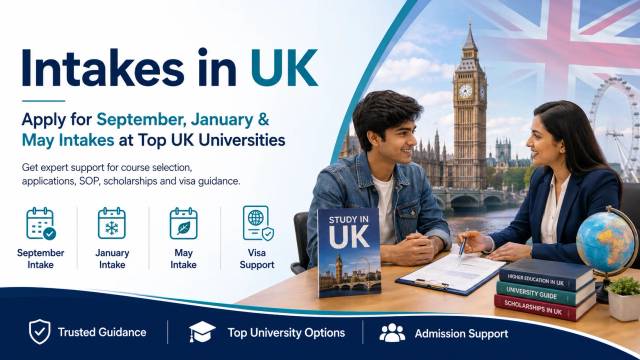
Intakes in UK 2026: January, May & September Admissions
21JAN

Intakes in UK 2026: January, May & September Admissions

Planning to apply for the 2026 intakes in UK? Pay heed to the changing dynamics of the UK’s higher education application processing systems, as it will be a win-or-lose situation for all Indian students pursuing their studies abroad in the coming months. Understanding the tunnel created by the UK’s Home Office (comprising the Office for Students (OfS), the Department for Education, and the UK Visa and Immigration department), with other regulatory authorities for the application process, will help you as an international student to prepare for the 2026 intakes at UK universities.

How Many Intakes are Available for International Students to Study in UK?

The intakes in UK are mainly in three different categories, and we will take a look at each of them briefly to better understand which one is right for you. Here are the three primary entry points for international students to apply for their respective courses at top universities in UK:

  1. Autumn/Fall Intake (September)

The first and primary intake is in September, which is referred to as “Autumn (or Fall) Intake”. This intake is the most important and popular choice for both domestic and international students to apply for admission at UK universities, including the following:

University

Global Ranking

Popular Courses

Imperial College London

2

STEM, Business, Medicine

University of Oxford

4

Humanities, Medicine, Law

University of Cambridge

6

Engineering, Sciences, Mathematics

University College London

9

Architecture, Psychology, Economics

University of Edinburgh

34

Informatics, Social Sciences, Arts

  1. Winter Intake (January)

The second intake is mostly for postgraduate students, but undergraduate applicants also prefer this entry door. It is the second of all the intakes in UK that is preferred by those who missed the September intake. It is also referred to as “Winter Intake” but has a lesser popularity compared to the Autumn intake. Here are the popular options for UK universities accepting applications in this intake:

University

Global Ranking

Popular Courses

University Birmingham

76

Business, Computer Science, Engineering

University of Leeds

86

Data Science, Management, Law

University of Portsmouth

635

Civil Engineering, Biotechnology

Middlesex University

801-850

Cyber Security, MBA, Digital Marketing

University of Greenwich

801-850

Engineering Management, Logistics

  1. Summer/Spring Intake (May)

The third intake is in May, which is also referred to as “Summer (or Spring) intake”. Due to its limited availability for both undergraduate and postgraduate students, this remains the least preferred option, but with niche preferences for particular applicants. The following top-ranked universities in UK offer this pathway:

University

Global Ranking

Popular Courses

Northumbria University

550

MSc in Big Data, Project Management

Coventry University

558

MBA, MSc in International Business

University of Roehampton

801-1000

Financial Management, MBA

University of Bedfordshire

1001-1200

Business Analytics, MSc in Management

University of East London

1001-1200

Cloud Computing, AI, Construction

Pros and Cons of Each Intake in UK for International Students

Understand the advantages and disadvantages of all the aforementioned intakes in UK so that you can make the right choice. Here is a comprehensive representation of each intake, based on what international students can expect for the UK admissions 2026:

Intake

Month

Pros

Cons

Best For

Autumn/Fall

September

Availability of all courses and scholarships

Highly competitive, big class sizes

All undergraduate and postgraduate courses

Winter

January

Lower competition, more time to prepare for admissions

Lower acceptability for applications, and limited courses

Master’s students in business, data science, engineering, and management

Summer/Spring

May

Smaller class sizes with personalised attention from the faculty members

Very limited participation of the universities with low options for both courses and scholarships

Foundation programs, English language sessions, and vocational education in specific master’s programs

Timeline for International Applicants to Study in UK 2026

Following the steps with intakes in UK is crucial for all international students to ensure that they have a smoother admission process for their chosen academic program and university. Here is a quick, step-by-step instruction on how to apply for your preferred admission intake:

  • 10-12 Months Before the Application

Begin to research the UK universities, and learn more about their available courses and their modules for the academic year. Prepare for required exams, such as standardised tests (GRE/GMAT) and English proficiency tests (IELTS/PTE/TOEFL).

  • 8-10 Months Before the Application

Prepare the required academic documents that are curated for the admission process during one of the chosen intakes in UK. This includes a Statement of Purpose (SOP) and Letters of Recommendation (LORs).

  • 6-8 Months Before the Application

During this period, you should submit your application form to the UK university/institution of your choice. For example, if you are applying for the September intake 2026, submit the application form in January 2026.

  • 3-4 Months Before the Application

By this time, you will receive your (conditional or unconditional) letter from the university. Pay your university the required tuition deposit before the final enrolment to receive your Confirmation of Acceptance for Studies (CAS).

  • 3 Months Before the Application

For the final step of admission in one of the intakes in UK, apply for the UK’s “Student Visa” at the nearest UK embassy or consulate by submitting the visa application form, supported by the CAS and other required documents.

Understanding the Choice for Intakes in UK: A Reflective Analysis for International Applicants (With Universities)

Making the right choice for your first step towards the entry door of the UK’s admission system is very important. It will be a make-or-break situation for all applicants from India to ensure that they are right in their approach and realise their dream of overseas education. Here is what you need to understand for all the intakes in UK to make the right decision:

Why September Intake?

All applicants who want to pursue an undergraduate degree, especially a Bachelor of Arts (BA) or Bachelor of Science (BSc), can choose to apply for admission in the September intake. More importantly, the students who want to study in UK with a wider range of academic programs and universities can choose this intake.

All the top universities in UK keep their doors open for applicants during the Autumn (September) intake, including the top names like Oxford, Cambridge, London, and Imperial. Of all the intakes in UK, a September intake offers all international students a very fascinating opportunity to join a large selection of student societies and clubs during the “Freshers’ Week”.

Why January Intake?

If you are interested in applying for a postgraduate education, especially for a specific course of interest in enrolling at a business school, choose to apply for admission during the January intake. Many international students prefer this intake to obtain and utilise a slightly longer buffer period to save money for their studies, or improve their exam scores, such as standardised/aptitude tests and language proficiency tests.

This is one of the excellent intakes in UK for those applicants who want to enjoy a smaller batch in their classrooms, or make up for their missed deadline in the September intake. Also, the Winter (January) intake has lower competition compared to the main intake, which allows students to easily receive approvals from the admissions office in the UK universities.

Why May Intake?

While it is the least preferred option by international students, it can be an advantageous intake period for students who want to apply for a Foundation pathway or a short-term academic program in a specific field of study. This is one of the intakes in UK that offers a very strategic and balanced time period to find job opportunities in the market.

Many students benefit from enrolling during this period, as they can dodge the “graduate glut” issue pertaining to over 70+ applications in June/July, filled with most applicants who entered the admissions process at UK universities through the other two intakes. However, despite the smallest number of applicants, it can still be difficult to enrol during this period at UK universities.

Final Thoughts: Takeaway for International Students

Enrolling at the top UK universities requires a careful planning process for all applicants. While the most common and popular option among all three intakes in UK is the September (fall/autumn) intake, the other two intakes keep the door open to applicants. With each of them having its own advantages and disadvantages, choosing the right intake makes all the difference. Here is an overview of what we have learned so far for each intake for international students:

Category

September Intake

January Intake

May Intake

Level of Competition

High

Moderate

Low

Courses Availability

Maximum

Moderate

Limited

Trend for Foreign Graduates During a Job Season

High Job applications

Moderate Level and Number of Opportunities

Seasonal/specific work opportunity

Comprehension of the complexity of understanding the intakes in UK is significant. However, international students are also advised to keep up with the latest updates and developments of the admissions process and regulations by the UK Home Office. With specific reference to the financial requirements and restrictions on a student visa in UK, Indian applicants must prepare themselves well for the admissions in 2026.

Ready to begin your academic journey in the UK universities? Talk to one of your consultants to find out more about the admissions and application process to study in UK. Register with Education Vibes and kickstart the process from today!

Climate in Russia: Seasons, Weather Patterns & Average Temperatures
17DEC

Climate in Russia: Seasons, Weather Patterns & Average Temperatures

MBBS abroad is the most acknowledged and preferred destination among Indian students and allows for better options and career opportunities. Russia has caught the major attention over the last 40 years, that enabled students to gain better knowledge and opportunities that enhance their careers. However, while choosing a destination for abroad education, students prefer to analyse the destinations, including reading climate in India. This plays a major role in selecting a destination and university to study in Russia. Different cities in Russia face different climatic conditions at the same time. This enables students to stay healthy and study with complete dedication. In this blog, we’ll read about the different climatic conditions faced in multiple destinations in Russia.

Uncover the Seasonal Variations to Understand the Climate in Russia

In India, we have 4 major seasonal changes that ultimately affect the climate of India. Similarly, Russia's Climate is known for its vibrant and beautiful cold weather. Today, we will compare the climate in Russia according to four seasonal appearances. This enables students to analyze the different Russian climatic Conditions compared to the Indian climate.

  1. Winter Season (December to February): The Russian weather in December​ is quite cold and snowy. January and December are the coldest months of the year, and the temperature often falls to -20 °C. Winter in Russia is not less than any snowy imaginations of students. Students take time to adapt to this season, but wearing hot can be a preventive measure for the winter climate in Russia.
  2. Summer (June to August): Summer is not very hot in Russia; it is warm. The Russian temperature in Summer can majorly range between 15 °C to 30 °C. July and August face high temperatures in Russia, but Indian students are easily adaptable to them. Summer will be the most comfortable climate in Russia for Indian aspirants.
  3. Spring (March to May): Similar to India, Russia's temperature in May is the warm-up to summer, which leads students to gain a comfortable environment and green grass. The temperature in Spring ranges from -10 °C to 10 °C.
  4. Autumn (September to November): The weather in Russia in September starts cooling, which signals the arrival of the winter season. The Russian temperature in autumn starts going down from 20°C.

Explore the Climate in Russia in Different Regions

In this blog, we will look at the different destinations of Russia facing different climates in Russia, enabling students to face different adaptation challenges. Reading this section enables students to gain a better understanding and analysis of different opportunities and enhances their opportunities to gain enough knowledge of upcoming challenges.

Region

Winter

Spring

Summer

Autumn

Moscow

-10°C to -15°C

0°C to 15°C

15°C to 25°C

0°C to 10°C

Kazan

-10°C to -20°C

0°C to 15°C

15°C to 25°C

0°C to 10°C

Perm

-18°C to -25°C

-5°C to -10°C

10°C to 20°C

-5°C to 5°C

St. Petersburg

-8°C to -12°C

0°C to 15°C

15°C to 25°C

0°C to 10°C

Baltic Sea

-5°C to -10°C

0°C to 15°C

15°C to 25°C

0°C to 10°C

Northwestern Russia

-10°C to -15°C

0°C to 15°C

15°C to 25°C

0°C to 10°C

Central Russia

-15°C to -20°C

-5°C to 10°C

10°C to 20°C

-5°C to 5°C

Southern Russia

0°C to 5°C

10°C to 20°C

20°C to 30°C

5°C to 15°C

Ural

-20°C to -30°C

-10°C to 0°C

0°C to 15°C

-10°C to 0°C

Siberian

-30°C to -40°C

-20°C to -10°C

-10°C to 0°C

-20°C to -10°C

Far Eastern Russia

-20°C to -30°C

-10°C to 0°C

0°C to 15°C

-10°C to 0°C

Being a cold country, Russia's lowest temperature in winter can fall up to -30°C. Students can easily adapt to this climate in Russia and get the benefit of all the educational and career opportunities to gain excellence and opportunities.

Conclusion

In this blog, we have seen the different temperatures in Russia that enable students to get informed and make a valid and better decision before choosing the particular university to study MBBS in Russia. The climate in Russia is generally referred to as Cold, and students adapt to the Russian weather to pursue their dream education and opportunities in career.

Education Vibes has written this informational blog to help students compare the Russian climate with India’s. This helps them to better understand and make informed decisions.

Fall Intake in USA in 2025: Top Universities & Admission Deadlines Months
27FEB

Fall Intake in USA in 2025: Top Universities & Admission Deadlines Months

Studying in the United States of America is a dream for many international students. The USA is known for its world-renowned universities, diverse UG, PG, and doctoral courses, and extensive research opportunities. One of the most significant facets of studying in the United States is understanding the different Intakes in USA the colleges and Universities offer. The Fall intake in the USA is the most popular among international students among the 3 primary intakes.

Fall Intake in the USA: An Introduction

The Fall intake in the USA usually starts in August or September. This intake offers the highest number of UG and PG programs, financial aid/scholarships, and internship opportunities. This blog provides a comprehensive overview of the Fall intake in the United States, its advantages, application deadlines, and a list of top colleges or universities offering multiple intakes in the US. Let’s explore!

What is Fall Intake?

Fall intake in the USA, also known as the September intake, often called August, is the most significant admission period in the United States. It witnesses hundreds of thousands of student applications and the broadest program availability. The Fall intake normally begins in August or September and extends until December or early January in a year.

Advantages of Fall Intake in the USA

Wider UG and PG Programs Selection

The fall intake in the United States provides the most extensive range of undergraduate, graduate, and doctoral programs compared to the Spring and Summer intakes. During this period, many new courses and specializations are introduced.

More Scholarship Options

Since fall intake is the primary intake, most colleges and universities allocate a substantial portion of their financial aid or scholarships to Fall applicants.

Better Job Opportunities and Internship Options

International students enrolling in the Fall semester in any college or university in the United States can align with the internship and placement cycles if necessary, improving their chances of securing jobs, training, or internship options.

Higher Acceptance Rate

As most top colleges and universities open maximum seats for Fall intake in the USA, international students have a better option and chance of securing admission into their preferred UG, PG, or doctoral programs.

More Networking Opportunities & Extracurricular Activities

Top colleges and Universities in the USA organize the most renowned clubs, groups, student organizations, and extracurricular things during the Fall intake in the USA, allowing international students to engage in a vibrant campus life.

Application Process for Fall Intake

Shortlist College and Universities

You may shortlist colleges and universities 12 to 18 months before the intake. It is wise to start by researching colleges or universities and the programs that match your career, or academic journey.

Check Admission Requirements

You may check the admission requirements 10 to 12 months before the intake. It is wise to research each university that has particular admission criteria, including standardized test scores, such as GRE, GMAT, English language proficiency test, IELTS, TOEFL, PTE, GPA, and work experience, if applicable.

Prepare for Tests

You may prepare for the tests 10 to 12 months before the intake starts. It is wise to plan and register for standardized English language tests like TOEFL/IELTS/PTE, or entrance exams, like GRE/GMAT, and SAT (for undergraduate programs) based on the program requirements.

Prepare Application Documents

You may prepare the application documents before 8 to 10 months the intake. You may start drafting your SOP-Statement of Purpose, LOR - letter of Recommendation and updating your Curriculum Vitae/Resume. Ensure that your academic transcripts as well as financial documents are ready.

Apply to Universities

You may apply for the colleges or universities before 6 to 8 months of the intake. It is wise to submit the applications through the college or university portals before the deadlines. Most top colleges or universities have Early Decision and Regular Decision deadlines for the fall intake in the USA.

Await Admission Decision & Acceptance

Normally, the admission decision and acceptance take four to six months before the intake. Thus, colleges and universities review applications and release acceptance letters. Once you get an offer from your chosen college or university, confirm your acceptance by paying the initial admission fee.

Apply for the student visa

You must apply for the student visa for the USA i.e. F1 visa through the United States embassy, attend the visa interview for studying in the USA, and receive the necessary documents, such as the I-20 form. It must be three to four months before the intake.

Prepare for the Departure

You must prepare for the departure before one to two months of the intake you chose. You must book flights, arrange your accommodation, and prepare for your new academic journey in the United States.

Fall Intake in the USA Deadlines

Each college or university sets its deadlines for the Fall intake admissions in the USA. Generally, deadlines for most colleges and universities fall into 3 categories: Here is the table that will help you find the exact deadline with application type.

Application Type

Deadline Period

Early Decision

October-November - Previous Year

Regular Decision

December to February

Rolling admission process

Varies up to May - June

Universities Offering Multiple Intakes

While Fall is the primary intake in the United States of America, many top colleges and universities in the US also offer Spring and Summer intakes. Here is a list of colleges or universities with their intake options in a table format:

University

Fall Intake

Spring Intake

Summer Intake

Harvard University

Yes

Limited

No

Sanford University

Yes

No

No

Massachusetts Institute of Technology

Yes

No

No

University of California, Berkeley

Yes

Limited

No

University of Illinois Urbana-Champaign

Yes

Yes

Limited

University of Michigan, Ann Arbor

Yes

Yes

No

New York University

Yes

Yes

Limited

Columbia University

Yes

Yes

Limited

University of Texas, Austin

Yes

Yes

No

Carnegie Mellon University

Yes

Yes

Limited

University of Southern California

Yes

Yes

Yes

Purdue University

Yes

Yes

Yes

Arizona State University

Yes

Yes

Yes

The Key Takeaway

Fall intake in the USA is the most preferred and beneficial period for international students due to its vast academic opportunities, availability of the UG and PG programs, higher scholarship options, and better job prospects. If you plan to study in the USA from 2025 to 2026, fall intake could be the best option for you. Here in this blog, we have narrated why you choose fall intake in the United States for your further studies, the advantages, and the top colleges or universities that offer courses in this intake. Normally Fall intake ensures you start preparing at least one year in advance to meet all deadlines. This helps you increase your chances of securing admission to your dream college or University in the USA.

By following the timely preparation, right approach, and reliable guide, you can successfully embark on your academic journey in the United States. If you are looking for a reliable study abroad guide, choose no further than Education Vibes. We are one of the leading and most trusted study abroad consultants to help students choose their dream course and university in the USA in their desired intake. Drop an email or call us for more details!

Masters in Australia: Top Universities, Courses, Fees, & Intakes 2025-26
20DEC

Masters in Australia: Top Universities, Courses, Fees, & Intakes 2025-26

Australia is an amazing country. It is a multicultural nation with friendly people and a laid-back lifestyle. Australia’s outstanding education system and a high living standard sets it apart from other countries among international students. Masters in Australia offers a complete experience as you can study in some of the world's best Universities and live in one of the most popular travel destinations on the globe.

Furthermore, living expenses and the cost of education in Australia are comparatively lower than those in the United States, France, Canada, and the United Kingdom. Due to its robust infrastructure and great living standards, Australia has traditionally been a popular higher-study destination for international students.

Is It worth doing a masters in Australia?

Graduates from top Universities in Australia are in high demand worldwide. Masters in Australia get humongous opportunities worldwide for their skills, knowledge, and research-oriented mindset. So if you are considering studying a master's program in Australia, this blog post will be your handy guide!

Australia is the destination of 42 universities, 37 public, 3 private, and 2 private international universities. This guide helps you to understand everything you should know before moving to Australia for higher studies. Let’s read on why you pick Masters Courses in Australia!

  • Australian universities are pioneers in including the newest innovations, technology developments, and current industry trends in teaching and learning.
  • Australian universities offer a diverse selection of Master's degrees and courses, and students have extensive alternatives.
  • Masters in Australia cost between AUD 22,000 and AUD 50,000 per year.
  • Australian Universities are more popular as they provide students with career-focused and useful skills that most companies need.
  • Companies, and other educational institutions all around the world, recognize and appreciate degrees earned at Australian universities.
  • Most universities in Australia for masters have international student assistance units on campus. This group assists foreign students by addressing queries and directing them to the appropriate service.
  • The government has simplified the visa procedure to ensure Australia remains a desirable location for international students.
  • Master students in Australia can work 20 hours each week and 40 hours during holiday seasons. This helps students gain work experience and earn decent money while studying.

Top 10 Universities in Australia for Masters

Here are the top ten universities in Australia for Masters. These are some of the top global universities known for academic excellence!

Universities

University Type

Global Rank

Total Master’s Program

Total Scholarships Available

University of Melbourne

Public

24

147

54

University of Sydney

Public

48

211

64

Monash University

Public

51

95

52

University of New South Wales

Public

52

127

167

University of Queensland

Public

54

223

155

Australian National University

Public

60

128

54

University of Western Australia

Public

95

151

58

University of Adelaide

Public

106

94

59

University of Technology Sydney

Public

138

138

87

Macquarie University

Public

159

58

67

Deakin University

Public

191

91

58

Top Masters Courses in Australia

Here are the top master's courses in Australia that most international students prefer.

  • Accounting and Finance
  • Biomedical Engineering
  • Business Management
  • Civil Engineering
  • Computer Science and IT
  • Cybersecurity
  • Data Science
  • Electrical and Electronics Engineering
  • Nursing
  • Psychology
  • Social Work

Masters in Australia Duration

The duration of opting for a master's degree in Australia depends upon type of the program you choose. Normally, a master's degree in Australia takes 1 to 2 years to complete.

Masters in Australia Requirements in 2025

Whether you apply for a Bachelor's or Master's in Australia, you need to take one of the accepted English language tests and obtain the required scores. Besides, you need to have the eligibility to study graduate-level courses. The required English language score and eligibility will help you secure admission varies based on the level of study you apply for, the university you apply for, and your country of citizenship.

Also, regarding the admission test to study for a master's in Australia refer to the table below for a broad idea of the tests you need to take to study your course of choice.

Masters in Australia Eligibility

To be eligible for a master's in Australia, you'll need to meet the requirements, including:

  • Undergraduate degree from a recognized University
  • English proficiency with a score of at least 6.5 on an English language proficiency test like IELTS.
  • You may also need to provide a GMAT score
  • Academic transcripts
  • A Curriculum Vitae
  • Letters of recommendations
  • Proof of enrollment
  • A valid passport
  • Visa application fee
  • Genuine Temporary Entrant (GTE) statement
  • Proof of funds
  • Health insurance documents
  • Passport size photographs

What Is The Minimum CGPA Requirement for Masters in Australia?

Most universities in Australia accept an average GPA of 2.8–3.3, but some may require a higher GPA. Before you enroll for a master's course in Australia, we advise you to visit the University website about the requirements or talk to a study abroad consultant.

Masters in Australia English Language Tests Requirements

Name of the Test

Abbreviation

Minimum Score

TOEFL - ONLINE

Test of English as a Foreign Language

46

IELTS

International English Language Testing System

55

PTE

Pearson Test of English

42

CAE

Cambridge Advance English Test

162

OET

Occupational English Test

Pass A or B

How To Apply for Master's in Australia?

The masters in Australia admission process is straightforward. Sending an application is the first crucial step in an Australian University. A complete and well-crafted application can help you secure admission to the best University in Australia for a master’s program. Here are the steps to follow:

  • Complete the application form
  • Institution application fee (wherever applicable)
  • Academic Documents
  • Bachelor's degree certificate/ provisional degree certificate
  • Year 12 passing certificate
  • Year 10 passing certificate

Note:

International students going to study masters in Australia need to purchase health insurance coverage. It is called the Overseas Students Health Cover (OSHC). It is one of the prerequisite conditions of your student visa.

Cost of Living and Studying Masters in Australia

Here are the indicative tuition fees per year for pursuing master-level degrees in Australia. Studying masters in Australia usually costs between AUD 22,000 and AUD 50,000. It varies from program to program.

Cost of Living

  • Hostels and Guesthouses - AUD 90 to AUD 150 per week
  • Shared Rental - AUD 95 to AUD 215 per week
  • On campus - AUD 110 to AUD 280 per week
  • Homestay - AUD 235 to AUD 325 per week
  • Rental - AUD 185 to AUD 440 per week

Other Living Expenses

  • Groceries and eating out - AUD 140 to AUD 280 per week

  • Gas, electricity -AUD 10 to AUD 20 per week
  • Phone and Internet - AUD 15 to AUD 30 per week
  • Public transport - AUD 30 to AUD 60 per week
  • Car (after purchase) - AUD 150 to AUD 260 per week
  • Entertainment - AUD 80 to AUD 150 per week

Scholarships for Masters in Australia

SL No.

Name of the Scholarship

Description

1

Australian Government Research and Training Program (AGRTP)

Covers tuition fees and health insurance for up to three years

2

Australia awards

Covers tuition fees and health insurance for up to three years

3

Destination Australia

AUD 10,000 to AUD 20,000

4

John Allwright Fellowship

AUD 30,000 per year

Final Words

Masters in Australia is an excellent choice for international students due to its high-quality education, diverse range of programs, strong research opportunities, international recognition, and multicultural environment. Top Australian universities are known for their academic excellence and offer a wide array of master’s programs across various disciplines. A Master’s degree from Australian University is highly respected worldwide. If you want to explore a global academic environment and create a global career with unlimited potential, a Master's in Australia is the one for you.

For more information about top Australian Universities, master courses, VISA process, and all, feel free to get in touch with Education Vibes today. We are one of the leading and most trusted study-abroad consultants to help students choose their top master courses in Australia. Look no further!

PTE Exam Dates 2024
03APR

PTE Exam Dates 2024

A computer-based exam called the Pearson Test of English (PTE) evaluates non-native speakers' proficiency in the language when they apply to universities in English-speaking nations. Many nations, including the United States, United Kingdom, Canada, Australia, New Zealand, Germany, Ireland, France, and the Netherlands, accept PTE. To begin with, you should be aware of your present English proficiency level and the required PTE score. By using the online practice tests, you can prepare for the PTE Academic exam and gain a sense of the minimum score required for the real exam.

PTE Exam Dates 2024 and other Details

One of the most popular English language competency tests for applicants wishing to pursue higher education in an English-speaking nation is PTE Academic, which is administered by Pearson PLC Group. PTE test dates are accessible all year round, so applicants who choose to take the test can do so at any time of the year, just like in most other international exams.

It is necessary for candidates who wish to take the PTE examinations in 2024 to register on the official website. Additionally, candidates must confirm that the PTE exam date of 2024 is available at many PTE testing locations. PTE tests are given from Monday through Sunday. Those who wish to take the Pearson PTE Exam Dates 2024 can do so at more than 400 testing locations across the world. Within three to five days of taking the exam, candidates can anticipate receiving their PTE exam results for 2024.

The steps that are required to file a candidature of Pearson PTE exam dates are mentioned below:

  • Create or log into the account on the official PTE Academic Website
  • Enter all the required details according to your passport.
  • Select the test you want to appear for i.e. PTE Academic or PTE-A, UKVI, Home, or PTE Academic Online.
  • Select the convenient test center location.
  • Select a desired Pearson PTE exam date.
  • Review their PTE exam dates and PTE exam locations.
  • Pay the registration amount and save the acknowledgment receipt.

The Dates for PTE Exam 2024

PTE Exam Dates New Delhi

PTE exam center location

Months

PTE exam dates

Pearson Professional Centers-New Delhi

302/305, Ashoka Estate

24, Barakhamba Road

Fire Brigade Lane

New Delhi

Delhi 110001

India

March

21, 23, 24, 28, 29, 30, 31.

April

04, 11, 19, 24.

May

03, 06, 16, 20, 30.

June

06, 14, 20, 28.

July

03, 12, 26.

August

02, 06, 16, 28.

September

05, 13, 18, 26.

October

03, 08, 16, 24, 31

November

07, 13, 21, 28.

December

05, 12, 19, 26.

PTE Exam Dates New Delhi

PTE exam center location

Months

PTE exam dates

Global Opportunities Pvt Ltd

HS 27, Second Floor

Kailash Colony Market

Kailash Colony

New Delhi

Delhi 110048

India

March

20 to 31

April

1 to 30

May

1 to 31

June

1 to 30

July

1 to 31

August

1 to 31 except 15 August

September

1 to 30

October

1 to 31 except 2 October

November

1 to 30

December

1 to 29 except 25 December


PTE Exam Dates Jalandhar

PTE exam center location

Months

PTE exam dates

Pearson Professional Center

Lajpat Nagar, Jalandhar

and

Pearson Professional Center

VCN Tower, Jalandhar


March

7, 15, 21, 28

April

4, 11, 19, 24

May

3, 6, 16, 21, 30

June

6, 14, 20, 28

July

3, 12, 26

August

2, 6, 16, 28

September

5, 13, 18, 26

October

3, 8, 16, 24

November

7, 13, 21, 28

December

5, 12, 19, 26

PTE Exam Dates Amritsar

PTE exam center location

Months

PTE exam dates

Pearson Professional Center

Unit 303 and 304, Mukut House

and

Pearson Professional Center

SRK Mall, Passport Office Building, Mall Road

March

7, 15, 21, 28

April

4, 11, 19, 24

May

3, 6, 16, 21, 30

June

6, 14, 20, 28

July

3, 12, 26

August

2, 6, 16, 28

September

5, 13, 18, 26

October

3, 8, 16, 24

November

7, 13, 21, 28

December

5, 12, 19, 26

PTE Exam Dates Chandigarh

PTE exam center location

Months

PTE exam dates

Pearson Professional Center

Unit 303 and 304, Mukut House

and

Pearson Professional Center

SRK Mall, Passport Office Building, Mall Road

March

7, 15, 21, 28

April

4, 11, 19, 24

May

3, 6, 16, 21, 30

June

6, 14, 20, 28

July

3, 12, 26

August

2, 6, 16, 28

September

5, 13, 18, 26

October

3, 8, 16, 24

November

7, 13, 21, 28

December

5, 12, 19, 26

PTE Exam Dates Bangalore

PTE exam center location

Months

PTE exam dates

Pearson Professional Center

Central Street, Shivajinagar

and

Pearson Professional Center

Lalbagh Road

March

7, 15, 21, 28

April

4, 11, 19, 24

May

3, 6, 16, 21, 30

June

6, 14, 20, 28

July

3, 12, 26

August

2, 6, 16, 28

September

5, 13, 18, 26

October

3, 8, 16, 24

November

7, 13, 21, 28

December

5, 12, 19, 26

PTE exam center location

Months

PTE exam dates

TC Global

Mittal Towers, MG Road


March

1, 2, 4, 6, 11, 13, 15, 16, 18, 20, 22, 23, 25, 27, 30

April

1, 3, 5, 6, 8, 12, 13, 15, 17, 19, 20, 22, 24, 26, 27, 29

May

3, 4, 6, 8, 11, 13, 15, 17, 18, 20, 22, 24, 25, 27, 29, 31

June

1, 3, 5, 7, 8, 10, 12, 14, 15, 19, 21, 22, 24, 26, 28, 29

July

1, 3, 5, 6, 8, 10, 12, 13, 15, 19, 20, 22, 24, 26, 27, 29, 31

August

2, 3, 5, 7, 9, 10, 12, 14, 16, 17, 19, 21, 23, 24, 26, 28, 30, 31

September

2, 4, 6, 9, 11, 13, 14, 18, 20, 21, 23, 25, 27, 28, 30

October

4, 5, 7, 9, 11, 14, 16, 18, 19, 21, 23, 25, 26, 28, 30

November

4, 6, 8, 9, 11, 13, 15, 16, 20, 22, 23, 25, 27, 29, 30

December

2, 4, 6, 7, 9, 11, 13, 14, 16, 18, 20, 21, 23, 27, 28


PTE Exam Dates Hyderabad

PTE exam center location

Months

PTE exam dates


Pearson Professional Center

C1360, 3rd Floor, SP Road, Begumpet

and

Pearson Professional Center

Manjeera Trinity Corporate, Hitec City Road


March

7, 15, 21, 28

April

4, 11, 19, 24

May

3, 6, 16, 21, 30

June

6, 14, 20, 28

July

3, 12, 26

August

2, 6, 16, 28

September

5, 13, 18, 26

October

3, 8, 16, 24

November

7, 13, 21, 28

December

5, 12, 19, 26

PTE Exam Dates Ahmedabad

PTE exam center location

Months

PTE exam dates

Pearson Professional Center

Westgate sarkhej, Makarba


March

7, 15, 21, 28

April

4, 11, 19, 24

May

3, 6, 16, 21, 30

June

6, 14, 20, 28

July

3, 12, 26

August

2, 6, 16, 28

September

5, 13, 18, 26

October

3, 8, 16, 24

November

7, 13, 21, 28

December

5, 12, 19, 26


PTE exam center location

Months

PTE exam dates

Take Off Academy

404, Elanza Vertex


March

1st - 31st (except 3rd, 10th, 17th, 24th, 25th, 31st)

April

1st - 30th (except 7th, 14th, 21st, 28th)

May

1st - 31st (except 5th, 12th, 19th, 26th)

June

1st - 30th (except 2nd, 9th, 16th, 23rd, 30th)

July

1st - 31st (except 7th, 14th, 21st, 28th)

August

1st - 31st (except 4th, 11th, 15th, 18th, 25th, 30th)

September

1st - 30th (except 1st, 8th, 15th, 22nd, 29th)

October

1st - 31st (except 2nd, 6th, 12th, 13th, 20th, 27th, 31st)

November

1st - 30th (except 1st, 2nd, 3rd, 4th, 10th, 17th, 24th)

December

1st - 31st (except 1st, 8th, 15th, 22nd, 25th, 29th, 30th, 31st)

PTE Exam Dates Surat

PTE exam center location

Months

PTE exam dates


Pearson Professional Center

Swastik House, Nandi Park Society


March

7, 15, 21, 28

April

4, 11, 19, 24

May

3, 6, 16, 21, 30

June

6, 14, 20, 28

July

3, 12, 26

August

2, 6, 16, 28

September

5, 13, 18, 26

October

3, 8, 16, 24

November

7, 13, 21, 28

December

5, 12, 19, 26


PTE exam center location

Months

PTE exam dates


AUO University

Earthspace, Hazira Road

March

1, 4, 5, 6, 7, 11, 12, 13, 14, 15, 18, 19, 20, 21, 22, 26, 27, 28, 29

Studying In Canada Can Change Your Life and Career Forever
12FEB

Studying In Canada Can Change Your Life and Career Forever

Should you move to Canada for higher studies? If we say “yes”, you should. What do you do?

What do you think if we say study in Canada can change your life forever! Will you believe it?

Hmm, you must be in doubt for sure.

Oh, you are not alone!

There are a number of higher study aspirants who think that only studying in the UK or USA is great, but that is partially correct.

Through the past few years, where more than hundred countries offer higher education to international students, and in this league the UK, the USA, France, Ireland, Australia are some of the names that come on the top of the list. If we say CANADA is one of those countries that offer high standard education at best cost, and certainly comes up in the top 5 list. Would you mind? Oh, you shouldn’t. Here, in this blog, we will tell you why you should study in Canada and how it can change your life.

It goes without saying that studying abroad in some countries could make a real change in your life and career, and CANADA is beyond doubt the most favoured country that could help you bring out a significant change in your life and career.

Here are the 4 major things that could change your life forever, when you study in Canada. Read on what those ways are!

Intellectual Way Of Thinking

This could be the first and foremost reason higher study aspirants these days dream of moving Canada for their higher studies.

Education system in Canada has been designed in such a way that can make students skilled, knowledgeable and job ready. These 3 things are core in today’s Canadian education. Canada’s education system makes sure that all the students whether bachelor or master, or in other courses put through diverse situations.

As a result of this, students’ problem solving ability and thought perspective change drastically, better to say enhance. Thus, allowing them to manage almost all types of situations, roadblocks or disruptions quite easily and efficiently.

Multicultural Environment

The second most important is multicultural environment experiences. Students move to study in Canada from all parts of the world. This helps you mingle with people from different cultures, heritage, experience and knowledge. It has been said, the more you share the more you grow.

You will enjoy a lot of recreational activities, events, festivals and more to be celebrated. You will also have the opportunity to taste different types of cuisines. All these things certainly help you get out of your comfort zone and indulge your growth in a wider community.

Global Work Opportunity

Canada is flooded with top Universities in the world, known for quality education, training and research. Needless to mention, the degree you earn studying in Canada will be recognised globally. Your degree earned from one of the top Universities like – University of Toronto, McGill, University of British Columbia, McMaster or Alberta, to name a few could be an asset for your life and career. It will make you apart from the crowd. Also, a degree earned from Canadian University could give you abundant job opportunities throughout the world.

Joy Of Getting Permanent Resident VISA

When you study in Canada as an international student, you will have an option of getting a permanent resident visa when you abide by the rules set by the Canadian government.

Study and work experience in Canada is considered one of the most important factors for international students, and it is also essential in some of the immigration programs. On becoming a permanent resident visa, you will get abundant benefits, and will be able to live a high-quality life like native Canadians.

When higher education is done correctly, it will help you deal with almost all sorts of aspects, and also help you accelerate for more.

Let us close by saying that studying in Canada could help you change your life, and career-wise, it will help you grow exponentially.

If you have a long cherished dream of studying in Canada and are stuck in thinking how to start your dream journey, get in touch with Education Vibes today. We will help you start your transformation to-day! Look no more!

How Do I Score High in the Reading Section in PTE Academic
08FEB

How Do I Score High in the Reading Section in PTE Academic

PTE is another English proficiency exam conducted by Pearson. This is one of the high demanding exams like TOEFL, IELTS etc. If you are new to this type of English language proficiency exam and stuck in question - what is PTE? Then this post would be a great help.

Needless to say, if you want to study abroad, especially in Europe or America, you will be asked to show your English language proficiency exam score, and you can show your PTE score as well. Here, in this blog, we will tell you how to score high in the reading section on PTE academic. This blog is written specially for the first-time examinees who want to know the PTE exam pattern. Let’s understand what PTE academic is, and how many sections there are.

About PTE Academic

PTE Academic aka Pearson Test of English Academic is a computer-based English language proficiency test designed for non-native English speakers who wish to study or work in English-speaking countries. It assesses the individual's abilities in the four key language skills: listening, reading, speaking, and writing.

Here are some key features, PTE exam pattern, and aspects of the PTE Academic test:

Format: PTE Academic is a computer-based test, which means the entire test is taken on a computer. The test is divided into three main parts: Speaking and Writing, Reading, and Listening. The test is taken in a single sitting and lasts approximately 3 hours.

Scoring: The test is scored on a scale of 10 to 90, with 10-point increments. Each of the four language skills is scored separately, and the overall score is the average of these four scores.

Question Types: PTE Academic includes a variety of question types to assess different language skills. These include multiple-choice questions, fill in the blanks, re-order paragraphs, essays, and speaking tasks where you need to record your responses.

Speaking Section: The speaking section consists of various tasks, such as reading aloud, repeating sentences, describing images, and answering short questions. You will speak into a microphone, and your responses will be recorded and scored by AI algorithms.

Writing Section: The writing section includes tasks like summarising written texts, writing essays, and summarising spoken texts. You need to type your responses in this section.

Reading Section: The reading section assesses your ability to comprehend and analyse written texts. You will encounter different question types that evaluate your reading skills.

Listening Section: The listening section involves listening to audio clips and responding to questions based on what you've heard. This section evaluates your listening comprehension skills.

Test Availability: PTE Academic is widely accepted by universities, colleges, and governments in English-speaking countries as evidence of English language proficiency. It is recognized by institutions in countries like the United States, Australia, Canada, the United Kingdom, and more.

Quick Results: One of the advantages of PTE Academic is that you usually receive your scores within a short period after taking the test, often within 2 to 5 business days.

Test Centers: PTE Academic is administered at authorised test centres around the world. You need to schedule your test in advance through the official PTE Academic website.

How Do You Score High in the Reading Section on PTE Academic?

For the purpose of the reading section of the PTE academic, the trick is to have fluency in reading, so you need to have frequent reading practice at home. You need to focus and understand all types of passages. If you have a regular reading habit, it would be an added advantage for you.

Reading section is one of the most important sections, like the writing and listening and speaking sections. You will use this reading skill at once when attempting the PTE academic exam. In the reading section exercise, you need to learn them step-wise. Here is a list that you need to improve for the reading section. This will also help you hone in the other sections as well.

  • First, build your vocabulary
  • Second, understand the technicalities of the section
  • Third, you need to have time management, which is important to ace the reading section
  • Fourth, practise more and more on the grammar
  • Last, opt for an elimination strategy

We have included a table below to show you the current PTE reading section question topics, as well as the number of questions per topic that would be tested during the exam.

PTE Reading Section Question Topics

PTE Question Format

Fill in the blanks –reading & writing

5-6

Multiple choice, multiple answers

1-2

Re-order paragraph

2-3

Fill in the blanks –reading

4-5

Multiple choice, single answer

1-2

Total Questions

13-18

Time Allocation

29-30 (Minutes)

For your information we have included the PTE exam fee. One thing to keep in mind is - the exam fee can be changed and it totally depends on the PTE authority, so please visit their website to know the current fee for the exam.

PTE exam fee in India is INR 15,900, . The exact fee is INR 13,038 and there is an additional 18% tax payable which is INR 2,862, adding to it, the total PTE test price is INR 15,900.

Finishing Lines

Before taking the PTE academic test, it is important to familiarise yourself with the test format, practice with sample questions, and consider taking preparation courses if needed. Keep in mind that each institution or organisation may have its own minimum score requirements for admission or employment, so it is a good idea to research those requirements beforehand.

PTE Exam Dates
30JAN

PTE Exam Dates

Do you want to study abroad? You're in for an adventure, but first, you must demonstrate your command of the English language. The Pearson Test of English (PTE) or PTE Exam Dates in 2024 is an exam that evaluates your abilities to read, speak, listen, and write in English.

Nearly 3000 institutions worldwide, including well-known nations like Canada, the United Kingdom (UK), the USA, Australia, and New Zealand, will accept the PTE exam 2024.

Overview of PTE Exam Pattern 2024

Do you want to pass the PTE exam 2024 for study abroad in the USA, study abroad in Australia, study in the UK, or study in Canada?

Here's the scoop:

It's a two-hour computer-based exam that takes place in a secure testing facility. Each portion of the exam focuses on a separate skill: reading, writing, listening, and speaking. There will be 20 different questions in each of these parts. Speaking and writing take around 54-67 minutes, reading takes approximately 29-30 minutes, and listening takes approximately 30-43 minutes.

Here's everything you need to know about the PTE exam pattern:

  • Criteria for PTE Eligibility: Applicants must be 16 years old or older.
  • Availability of Testing: Throughout the calendar year
  • Duration of the test: 2 and 15 minutes
  • Exam format: The test consists of 20 question types within 3 main parts (speaking and writing, reading, and listening)
  • Registration: Online via Pearson PTE Academic website
  • Exam Fees: ₹15,900
  • Results and Score Scale: Results in 48 hours, score ranges from 10-90

PTE Exam Pattern 2024: Section-wise details

  1. Speaking and Writing (54 – 67 Minutes)
  • It is the longest section of the PTE exam 2024, lasting between 54 and 67 minutes. We're here to see how effectively you can speak and write English in an academic setting.
  • First, you start with a fast personal Introduction - that's 55 seconds total: 25 seconds to talk about yourself and 30 seconds to record it—but self-introduction does not offer test takers any points.

Now, let's take a look at the seven sections, each of which tests distinct speaking and writing abilities:

Read aloud (various): After 30-40 seconds of preparation, read a brief 60-word sentence.

Sentence to be repeated (15 seconds): Listen for 3-9 seconds to a sentence, then repeat it for 15 seconds.

Image description (40 seconds): Take 25 seconds to look at a photo, then describe it.

Lecture Retell (40 seconds): Listen to a lecture, then prepare for 10 seconds before telling it again in 40 seconds.

Answer the following short question (10 seconds): Answer a question in 10 seconds or less.

Written Text Summarization (10 minutes): Within 10 minutes, summarise a 300-word text in one sentence.

Essay (20 minutes): Within 20 minutes, write a 200-300-word essay based on 2-3 phrases.

Each segment assesses a separate set of skills, such as reading, speaking, listening, and writing.

In Read Aloud, for example, you read a brief passage aloud. You repeat what you hear in a repeated sentence. Isn't it simple?

These challenges allow PTE students like you to demonstrate your English skills. Are you prepared to master the speaking and writing sections? Let's go!

  1. Reading Section (29 – 30 mins)

It's time to plunge into the PTE exam 2024 Reading part, a 29-30 minute adventure that assesses your ability to read English. This section is significant since it connects to the others. It's not only about reading; your writing is also considered, particularly in the first question.

Let's dissect the reading format.

This portion is divided into five pieces, and you have 29-30 minutes to complete them:

Fill in the blanks: You'll see a text with gaps, and all you have to do is complete them with the appropriate words. The text is around 300 words long.

Multiple Answer, Multiple Choice: After reading a text, answer a multiple-choice question. Take care; there may be more than one right answer. The text is around 300 words long.

Re-order Paragraphs: Your job is to arrange the text boxes appropriately. To make sense of it, drag and drop. The text is around 150 words long.

Fill in the blanks: Another assignment of filling in the blanks, but with shorter text this time. To finish the passage, select the appropriate words from a box. The text is around 80 words long.

Multiple Choice, Single Response: Read a chapter and answer a multiple-choice question; however, there is only one correct answer this time. The text is around 300 words long.

These assignments ensure that you can read and comprehend instructions, which is critical.

3) Listening Section (30 – 43 minutes)

Let's take a look at Part 3 of the PTE exam 2024, which is the second-longest session, lasting 30-43 minutes. This section assesses your English listening abilities against academic norms. It consists of audio or video segments that allow you to take notes while listening. There are eight sub-segments, each with its own unique difficulty. Let us investigate:

Summarise Spoken Text: Within 10 minutes, listen to an audio recording and summarise it in 50-70 words. You'll have 60-90 seconds to retain the knowledge before writing for 10 minutes.

Multiple-choice, multiple-answer questions: Within 40-90 seconds, respond to multiple-choice questions based on an audio recording.

Please fill in the blanks: After listening to an audio recording for 30-60 seconds, fill in the blanks in a transcript.

Correct summary highlighted: Choose the paragraph that best summarises a 30-90-second audio recording.

Multiple Choice, Single Answer: Choose the paragraph that best summarises a 30-90-second audio recording.

Select Missing Word: Within 20-70 seconds, select the proper missing word from the alternatives in an audio recording.

Underline Incorrect Words: Within 15-50 seconds, identify words in a transcript that differ from the spoken words in an audio recording.

Dictation to Writing: Within 3-5 seconds, listen to a short statement and write it down.

Finally, knowing the PTE exam 2024 test format for 2024 is critical for students who want to study abroad. Reliable PTE exam 2024 tutoring becomes a significant advantage for people wishing to manage this trip smoothly. The skilled specialists at Education Vibe give thorough advice, ensuring you are well-prepared to pass the PTE on the first try.

Is Duolingo Compulsory for Study Abroad?
15JUN

Is Duolingo Compulsory for Study Abroad?

As more than two million Indian students plan to pursue higher education abroad, demonstrating proficiency in English is a key factor in the process. The Duolingo English Test (DET) is an option that enables this global mobility and opens the door to smoother college acceptance and immigration. Trusted by many universities and millions of students worldwide, DET is a leading digital, high-stakes assessment of English language proficiency. Designed for comfort, speed, affordability, and reliability, this is a great choice for students who are looking for a smooth and successful language assessment experience.

Meet Student Visa Requirements


When it comes to studying abroad, aspiring students need a student visa to continue their studies. They are often skeptical about whether language proficiency tests will be accepted for visas.

Duolingo's English test is accepted for visas in the US, UK, and Ireland. For Canada and Australia, the test is accepted, but the process is a bit different. Acceptance from a Designated Learning Institution (DLI) is required for a traditional study permit. You may not need to take an additional English test to apply for a student visa if the applicant institution accepts the DET as part of their application process. Students from specific countries can also apply for a student visa using the Student Direct Stream (SDS) process. Currently, IELTS is the only English proficiency test recognized by SDS as part of the application process. To use DET results, students should follow the normal student visa route, instead of using SDS.


DET Student Visa Requirements by Country


Here are the requirements for student visas in the top five English-speaking countries:

  • Study Abroad in USA - It is accepted for US student visa applications. Minimum DET scores vary by university. The average DET score requirement for US universities is between 100 and 150. However, top universities generally accept DET scores above 120.

  • Study Abroad in UK - It is accepted for UK student visas. However, applicants must ensure that they have met the necessary requirements set forth by the UK government. The UK requires a minimum DET score of 105. Although this can vary depending on the choice of UK university and the program the person is applying to,

  • Study in Canada - If a student is accepted into a university, DET can be used for the visa process; DET is not accepted for the Student Direct Stream (SDS) process. To use DET results, students should follow the regular student visa route instead of using SDS. Immigration authorities do not currently accept online English tests.

  • Study in Ireland - Duolingo's English test is accepted for visas to Ireland. DET has become a permanent offering as the current minimum English standard for Irish student visas. For high school and basic or preparatory English courses, applicants must have a minimum score of 55, while the minimum score for all other courses is 75.

  • Study Abroad in Australia - DET can be used for the visa application process if prospective students are accepted into a university. However, the Australian government may require them to take another language proficiency test, depending on the needs of the applying university.

DET: A Gateway to Renowned Universities

Currently, university acceptance of Duolingo English tests is on the rise, with an increasing number of institutions trusting the test. More than 4,500 universities and institutions around the world officially accept the DET. Institutions such as Adelphi University, USA; Baylor University, USA; California State University, Los Angeles; Cambrian College, Canada; the University of Windsor, Canada; Kingston University, UK; and the Australian National University, Australia, to name a few, accept DET. Visit the official exam website for a complete list of universities that recognize the Duolingo English test.

DET Scores are Validated by Institutions


As part of the admissions process, many institutions often set a minimum score threshold for language proficiency tests. Although many universities list English language proficiency requirements on their websites, the easiest way to find out what Duolingo test scores a university accepts is to email their admissions office at this establishment and ask them directly. Along with test scores, it also provides more information about test takers through their speaking and writing samples to create an overall report.

The Duolingo English Test is a modern assessment of English language skills for today's international students and organizations. The test is available online upon request. You don't need to make an appointment or go to the test center, you; can take the test at home using your computer and webcam. The test is administered using adaptive computer technology, which means that the difficulty of the question adapts to each candidate. The test also incorporates a video interview and sample writing, which are sent to an institution along with your proficiency score when you submit your results. The entire testing experience took less than an hour. Test results are certified within two days and can be shared with any organization.

Frequently asked Questions

If you cancel the PTE test, with less than 14 calendar days, but at least 7 calendar days before your test date, then you will receive a partial refund of 50% of the PTE test fee paid. If you want to challenge the test score, you need to request a machine rescore. One thing you should keep in mind is – PTE tests are machine scored, so it is unlikely that your overall scores will change.
You can select any test centre for PTE exam as per their choice test dates and time, and that is totally based on the availability of test centres. There are no fixed dates for the PTE exam. If you are interested to take the test, then you have to register on the PTE website first to check when an exam date is available.
Normally, the fee for the PTE academic test is Rs. 15,900 INR including GST. If you book your PTE exam within 48 hours of the test date, then you will have to pay a PTE late booking fee as well.
If you cancel within 14 days of your scheduled PTE test date, full refund is possible. You will get a 50 percent refund whether you cancel within 14 days but before 7 days. Keep in mind one thing that there would be no refund whether you cancel the test less than 7 days before the scheduled test date.
Determining which test is tougher, PTE or IELTS is out and out subjective and can vary from person to person based on individual strengths, weaknesses and familiarity with the test format.
IELTS & PTE are both widely recognized English language proficiency tests, but they differ in a few key aspects. One of the significant differences between IELTS and PTE is the test format. IELTS consists of four sections: Listening, Reading, Writing, and Speaking. PTE, on the other hand, is a computer-based test that assesses the four skills through various task types, including speaking into a microphone. IELTS uses a band score ranging from 0 to 9 for each section. PTE employs a scoring scale of 10 to 90.
The eligibility criteria for taking the PTE exam are generally straightforward and do not involve strict qualifications. Anybody over the age of 16, regardless of nationality or background can take the PTE exam. Anyone can take the test regardless of their age. Candidates can take the test regardless of their educational qualifications or background.