Table of Contents
Why Do Indian Students Choose Russia for MBBS?
Scroll HereStep 1: Check the Eligibility Criteria
Scroll HereStep 2: Verify NMC Compliance and Recognition
Scroll HereStep 3: Shortlist Universities by Reputation and Budget
Scroll HereStep 4: Compare the Total 6-Year Cost
Scroll HereStep 5: Confirm a Full English-Medium Programme
Scroll HereStep 6: Check Infrastructure and Facilities
Scroll HereStep 7: Evaluate Clinical Exposure
Scroll HereStep 8: Check FMGE/NExT Results and Preparation Support
Scroll HereStep 9: Look at Student Support, Safety and Climate
Scroll HereQuestions to Ask Before You Finalise a University
Scroll HereConclusion
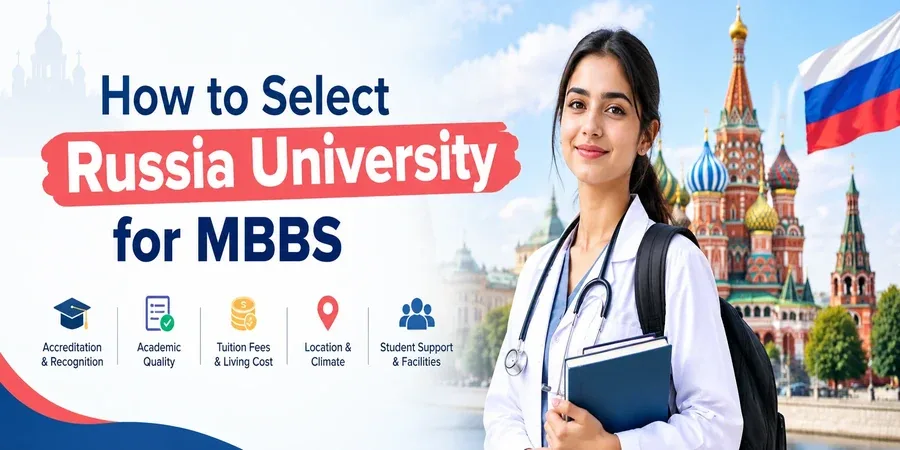
Scroll HereEvery year, thousands of Indian students choose to study MBBS in Russia because of affordable fees, English-medium teaching and globally recognised degrees. But with dozens of universities to choose from, the real question is how to select Russia university for MBBS that fits your budget, career goals and NMC rules.
This guide gives you a simple, step-by-step checklist: NMC compliance, eligibility, English-medium teaching, clinical exposure, FMGE/NExT support, student life and the questions to ask before you pay any fees.
Why Do Indian Students Choose Russia for MBBS?
Russian medical universities are listed in the World Directory of Medical Schools (WDOMS) and many follow India's National Medical Commission (NMC) guidelines. Key advantages include:
- Lower tuition and living costs than private medical colleges in India or universities in the US, UK and Australia
- English-medium MBBS at most universities, with no need to know Russian before joining
- No capitation fee or donation
- A well-established medical education system that has trained international students for decades
- Eligibility to appear for India's FMGE/NExT licensing exam after graduation
These benefits make Russia attractive, but the country alone should not decide your choice. The university you pick determines the quality of your clinical training and your success as a doctor.
Step 1: Check the Eligibility Criteria
Before shortlisting universities, make sure you meet the basic admission criteria:
- NEET qualification
- Minimum 50% marks in Physics, Chemistry and Biology in Class 12 (40% for SC/ST/OBC)
- Minimum 17 years of age by 31 December of the admission year
- A valid passport with at least 18 months' validity
Important: NEET is mandatory for Indian students who study MBBS abroad. Without it, you cannot register with the NMC in India.
Step 2: Verify NMC Compliance and Recognition
This is the most important step when deciding how to select Russia university for MBBS. Verify the university's status in these official sources:
- NMC (FMGL Regulations 2021): minimum 54 months of course duration plus a 12-month internship at the same institution, taught entirely in English
- WDOMS: confirms the university is listed as a recognised medical school
- ECFMG / FAIMER: required if you plan to take the USMLE (USA) or PLAB (UK)
The degree must also allow you to register and practise as a doctor in Russia. This is a mandatory NMC requirement for Indian students studying abroad. You will also need an NMC eligibility certificate before you leave India.
Step 3: Shortlist Universities by Reputation and Budget
Here are some medical universities in Russia that are popular with Indian students:
| University | Year of Establishment | Approx. Tuition Fees Per Year (RUB) |
|---|---|---|
| Altai State Medical University | 1954 | 3,10,000 – 5,10,500 |
| Bashkir State Medical University | 1932 | 2,82,000 – 4,05,000 |
| Belgorod State University | 1876 | 3,45,000 – 4,00,000 |
| Perm State Medical University | 1916 | 3,40,000 – 3,90,000 |
| Orenburg State Medical University | 1944 | 2,75,000 – 4,22,380 |
| Mari State University | 1972 | 3,20,000 – 4,77,000 |
| Pskov State University | 2010 | 2,40,000 – 3,10,000 |
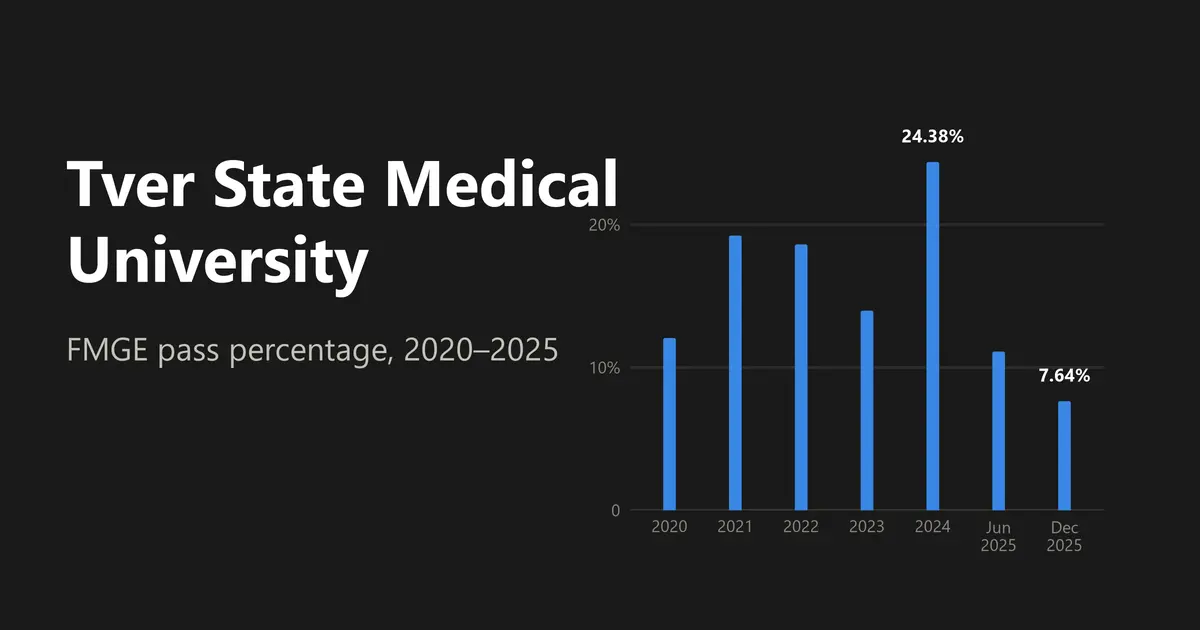
| Tver State Medical University | 1936 | 3,50,000 – 4,50,000 |
| Siberian State Medical University | 1878 | 4,10,000 – 4,80,000 |
| Kazan State Medical University | 1814 | 6,00,000 – 6,36,000 |
Fees are approximate and change every year. For the latest university-wise fees and the full list of NMC-approved universities, see our Russia country guide linked above.
Step 4: Compare the Total 6-Year Cost
Do not compare tuition alone. A realistic yearly budget looks like this:
- Tuition fees: ₹3 – ₹6 lakh
- Hostel and food: ₹80,000 – ₹1.5 lakh
- Miscellaneous: ₹30,000 – ₹50,000
- Total per year: ₹4 – ₹7.5 lakh
City affordability, insurance and visa renewals also affect your total cost, so ask each university for its complete 6-year cost. For a detailed breakdown, read our guide on the total cost of MBBS abroad.
Step 5: Confirm a Full English-Medium Programme
Always choose a university that teaches the complete 6-year MBBS in English for international students.
- Universities also teach basic Russian, because clinical rotations after Year 3 involve talking to patients.
- Avoid universities where students must switch to Russian midway through the course.
Ask clearly whether all 6 years of classes are taught in English.
Step 6: Check Infrastructure and Facilities
Modern infrastructure improves learning. Look for universities with:
- Simulation-based clinical labs
- Advanced anatomy and pathology labs
- Smart classrooms
- English-language medical libraries
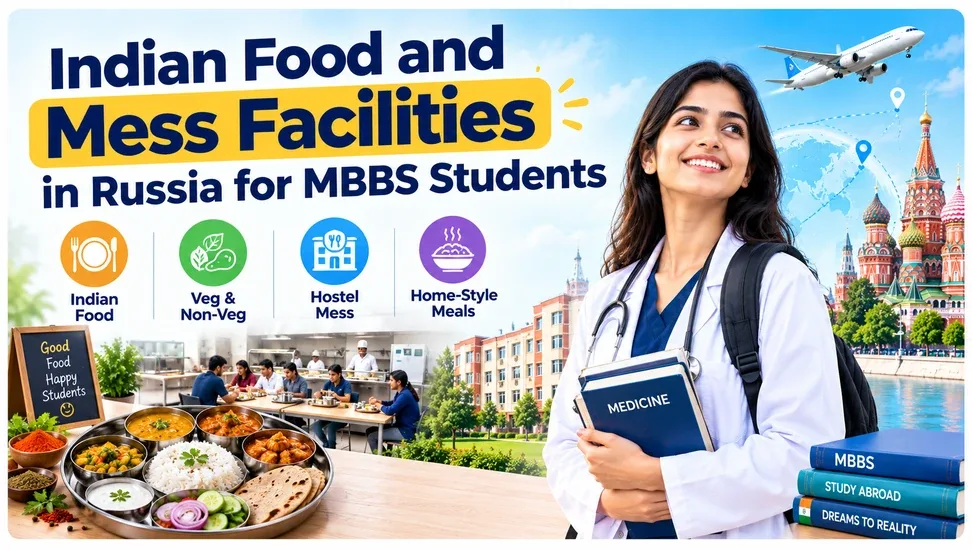
- Indian food in hostels
- Wi-Fi-enabled campuses
Step 7: Evaluate Clinical Exposure
Theory must be backed by practical training, so hospital affiliations matter a lot.
- Hospital bed capacity: prefer universities attached to large, state-run multi-speciality hospitals (1,000+ beds). High patient volume exposes you to more cases.
- Simulation-based learning: look for simulation centres with virtual dissection tables, high-fidelity manikins and surgical skill stations.
- Patient interaction: learning conversational Russian in the first two years helps you talk to patients during bedside teaching in Years 3 to 6.
Universities in bigger cities such as Moscow, Kazan or Volgograd often offer more clinical opportunities because of the higher number of hospitals. For example, Kazan State Medical University is known for its simulation facilities and large teaching hospitals.
Step 8: Check FMGE/NExT Results and Preparation Support
To practise in India, foreign medical graduates must clear the FMGE, which is being replaced by the National Exit Test (NExT). Before choosing a university:
- Past FMGE results: ask for the university's recent pass-rate trend. The overall FMGE pass rate is low (around 20–25%), but stronger universities such as Kursk, Kazan, Pirogov and Bashkir tend to perform better.
- Curriculum alignment: check that the syllabus closely matches Indian MBBS subjects such as Anatomy, Pathology, Pharmacology, Medicine and Surgery.
- In-house coaching: many universities with large Indian student groups offer FMGE/NExT preparation from the 3rd year.
To start early, see our tips on how to prepare for FMGE.
Step 9: Look at Student Support, Safety and Climate
- Indian student support: Indian student associations, an Indian mess or kitchen, a 24/7 helpline and help with visas and documents
- Climate readiness: winters in central and northern Russia can drop to -15 °C to -25 °C, so check that hostels have central heating and 24-hour hot water
- Campus safety: 24-hour security desks, card access and CCTV surveillance
A supportive campus helps you settle quickly and focus on your studies.
Questions to Ask Before You Finalise a University
Before you book a seat or pay a deposit, get clear answers to these questions:
- Does the degree allow graduates to take the local licensing exam in Russia without extra conversion steps?
- Is all clinical training completed on site in the university's own hospital network?
- What is the complete 6-year cost, including tuition, hostel, insurance and visa extensions?
- Does the university help international students with registration, visa renewals and medical emergencies?
Conclusion
When you think about how to select Russia university for MBBS, look beyond tuition fees. Check NMC FMGL compliance, a fully English-taught programme, strong hospital training, FMGE/NExT results and student support. Compare every shortlisted university against these points before you decide.
Need help shortlisting? Talk to the counsellors at Education Vibes, speak with current students and ask detailed questions before you apply.