Table of Contents
Highlights of Indian Mess for Indian Students in Russia
Scroll HereWhy Food Matters for Indian Students in Russia
Scroll HereIndian Food in Russia for Indian Students: Self-Cooking vs Restaurants vs Indian Mess
Scroll HereWhat Kind of Food Is Available at an Indian Mess in Russia?
Scroll HereDo All Russian Universities Offer Indian Food?
Scroll HereIndian Food and Mess Facility at NovSU
Scroll HereFood Planning During Winters and University Holidays
Scroll HereHostel Accommodation and Indian Food
Scroll HereWhat Should Indian Students Realistically Expect?
Scroll Here5 Things Indian Students Should Not Assume About Food in Russia
Scroll HereFeel at Home: Celebrate Festivals with Indian Food
Scroll HereConclusion
Scroll HereFrequently Asked Questions
Scroll HereAre you an Indian student who is pursuing, or planning to pursue, MBBS in Russia? Apart from tuition fees and hostels, one of the biggest worries students and parents have is simple: “Will I get Indian food in Russia?” Don’t worry! You can eat at an Indian mess or cook in your hostel kitchen, and get familiar food like rice, dal, roti, sabzi and curry every day. However, how easily you find the taste of home depends on your university and the city you live in.
This blog is a complete guide to Indian food and mess facilities at Russian universities. While some universities have mess facilities serving Indian food, many do not, which leaves students depending on restaurants, self-cooking or Russian meals. Here’s what you can realistically expect and how to plan for it.
Highlights of Indian Mess for Indian Students in Russia
| Feature | Overview |
| Meals covered | Three meals daily: breakfast, lunch and dinner |
| Dietary options | Separate vegetarian and non-vegetarian options |
| Culinary team | Experienced Indian cooks |
| Menu variety | Weekly rotation of dal, roti, rice, sabzi, chicken, egg and curries |
| Special occasions | Traditional dishes served during Holi, Diwali and Eid |
| Approximate cost | USD 1,200 to USD 1,500 per year (varies by university) |
Why Food Matters for Indian Students in Russia
Studying medicine abroad is a big step, and adjusting to food is often one of the hardest parts of it. Russian cuisine is quite different from Indian food in terms of spices, cooking style and ingredients. Most students try to adjust, but homesickness and dietary needs soon push them to look for better options.
MBBS is a demanding course with long lectures, practicals and hospital postings. When you are not eating well, it shows in your energy, your health and eventually your studies. That’s why checking the food situation is just as important as checking fees and hostels before you choose a university.
Indian Food in Russia for Indian Students: Self-Cooking vs Restaurants vs Indian Mess
Moving abroad means adjusting to a new climate, a new routine and new food. Cooking every day can become exhausting when you have long study hours, and eating out regularly is neither healthy nor cost-effective in the long run. This is why most students look for an Indian mess at their university. Here is a quick comparison:
| Factors | Self-cooking in hostel | Local cafés/restaurants | Indian mess |
| Time required | 2 to 3 hours daily | 1 to 2 hours daily (including travel) | Almost none, as meals are ready |
| Taste | Depends on your cooking skills | Mostly mild, non-spicy dishes | Familiar Indian flavours |
| Expenses | Changes with grocery prices | Quite expensive | Fixed budget (approx. USD 1,200 to 1,500 per year) |
| Nutrition | Quick meals often miss balance | Not always balanced | Balanced meals with carbs, protein, fibre and fats |
To see how food fits into your overall monthly budget, read our detailed guide on the cost of living in Russia.
What Kind of Food Is Available at an Indian Mess in Russia?
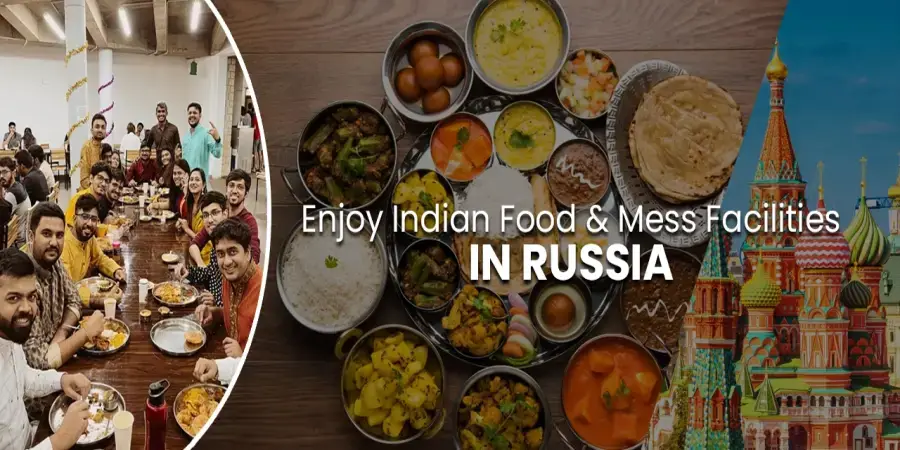
Since a large number of Indian students study in Russia, many universities have Indian mess facilities on campus or nearby. These are usually run with the support of the university, Indian student groups, the local Indian community or admission partners. The cost is around USD 1,200 to USD 1,500 per year. At a typical Indian mess, students get:
- Indian cooks preparing vegetarian and non-vegetarian dishes
- Three meals a day: breakfast, lunch and dinner
- A weekly menu with dal, roti, sabzi, rice, biryani and more
- Special festive meals during Diwali, Holi and Eid
- Hygienic kitchens with Indian spices sourced regularly
- Light, non-spicy food for students who fall sick
These small things make a big difference. When meals are sorted, students can focus on their studies without worrying about what to eat or how it affects their health.
Do All Russian Universities Offer Indian Food?
No. Some universities offer multi-cuisine options in their canteens, but Indian food on campus is not guaranteed everywhere. Without it, students end up eating out often, cooking every day or adjusting to Russian meals. Over time, this can lead to health issues, extra expenses and stress during a busy academic schedule. So, always ask about Indian food and mess facilities before you take admission.
Indian Food and Mess Facility at NovSU
Understanding these challenges, Education Vibes has started an Indian food and mess facility at Yaroslav-the-Wise Novgorod State University (NovSU). The idea is simple: students should get hygienic, nutritious, home-style meals and feel at home even while studying far away.
Students who opt for mess services through Education Vibes are generally accommodated close to the Indian kitchen, so they don’t have to travel for meals, even in peak winter.
Food Planning During Winters and University Holidays
Winter temperatures in many Russian cities range between -10°C and -25°C. During this time, daily grocery shopping becomes difficult and travelling to another place for food is tiring. You can read more about what to expect in our guide on the climate in Russia. The most practical option is an on-campus or nearby mess, backed by a small stock of basics like rice, dal, atta and packaged foods in your room.
During university holidays and semester breaks, check with the mess in-charge whether the mess will stay open. Plan your meals accordingly or arrange an alternative in advance.
Before winters and holidays, check:
- Mess operating days and timings
- Holiday meal timings
- Whether your hostel has a kitchen
- Location of the nearest Indian grocery store
- Availability of a refrigerator
- Emergency food supplies
- Enough storage space for food
Hostel Accommodation and Indian Food
Along with food, accommodation plays a big role in student life. Most Russian medical universities offer hostels on or near the campus, which usually include:
- Separate hostels for boys and girls
- Clean rooms on 2 to 3 sharing basis
- Central heating during winters
- Wi-Fi and security surveillance
- Laundry services and common kitchens
- Easy access to the mess, classrooms and nearby hospitals
If you or your parents have questions about living conditions and security, our blog on whether Russia is safe for Indian students covers it in detail.
What Should Indian Students Realistically Expect?
Indian food is available in Russia, but not every Russian medical university has an Indian mess. Special diets like Jain food are rarely available, so confirm this directly if you need it. Menus are not the same everywhere and may differ from one university to another. Before admission, check the food options, meal timings, monthly cost, vegetarian options and hostel cooking rules.
Education Vibes helps students arrange Indian mess facilities through its tie-ups with Russian universities. You get your favourite food even outside India, stay in safe and comfortable accommodation, and focus fully on building your medical career. After all, when you’re far from home, it’s the small comforts that make the biggest difference.
Most Indian messes in Russia charge around USD 100 to USD 125 per month, which works out to roughly USD 1,200 to USD 1,500 per year for three meals a day. The exact amount depends on the university, the city and whether you choose veg or non-veg meals.
Self-cooking can be slightly cheaper if you cook regularly and buy groceries smartly, but it takes 2 to 3 hours a day. For most MBBS students with long classes and hospital postings, the mess saves time and gives more balanced meals for a fixed budget.
Yes, the mess keeps serving meals during exams, so you don’t have to cook when you’re busy studying. Many Indian messes also prepare light, non-spicy food like khichdi or dal-rice for students who are unwell.
Carry some basic spices, instant mixes, pickles and ready-to-eat packets to get you through the first few weeks. After that, you can buy rice, dal, atta and most Indian spices from local stores or online platforms in Russia.
5 Things Indian Students Should Not Assume About Food in Russia
| Assumption | Reality |
| Every Russian medical university has an Indian mess | Not true; facilities vary by university |
| Meal timings are the same everywhere | No, they change by university and location |
| Jain food options are available | Rarely; confirm directly with the mess officials |
| Mess charges are included in hostel fees | Not always; they are often charged separately |
| Cooking in the hostel is always allowed | No, cooking rules differ from university to university |
Feel at Home: Celebrate Festivals with Indian Food
Whether it is Holi, Diwali, Eid or any other festival, the Indian mess started by Education Vibes turns into a festive space. Students come together to celebrate their traditions over good food and good company.
With DESI FOOD FOR DESI STUDENTS, Education Vibes goes the extra mile to make sure Indian MBBS students feel supported throughout their time in Russia. By partnering with local vendors and the university committee, we have set up Indian mess and food facilities for our students. Our aim is to help medical students enjoy their favourite food and stay connected to their roots.
Conclusion
Food should never be the reason you struggle with your studies abroad. With DESI FOOD FOR DESI STUDENTS, Education Vibes brings a taste of home to Indian students in Russia and helps them settle in without stress. We are also working with other universities to provide similar Indian mess facilities.
Our 5-year partnership with Yaroslav-the-Wise Novgorod State University ensures Indian students get good food, comfortable accommodation and a smooth transition to life in Russia, with Indian meals for both veg and non-veg students.
For Indian students, Education Vibes is not just an MBBS abroad consultant. We are here to see you become a successful medical professional. We Work and Think of You!
Frequently Asked Questions
Is Indian food available in Russia for Indian students?
Yes, Indian food is available at mess facilities and Indian restaurants. Students can also cook for themselves, as Indian groceries are easily available in most big cities.
Can Indian students cook food in Russian university hostels?
If the hostel allows cooking in a common kitchen, students can cook their own food. This rule varies by university.
Are vegetarian food options available in Indian mess?
Yes, Indian messes provide vegetarian food options. It’s still a good idea to confirm the menu with the mess authorities.
Can I get Indian groceries in Russia?
Yes, in major cities like Moscow and St. Petersburg, Indian groceries and spices are easily available. You can also order many Indian products online through platforms like Wildberries and Ozon.
What should Indian students check before joining an Indian mess?
Check the menu, meal timings, veg/non-veg options, hygiene, and whether the mess stays open during semester breaks and holidays.