Table of Contents
Overview of MBBS Seat Matrix in India: What does “Total MBBS Seats in India” Mean
Scroll HereMBBS Seat Distribution in Government and Private Colleges
Scroll HereState-Wise MBBS Seats Distribution for 2026-27 Cycle
Scroll HereHow the NMC Updates MBBS Seat Capacity
Scroll HereHow Many Marks Are Required in NEET for MBBS
Scroll HereQualifying Percentile and Marks for NEET 2026 - By Category
Scroll HereConclusion
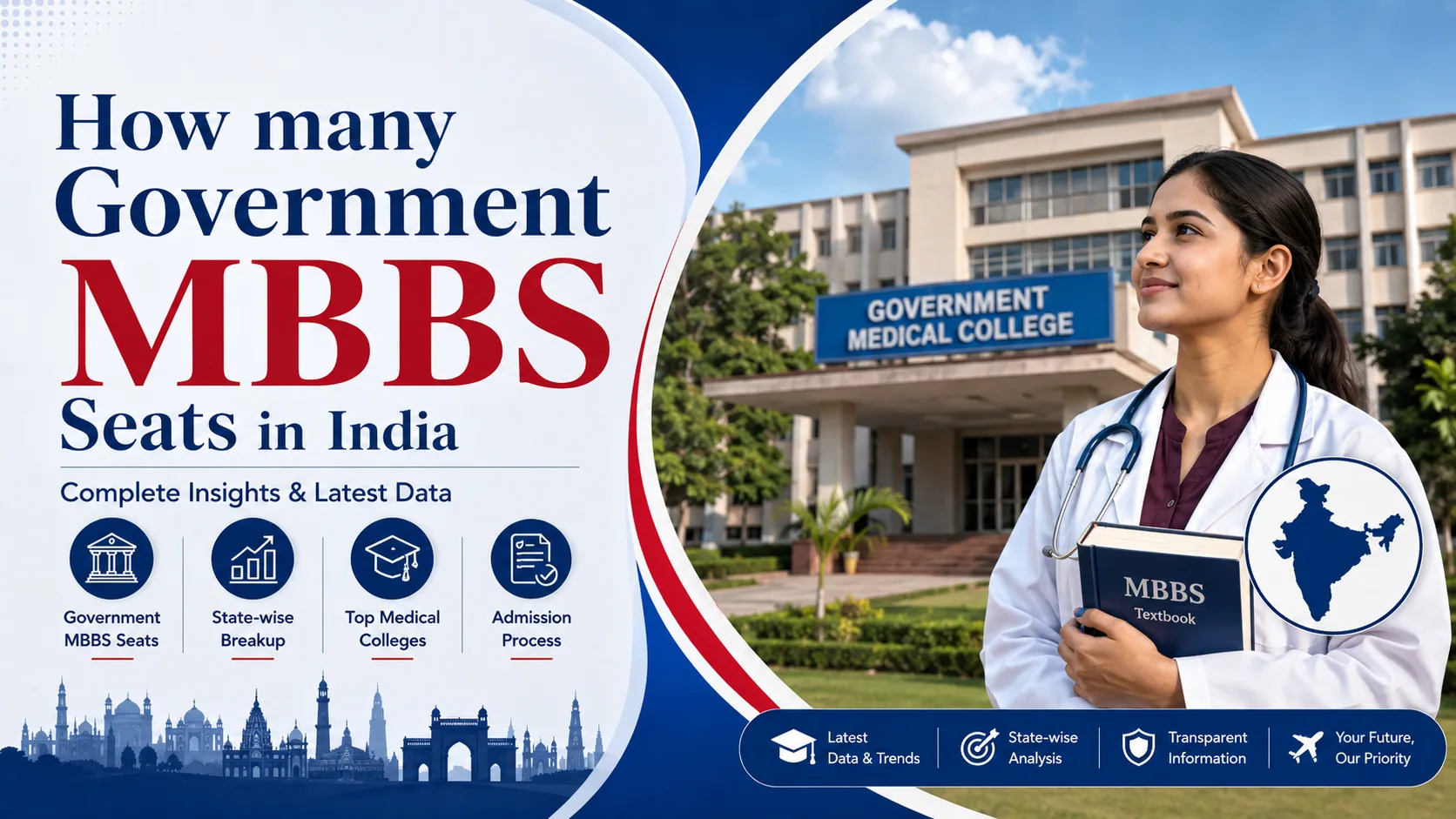
Scroll HereIn 2026, total MBBS seats in India stand at approximately 1,36,939 across 823 medical colleges/institutions, excluding AIIMS, JIPMER, and other Institutions of National Importance (INIs), as per the latest MBBS Seat Matrix 2026-27 (MARB Public Notice dated 14 July 2026) published by the Medical Assessment and Rating Board (MARB) on the official website of the National Medical Commission (NMC). This official figure is what NEET UG 2026 counselling authorities will use for the seat distribution.
Every year, millions of medical aspirants across India appear for the NEET-UG to pursue their MBBS. Based on their final scores and All India Ranking (AIR), students learn about the seats available for their MBBS admission. In recent years, India’s medical education landscape has gone through significant developments under the guidance of the National Medical Commission (NMC). We will look at a detailed breakdown of seat distribution, cutoff trends, NMC guidelines and other major details to understand the MBBS seat framework.
Overview of MBBS Seat Matrix in India: What does “Total MBBS Seats in India” Mean
When we talk about the total MBBS seats in India, we are referring to all undergraduate MBBS seats approved by the NMC across government, private, and deemed medical institutions that participate in the NEET-UG counselling process. The official seat matrix published by the MARB on the NMC’s official website does not include seat allocation in Institutions of National Importance (INIs), such as AIIMS and JIPMER. Intakes for these institutions are recorded separately and added to the standard matrix list.
“Total MBBS seats in India 2026” directly points to the NMC’s final seat matrix for the 2026-27 session. This seat matrix for '26-'27 was released through a public notice and a detailed college-wise PDF on the NMC website. Since the document adheres to the requirements of the Medical Counselling Committee (MCC) and all state counselling bodies, no other medical college or institution can legally admit more than what is shown in the matrix. Here are the official numbers according to the NMC’s Medical Assessment and Rating Board (MARB) for the academic year 2026-27 (excluding INIs) and other details:
Total Approved Medical Colleges in India | 823 Institutions |
Total MBBS Seats in India (2026-27) | Approx. 136,939 seats |
Total Number of Government Colleges | 441 |
Total MBBS Seats in Government Colleges | 63,296 |
Total Number of Private Colleges | 382 |
Total MBBS Seats in Private Colleges | 73,643 |
Official Governing Regulatory Body | National Medical Commission (NMC) |
Entrance Examination for MBBS | National Eligibility cum Entrance Examination - Undergraduate (NEET-UG) |
Note: The figures are reflective of the NMC’s MBBS seat matrix for the 2026-27 academic year, published by the Medical Assessment & Rating Board (MARB) on the NMC’s website.
The above-represented figures show that MBBS seats in India have increased by 9,911 compared to the same period in the previous year. In the new notification, 1,27,028 seats were renewed, and 9,911 seats were newly added due to the new colleges and capacity increase. The official notification by the NMC also mentions that around 2,400 of these new seats belong to 25 newly established colleges, including 7 government colleges and 18 private colleges.
This increase in the number of colleges with a new capacity for MBBS seats has further increased access to MBBS in India for aspirants. Since the total number of MBBS seats in India 2026 excludes Institutions of National Importance (INIs), such as AIIMS and JIPMER, the actual national capacity is slightly higher if these seats are added to the overall number of seats. However, NEET-UG seat matrix documents treat the medical seats of the INIs separately for regulatory clarity.
MBBS Seat Distribution in Government and Private Colleges
The total government MBBS seats in India stand at 63,296 seats across 441 colleges in the 2026-27 academic year. These seats are spread over all subcategories of the government institutions, including central, state, and ESIC/government-aided colleges. Students targeting enrolment in public medical institutions should know that these government seats are mainly filled through All India Quota (15%) and state quota (85%) counselling based on the NEET-UG rankings.
On the other hand, private colleges and deemed universities collectively accounted for 73,643 seats across 382 colleges, indicating that a little more than half of the total MBBS seats in India are in self-financed institutions. This leaning of the scales towards private colleges and deemed universities highlights a significant element of MBBS in India: while government seats remain the most competitive, a large share of MBBS seats in India are accessible through higher tuition fees and management or NRI quotas.
Factor | Government (including central, state & ESIC) | Private & Deemed (self-financed) |
Total Colleges in India | 441 | 382 |
Avg. Tuition Fee | ₹10,000-₹1.5 lakh per year | ₹7-₹30 lakh per year |
Level of Competition | Very high | High to moderate |
Seat Availability | 63,296 | 73,643 |
Typical Quotas | AIQ: 15%, State: 85% | State, Management & NRI Quotas |
Note: The table is compiled from the official list of colleges and institutions from the NMC’s website and its 2026-27 MBBS seat matrix. The NMC classifies colleges under its “Management of College” field as Government, Private, Trust, or Society. The matrix divides seats into government & private while counting deemed institutions together with the private category. The list does not include the count of Trust and Society-classified institutions.
State-Wise MBBS Seats Distribution for 2026-27 Cycle
While the NMC has provided a full state-wise seat matrix on its official website, a few high-intake states stand out for the 2026-27 academic cycle. Of all states and union territories in the list, Karnataka, Uttar Pradesh, Tamil Nadu, Maharashtra, and Telangana have collectively contributed a significant portion of the total MBBS seats in India. In addition, each state has a significant number of colleges with thousands of MBBS seats.
For example, the NMC seat matrix shows Karnataka with a total of 15,395 seats (14,095 renewed + 1,300 new seats), followed by Uttar Pradesh with 14,000 seats and Tamil Nadu with 13,999 seats. This reflects a wider, sustainable expansion of the MBBS seats in these traditionally high-demand states. When you look at the MBBS seats in India from a state perspective, these five states offer a larger share of all available seats, which naturally makes them the most preferred options during the NEET-UG counselling. Look at the table below to get an idea of the seat distribution among different states and union territories.
State/UT | Total Colleges/Institutions | Total Seats | Government Colleges & Seats | Private Colleges & Seats |
Andaman & Nicobar Islands | 1 | 114 | 1 (114) | 0 (0) |
Andhra Pradesh | 40 | 7,465 | 19 (3,515) | 21 (3,950) |
Arunachal Pradesh | 1 | 100 | 1 (100) | 0 (0) |
Assam | 15 | 1,875 | 15 (1,875) | 0 (0) |
Bihar | 26 | 4,160 | 12 (1,710) | 14 (2,450) |
Chandigarh | 1 | 200 | 1 (200) | 0 (0) |
Chhattisgarh | 21 | 2,925 | 15 (1,725) | 6 (1,200) |
Dadra & Nagar Haveli | 1 | 177 | 1 (177) | 0 (0) |
Delhi | 10 | 1,415 | 8 (1,165) | 2 (250) |
Goa | 1 | 250 | 1 (250) | 0 (0) |
Gujarat | 42 | 7,750 | 23 (4,250) | 19 (3,500) |
Haryana | 18 | 2,960 | 8 (1,060) | 10 (1,900) |
Himachal Pradesh | 7 | 871 | 6 (721) | 1 (150) |
Jammu & Kashmir | 11 | 1,675 | 10 (1,525) | 1 (150) |
Jharkhand | 10 | 1,500 | 6 (800) | 4 (700) |
Karnataka | 75 | 15,395 | 24 (4,400) | 51 (10,995) |
Kerala | 36 | 5,704 | 14 (1,855) | 22 (3,849) |
Madhya Pradesh | 34 | 6,020 | 20 (3,020) | 14 (3,000) |
Maharashtra | 86 | 13,099 | 42 (6,000) | 44 (7,099) |
Manipur | 4 | 550 | 3 (400) | 1 (150) |
Meghalaya | 3 | 250 | 2 (100) | 1 (150) |
Mizoram | 1 | 100 | 1 (100) | 0 (0) |
Nagaland | 1 | 100 | 1 (100) | 0 (0) |
Odisha | 20 | 2,950 | 14 (1,850) | 6 (1,100) |
Puducherry | 8 | 1,780 | 1 (180) | 7 (1,600) |
Punjab | 12 | 1,850 | 5 (900) | 7 (950) |
Rajasthan | 51 | 8,080 | 33 (4,480) | 18 (3,600) |
Sikkim | 2 | 200 | 1 (100) | 1 (100) |
Tamil Nadu | 78 | 13,999 | 37 (5,349) | 41 (8,650) |
Telangana | 66 | 10,250 | 36 (4,400) | 30 (5,850) |
Tripura | 3 | 500 | 1 (200) | 2 (300) |
Uttar Pradesh | 88 | 14,000 | 49 (5,700) | 39 (8,300) |
Uttarakhand | 9 | 1,475 | 5 (625) | 4 (850) |
West Bengal | 41 | 7,200 | 25 (4,350) | 16 (2,850) |
TOTAL | 823 | 136,939 | 441 (63,296) | 382 (73,643) |
Note: The data is presented based on the NMC information desk. "Deemed" is a subset, not an additional management category. Most deemed institutions in this NMC dataset are marked Private under "Management of College". Deemed institutions are included within the NMC’s Private or Government management categories and are not counted separately. The state-level Government/Private split shown above is our own compilation from the NMC college list — the MARB public notice itself publishes only total, renewed and newly added seats for each state — so treat those two columns as indicative rather than official.
How the NMC Updates MBBS Seat Capacity
Every year, colleges that wish to start new MBBS programmes or increase their intake must apply under the NMC’s regulation, titled “Opening of a New or Higher Course of Study or Training… and Increase of Admission Capacity…”, which outlines the approval process for the institution. It is important to remember that no institution is permitted to increase seats without prior approval and a valid Letter of Permission (LoP) from the central government or the National Medical Commission (NMC).
Any additional intakes beyond the approved limits can invite penalties from the NMC. This is why the total MBBS seats in India are always tied to a specific date (for example, 2026-27 figures are shown as 14.07.2026), and the NMC notice clearly states that the seat matrix may be revised if appeal decisions are in discussion or regulatory changes are happening. Therefore, students should rely on the latest seat matrix PDF published by the MARB on the official NMC website and the NMC’s “List of Colleges Teaching MBBS” page, which lists each college’s recognition status and annual intakes.
How Many Marks Are Required in NEET for MBBS
Many aspirants naturally ask, "How many marks are required in NEET for MBBS?" But there is no single, fixed number because cut-offs keep changing and vary by state, category, college type, and year. Officially, the NEET qualifying range is 50% for General/UR and 40% for OBC/SC/ST. In Re-NEET UG 2026, the qualifying cut-offs stood at 715-213 marks for UR/EWS and 212-177 marks for OBC/SC/ST. But these only decide whether you are eligible for counselling, not whether you get an MBBS seat.
Most analyses suggest that 550+ marks are generally safe for the general category students to secure an MBBS seat in a government college with lower cut-offs, while 620+ is considered an assured value for securing your spot in a government college of high-demanding states. Since the total MBBS seats in India are still much lower than the number of NEET candidates, actual admission cut-offs remain significantly higher than the bare minimum qualifying marks, especially for AIQ seats and premier institutions.
Qualifying Percentile and Marks for NEET 2026 - By Category | |||
|---|---|---|---|
Category | Qualifying Percentile | Marks Range | Candidates Qualified |
UR/EWS | ≥ 50th percentile | 715–213 | 9,96,935 |
OBC | ≥ 40th but < 50th percentile | 212–177 | 81,111 |
SC | ≥ 40th but < 50th percentile | 212–177 | 29,947 |
ST | ≥ 40th but < 50th percentile | 212–177 | 12,452 |
UR/EWS & PwBD | ≥ 45th but < 50th percentile | 212–194 | — |
OBC & PwBD | ≥ 40th but < 45th percentile | 193–177 | — |
SC & PwBD | ≥ 40th but < 45th percentile | 193–177 | — |
ST & PwBD | ≥ 40th but < 45th percentile | 191–177 | — |
Total | Approx. 11.21 lakh | ||
Note: Figures are for the Re-NEET UG 2026 examination. The NTA did not separately notify category-wise qualified-candidate counts for the PwBD sub-categories, so those cells are left blank. Around 11.21 lakh candidates qualified in total.
When discussing the minimum marks required in NEET for MBBS in private colleges, you should remember that private cut-offs are typically lower than those of government colleges but still vary widely by state fee regulation as well as college reputation. In recent years, the general category of students with a 450-520 score range has had higher chances of finding MBBS seats in India through private or deemed institutions, especially in later counselling rounds. But it’s important to remember that these numbers are changing every year.
Conclusion
According to the latest MBBS seat matrix for the 2026-27 academic year, published by the MARB on the NMC official website, total MBBS seats in India are 1,36,939 across 823 medical colleges/institutions (excluding AIIMS, JIPMER, and other Institutions of National Importance). In this seat matrix, Karnataka, Uttar Pradesh, Tamil Nadu, Maharashtra, and Telangana have the highest MBBS seats. Government seats are 63,296 across 441 institutions, and private colleges (with deemed universities) have 73,643 seats across 382 medical institutions. Depending on your category, college preference and quota, the cost of MBBS in India will vary.
Planning to apply for an MBBS at an Indian institution? Do you need further counselling to pursue your higher education? Alternatively, MBBS abroad can be a better option for getting admission to highly advanced universities and colleges outside India. Register to learn more about the entire process.