Table of Contents
About ₹35 lakh for six years at a typical university roughly ₹21.6 lakh in tuition and ₹13.5 lakh in living costs. At the most expensive private universities the total can reach ₹44 lakh.
The Philippines, mainly because it has published data at all. Philippine graduates have recorded pass rates in the mid-teens to mid-twenties across recent sessions. Vietnam has no meaningful country-wise FMGE record because its first sizeable Indian cohort is only now graduating. Note that the university you pick affects your odds far more than the country does.
Vietnam takes six years: five years of study plus a one-year internship. The Philippines takes about 5.5 to 6.5 years: a 1.5 to 2 year BS pre-medical course, a four-year MD programme, and a 12-month internship.
The Philippines. Its medical schools follow a US-style curriculum and teach entirely in English, which maps closely onto USMLE Step 1 and Step 2 CK. Vietnam’s programmes are structured around NMC requirements rather than the American pathway.
MBBS Vietnam vs Philippines: Comparison Chart
| Comparison Criteria | MBBS in Vietnam | MBBS in Philippines |
| Programme duration | 6 years, direct MBBS entry | 54-month MD + 1 year of internship (5.5-6 years; some add pre-med) |
| Average tuition fee per year | 4000 USD | 4500 USD |
| FMGE pass rate | NR | Approx 19%, as per NBEMS December 2025 data. |
| Medium of Instruction | English for International students | 100% English |
| Visa requirement | Yes | Yes |
MBBS in Vietnam vs MBBS in the Philippines: Cost comparison~
Cost is the primary factor to consider before choosing MBBS Vietnam vs Philippines. Hostel, mess, insurance and visa renewals add up to roughly ₹2 lakh a year in both countries, so you should always compare six-year totals rather than the headline per-year figure. For a wider view across destinations, compare the full cost of MBBS abroad for Indian students before you shortlist.
MBBS fees in Vietnam
The Average MBBS tuition fees in Vietnam are 4000 USD (₹3.6 lakh) per year, depending on the university and its location. The hostel fee is approximately 2500 USD. The table represents the MBBS fees of a few top universities:
| University | City | Tuition per year (USD) | Tuition, 6 years (USD) | Tuition, 6 years (INR) |
| Duy Tan University | Da Nang | 5,700 | 34,200 | ₹30.8 lakh |
| Buon Ma Thuot Medical University (BMTU) | Buon Ma Thuot | 4,500 | 27,000 | ₹24.3 lakh |
| Hanoi Medical University | Hanoi | On request | On request | — |
| Thai Binh University | Thai Binh | On request | On request | — |
(Note: The table shows tuition fee conversion in INR using 1 USD = INR 90.)
Top Medical Universities of Philippines
Average Philippines MBBS fees are about USD 4,500 (₹4.05 lakh) per year across the BS and MD stages combined, Costs can vary based on location, university, and city. Take a look below at the table to know university-wise MBBS tuition fees:
| University | City | Tuition per year (USD) | Tuition, 6 years (USD) | Tuition, 6 years (INR) |
| Our Lady of Fatima University | Valenzuela City, Metro Manila | 6,000 | 36,000 | ₹32.4 lakh |
| University of Santo Tomas | Manila | 3,000 | 18,000 | ₹16.2 lakh |
| AMA School of Medicine | Makati City, Metro Manila | 3,500 | 21,000 | ₹18.9 lakh |
| University of Perpetual Help System DALTA | Las Piñas | 5,000 | 30,000 | ₹27 lakh |
So which one is actually cheaper?
Vietnam, but by less than the headline fee tables suggest. On tuition alone Vietnam is about 11% cheaper (USD 4,000 vs USD 4,500 per year). Once you add living costs, the six-year totals are:
- Vietnam: USD 24,000 tuition + USD 15,000 living = USD 39,000 ≈ ₹35.1 lakh
- Philippines: USD 27,000 tuition + USD 14,040 living = USD 41,040 ≈ ₹36.9 lakh
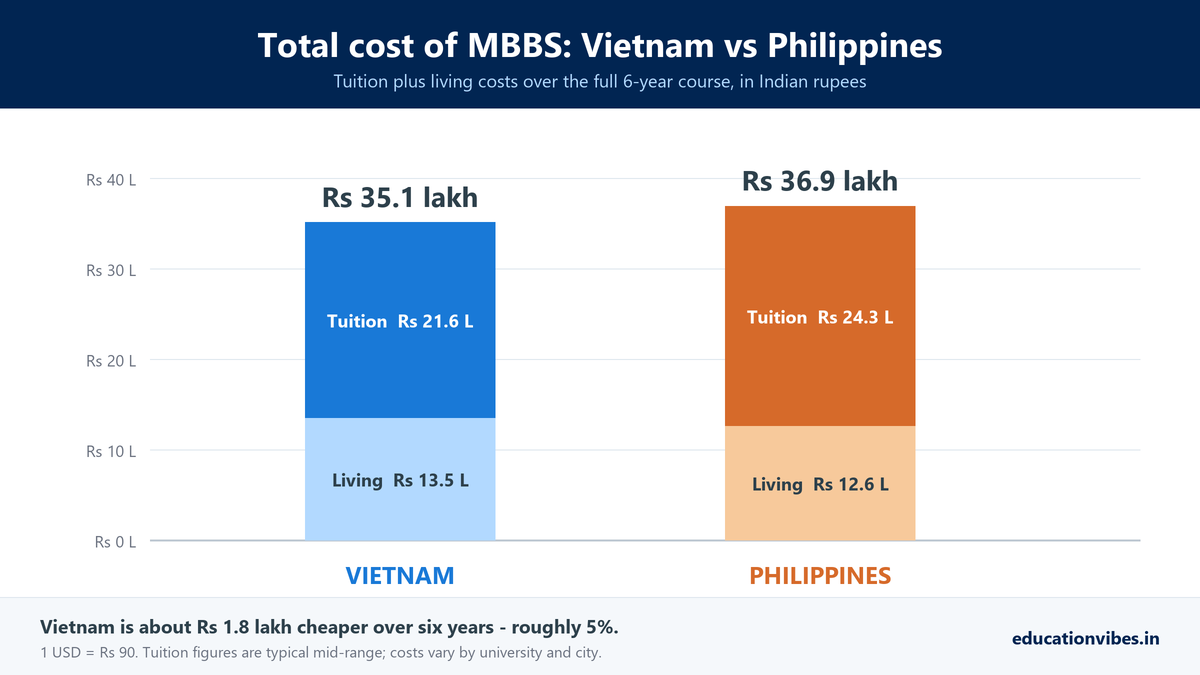
mbbs vietnam vs philippines total cost inr
That is a real gap of roughly ₹1.8 lakh across six years about 5%. Meaningful, but not the deciding factor on its own. A few other destinations undercut both; see which country has the lowest MBBS fees.
Living cost: Vietnam vs the Philippines
Tuition tables are everywhere online; monthly living costs rarely are. This is where the two countries are closest, and where your choice of city matters more than your choice of country.
| Monthly expense (INR) | Vietnam | Philippines |
| Hostel / accommodation | ₹9,000 | ₹9,000–₹11,000 |
| Food and mess | ₹7,500 | ₹6,000–₹8,000 |
| Local transport | ₹1,500 | ₹1,500–₹2,500 |
| Miscellaneous | ₹1,500 | ₹1,500–₹2,500 |
| Typical monthly total | ₹12,000–₹20,000 | ₹10,000–₹18,000 |
| Annual total (incl. insurance, visa) | ~₹2.25 lakh | ~₹2.10 lakh |
City choice swings this more than country choice. Hanoi and Ho Chi Minh City run ₹18,000–₹28,000 a month, while Can Tho or Da Nang are comfortable at around ₹15,000. In the Philippines, Metro Manila can touch ₹30,000 a month, whereas Cebu, Davao and Iloilo sit at the lower end of the range.
Note: Indian groceries and vegetarian food are easier to find in the Philippines and in Hanoi or Ho Chi Minh City than in smaller Vietnamese cities. Factor this in if you have dietary requirements.
MBBS course structure: Vietnam vs the Philippines
MBBS Vietnam vs Philippines have slightly different medical degree structures. Vietnam universities have an easier medical curriculum, while the Philippines requires students to complete a pre-medical course before the 4-year MBBS programme.
MBBS Course and Syllabus in Vietnam
The MBBS degree in Vietnam lasts 6 years. The first 5 years focus on academic learning, followed by 1 year of supervised training. The duration is slightly more than the required NMC guidelines. Therefore, the additional duration is usually invested in more structured clinical exposure. The 6 years are divided into three phases:
- Pre-clinical phase: The Pre-clinical phase consists of the initial two years of the programme. During this phase, students learn core subjects: Anatomy, Physiology, Biochemistry, Histology, Medical Biology & Genetics, and Medical Ethics.
- Para-clinical phase: During the other 2 years, students learn about Pathology, Microbiology, Parasitology, Forensic Medicine, and Community Medicine.
- Clinical Phase: In the last 2 years, students learn specialised subjects while doing internships.
MBBS Course and Syllabus in Philippines
Unlike Vietnam, an MBBS degree in the Philippines lasts 5.5 to 6 years. The course structure has three phases. These include a pre-medical course, followed by a Doctor of Medicine degree and a 12-month internship period.
- Phase 1(Pre-Medical Course): This phase is also known as the BS course. This phase builds a basic foundation for further studies. Hence, it becomes important to study. This phase roughly runs for 1 to 1.5 years.
- Phase 2 (MBBS phase): After completing the BS course, students study for the MBBS programme, which is known as Doctor of Medicine in the country. The MBBS programme lasts 4 years, during which students learn core medical theory and clinical practices.
- Phase 3 (Internship period): The internship period lasts 12 months. During this duration, students focus on hands-on patient care and practical learning in affiliated hospitals.
What this difference means for you
Three practical consequences. First, the Philippines route can add six to twelve months before you hold a medical degree. Second, the BS year is an extra fee cycle, which is part of why the Philippines totals run higher. Third, the BS stage is also where NMAT sits so the Philippines has an extra academic hurdle that Vietnam simply does not have.
FMGE pass rate: Vietnam vs the Philippines
Whatever you study and wherever, you must clear the FMGE (soon to be replaced by NExT) to practise in India. National pass rates have been falling sharply, so treat this section as the most important one on the page.
| FMGE session | Candidates appeared | Qualified | Pass percentage |
| June 2026 | 36,300 | 4,635 | 12.77% |
| December 2025 | 43,933 | 10,264 | 23.90% |
| June 2025 | 36,039 | 6,707 | 18.61% |
Source: NBEMS session results as reported publicly. Verify the latest session on natboard.edu.in before quoting these figures.
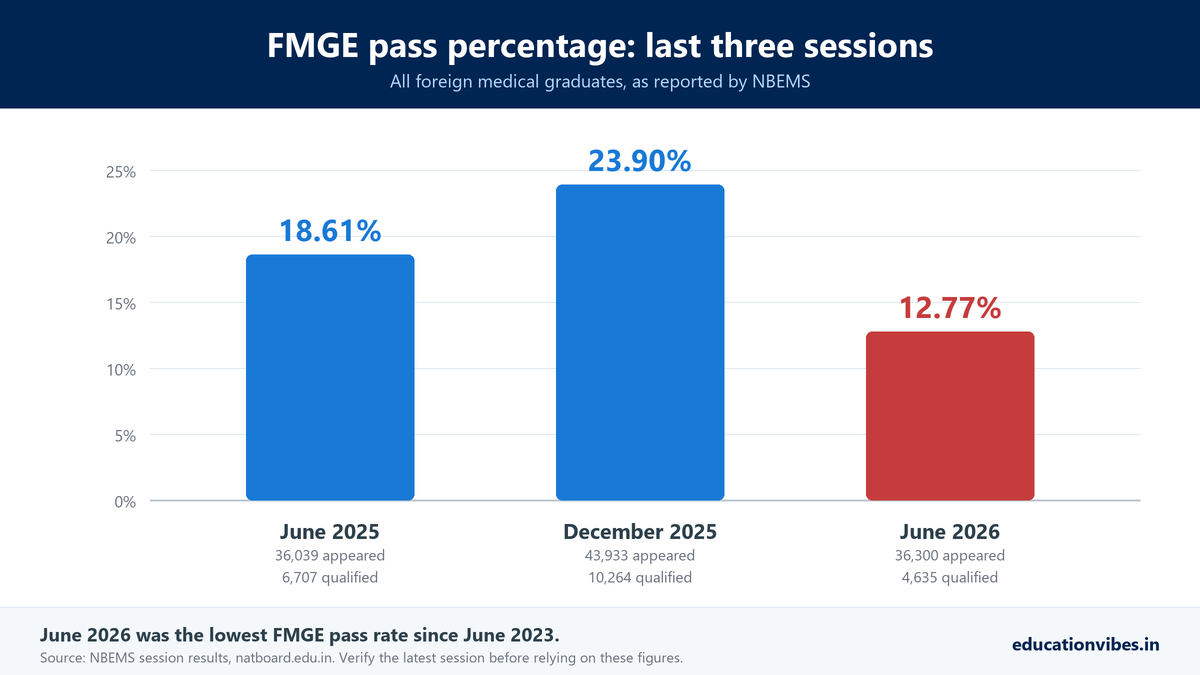
fmge pass percentage 2025-2026
The Philippines
Philippine graduates have recorded FMGE pass rates in the mid-teens to mid-twenties across recent sessions, with roughly 14.4% in the most recent published country-wise breakdown. The spread between universities is far wider than the spread between countries: some Philippine medical schools clear 40% while others sit in single digits. See how the country compares in our breakdown of the FMGE passing percentage of top countries for MBBS.
Vietnam
Vietnam has no meaningful FMGE record yet. The country is an emerging destination and its first sizeable Indian cohort is only now reaching graduation, so no reliable country-wise statistics exist. Read that as an unknown, not as a positive. If you want published evidence of licensing outcomes before you commit six years and ₹35 lakh, the Philippines is the only one of the two that can give it to you today.
MBBS eligibility criteria: Vietnam vs the Philippines
The academic bar is almost identical; the entrance exam requirement is not. Both sit inside the wider MBBS abroad eligibility rules the NMC applies to every Indian student.
| Requirement | Vietnam | Philippines |
| Minimum age | 17 years by the last date of the admission year | 17 years as of 31 December of the admission year |
| Subjects in Class 12 | Physics, Chemistry, Biology, English | Physics, Chemistry, Biology, English |
| Minimum PCB aggregate | 50% general, 40–45% SC/ST/OBC | 50% general, 40% SC/ST/OBC |
| NEET UG | Mandatory | Mandatory |
| Entrance exam | None | NMAT at most universities |
Your NEET qualification is non-negotiable for either country if you intend to practise in India afterwards. Once you have an offer, keep the documents required for MBBS abroad ready and check the visa requirements for MBBS abroad admission — both are broadly similar for the two countries.
What is NMAT, and can you avoid it?
NMAT (National Medical Admission Test) is the Philippines’ entrance test for the MD programme. It is an aptitude-style paper covering verbal, inductive and quantitative reasoning plus biology, physics, chemistry and social science, and it is usually taken during or just after the BS course. Most Philippine medical schools require it; a handful admit on the BS result alone, but relying on that is risky. Vietnam has no equivalent test, which is why students who want the shortest, most predictable admission path often pick Vietnam.
NMC requirements: Vietnam vs the Philippines
Neither country is approved or rejected as a whole. NMC guidelines apply university by university, so the country name on your degree matters far less than the six checks below.
- Medium of instruction: under the FMGL Regulations, English must be the primary medium of instruction throughout.
- Minimum duration: at least 54 months of study, followed by a 12-month clinical internship.
- Mandatory subjects: the 19 subjects listed in Schedule 1 of the Gazette of India must all be taught.
- Recognition of the degree: the degree must be recognised by the medical regulator of the host country, and the university should be listed in WDOMS and FAIMER.
- Internship at the same institution: the 12-month internship must be completed at the same institution where you studied.
- Licensing exam in India: you must clear the FMGE/NeXT exam to practise in India after graduating.
One more check that most 2024-era guides miss: the NMC now expects the university’s accrediting agency to be recognised by the World Federation for Medical Education (WFME). Ask the university directly which agency accredits it and whether that agency holds WFME recognition get the answer in writing.
Which universities in Vietnam comply with NMC guidelines?
Vietnam has roughly 20 to 29 institutions offering medical degrees to international students, but only a few are structured for NMC compliance. For the 2026 intake, restrict your shortlist to universities listed in WDOMS and FAIMER.
Public universities
- Hanoi Medical University
- Ho Chi Minh City University
- Hue University
- Can Tho University
- Thai Binh University
- Pham Ngoc Thach University
Private universities
- Hong Bang International University
- Phan Chau Trinh University
- Duy Tan University
- Vo Truong Toan University
Specialised institutions
Cross-check any shortlist against the NMC-approved medical colleges abroad list before paying a deposit.
Which universities in the Philippines comply with NMC guidelines?
The Philippines has a much larger pool of NMC-aligned colleges, but the quality spread is also wider. Verify duration, syllabus and internship arrangements individually. Here are the top medical schools in the Philippines:
Public universities
- University of the Philippines Manila
- University of Northern Philippines (UNP)
Private universities
- University of Perpetual Help System DALTA
- UV Gullas College of Medicine
- Our Lady of Fatima University
- AMA School of Medicine
Other well-known medical schools
- Davao Medical School Foundation (DMSF)
- University of Santo Tomas
- Ateneo School of Medicine and Public Health
- De La Salle Medical and Health Sciences Institute
Admission process and 2026 intake timeline
Both countries run a September primary intake and a February secondary intake. Working backwards from September, here is what a realistic year looks like. The full MBBS abroad admission process 2026 walks through each step in detail.
| Month | Vietnam | Philippines |
| January – March | Shortlist universities; verify WDOMS/FAIMER listing | Shortlist universities; register for NMAT if required |
| April – May | Appear for NEET UG; submit applications | Appear for NEET UG; submit BS applications |
| May – June | NEET result; receive offer letters | NEET result; NMAT exam window |
| June – July | Pay first instalment; receive invitation letter | Pay first instalment; confirm seat |
| July – August | Student visa, medical tests, document apostille | Student visa (9(f)), medical tests, apostille |
| August – September | Departure and enrolment | Departure and enrolment |
| February | Secondary intake | Secondary intake |
Pros and cons: MBBS in Vietnam vs the Philippines
MBBS in Vietnam
| Advantages | Drawbacks |
| Lowest tuition of the two, and cheaper outside major cities | No FMGE track record yet — outcomes are unproven |
| Direct 6-year MBBS with no NMAT or BS stage | Vietnamese is often needed for patient interaction in clinical years |
| Early hospital exposure, often from year one or two | Fewer universities actively enrol Indian students |
| 4–5 hour flight from most Indian metros | Smaller Indian student community and fewer Indian food options |
| Curricula increasingly restructured around NMC norms | Fee structures vary widely and change often |
MBBS in the Philippines
| Advantages | Drawbacks |
| 100% English instruction, including clinical rounds | BS plus MD adds 1.5–2 years and an extra fee cycle |
| US-style curriculum that maps well onto the USMLE | NMAT is an additional entrance hurdle |
| Years of published FMGE data to check before you commit | Higher total cost — roughly ₹2 lakh more over six years |
| Large, established Indian student community | FMGE pass rates are still modest in absolute terms |
| Wide choice of NMC-aligned colleges | Metro Manila living costs and typhoon season |
Career prospects in India after MBBS
Medical career after MBBS in Vietnam
After completing MBBS in Vietnam, Indian students can practice medicine in India, provided they clear the FMGE licensing exam. Students also need to complete a 1-year mandatory internship to register with the NMC. Indian students can practice medicine in numerous ways:
- Can work as a doctor in government or private hospitals.
- Can open their own clinic
- Can pursue postgraduate studies
Medical career in India after MBBS from the Philippines
The Philippines maintains a notable track record with FMGE preparation. Philippine universities prepare students well for licensing exams. Graduates must qualify for the FMGE licensing test, after which they must complete a 1-year internship in India. Register with the NMC or local state medical council to get the license to practice. After MBBS, students can: Read more on whether a Philippines medical degree is valid in India.
- Work as a healthcare professional in a hospital (government or private)
- Set up his/her own clinic
- Pursue postgraduation
Who should choose which: a quick decision table
| If your priority is… | Choose | Why |
| The lowest total cost | Vietnam | Tuition is ~11% lower; ~₹1.8 lakh cheaper over six years |
| The fastest, simplest admission | Vietnam | No NMAT, no BS stage, direct 6-year MBBS |
| Staying close to home | Vietnam | 4–5 hour flights from most Indian metros |
| Studying entirely in English, including wards | Philippines | English is an official language, so patient interaction is in English too |
| Proven licensing data before committing | Philippines | Years of published FMGE results; Vietnam has none yet |
| USMLE or practising abroad | Philippines | US-style curriculum built around USMLE Steps |
| A large Indian peer group and Indian food | Philippines | Long-established Indian student community |
Our recommendation
If your decision is driven by budget, admission simplicity and proximity to home, Vietnam wins. If it is driven by language, curriculum quality and evidence of licensing outcomes, the Philippines wins and for most students who want certainty, that evidence is worth the extra ₹2 lakh. Either way, pick the university before you pick the country: an NMC-compliant college in a "weaker" country beats a non-compliant one in a "stronger" country every time. If you are still weighing an Indian seat against an overseas one, check your likely rank first with our NEET rank predictor.
Frequently asked questions
Q. Is MBBS from Vietnam valid in India?
Yes. An MBBS degree from Vietnam is valid in India provided the university and its course meet the NMC Foreign Medical Graduate Licentiate (FMGL) Regulations, 2021 English instruction, at least 54 months of study, a 12-month internship at the same institution, and the 19 mandatory subjects. You must then clear the FMGE or NExT.
Q. Is MBBS from the Philippines valid in India?
Yes. The Philippine Doctor of Medicine degree is treated as equivalent to MBBS and is valid in India if the course meets the same NMC FMGL conditions. The BS pre-medical stage does not count towards the 54-month requirement, so confirm that the MD programme plus internship satisfies it on its own.
Q. Which is cheaper, MBBS in Vietnam or the Philippines?
Vietnam. Tuition averages about USD 4,000 a year against USD 4,500 in the Philippines, roughly 11% lower. Including living costs, six years works out to about ₹35 lakh in Vietnam and ₹37 lakh in the Philippines — a real gap of about ₹1.8 lakh.
Q. Is NEET compulsory for MBBS in Vietnam and the Philippines?
Yes, for both. NEET UG qualification is mandatory for any Indian student who wants to study medicine abroad and practise in India afterwards. Some universities will admit you without it, but you will not be eligible for the FMGE or NExT, which makes the degree unusable in India.
Q. Is NMAT compulsory for MBBS in the Philippines?
For most Philippine medical schools, yes. NMAT is required for entry into the four-year MD programme and is taken during or just after the BS course. A small number of colleges admit on the BS result alone. Vietnam has no equivalent entrance exam.
Conclusion
Comparing MBBS Vietnam vs Philippines comes down to three trade-offs: about ₹2 lakh in cost, six to twelve months in time, and proven licensing data versus an unproven but cheaper newcomer. Vietnam is the easier and cheaper entry point. The Philippines gives you English immersion, a US-style curriculum and a published FMGE record you can actually inspect before you commit. What neither country gives you automatically is NMC compliance — that is decided university by university, and verifying it is the one step you cannot skip.
Planning to study MBBS abroad? Talk to our certified counsellors for a personalised shortlist of NMC-compliant universities in Vietnam and the Philippines, with a full cost breakdown for your budget.