Table of Contents
Why Choosing the Right Country Matters More Than Choosing the University
Scroll HereKey Reasons to Select a Country First
Scroll HereKey Factors on How to Choose Country for MBBS Abroad in 2026
Scroll HereNMC Recognition & Screening Test Eligibility
Scroll HereCourse Duration & Curriculum
Scroll HereTotal Cost of MBBS
Scroll HereLanguage of Instruction
Scroll HereSafety & Student Support Infrastructure
Scroll HereClinical Exposure & Hospital Attachments
Scroll HereFMGE/NExT Pass Percentage
Scroll HereTop MBBS Study-Abroad Destinations Compared
Scroll HereCommon Mistakes Students Make When Choosing a Country
Scroll HereScrolling for Lowest Fees Without Checking Recognition
Scroll HereIgnoring FMGE Pass Rates
Scroll HereNot Verifying Hidden Costs
Scroll HereStep-by-Step Decision Making to Choose the Best Country for MBBS
Scroll HereStep 1 – Shortlist by Budget
Scroll HereStep 2 – Filter by Recognition & Eligibility
Scroll HereStep 3 – Compare Pass Percentages
Scroll HereStep 4 – Match Your Comfort Factors
Scroll HereConclusion
Scroll HereFAQs
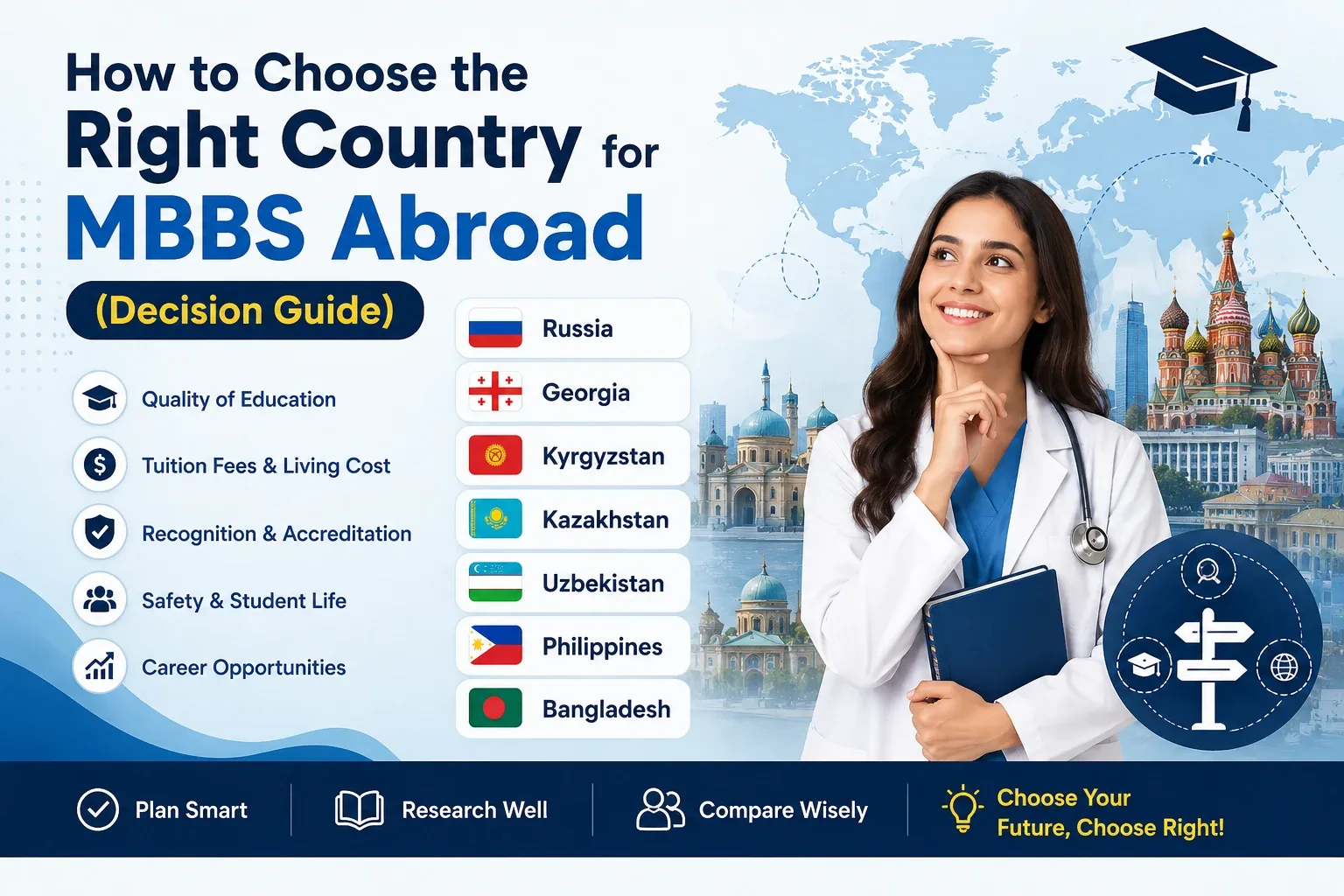
Scroll HereStudying MBBS abroad usually begins with one big question: which country is right for the next six years of your medical education? The list of options is long — Russia, Georgia, Kazakhstan, Uzbekistan, Kyrgyzstan, the Philippines, Bangladesh, and more.
But no single country suits everyone. That is where the real question starts: how to choose country for MBBS abroad without regretting the decision three years in. Some students are searching for the best affordable country for MBBS for Indian students, others want a degree that travels well internationally. The right answer depends on your own constraints — total budget, licensing goals, safety, and language.
This guide walks you through the factors that actually decide the outcome, and the order in which you should check them.
Why Choosing the Right Country Matters More Than Choosing the University
Most students begin by shortlisting individual universities based on campus photos and facilities. In practice, the country matters more than the university, because it determines whether your degree is usable back home.
A country's medical education system decides the real-world value of your MBBS degree. So the first checkpoint is recognition: does the qualification align with the guidelines of the National Medical Commission (NMC) of India?
Key Reasons to Select a Country First
Select the country initially because,
- Global recognition of the medical degree.
- Lifestyle and expense management.
- Local language of the country to communicate with local patients during internship.
- Visa safety for Indian students.
- Post-graduation medicine practice rights for foreign students.
Key Factors on How to Choose Country for MBBS Abroad in 2026
According to a report in The Hindu, roughly 25,000 Indian students head overseas for MBBS every year, driven by limited government seats and rising NEET cut-offs. Deciding which country is best for MBBS abroad comes down to a handful of checks. Run through these seven factors before you shortlist a single university.
NMC Recognition & Screening Test Eligibility
NMC compliance needs to be the first checkpoint. Under the Foreign Medical Graduate Licentiate (FMGL) Regulations, 2021, the foreign medical degree is only valid in India if the country and the university strictly meet the NMC guidelines.
Moreover, the host country should grant you a license to practice medicine after completion of graduation. If you do not have the local practising right, then you cannot appear for the FMGE/NExT screening test in India.
Course Duration & Curriculum
According to the NMC guidelines, the host country should offer
- A minimum 54 months (4.5 years) academic course.
- 12 months clinical internship at the exact foreign university.
Some of the compliant destinations such as Russia, Georgia, and Kazakhstan follow the same timeline of 5+1 years. Alternatively, countries offering internships in different hospitals or mid-course transfers between universities can make your degree invalid as per NMC.
Total Cost of MBBS
Affordability is usually the deciding factor. An MBBS seat in an Indian private college costs anywhere from ₹70 lakh to over ₹1 crore. Abroad, the same six years typically works out to ₹20–45 lakh, spread across three cost heads.
- Tuition Fees: Usually paid annually directly to the university.
- Living Expenses: Food, hostels, and other utility charges.
- Hidden Costs: Visa renewal cost, health insurance, and airfare.
Check all the financial factors of the selected country to manage your expenses for the entire course duration.
Language of Instruction
NMC requires the entire course to be delivered in English. In practice, many destinations run bilingual campuses. Russia, Georgia, and Kazakhstan teach the academic programme in English, but ward rounds and patient histories during your internship happen in the local language. Plan to pick up conversational Russian, Georgian, or Kazakh — most universities offer it as a subject in the first two years.
Safety & Student Support Infrastructure
Safety deserves as much weight as academics. Check the country's political stability, its record with international students, and its diplomatic relationship with India before committing to any programme. It also helps to look at the size of the local Indian student community, embassy support during medical emergencies, and how straightforward residence-permit renewal is.
Clinical Exposure & Hospital Attachments
Medicine is learned at the bedside, not only in lecture halls. Favour countries whose universities run their own multi-speciality teaching hospitals with high patient footfall. Thin clinical exposure tends to show up years later, in residency interviews and in confidence on the ward.
FMGE/NExT Pass Percentage
Once you graduate, you still need to clear the FMGE (soon to be replaced by NExT) to practise in India. That screening exam is the clearest single measure of how well a country's universities prepare Indian students. Historically the overall FMGE pass rate sits between 15% and 25%, though top-tier universities in Uzbekistan, Russia, and Bangladesh consistently perform better. Compare the FMGE passing percentage of top countries for MBBS before you commit.
Recognition, before anything else. The country and the university must meet NMC norms, and the host country must allow foreign graduates to practise medicine locally. If a country does not grant you that local licence, you cannot sit the FMGE/NExT in India — which makes fees, campus quality and rankings irrelevant.
Not automatically. National averages pool strong and weak universities together. A country sitting at 20% can still contain institutions clearing 40%+, and a country averaging 32% can contain colleges well below 15%. Ask for university-wise FMGE data for the last two or three years before you decide.
Yes, for clinical work. NMC requires 100% English instruction, and countries like Russia, Georgia and Kazakhstan comply in the classroom. But patient histories, ward rounds and your internship happen in the local language. Most universities teach conversational Russian, Georgian or Kazakh in the first two years — treat it as essential, not optional.
The recurring ones outside tuition: annual student visa or residence-permit renewal, mandatory health insurance, document legalisation and attestation, hostel and mess charges, and flights home. Over six years these can add several lakhs, which is often enough to reverse the ranking of two countries that looked equally priced on tuition alone.
Top MBBS Study-Abroad Destinations Compared
Here is how the most popular destinations compare on annual tuition, course duration, NMC compliance, and FMGE outcomes. Pass rates are taken from the December 2025 FMGE session.
| Country | Annual Tuition Fee | Course Duration | NMC Compliance | FMGE Passing Outcome 2025 |
| Russia | ₹3,30,000 | 5+1 years | Yes | 30.94% |
| Georgia | ₹4,05,000 | 5+1 years | Yes | 32.36% |
| Kyrgyzstan | ₹3,60,000 | 5+1 years | Yes | 20.21% |
| Kazakhstan | ₹3,60,000 | 5+1 years | Yes | 29.33% |
| Uzbekistan | ₹2,71,683 | 5+1 years | Yes | 40.37% |
| Philippines | ₹4,05,000 | 5.5+1 years | Yes | 18.56% |
| Bangladesh | ₹6,48,403 | 5+1 years | Yes | 34.45% |
(Note: Country wise tuition fees may change depending on the currency exchange rates of INR and the selected country currency.)
Common Mistakes Students Make When Choosing a Country
An overseas medical degree is one of the biggest investments a family makes. These are the mistakes we see most often — worth reading before you sign anything.
Scrolling for Lowest Fees Without Checking Recognition
It is tempting to sort listings by fee and pick the cheapest one. Unusually low tuition often signals weak learning infrastructure, no attached teaching hospital, or a university that does not meet NMC norms.
Ignoring FMGE Pass Rates
Country-level averages hide a lot. A destination can look respectable overall while the specific university you are considering performs far below that average. Always ask for university-wise FMGE data.
Not Verifying Hidden Costs
Families compare annual tuition and stop there. The recurring extras add up over six years:
- Annual renewal of student visa, health insurance.
- Document legalisation and transition for local residency permit.
Step-by-Step Decision Making to Choose the Best Country for MBBS
The FMGE Performance Report 2025 lists Indian graduates from more than 45 countries. Narrowing that down should not be guesswork. Work through these four steps in order.
Step 1 – Shortlist by Budget
Add up tuition, hostel, food, and the recurring extras for a full six years, then compare that number against what your family can realistically fund. On an all-inclusive basis, Uzbekistan, Kyrgyzstan, Kazakhstan, Russia, and Georgia are the usual affordable picks.
Step 2 – Filter by Recognition & Eligibility
Eliminate the country and university that fail to follow NMC guidelines.
- The primary teaching medium should be 100% English.
- Must give foreign nationals equal license to practice medicine.
- Offer a minimum 54 months academic course and 12 months internship.
Now continue with the country that is affordable and NMC-approved.
Step 3 – Compare Pass Percentages
Pull the last two or three years of FMGE data for every country still on your list, then drill down to individual universities. As a rule of thumb, prioritise institutions holding a 30%+ average pass rate.
Step 4 – Match Your Comfort Factors
Now match the shortlisted countries with your comfort factors that impact daily quality of life.
- Climate: Can you adapt to extreme low or high temperatures, or prefer normal temperatures?
- Language and patient inflows: Are you interested in learning the local language of the selected country to communicate with patients during internships?
- Lifestyle & student support: Does the shortlisted country offer an Indian mess facility, hostel security, or embassy responsiveness?
Conclusion
Choosing a country for MBBS abroad is not simply about finding the lowest fee. It is about protecting the legal standing of your degree and making sure you get real clinical exposure along the way. Before finalising anything, be certain about three things: NMC compliance, the true all-in cost, and the FMGE track record. Get those right and the next six years become a plan rather than a gamble.
Still unsure where you fit? Our counsellors help students shortlist countries and universities around their budget, NEET score, and long-term licensing plans.
Ready to find your ideal medical destination? Book a free one-on-one counselling session with our MBBS abroad advisors.
FAQs
- Which country is best for MBBS abroad in 2026?
It depends on your budget and your end goal. Georgia is valued for its European-standard teaching and a strong FMGE success rate, while Uzbekistan, Russia, Kazakhstan, and Kyrgyzstan offer solid quality at a lower total cost. Our detailed breakdown of which country is best for MBBS compares them side by side. - Is MBBS abroad valid in India?
Yes, provided the university follows NMC regulations. The full course must be taught in English, run for at least 54 months of academic study plus a one-year internship at the same institution, and the host country must grant foreign graduates a licence to practise medicine locally. - What is the cheapest country for MBBS with NMC approval?
Uzbekistan and Kyrgyzstan are currently the most affordable NMC-compliant destinations. Compare the total cost, not just tuition — living expenses, hostel, and mess charges make a significant difference over six years. - Is NEET qualification mandatory for studying MBBS abroad?
Yes. NEET-UG qualification is mandatory for Indian students pursuing a foreign medical degree. Without it, you will not be permitted to sit the FMGE/NExT screening test and cannot obtain an Indian medical licence. - Can I transfer to another university or country in the middle of the MBBS abroad course?
No. Under the NMC Foreign Medical Graduate Licentiate (FMGL) Regulations, transferring universities or countries mid-course invalidates your degree in India. The entire programme must be completed at a single foreign institution.