Table of Contents
How to Prepare for FMGE
Scroll HereWhat is FMGE? A Quick Overview
Scroll HereExam Pattern & Marking Scheme
Scroll HereEligibility Criteria
Scroll HerePassing Criteria
Scroll HereHow to Prepare for FMGE — The Ultimate 6-Month Roadmap
Scroll Here6-Month Study Plan
Scroll HereDaily/Weekly Study Schedule
Scroll HereSubject-Wise Time Allocation (High-Yield vs Low-Yield)
Scroll HereNot Sure Which Subjects to Prioritise?
Scroll HereEssential FMGE Study Material
Scroll HereHow to Pass FMGE 2026: 5 Proven Test-Taking Tips
Scroll HereBeat FMGE Burnout, Guard Your Mind
Scroll HereKey Takeaways
Scroll HerePlan Your Next Attempt With Education Vibes
Scroll HereFrequently Asked Questions (FAQs)
Scroll HereOnly 23.9% of candidates cleared the FMGE June 2026 session: 10,264 qualified out of 42,872 who appeared, as per the NBEMS FMGE result declared on 8 July 2026. The January 2026 session was barely better at 25.4%. In plain terms, roughly three out of every four foreign medical graduates walk away without the licence they spent five and a half years earning, and the gap is almost never raw knowledge. It is strategy. If you are working out how to prepare for FMGE without drowning in a 19-subject syllabus, a clear roadmap is what separates the quarter who pass from everyone else.
Your next shot, the FMGE December 2026 session, is listed for 9 January 2027 in the tentative NBEMS calendar. That is almost exactly the six months this plan is built around, so if you start today, you are on schedule.
This guide provides a short introduction to FMGE, a practical study plan, some important study material that successful candidates have used to pass FMGE, and a few expert passing tips. You will learn strategies to boost your score by focusing on high-weightage clinical subjects, solving previous years' papers (PYQs), and following a structured prep platform. Whether you are starting your first pass or refining your final revision strategy, this step-by-step framework will build the conceptual clarity, speed, and confidence needed to clear the exam on your very first attempt.
How to Prepare for FMGE
If you read nothing else on this page, read this:
- Target: 150 out of 300. There is no negative marking and no sectional cut-off, so attempt all 300 questions.
- Where the marks are: 200 marks come from clinical subjects and 100 from pre- and para-clinical. Give clinicals roughly half of your total study hours.
- Timeline: six months. Months 1 to 3 for the first full reading plus daily MCQs, months 4 and 5 for high-yield consolidation and image-based questions, month 6 for grand tests and rapid revision.
- Daily rhythm: 5 to 6 hours of theory, 50 to 70 MCQs, 1 hour of image-based questions and 2 hours revising your error notebook.
- Biggest single lever: an error notebook you actually revisit, plus the last 5 to 7 years of previous year questions.
What is FMGE? A Quick Overview
To appear for FMGE, you first need to have a clear idea of what this examination is all about, its pattern, marking scheme, eligibility & passing criteria. The Foreign Medical Graduate Examination (FMGE) is a mandatory screening test conducted twice a year by the NBEMS for all Indian citizens and Overseas Citizens of India having an MBBS degree from foreign land. The examination tests clinical and theoretical competency according to Indian standards and must be cleared to be eligible to receive registration from the NMC or the State Medical Council.
Exam Pattern & Marking Scheme
The FMGE is a one-day computer-based exam consisting of 300 multiple-choice questions (MCQs) in English throughout the entire MBBS syllabus consisting of 19 subjects. Conducted in two 2.5-hour sections—Part A and Part B (150 questions each) with a break—the paper allocates 100 marks to Pre & Para-Clinical subjects and 200 marks to Clinical subjects. Candidates earn +1 mark for every correct response, with zero penalty for incorrect answers.
Eligibility Criteria
The following are the eligibility requirements that the candidates must fulfil to apply for FMGE:
- Nationality: Applicants must be Indian citizens or Overseas Citizens of India (OCI).
- Primary Qualification: Candidates should possess a foreign undergraduate medical degree (MBBS or equivalent) from a medical college recognised by an institution registered under the ‘World Directory of Medical Schools’, officially verified by the Indian Embassy.
- Result Cutoff: The result of the final degree must be declared on or before the NBEMS cutoff date of the session.
- Prerequisite Mandate: A relevant NEET-UG scorecard or an official Eligibility Certificate (EC) is required from the NMC/MCI as per the relevant admission year.
(Note: Candidates holding recognised medical degrees of undergraduate and postgraduate from the USA, UK, Canada, Australia or New Zealand are exempted from appearing in the FMGE.)
Passing Criteria
The FMGE is a non-competitive examination, in which a minimum of 150 out of 300 (50%) marks are needed to qualify. There is no negative marking in this examination, no sectional cut-offs either. Therefore, you can confidently attempt all 300 questions.
One more thing worth knowing before you plan: pass rates differ sharply depending on where you graduated from. If you want to see where your university sits, we have broken the numbers down in our guide to the FMGE passing percentage of top countries for MBBS.
Now that you know all about FMGE - 300 questions, focusing on clinical, 150 as the passing score- what to do with those? Transform your exam policies into an effective routine, and convert those strict regulations into winning strategies by creating your own study plan!
How to Prepare for FMGE — The Ultimate 6-Month Roadmap
Turn these 19 complex MBBS subjects into an all-inclusive pass mark of 150+ with this high-yield, organised approach: An integrated, phased study plan combining fundamentals, daily practice, and efficient revision so that recall is cemented and there's no stress on the big day!
6-Month Study Plan
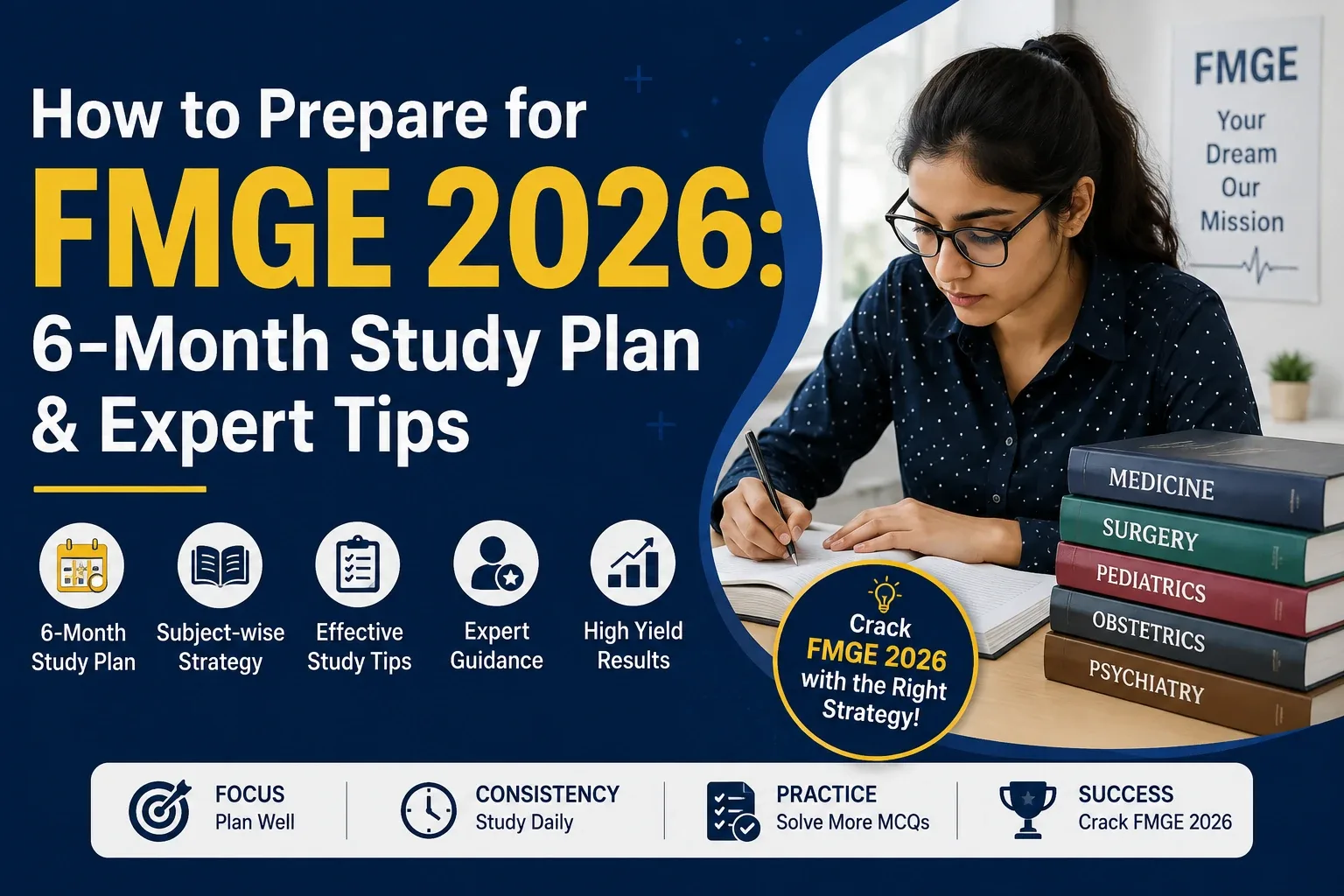
A 6-month timeline allows candidates to complete the comprehensive 19-subject MBBS syllabus twice while building a strong foundation in clinical reasoning and Image-Based Questions (IBQs).
Months 1-3
- Objective: Acquire a knowledge base through an initial full study cycle of 19 subjects, and activate that knowledge via Active Recall.
- Daily Flow: Study from video and written notes in the morning. Apply this knowledge by solving 70-100 subject-related MCQs in the afternoon.
- Error Tracking: Log mistakes and bookmarked items in an “Error Book” for systematic revisit later.
Months 4-5
- Goal: Solidify high-yield topics, improve weak subjects and gain confidence in using visual diagnostics.
- Daily Schedule: Watch lecture videos of top subjects at 2x pace, 1 hour for IBQs.
- Assessments: Take one mini-test topic-wise every three days to understand areas for improvement.
Month 6
- Objective: To increase speed in answering questions, exam endurance, and quick recall of high-yield concepts.
- Revision & Test practice: Change to condensed rapid revision notes entirely and take full 300-question Grand Tests under real exam conditions every 4-5 days.
- Analysis: Dedicate 3-4 hours to reviewing each Grand Test to find mistakes and avoid them happening again.
Daily/Weekly Study Schedule
Having a good daily plan that doesn't burn you out and covers theory, practical and revision all at once is really something that all aspiring MBBS candidates look for. So take a quick look at the daily timetable and the weekly structure that can help you with your FMGE preparation.
Daily Timetable
| Time | What To Do |
| 06:30 AM – 07:00 AM | Morning Routine & Daily Goals Setting |
| 07:00 AM – 10:00 AM | Theory & Note Reading (Block 1) |
| 10:00 AM – 10:30 AM | Break |
| 10:30 AM – 01:00 PM | Theory & High-Yield Tables (Block 2) |
| 01:00 PM – 02:00 PM | Lunch & Rest |
| 02:00 PM – 04:30 PM | QBank Practice (50–70 MCQs) & Error Log |
| 04:30 PM – 05:00 PM | Evening Break |
| 05:00 PM – 07:00 PM | Image-Based Questions (IBQs) & PYQ Review |
| 07:00 PM – 08:00 PM | Dinner |
| 08:00 PM – 10:00 PM | Daily Revision of Error Notebook & Weak Topics |
Weekly Structure
- Monday - Saturday: Implement the daily routine, covering daily new theory and practice daily MCQs.
- Sunday (Evaluation & Revision): Take a morning Grand test/subject test, evaluate mistakes in the afternoon, and revise light notes in the evening.
Subject-Wise Time Allocation (High-Yield vs Low-Yield)
Out of the total 300-mark paper, approximately 200 marks are for the Clinical subjects and 100 marks are for the Pre/Para-Clinical subjects. You need to distribute time according to the marks allocation of the questions.
Tier 1: Core Clinical & High-Yield Drivers (~160 Marks)
Focus: Maximum study time allocation (50% of overall schedule)
| Subject | Expected Weightage | Recommended Days (6-month plan) |
| General Medicine & Allied | 33–40 Qs | 14–16 Days |
| General Surgery & Allied | 32–38 Qs | 12–14 Days |
| Obstetrics & Gynecology | 28–30 Qs | 10–12 Days |
| Community Medicine (PSM) | 25–30 Qs | 8–10 Days |
| Paediatrics | 15–20 Qs | 6–7 Days |
Tier 2: Core Anchor & Para-Clinical Subjects (~90 Marks)
Focus: High return-on-investment subjects that bridge theory and clinicals (30% of schedule)
| Subject | Expected Weightage | Recommended Days (6-month plan) |
| Pharmacology | 13–18 Qs | 7–8 Days |
| Pathology | 13–15 Qs | 7–8 Days |
| Anatomy | 15–17 Qs | 6–7 Days |
| Physiology & Biochemistry | 30–34 Qs combined | 8–10 Days combined |
| Microbiology & FMT | 20–23 Qs combined | 6–7 Days combined |
Tier 3: Short Clinical Subjects (~50 Marks)
Focus: High-scoring subjects requiring low reading volume; do not skip (20% of schedule)
| Subject | Expected Weightage | Recommended Days (6-month plan) |
| Ophthalmology & ENT | 20–25 Qs combined | 6–7 Days combined |
| Orthopedics | 5–8 Qs | 3 Days |
| Dermatology & Psychiatry | 10–12 Qs combined | 3–4 Days combined |
| Anesthesia & Radiology | 8–10 Qs combined | 2–3 Days combined |
No matter how perfectly you’ve designed the plan for studying, your entire plan is as strong as the tools that’ll help you. So once you’ve set up the timetable for your day, you’ll need to put your planned sessions in line with the required books, high-yield question banks, and some actual previous-year papers, ensuring each hour you put into studying can directly reflect in exam accuracy and retrievability.
Not Sure Which Subjects to Prioritise?
Most repeaters do not fail because they studied too little. They fail because they spread all 19 subjects evenly across six months instead of following the marks. Our counsellors work with foreign medical graduates every week. Share your last mock score and your target session, and we will help you rebalance the six-month plan around your weakest high-weightage subjects.
Essential FMGE Study Material
Choosing the right FMGE study material is crucial, more than collecting the sources. With 300 MCQs, no negative marking, 150 marks, 19 subjects: it's all about rapid recall, not exhaustive memorisation!
Start with one video lecture series to build your base, then anchor your reading to a single reliable subject-wise reference such as FMGE Solutions. Once theory is done, shift the bulk of your hours to a digital question bank. Any of the established Indian FMGE and NEET-PG prep platforms will do the job. What matters far more than which one you choose is that you choose one and finish it, because switching platforms midway is one of the most common reasons candidates run out of time.
Work through the last 5 to 7 years of previous year questions. FMGE recycles themes heavily, so PYQs are the closest thing you have to a syllabus filter. Use a paid platform if you want the full package of subject tests and grand tests, and keep free resources for plugging specific gaps. Beyond PYQs, one reliable reference per subject is enough, because anything more eats revision time you cannot get back.
While you get enough resources to acquire knowledge for FMGE 2026, test-taking strategy has the potential to convert it into 150+ Marks to qualify the examination.
Clinical subjects account for 200 of the 300 marks. General Medicine (33 to 40 questions), General Surgery (32 to 38), Obstetrics and Gynaecology (28 to 30) and Community Medicine (25 to 30) are the four biggest scorers and should get the largest share of your study time.
The FMGE December 2026 session is listed for 9 January 2027 in the tentative NBEMS calendar. Dates are provisional until the official information bulletin is released, so check natboard.edu.in before planning around them.
How to Pass FMGE 2026: 5 Proven Test-Taking Tips
Cracking FMGE necessitates a fundamental paradigm shift, moving away from mere reading to deliberate recall, disciplined diagnosis and clever management of time. To easily cross the obligatory 150-mark qualifying criteria, you will need to resort to retention techniques and minimisation of mistakes.
Below are the 5 expert tips to make your preparation efforts efficient and crack the exam:
- Condense main notes into 15-20 pages (high-yield) notebooks for last-minute exam revision.
- Save your Q bank and mock mistakes to focus more on the topics wherein errors occur.
- Speed up grand tests at 1 every 4-5 days, and try to work on your weaknesses through error solving.
- Complete fast questions at speed in Pass 1 and clinical ones flagged to be read again in Pass 2.
- Follow a single website to practice (to prevent confusion), and attempt all 300 questions. You have nothing to lose, as zero negative marking applies!
Beat FMGE Burnout, Guard Your Mind
The FMGE prep is a long, gruelling marathon. Therefore, take care of your mental health to avoid getting burnt out. Schedule a short break daily, keep a routine for your sleep, and most importantly, recharging yourself preserves your memory, concentration, and exam-day confidence!
Key Takeaways
The thought of “How to pass FMGE?” needs a strategic shift from constant studying to conscious execution. Through this six-month roadmap of learning subject-based theories, entering every wrong answer into your error notebook and rapid-fire revision, you can ease past the cut-off mark by reaching 150 marks. Adhere to the daily schedule you have made, stick to your sources of study, and maintain good health and mental well-being at all times.
Plan Your Next Attempt With Education Vibes
Whether you are sitting the January 2027 session for the first time or coming back for another attempt, the distance between 140 and 160 is usually a handful of fixable habits, not more hours at the desk.
Send us your subject-wise mock breakdown and an Education Vibes counsellor will help you build a realistic six-month plan around it, free of charge.
Still deciding where to study medicine, or guiding a junior who is? Start with our MBBS Abroad guide, or compare destinations directly: MBBS in Russia, MBBS in Georgia, MBBS in Uzbekistan and MBBS in Kazakhstan. Your choice of university has a measurable effect on your FMGE odds later.
Frequently Asked Questions (FAQs)
Q1: How many hours should I study daily for FMGE preparation?
Usually, dedicated candidates spend 6-8 hours during the beginning phase and push up to 10-12 hours during the 2 months before revision.
Q2: What is the passing mark for FMGE 2026?
You need 150 out of 300 marks, which is 50 per cent. FMGE is a pass or fail screening test rather than a ranking exam, so there is no category-wise relaxation and no sectional cut-off.
Q3: How many attempts are allowed for FMGE?
As of the 2026 sessions, NBEMS places no cap on the number of FMGE attempts. You can appear as many times as needed until you qualify. The NMC has signalled a future rule limiting candidates to six attempts within three years, but it has not been notified for current candidates, so always confirm against the official information bulletin for your session.
Q4: Can I pass FMGE without coaching?
Yes. A large share of successful candidates clear FMGE without formal coaching. Consistent self-study, one condensed set of notes, a structured online question bank and previous year papers are enough. Coaching mainly buys you structure and accountability, both of which you can build yourself with the schedule above.
Q5: Is 3 months enough to prepare for FMGE?
Three months can be enough if your MBBS fundamentals are solid and you can sustain a disciplined 10 to 12 hour daily schedule focused strictly on high-yield topics and PYQs. If your basics are shaky, or you are working alongside preparation, six months is the safer target.