Table of Contents
Quick Checklist Before You Choose a Country
Scroll HereRussia vs Kazakhstan vs Kyrgyzstan: At a Glance
Scroll Here1. Tuition Fees and Total Cost
Scroll Here2. NMC Compliance and University Choice
Scroll Here3. FMGE Outcomes: The Number That Actually Matters
Scroll Here4. Language of Instruction and Clinical Training
Scroll Here5. Climate and Living Conditions
Scroll Here6. Safety and the Geopolitical Question
Scroll Here7. Indian Student Community and Support
Scroll HereHow to Decide: A Simple Framework
Scroll HereFrequently Asked Questions
Scroll Here1. Do I need NEET to study MBBS in Russia, Kazakhstan or Kyrgyzstan?
Scroll Here2. Which country has the best FMGE pass rate?
Scroll Here3. Is Kyrgyzstan safe for Indian students?
Scroll Here4. Will NExT replace FMGE before I graduate?
Scroll Here5. Do I need to learn Russian for MBBS in these countries?
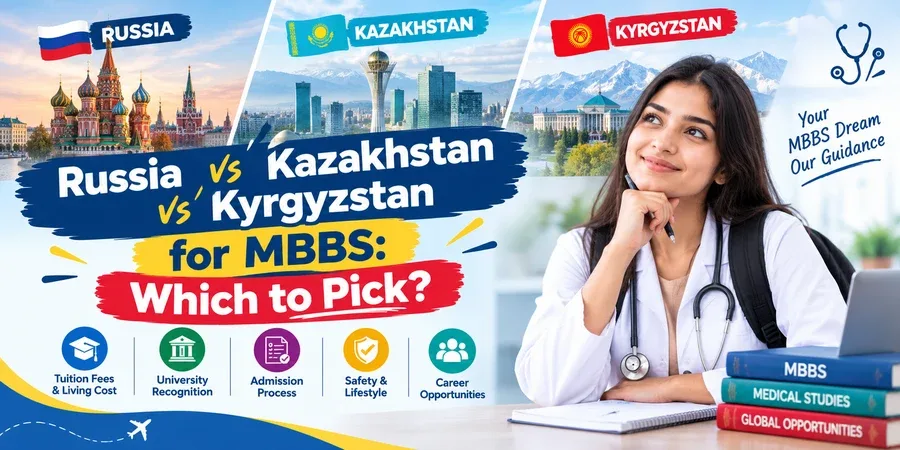
Scroll HereDid your NEET score fall short of a government seat, and are Indian private medical colleges beyond your budget? If you are now looking at MBBS abroad, three names come up again and again: Russia, Kazakhstan and Kyrgyzstan. All three have NMC-compliant universities, English-medium programmes and fees well below Indian private colleges.
So which one should you pick? There is no single "best" country. The right choice depends on your budget, academic profile, climate preference and how much risk you are comfortable with. This guide compares the three side by side so you can decide with facts, not sales pitches.
Quick Checklist Before You Choose a Country
- Total 6-year cost (tuition + hostel + living)
- NMC compliance and WDOMS listing of the university
- University-wise FMGE pass record
- Safety for international students
- Climate you can live with for six years
Russia vs Kazakhstan vs Kyrgyzstan: At a Glance
| Factor | Russia | Kazakhstan | Kyrgyzstan |
|---|---|---|---|
| Approx. 6-year tuition | ₹18–40 lakh | ₹20–29 lakh | ₹19–25 lakh |
| Choice of NMC-compliant universities | Widest | Moderate (10+) | Limited (about 10) |
| FMGE pass rate (2024) | 29.54% | 25.13% | 25.05% |
| Climate | Long, harsh winters | Continental; milder in the south | Continental; moderate in Bishkek |
| Indian student community | Large, city-dependent | Smaller but growing | Very large (Bishkek) |
Figures are indicative. Hostel and living costs are extra, and fees vary by university and year.
1. Tuition Fees and Total Cost
Cost is usually the first filter, so start here.
- Kyrgyzstan is generally the most affordable, with tuition of roughly ₹3–4 lakh per year.
- Kazakhstan sits slightly higher, with 6-year tuition of around ₹20–29 lakh.
- Russia has the widest range. Mid-tier universities are comparable to Central Asia, while top-ranked universities in Moscow and St. Petersburg cost considerably more.
Practical takeaway: On a tight budget, Kyrgyzstan and selected Kazakh universities give the best value. With a higher budget, Russia offers more choice of established universities. For university-wise fee structures, see our detailed guides on MBBS in Russia, MBBS in Kazakhstan and MBBS in Kyrgyzstan.
2. NMC Compliance and University Choice
If you plan to practise in India, this is the filter you cannot skip. Your university must be:
- Listed in the World Directory of Medical Schools (WDOMS)
- Compliant with the National Medical Commission (NMC) Foreign Medical Graduate Licentiate Regulations
- Recognised by its own country's health or education ministry
All three countries have eligible universities, but the depth of choice differs:
- Russia has the largest pool of established medical universities, many with over a century of history, such as Kazan State Medical University and First Moscow State Medical University.
- Kazakhstan has fewer options, but long-standing institutions like Kazakh National Medical University and Al-Farabi Kazakh National University have trained international students for decades.
- Kyrgyzstan has the most limited reliable choice. A recent Ministry of Health review found that a large share of evaluated medical institutes did not meet the required standards, so shortlist carefully. Established names such as Kyrgyz State Medical Academy (KSMA) and Kyrgyz Russian Slavic University (KRSU) remain strong options.
Before shortlisting any university: verify its name on the WDOMS portal and confirm its recognition with that country's ministry.
3. FMGE Outcomes: The Number That Actually Matters
Fees and rankings help you shortlist, but your FMGE result decides whether you can practise in India. Pass rates vary far more between universities than between countries.
Country-wise FMGE 2024 data published by NBEMS:
| Country | Appeared | Passed | Pass Rate |
|---|---|---|---|
| Russia | 11,276 | 3,331 | 29.54% |
| Kazakhstan | 5,018 | 1,261 | 25.13% |
| Kyrgyzstan | 15,135 | 3,792 | 25.05% |
Russia leads slightly, but the gap is small. What matters more is the record of the specific university you choose and how well you prepare. Our guide on how to prepare for FMGE can help you plan from year one.
Questions to ask a university or consultant:
- "Can I speak to a recent graduate who has appeared for FMGE?"
- "What FMGE/NExT preparation support is built into the curriculum?"
If you only get a country-wide statistic instead of university-specific numbers, treat it as a red flag.
4. Language of Instruction and Clinical Training
All three countries offer English-medium MBBS at NMC-compliant universities, so the theory years look similar. From around the third year, clinical rotations involve real patients, so you will need working knowledge of the local language: Russian in Russia, Russian or Kazakh in Kazakhstan, and Russian or Kyrgyz in Kyrgyzstan. Universities usually teach this as part of the curriculum.
5. Climate and Living Conditions
- Russia: Long, cold winters with frequent snowfall; temperatures in many university cities regularly drop well below zero.
- Kazakhstan: Continental climate with cold winters. Southern cities like Almaty and Shymkent are milder than the north.
- Kyrgyzstan: Continental and cold in winter, but Bishkek is relatively moderate, and the mountainous setting suits an outdoor lifestyle.
6. Safety and the Geopolitical Question
Russia's geopolitical situation is a fair concern for parents. Most cities where Indian students study are far from conflict zones, and universities typically provide CCTV surveillance, security staff and separate hostels for boys and girls. Always check the latest Indian government travel advisory for your city.
Kazakhstan and Kyrgyzstan are generally considered stable and welcoming for international students, with large Indian communities in the main university cities.
7. Indian Student Community and Support
- Kyrgyzstan: Bishkek has one of the largest Indian student communities, and many universities offer Indian mess facilities.
- Russia: A large Indian population overall, with the most organised communities in cities like Moscow, St. Petersburg and Kazan.
- Kazakhstan: A smaller but steadily growing Indian community in major cities.
How to Decide: A Simple Framework
- Fix your total 6-year budget, including hostel, food, insurance, flights and FMGE/NExT coaching.
- List the universities that fit within that budget.
- Confirm each one is NMC-compliant and WDOMS-listed.
- Compare their FMGE results over the last 2–3 exam cycles.
- Decide whether you can handle a harsh winter or prefer a milder city.
- Check the current safety status of the specific city.
The country whose universities pass all these filters is your answer, a decision based on facts rather than a consultant's generic opinion.
Frequently Asked Questions
1. Do I need NEET to study MBBS in Russia, Kazakhstan or Kyrgyzstan?
Yes. Indian students must qualify NEET to be eligible to practise in India after an MBBS abroad. Qualifying marks are enough; you do not need a high rank.
2. Which country has the best FMGE pass rate?
In FMGE 2024, Russia had a slightly higher pass rate (29.54%) than Kazakhstan and Kyrgyzstan (about 25% each). However, results vary much more by university than by country, so compare individual universities.
3. Is Kyrgyzstan safe for Indian students?
Kyrgyzstan is generally considered safe and stable. Popular universities provide campus security, and Bishkek has a large, active Indian student community.
4. Will NExT replace FMGE before I graduate?
The NMC has stated that NExT will replace FMGE, but the implementation timeline for foreign medical graduates has not been finalised. Check official NMC notices before you apply.
5. Do I need to learn Russian for MBBS in these countries?
Not at admission. Teaching is in English at NMC-compliant universities, but you will learn the local language (mostly Russian) for clinical rotations from around the third year.