Table of Contents
MBBS Abroad Admission Process 2026 at a Glance
Scroll HereMBBS Abroad Eligibility Criteria 2026
Scroll HereEntrance Exams and Language Requirements
Scroll HereMBBS Abroad Admission Process 2026: Step by Step
Scroll HereHow to Check NMC Compliance Before Choosing a University
Scroll HereDocuments Required for MBBS Abroad Admission
Scroll HereMBBS Abroad Admission Intakes 2026
Scroll HereHow Long Does the MBBS Abroad Admission Process Take?
Scroll HereHow Much Should You Budget for MBBS Abroad?
Scroll HereHow Education Vibes Helps Students With MBBS Abroad Admission
Scroll HereCommon Mistakes to Avoid When Applying for MBBS Abroad
Scroll HereFrequently Asked Questions About MBBS Abroad Admission
Scroll HereConclusion
Scroll HereDue to intense competition for medical seats in India and the high cost of many private medical colleges, an increasing number of Indian students consider studying medicine abroad. However, getting admission to a foreign medical university is not simply about finding a low-fee course. Students need to check eligibility, qualify NEET as applicable, select a suitable university, verify the course against the latest NMC requirements, prepare documents and complete the visa process.
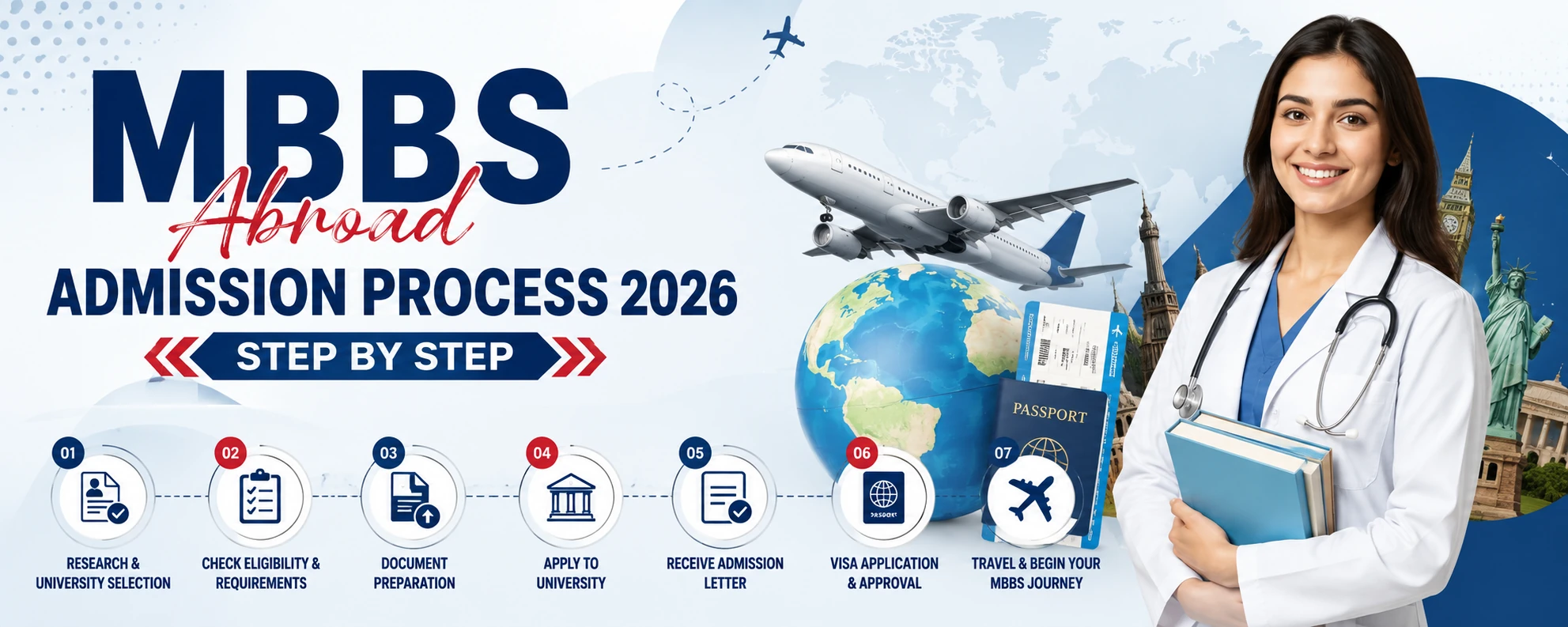
The MBBS abroad admission process can vary by country and university, but the overall journey follows a clear sequence from checking eligibility and selecting a university to receiving an admission letter, completing visa formalities and joining the university. This guide explains each stage in simple terms so students and parents can plan their admission for the 2026 academic cycle.
MBBS Abroad Admission Process 2026 at a Glance
Step | What You Need to Do |
1 | Check your academic, age and NEET eligibility |
2 | Choose the country based on your academic and financial requirements |
3 | Select and verify a suitable medical university |
4 | Prepare the required application and supporting documents |
5 | Submit the university application |
6 | Receive and review the admission/offer letter |
7 | Complete the required fee payment |
8 | Receive an invitation letter where the destination requires one |
9 | Apply for the student visa |
10 | Complete pre-departure arrangements |
11 | Travel, report to the university and complete registration |
MBBS Abroad Eligibility Criteria 2026
Before applying, students should check two sets of requirements: the eligibility conditions that apply to Indian students under the relevant NMC framework and the admission requirements of the chosen foreign university. Meeting one does not automatically mean that the other has been met.
Age Requirement
For the commonly applicable Indian medical eligibility pathway, the student should meet the required minimum age of 17 years by the prescribed date in the admission year. The university or country may also specify its own age rules, so the final requirement should be checked before applying.
Academic Qualification
Students generally need to complete Class 12 or an equivalent qualification with Physics, Chemistry and Biology/Biotechnology, along with English where required. The exact subject and percentage requirements can vary by institution and destination.
NEET Requirement
Indian students intending to obtain their primary medical qualification abroad should carefully check the applicable NEET requirement before admission. NMC specifically states that Indian citizens and OCI candidates seeking a primary medical qualification outside India must qualify NEET under the applicable rules. NTA is the official authority conducting NEET-UG.
Minimum Marks
A commonly used eligibility benchmark is 50% in the relevant PCB subjects for the General category and 40% for specified reserved categories, but students should verify the latest applicable rules and the university's own eligibility criteria before applying. Do not assume that the same percentage applies to every foreign medical university.
Entrance Exams and Language Requirements
Is NEET Required for MBBS Abroad?
Indian students who qualify NEET can explore different options for studying medicine overseas. You can also read our detailed guide on MBBS abroad after NEET 2026 to understand the available pathways and admission considerations.
Is IELTS or TOEFL Required?
Not always. English-language requirements depend on the country, university and programme. Some universities may accept previous English-medium education, while others may ask for IELTS, TOEFL or another form of English-language proof. Always check the official university and visa requirements before applying.
Are Entrance Tests Required?
Some destinations or universities have their own entrance examinations, interviews or selection tests. Requirements can be very different between countries, so students should not assume that one admission model applies to all MBBS destinations.
MBBS Abroad Admission Process 2026: Step by Step
Step 1: Check Your Eligibility
Start by checking your age, Class 12 subjects, PCB marks, NEET status and any country-specific requirements. This prevents students from applying to universities where they may not meet the basic criteria.
Step 2: Choose the Right Country
Compare countries on tuition fees, living expenses, course structure, language, climate, safety, clinical training, visa requirements and long-term career plans. A low tuition fee should not be the only reason for selecting a destination.
Step 3: Select and Verify the Medical University
Shortlist universities only after checking the institution, degree, course duration, medium of instruction, clinical training, internship arrangement and eligibility to practise medicine in the country where the degree is awarded. NMC advises students to obtain course and fee details directly from the university and to exercise due diligence before admission.
Step 4: Prepare Your Documents
Prepare academic records, passport, photographs, NEET documentation and other documents requested by the university or visa authority. Keep clear scanned copies and originals safely organized.
Step 5: Submit the University Application
Complete the application form carefully and submit the required documents through the university's prescribed application channel. Check names, dates, passport details and academic information before submission.
Step 6: Receive and Review the Admission Letter
If the university accepts your application, it may issue an admission, offer or acceptance letter. Check the programme name, intake, tuition fee, conditions, payment deadline and other important details before accepting.
Step 7: Complete the Required Fee Payment
If an initial payment is required to confirm the place, follow the university's official payment instructions. Keep the payment receipt and written fee details for future reference.
Step 8: Receive an Invitation Letter Where Applicable
Some destinations issue an invitation letter or similar immigration document before the student visa application. The process and terminology vary by country, so follow the university and embassy instructions for your destination.
Step 9: Apply for the Student Visa
Prepare the visa application according to the destination country's current rules. Depending on the country, you may need your passport, admission documents, invitation letter where applicable, financial evidence, medical documents, photographs and proof of accommodation or other supporting documents.
Step 10: Complete Pre-Departure Formalities
After the visa is approved, arrange travel, accommodation, foreign currency/forex, medicines, SIM or connectivity, insurance where applicable and a folder containing important original documents and copies.
Step 11: Travel and Complete University Registration
After reaching the destination, report to the university within the required time. Complete final registration, document verification, accommodation formalities and orientation. If local support is available, students may also receive assistance with airport pickup and settling in.
How to Check NMC Compliance Before Choosing a University
One of the most important decisions is selecting a foreign medical programme that can support your future registration pathway in India. NMC does not simply publish a blanket list of 'NM-approved foreign universities'. Instead, students are advised to verify the institution and the programme against the applicable regulations and to obtain course details directly from the institution.
- Check that the medical education meets the applicable minimum duration requirements.
- Check the internship structure and whether the required internship is completed at the same foreign medical institution where applicable.
- Confirm that the medium of instruction is English for the medical programme as required by the applicable rules.
- Check the curriculum and clinical training structure against the applicable NMC requirements.
- Verify that the graduate is legally eligible to register/practise medicine in the country where the degree is awarded, where required.
- Ask for the complete fee structure, course duration and internship details in writing before paying.
For the latest regulatory position, refer to the NMC FMGL Regulations and official guidance rather than relying only on advertisements or third-party claims.
Apply according to the university's official intake calendar and allow enough time for admission, document processing and visa formalities. Applying early is generally safer when seats and visa appointments are limited.
Check the university's official programme details, course duration, medium of instruction, clinical training, internship structure and eligibility for medical practice in the study destination, and compare these with the latest applicable NMC requirements.
A foreign medical degree does not automatically provide the right to practise in India. Graduates must meet the applicable NMC requirements and complete the required licensing and registration pathway.
Yes, students can apply directly to universities where direct applications are available. Whether you use a consultant or apply independently, verify all information through the university and relevant government authorities.
Confirm the university name, programme, total course duration, internship arrangement, medium of instruction, fee structure, refund terms, accommodation costs and applicable regulatory requirements in writing.
Documents Required for MBBS Abroad Admission
The exact document list varies by university and destination. Commonly requested documents include:
- 10th and 12th mark sheets/certificates
- NEET scorecard or qualifying documentation, where applicable
- Valid passport
- Passport-size photographs
- Birth certificate, where required
- Medical/fitness documents, where required
- Financial or sponsorship documents for the visa, where required
- Police clearance certificate, where required
- University application, admission and invitation documents, where applicable
Keep both digital scans and physical copies of important documents. Legalisation, attestation or apostille requirements also vary by destination and document type; verify the exact process with the university and relevant authorities.
MBBS Abroad Admission Intakes 2026
Many foreign medical universities have a main intake around August–October, while some institutions also offer January–March or other intakes. However, there is no single intake calendar for all countries. Application opening dates, deadlines and seat availability vary by university.
Students should check the official university admission calendar for the exact 2026 intake and apply early enough to allow time for document processing and visa formalities.
How Long Does the MBBS Abroad Admission Process Take?
There is no universal processing time. The timeline depends on the university, intake, document readiness, admission review, invitation process where applicable and visa processing. Students who keep their passport, academic documents and NEET records ready can usually move through the application stages more smoothly.
Stage | What Can Affect Timing |
University selection | Seat availability and application deadline |
Application | Completeness and accuracy of documents |
Admission letter | University review time |
Invitation/visa | Country-specific process and embassy requirements |
Travel | Visa approval, flight and university reporting deadline |
How Much Should You Budget for MBBS Abroad?
The total cost depends heavily on the country and university. Students should calculate more than tuition fees and include hostel or accommodation, food, insurance, visa charges, travel, documentation, medical tests and day-to-day living expenses. Currency fluctuations can also affect the final budget.
For detailed country-wise fees and university options, use the Education Vibes MBBS Abroad page rather than repeating a large fee table in this process-focused article.
How Education Vibes Helps Students With MBBS Abroad Admission
The admission journey can involve several university and country-specific steps. Education Vibes can assist students with:
- Profile assessment and eligibility guidance
- Country and university shortlisting
- Application form and document assistance
- Admission and invitation letter coordination where applicable
- Visa documentation guidance
- Pre-departure preparation
- Post-arrival and university joining assistance
The specific support available depends on the chosen destination and university. Students should independently verify university, regulatory and visa information from official sources before making a final decision.
Common Mistakes to Avoid When Applying for MBBS Abroad
1.Choosing a university only because its fees are low.
2.Relying on an agent's verbal promise instead of written university information.
3.Failing to check course duration, clinical training and internship arrangements.
4.Ignoring the latest NMC requirements before paying fees.
5.Assuming every country has the same admission, apostille or visa process.
6.Waiting until the final deadline to prepare documents or apply for a visa.
7.Not calculating the complete cost, including living expenses and travel.
8.Submitting applications with mismatched names, dates or passport details.
Frequently Asked Questions About MBBS Abroad Admission
- How can I get admission to MBBS abroad?
Start by checking your eligibility and NEET status, choose a suitable country and university, verify the programme against applicable NMC requirements, prepare the required documents, submit the application, receive the admission letter, complete the required payment and visa formalities, and then travel for university registration.
- Is NEET mandatory for MBBS abroad?
Indian students should check the applicable NMC requirements. For Indian citizens and OCI candidates seeking a primary medical qualification abroad, NMC requires NEET qualification under the applicable rules.
- What documents are required for MBBS abroad admission?
Common documents include Class 10 and 12 records, passport, photographs, NEET documentation where applicable, and additional university or visa documents. The exact list varies by country and institution.
- Is IELTS required for MBBS abroad?
Not for every university. English-language requirements vary by country, university and programme. Check the university and visa authority's current requirements before applying.
- How long does MBBS abroad admission take?
There is no fixed timeline. Processing depends on the university, document readiness, intake, invitation process where applicable and visa requirements
Conclusion
The MBBS abroad admission process becomes easier when students treat university selection and regulatory verification as carefully as the application itself. Start with eligibility and NEET requirements, compare countries, verify the medical programme, prepare documents, submit the application and complete admission and visa formalities on time.
The most important point is to avoid choosing a university only on the basis of fees or a consultant's claims. Check the official university information and the latest NMC requirements before making a final decision. With proper planning, students can move from eligibility assessment to university admission and pre-departure preparation with greater clarity.