MBBS Abroad

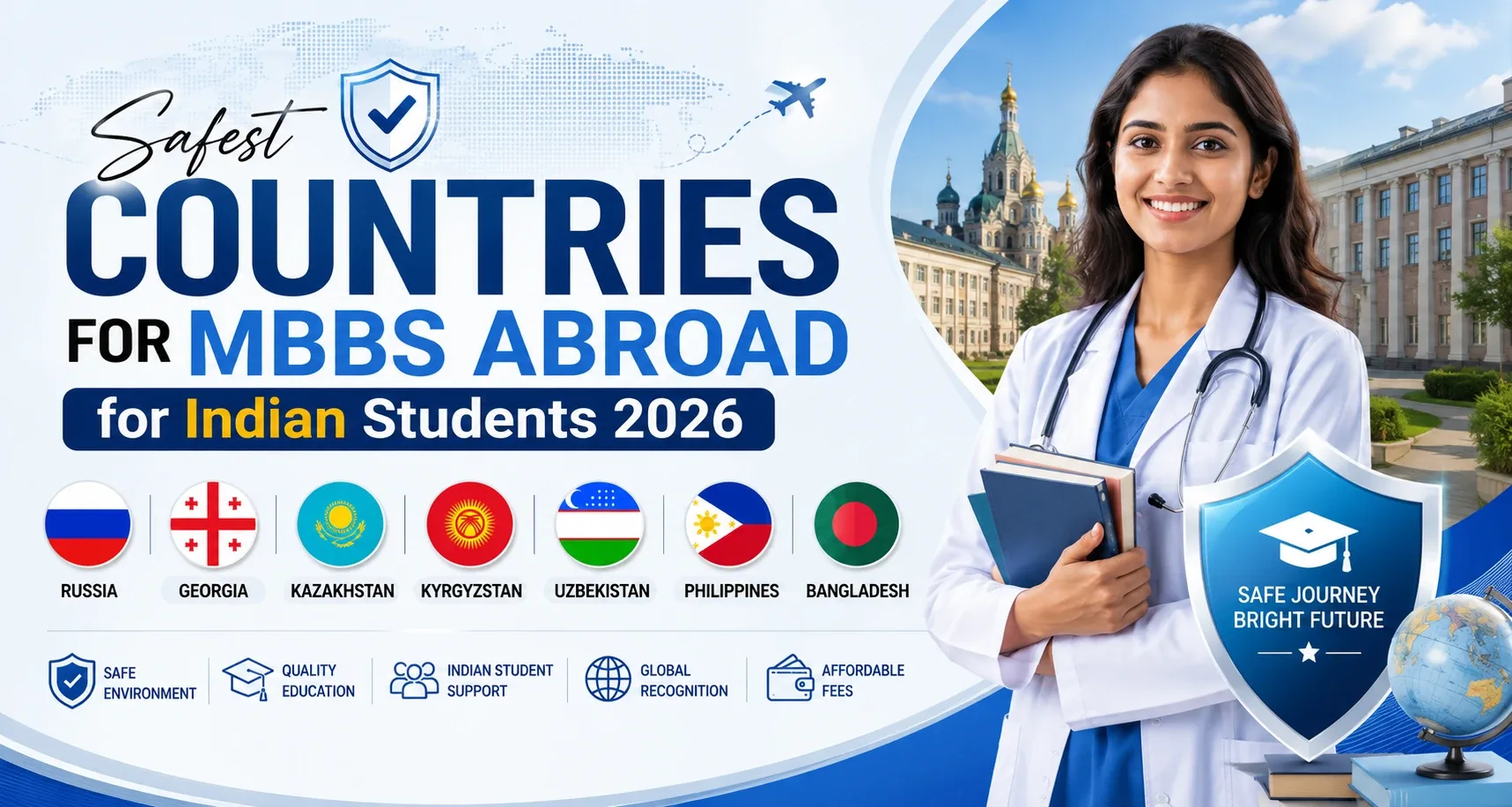
Safest Countries for MBBS Abroad for Indian Students 2026

Neeraj Rajput
Neeraj Rajput · Senior Content WriterUpdated at - August 31, 202613 Min Read0 views
Safest Countries for MBBS Abroad for Indian Students 2026

Table of Contents

There is no single safest country for MBBS abroad; however, all Indian students can study medicine in countries like Georgia and Kazakhstan, as these have lower crime rates, larger communities of Indian students, and an overall friendly environment for all international students. Safety encompasses physical security, political stability, social comfort, and reliable legal protection for all international medical aspirants. According to global benchmarks like the Institute for Economics and Peace (IEP) Global Peace Index and Numbeo Safety Rankings, understanding which country is safe for MBBS requires analysing both macro-level peace indicators and micro-level campus security.

Pursuing an MBBS abroad has evolved in recent times, and more Indian medical aspirants are choosing to lay the foundation for their clinical future in foreign universities. With intense competition to find a seat in government colleges, while dealing with the soaring tuition fees at private colleges in India, Indian students are pursuing overseas medical education. It offers them access to international exposure, world-class medical infrastructure, cost-effective fee structures, and an advanced clinical experience. However, along with verifying eligibility and budget constraints, identifying the safest country for MBBS abroad is today’s biggest concern for any Indian student and their parents.

Breaking It DownCreated with Ai. Errors are possible
  • No country wins on every measure. Georgia and Kazakhstan score highest overall for Indian students because they combine low violent-crime rates, large Indian student communities, regulated hostels with curfews, and full NMC compliance at under Rs 5 lakh a year in tuition. Poland is safer still on paper but costs roughly three times as much.

  • Five things, not one: the country’s Global Peace Index and violent-crime rate, the size and maturity of the local Indian student community, political and economic stability over a 5-6 year horizon, India’s diplomatic presence and bilateral ties, and enforced anti-discrimination plus campus security rules such as CCTV, biometric entry and warden-supervised dormitories.

  • Yes — safety and NEET score are unrelated. A low score limits which universities will admit you, not which countries are safe. The risk appears when a low score pushes students towards unverified colleges promising easy seats; screen every option against the World Directory of Medical Schools and FMGL 2021 norms regardless of score.

  • Choosing a university on an agent’s recommendation instead of verification. Before paying any deposit, confirm the college is listed in the World Directory of Medical Schools, meets NMC and FMGL 2021 requirements, and offers a 6-year English-medium programme — then register on the MADAD portal once you arrive.

Parameters for Evaluating Student Safety in a Country

Many Indian students and their parents ponder over the question, “Is it safe to study MBBS abroad”? Evaluating certain parameters can help them to make a mindful decision. When evaluating and shortlisting options of foreign countries, students and parents must look beyond promotional materials and analyse independent metrics, such as global peace and political stability. Here are some of the major parameters to examine when determining which country is safe for MBBS:

  • Global Peace and Crime Indices

What is the ranking of a country in global safety metrics? Does it have low rates of violent crime? Is there reliable law enforcement and internal social harmony?

  • Presence of Indian Students

Are there already established Indian communities in the near surroundings? Do you see active Indian student communities providing peer and cultural support? Will you have access to rapid assistance in times of emergencies?

  • Political and Economic Stability

Is the particular study destination free from geopolitical conflicts, civil tensions, or severe economic fluctuations? These are very critical questions when deciding the safest country for MBBS abroad, from the long-term perspective of living for 5-6 years in a foreign country.

  • Embassy and Diplomatic Support

Are there strong bilateral relations or any sort of bilateral relations between India and the chosen foreign country for the MBBS abroad? This addresses any sort of emergency and diplomatic support from local consulates whenever needed.

  • Strict Anti-Discrimination Laws

Does the foreign country or the particular medical institution have strict laws against hate speech and harassment of the students, especially international students?

Safety, Costs and Recognition: A Quick Comparison Between Countries

Identifying which country is safe for MBBS abroad involves a series of different parameters and factors to consider when making a thoughtful decision. This includes understanding the geographical, economic, and practical considerations. Other factors are linguistic comfort, living standards, and compliance with India's National Medical Commission (NMC).

The table below represents a comprehensive and comparative list of popular MBBS abroad destinations for Indian medical aspirants, highlighting safety standards maintained in the country, approximate tuition fees, and NMC compliance (to ensure that students who want to practise medicine in India after graduation can be eligible to do so).

Country

Global Peace & Safety Index

Security Features

Avg. Annual Tuition Fees

NMC Compliance

Georgia

High ratings for safety in Eurasia

Low theft rates, safe nightlife, regulated student housing

₹4,95,000

Yes (6-year English-medium medical courses)

Uzbekistan

Stable study environment

State security, cultural peace, high respect for doctors

₹2,70,000

Yes (6-year English-medium medical courses)

Kazakhstan

Peaceful study environment

Strict security measures, campus curfews, police support

₹4,05,000

Yes (fully compliant with the NMC guidelines)

Poland

Top 25 in Global Peace Index

EU safety standards, strong public transit security

₹13,18,740

Yes (6-year English-medium medical courses)

Philippines

Moderately secure campuses

Regulated student residential housing, dedicated security personnel

₹4,05,000

Partially (course duration varies across medical institutions)

Russia

Safe in Central & Volga regions

Dedicated campus guards, biometric entry systems

₹3,30,000

Yes (fully NMC-compliant medical education)

Still weighing Georgia against Kazakhstan, Poland or the Philippines? Education Vibes counsellors match your NEET score, budget and safety priorities to an NMC-compliant university and walk you through visa, hostel and admission timelines.

Determining the Safest Country for MBBS Abroad

The table above lists particular and popular foreign countries and highlights safety standards and compliance with the NMC, along with taking into account how much tuition fees are for studying medicine annually. Now, we will look at each country to determine which country is safe for MBBS:

Premier Safety Standards in Eurasia - Georgia

Georgia has rapidly climbed the ranks as a favourable destination for overseas medical education. With low rates of violent crime and a well-established law enforcement network, Georgia offers peace of mind to international students who are pursuing their higher education. Urban cities like Tbilisi and Batumi are especially renowned for maintaining safety measures, like round-the-clock surveillance and security personnel. This enables wider public safety measures, allowing Indian students to travel comfortably between university clinics and dormitories at any hour.

Georgia can be considered a legitimately safe country for MBBS abroad for its well-maintained safety standards and welcoming study environment with low crime rates. Furthermore, a majority of the Georgian medical institutions adhere to the NMC guidelines by offering Indian students a 6-year structured (5 years of academics + 1 year of internship) English-medium medical programme, making it one of the practically viable options to pursue medical studies overseas among European and Eurasian countries.

Stable Central Asian Countries - Uzbekistan and Kazakhstan

Central Asian countries have gained a substantial amount of momentum among Indian medical aspirants over the past few years. Both Uzbekistan and Kazakhstan maintain strong law enforcement networks; safety measures for students; living environments; and stable political climates. Cities like Tashkent, Samarkand, and Astana provide international students with a monitored study environment, with several districts having well-maintained infrastructure in public places and in university hostels.

Parents often ask whether it is safe to study MBBS abroad in Central Asian countries, given how underrated their education and research facilities are. The actual answer to the question lies in the region's long-standing diplomatic relations with India while maintaining strict university regulations, such as evening curfews and having dedicated security personnel in university hostels and dormitories. The growing reputation as a secure foreign destination with a very affordable fee structure makes it the most practical and safest country for MBBS abroad.

European Union Safety Standards: Poland and the Czech Republic

If a student prefers a study destination within the European Union, then Poland and the Czech Republic can be their best bets. Both European countries offer high living standards with a top-tier ranking on the Global Peace Index. These countries implement strict standards for public safety and security, have strong emergency support systems, and have a reliable, efficient public transport system that is safe to use during the night hours.

Choosing a member country of the European Union (EU) provides a stable and high-profile environment for Indian students, making any of the member countries the safest country for MBBS abroad. With EU-recognised qualifications and medical degrees, Poland is a good option for Indian medical aspirants. While living costs and tuition fees in Central Europe are higher than in Eastern Europe and Central Asia, the safety and security measures match the global standards of America and Europe in this case.

English-Medium, Secured Studies Close to Home: Philippines

The Philippines remains a popular MBBS abroad destination for Indian students due to its English-Medium and recognised education. Moreover, most medical institutions in the Philippines offer medical curricula that are aligned with US standards and have a similar academic structure. Medical colleges in major Filipino metropolitan areas offer their international cohort secure campuses equipped with private security personnel, 24/7 CCTV cameras, and practising security measures by maintaining a strict visitor verification system (logging entries and other safety measures).

Before enrolling in any Filipino medical institution, students frequently ask us, “Is it safe to study MBBS abroad in Southeast Asian countries and their cities?” The concern is quite understandable, as the country is quite controversial in terms of NMC compliance and an underrated living standard. Quite recently, the Manila Board has modified the medical programme by extending its overall duration, which makes it compliant with the NMC guidelines, and allowed Indian foreign medical graduates to appear for the medical licensing exam back in their home country. Additionally, local communities and established international student support services ensure that foreign students feel comfortable and safe while navigating daily life and studying. While seasonal patterns can be a concern for Indian students, they can be managed with basic preparation and a small investment.

Academic Standards and Bilateral Relations: Russia

Russia is increasingly chosen by Indian students, with many claiming it as the safest country for an MBBS abroad. It has educated generations of medical students, and currently, approximately 30,000 medical students (according to the Indian Parliament and other relevant sources of information) pursue their overseas studies in Russia. Over the decades, Russia has produced several Indian doctors and maintains a stable bilateral relationship with India. Major Russian universities have well-maintained infrastructure and safety standards.

Medical institutions located in Central and Volga regions have well-maintained and structured administration with dedicated support systems incorporated to support international students. On-campus hostels and dormitories utilise 24/7 CCTV surveillance, electronic entry systems with wardens and dedicated support desks. Indian medical aspirants wondering which country is safe for MBBS can select Russian universities located in peaceful central regions, especially in cities like Kazan or Moscow, as they offer a stable and secure environment for Indian students.

Essential Safety Protocols for Indian Medical Students in Foreign Countries

Even if a student has identified and made their choice of studying in the safest country for MBBS abroad, they need to practise certain protocols and procedures for ensuring their own safety. While host countries and universities implement strict security measures and policies, students should adopt personal precautions proactively to ensure they have a trouble-free academic journey.

  • Register on the MADAD Portal

Register with the nearest Indian embassy upon arrival in the foreign country. You can also register online through the official website of the Government of India and its portal that allows you to access quick diplomatic support and assistance whenever needed.

  • Verify University's Legitimacy

Ensure that your chosen foreign medical institution is enlisted in the World Directory of Medical Schools (WDOMS) and complies with all the latest NMC guidelines and FMGL Regulations 2021 outlined in the Indian Gazette to prevent legal or regional hurdles in India for medical practice.

  • Save Emergency Numbers

Always store emergency numbers, such as local police, ambulance, and the university's international office contacts. Keep these contacts along with your close ones' contact details on the speed dial.

  • Adhere to University Rules

Ensure that you adhere to the university's official rules and regulations. Practise hostel curfew times and inform the university's staff before travelling outside your host city.

Frequently Asked Questions About the Safest Country for MBBS Abroad

Which is the safest country for MBBS abroad for Indian students?

There is no single safest country for MBBS abroad. Based on global peace rankings, campus security, Indian student density and NMC compliance, Georgia, Kazakhstan and Uzbekistan are consistently the safest and most affordable options, while Poland offers the highest overall living standards at a higher cost.

Is it safe to study MBBS abroad in 2026?

Yes. Studying MBBS abroad is safe when you choose a politically stable country, a university listed in the World Directory of Medical Schools, and a campus with regulated hostels and 24/7 security. Registering with the nearest Indian embassy on arrival and following hostel curfew rules removes most day-to-day risk.

Is Georgia safe for Indian MBBS students?

Georgia has low violent-crime rates, reliable policing and a large Indian student community in Tbilisi and Batumi. Universities run monitored dormitories and most offer a 6-year English-medium programme that meets NMC norms, which makes MBBS in Georgia one of the safest choices in Eurasia.

Is Russia safe for Indian medical students?

Universities in the Central and Volga regions - such as Kazan and Moscow - remain stable and host roughly 30,000 Indian medical students with CCTV-monitored hostels, biometric entry and dedicated international student desks. Students should still track official travel advisories before choosing a specific city for MBBS in Russia.

Which safe MBBS abroad country has the lowest fees?

Uzbekistan is currently the most affordable safe destination at roughly Rs 2,70,000 per year, followed by Russia (Rs 3,30,000) and Kazakhstan (Rs 4,05,000). See our cost of living breakdown for Kazakhstan for a realistic monthly budget beyond tuition.

Is Kyrgyzstan safe for Indian MBBS students?

Kyrgyzstan is an affordable option, but safety varies sharply by university and city, so it needs closer scrutiny than Georgia or Kazakhstan. Read our detailed assessment of whether Kyrgyzstan is safe for Indian students before applying.

How do I choose between two equally safe countries?

Compare NMC compliance, medium of instruction, FMGE/NExT pass rates, total 6-year cost and travel time to India. Our country selection guide for MBBS abroad walks through the decision step by step.

Conclusion

While identifying the safest country for MBBS abroad, remember that there is no single destination that can check all your safety criteria and living standards; however, most countries, such as Russia, Georgia, Uzbekistan and the Philippines, have a stable and secure standard of living for international students. Do your proper research, register with the official embassy, and adhere to the local and administrative rules while keeping important contacts on the speed dial.

To answer whether it is safe to study MBBS abroad in a particular country, focus on nations with strong peace ratings, low rates of violent crimes, stable socio-political systems, and student-centric campus security measures and policies. Personal preferences and checklists regarding budget, climate and lifestyle vary; it is advisable to focus on peace indices, diplomatic relations and verified student experiences.

Get a Safety-First MBBS Abroad Shortlist

Safety, fees and NMC compliance rarely peak in the same country, so the right answer depends on your NEET score, budget and comfort with climate and language. Share those three details with Education Vibes and our counsellors will send you a verified shortlist of NMC-compliant universities, with hostel security and Indian student strength listed for each. You can also explore all MBBS abroad destinations.

Talk to an MBBS abroad counsellor free and get your safest-country shortlist
Tags:Safest Country for MBBS Abroadwhich country is safe for mbbsis it safe to study mbbs abroad

Our Newsletter

Stay updated with the latests news and exclusive content by and subscribing to our newsletter for education vibes.

Related Blogs

See All
MBBS Abroad Without Donation / Management Quota - The Truth
MBBS AbroadMBBS Abroad Without Donation / Management Quota - The Truth

While private Indian medical colleges charge high capitation fees, studying MBBS abroad without donation is definitely a viable option for eligible aspirants. Students get chances based on their academic scores in senior secondary standard (12th class). Check the full MBBS abroad eligibility criteria for 2026 before you shortlist any university. But the most important factor is that the chosen university aligns its course structure with NMC guidelines in 2026. Foreign medical graduates have to meet all the requirements to receive medical registration in India.“Without donation” doesn't mean “no additional charges”. You need to pay extra costs for pursuing medicine from overseas countries. Here is the 2026 reality of MBBS abroad without donation, including the actual costs, NMC compliance requirements, and potential hidden traps students should check before taking admission. Confused About Donation-Free MBBS Options? Talk to Our CounsellorWhat Does MBBS Abroad Without Donation Mean? MBBS abroad without paying any donation fees or hidden charges means you get admission through the actual admission procedures. You pay the tuition fees, hostel fees, and other required fees mentioned in the brochure. In Indian private medical colleges, the tuition fees are extremely high due to donation fees. In foreign countries, students are shortlisted and pay according to the fixed fee structure.As the fee structure is mentioned in the brochure, transparency is maintained for all. All the payments are made through the university's bank account. No third party is involved during the payment.Does MBBS Abroad Have a Management Quota? In many overseas countries like Russia, Georgia, and Kazakhstan, there is no such “Management Quota”. In most cases, seats are reserved for international students, and the admission procedures are different from domestic candidates. In India, top private medical colleges reserve seats in the management quota. Usually, the overall course fees for those quota seats are extremely high. If you want to explore top private medical colleges

August 31, 2026
Top Medical Universities in Vietnam for Indian Students 2026 – Fees, Eligibility & NMC Guidelines
MBBS AbroadTop Medical Universities in Vietnam for Indian Students 2026 – Fees, Eligibility & NMC Guidelines

For Indian medical aspirants looking beyond the border, Vietnam has quietly become one of the most discussed options of the 2026 session. The top medical universities in Vietnam charge between USD 3,100 and USD 4,011 (₹2,79,000 – ₹3,60,990) a year, run a six-year English-medium course that meets the NMC’s minimum-duration rule, and train students in teaching hospitals from the early years. MBBS in Vietnam now hosts 400+ Indian students across 10+ recognised medical universities.As per the Indian Embassy advisory dated 5 June 2026, a few Vietnamese medical universities require Vietnamese language proficiency for patient interaction during clinical rotations. This guide covers the eight universities Indian students actually apply to, their 2026 fees in USD and rupees, the NMC conditions your degree must satisfy, and the drawbacks nobody puts in a brochure. Check if you qualify for MBBS in Vietnam 2026 Quick Overview: MBBS in VietnamParticularsDetailsCountryVietnamCourse duration6 years (5 years academic + 1 year compulsory internship)Major study citiesHanoi, Ho Chi Minh City, Thai Nguyen, Thai Binh, Can Tho, Hue, Da NangMedium of instructionEnglish for Indian and international studentsAnnual tuition feesUSD 3,100 – USD 4,011 (₹2,79,000 – ₹3,60,990)Total 6-year cost (all-in)₹27 lakh – ₹36 lakh approx.Eligibility50% in 10+2 with PCB (40% for SC/ST/OBC/PwD) + qualified NEET-UGMinimum age17 years as on 31 December of the admission yearIntakesSeptember (primary), February (secondary)Clinical trainingAt university-affiliated teaching hospitals under senior doctorsRecognitionWHO, NMC-compliant, MoET Vietnam, WDOMS, FAIMER, ECFMG (varies by university)Licence to practise in IndiaFMGE / NExT after graduationKey challengeVietnamese needed for patient interaction during internship at some universitiesAI Section — Breaking It DownTop 8 Medical Universities in Vietnam – Fees Comparison 2026 Sr. No.UniversityCityTypeFoundedTuition / Year (USD)Tuition / Year (INR)1Thai Nguyen Medical UniversityThai NguyenPublic1968$3,100₹2,79,0002Can Tho UniversityCan ThoPublic1966$3,155₹2,83,9503Thai Binh UniversityThai BinhPublic1968$3,195₹2,87,5504Hue UniversityHuePublic1957$3,268₹2,94,1205Phan Chau Trinh University (PCTU)Da NangPrivate2007$3,347₹3,01,2306Vietnam Military Medical UniversityHanoiPublic1948$3,419₹3,07,7107Hanoi Medical UniversityHanoiPublic1902$3,528₹3,17,5208Pham Ngoc Thach UniversityHo Chi Minh CityPublic1989$4,011₹3,60,990 Compare

August 29, 2026
MBBS in Vietnam vs MBBS in Philippines: Which Is Better for Indian Students?
MBBS AbroadMBBS in Vietnam vs MBBS in Philippines: Which Is Better for Indian Students?

Quick answer: Vietnam is the cheaper and simpler route roughly ₹35 lakh for six years, a direct 6-year MBBS and no entrance test beyond NEET. The Philippines costs about ₹37 lakh, adds a 1.5–2 year BS course and the NMAT entrance exam, but gives you a US-style curriculum, 100% English instruction and a far longer FMGE track record. Choose Vietnam if budget and simple admission matter most. Choose the Philippines if you want full English immersion and plan to attempt the USMLE. High fees at private Indian medical colleges and a small number of government seats push thousands of Indian students to study overseas every year. Among Asian destinations, two names come up again and again: MBBS Vietnam vs Philippines. Both are recognised by the WHO and offer programmes that can meet National Medical Commission (NMC) requirements, and both cost a fraction of an Indian private college seat. But the two also vary by syllabus, as the Philippines sells you an American-style BS-MD pathway. On the other hand, Vietnam offers a straight 6-year MBBS programme. This guide compares them on nine parameters so you can decide with numbers rather than a brochure. Choosing a country for studying medicine is the first decision that actually matters the university comes second. AI Section — Breaking It Down MBBS Vietnam vs Philippines: Comparison Chart Comparison CriteriaMBBS in VietnamMBBS in PhilippinesProgramme duration6 years, direct MBBS entry54-month MD + 1 year of internship (5.5-6 years; some add pre-med)Average tuition fee per year4000 USD4500 USDFMGE pass rateNRApprox 19%, as per NBEMS December 2025 data.Medium of InstructionEnglish for International students100% EnglishVisa requirementYesYes MBBS in Vietnam vs MBBS in the Philippines: Cost comparison~Cost is the primary factor to consider before choosing MBBS Vietnam vs Philippines. Hostel, mess, insurance and visa renewals add up to roughly ₹2 lakh a year in both countries, so you

August 27, 2026
MBBS in India 2026: Admission, Fees, Eligibility, NEET & Top Medical Colleges
MBBS AbroadMBBS in India 2026: Admission, Fees, Eligibility, NEET & Top Medical Colleges

An MBBS in India offers a 5.5-year programme, comprising 4.5 years of academics and a 1-year clinical internship. The MBBS is an undergraduate degree programme, governed by the National Medical Commission (NMC). Depending on seat availability, more than 1 lakh students pursue their MBBS across different types of medical colleges in India each year. Tuition fees vary across different types of colleges/institutions (government, private and deemed), with government colleges being the most affordable option for Indian students, costing about ₹1-2 lakh per year, on average. Pursuing an MBBS in India is a unique academic opportunity for medical aspirants, paving the way for a successful career as a doctor. To pursue this academic pathway and realise their final career goals, one needs to qualify for the NEET-UG (National Eligibility cum Entrance Test - Undergraduate). More than 20 lakh students register for the official medical entrance examination across the country, marking the first step towards their career goals. Among these NEET candidates, the available medical seats are distributed based on their All India Rank (AIR) and category rank, allocating each student to a particular medical college. As of August 2026, based on the NMC information desk, the total number of MBBS seats in India is 1,36,939 across approximately 823 medical colleges/institutions, excluding AIIMS, JIPMER, and other Institutions of National Importance (INIs). After the MCC and state counselling process, students can begin pursuing MBBS in India. Get MBBS Admission Guidance MBBS in India - Quick Facts For Indian students, studying MBBS in India offers a unique opportunity to complete a rigorous 5.5-year program of academic study and clinical experience that opens doors to becoming a successful medical professional. Course Name MBBS Full Form Bachelor of Medicine, Bachelor of Surgery Total Duration 5.5 Years Academic Duration 4.5 Years Internship Duration 1 Year Entrance Exam

August 26, 2026
Low NEET Score? MBBS Abroad vs BDS/BAMS/BHMS - What to Choose
MBBS AbroadLow NEET Score? MBBS Abroad vs BDS/BAMS/BHMS - What to Choose

A low NEET score can feel like the end of the road, especially when MBBS in India has been the plan all along. It isn't. Every year, thousands of students with modest scores go on to build solid healthcare careers, just through a different door. The most common low NEET score options are MBBS abroad, BDS, BAMS, and BHMS, and each one leads to a very different kind of career.Before you pick one, it helps to slow down and compare them properly: eligibility, cost, duration, and what your working life actually looks like after graduation. This guide walks you through each option so you can decide what to do after a low NEET score with a clear head rather than a panicked one.Talk to our CounsellorWhat Can You Do After a Low NEET Score?Start with the end goal. If you want to be a practising doctor of modern medicine, MBBS is the only route that gets you there, so your first job is to check whether your score qualifies you for an Indian seat or for a foreign medical university that accepts your NEET marks. If you are open to other branches of healthcare, BDS (dentistry), BAMS (Ayurveda), and BHMS (Homoeopathy) are all recognised degrees that let you practise as a licensed professional. Beyond these, nursing, physiotherapy, and pharmacy are respectable careers in their own right.One thing worth knowing: NEET UG is not just for MBBS and BDS. The National Testing Agency uses the same exam for BAMS, BSMS, and BHMS admissions too. So a low score doesn't close the healthcare field; it simply changes which seats are realistically within reach.Alternative Medical Courses: Quick ComparisonHere is a quick snapshot of where each course leads before we look at them in detail.CourseMain FocusSuitable ForMBBS AbroadModern medicineStudents set on becoming a doctorBDSDentistryOral

August 21, 2026
Best MBBS Abroad Consultants in Delhi 2026
MBBS AbroadBest MBBS Abroad Consultants in Delhi 2026

With over 23 lakh aspirants competing for a limited number of government medical seats in NEET-UG, pursuing an MBBS abroad has become a serious backup option for Indian students. Selecting an MBBS abroad consultant in Delhi — the central hub for international education agencies and foreign embassy support — therefore needs careful consideration. A trustworthy consultant acts as a career risk manager: they streamline the admissions process, safeguard students against costly errors, and help them connect with institutions listed in the World Directory of Medical Schools and recognised by the NMC.However, studying MBBS abroad involves far more than completing an application. Strict National Medical Commission rules, shifting licensing mandates such as NExT implementation, and varying country-specific English-language requirements mean that a single mistake can affect a student’s entire medical career. This is where consultancies provide professional assistance. Let’s go through this guide to the best MBBS abroad consultants in Delhi 2026 and everything you need to check before selecting an MBBS admission consultant.Get Free MBBS Abroad CounsellingWhy Do You Need MBBS Abroad Consultants in Delhi?An expert MBBS abroad consultancy in Delhi helps students understand strict NMC guidelines, select globally recognised medical universities, manage documentation, and organise safe travel. They connect Indian medical aspirants with medical colleges overseas. Here are the most common reasons to work with the right consultant in Delhi:Direct Access to Foreign University Representatives and EmbassiesConsultants who help students study MBBS abroad from Delhi have tie-ups with globally recognised medical universities and explain admission deadlines, eligibility criteria, invitation letters, and visa processes. Students should still verify every important claim directly with the university or the relevant authority.Navigating NMC & WHO GuidelinesIndian students who complete an MBBS degree abroad must meet NMC requirements before they can practise in India. Check the university, course duration, medium of instruction, clinical training,

August 21, 2026
Is Kyrgyzstan Safe for Indian MBBS Students? Complete Guide 2026
MBBS AbroadIs Kyrgyzstan Safe for Indian MBBS Students? Complete Guide 2026

Yes, Kyrgyzstan is generally safe for Indian students. It ranks 61st of 163 countries on the 2026 Global Peace Index, and the February 2026 US travel advisory places it at Level 1, Exercise Normal Precautions, the lowest of four risk levels. Safety then depends on your university, your hostel and your night-time habits.Kyrgyzstan is also one of the most affordable places in the world to study medicine, which is why thousands of Indian students apply here every year. But affordability is only half the decision. The other half is the question every parent asks first: is Kyrgyzstan safe for Indian students once they actually land?Beyond the headline rankings, the wider picture matters too. There is no ongoing conflict in Kyrgyzstan, and it sits in the relatively peaceful band globally. As an Indian MBBS student, your safety depends on both that stable national environment and the precautions you take in your daily life. Direct Ask an Expert Counsellor Kyrgyzstan can be a safe MBBS abroad destination if you take the following measures:Choose an authorised university with an on-campus secured hostel facility.Keep your essential documents (i.e., passport, visa) under your controlFollow basic night rules and personal-safety habits, especially around crowded markets and nightlife areasStay connected with the Indian EmbassyKeep emergency numbers saved offlineConfirm if the university meets current NMC accreditation requirementsThe day-to-day life is far more ordinary than the shocking news headlines. Here is a complete guide for Indian MBBS aspirants considering MBBS in Kyrgyzstan in 2026.AI Section — Breaking It DownWhat Do International Travel Advisories Say About Safety in Kyrgyzstan?We have already established that safety depends on two factors: the national environment and personal safety measures. Here, we have added a few more suggestions from the international travel advisories that may help you get a wider perspective about safety in Kyrgyzstan.In

August 20, 2026
How to Choose the Right Country for MBBS Abroad (Decision Guide)
MBBS AbroadHow to Choose the Right Country for MBBS Abroad (Decision Guide)

Studying MBBS abroad usually begins with one big question: which country is right for the next six years of your medical education? The list of options is long — Russia, Georgia, Kazakhstan, Uzbekistan, Kyrgyzstan, the Philippines, Bangladesh, and more.But no single country suits everyone. That is where the real question starts: how to choose country for MBBS abroad without regretting the decision three years in. Some students are searching for the best affordable country for MBBS for Indian students, others want a degree that travels well internationally. The right answer depends on your own constraints — total budget, licensing goals, safety, and language.This guide walks you through the factors that actually decide the outcome, and the order in which you should check them.Why Choosing the Right Country Matters More Than Choosing the UniversityMost students begin by shortlisting individual universities based on campus photos and facilities. In practice, the country matters more than the university, because it determines whether your degree is usable back home.A country's medical education system decides the real-world value of your MBBS degree. So the first checkpoint is recognition: does the qualification align with the guidelines of the National Medical Commission (NMC) of India?Key Reasons to Select a Country FirstSelect the country initially because,Global recognition of the medical degree.Lifestyle and expense management.Local language of the country to communicate with local patients during internship.Visa safety for Indian students.Post-graduation medicine practice rights for foreign students.Get Your Free Country ShortlistKey Factors on How to Choose Country for MBBS Abroad in 2026According to a report in The Hindu, roughly 25,000 Indian students head overseas for MBBS every year, driven by limited government seats and rising NEET cut-offs. Deciding which country is best for MBBS abroad comes down to a handful of checks. Run through these seven factors before you shortlist a

August 18, 2026
How to Prepare for FMGE - Study Plan & Passing Tips 2026
MBBS AbroadHow to Prepare for FMGE - Study Plan & Passing Tips 2026

Only 23.9% of candidates cleared the FMGE June 2026 session: 10,264 qualified out of 42,872 who appeared, as per the NBEMS FMGE result declared on 8 July 2026. The January 2026 session was barely better at 25.4%. In plain terms, roughly three out of every four foreign medical graduates walk away without the licence they spent five and a half years earning, and the gap is almost never raw knowledge. It is strategy. If you are working out how to prepare for FMGE without drowning in a 19-subject syllabus, a clear roadmap is what separates the quarter who pass from everyone else.Your next shot, the FMGE December 2026 session, is listed for 9 January 2027 in the tentative NBEMS calendar. That is almost exactly the six months this plan is built around, so if you start today, you are on schedule.This guide provides a short introduction to FMGE, a practical study plan, some important study material that successful candidates have used to pass FMGE, and a few expert passing tips. You will learn strategies to boost your score by focusing on high-weightage clinical subjects, solving previous years' papers (PYQs), and following a structured prep platform. Whether you are starting your first pass or refining your final revision strategy, this step-by-step framework will build the conceptual clarity, speed, and confidence needed to clear the exam on your very first attempt.How to Prepare for FMGEIf you read nothing else on this page, read this:Target: 150 out of 300. There is no negative marking and no sectional cut-off, so attempt all 300 questions.Where the marks are: 200 marks come from clinical subjects and 100 from pre- and para-clinical. Give clinicals roughly half of your total study hours.Timeline: six months. Months 1 to 3 for the first full reading plus daily MCQs, months 4

August 18, 2026
Cost of Living in Kazakhstan for Indian MBBS Students: Hostel, Food & Monthly Budget 2026
MBBS AbroadCost of Living in Kazakhstan for Indian MBBS Students: Hostel, Food & Monthly Budget 2026

For Indian MBBS aspirants, a complete knowledge of the cost of living in Kazakhstan is equally important as knowing the university’s tuition fees before moving there. For an MBBS student, the living costs per month are around $290 to $495 (₹26,100 to ₹44,550). Including tuition, hostel fees, transportation costs, utility costs, and personal expenses, the collective cost is around INR 32 lakhs to INR 35 lakhs. However, tuition fees vary for different universities.The cost of living varies by different factors-CityAccommodation typeLifestyleThe exact expenses for the 6-year course can not be determined, but it is significantly lower than other European countries, and even Russia or Georgia.The “affordable option for MBBS” is tricky to say. It varies in Indian families based on financial background. So, check in detail the breakdown of Kazakhstan's cost of living for MBBS students. Also, we include a set of tips to reduce your budget. It also helps to separate the top myths and facts about MBBS in Kazakhstan from the actual numbers. Talk to Our Kazakhstan Admission Expert Cost of Living in Kazakhstan: HighlightsWant to know the cost breakdown excluding the tuition fees and one-time expenses? Scroll down for the numbers. Remember, these values can be lower or higher depending on city and lifestyle.FactorsApproximate Monthly (USD)Avg Monthly Expenses INRAccommodation Fees$65 to $100₹5,850 to ₹9,000Food Expenses$60 to $180₹5,400 to ₹16,200Bus Fare$45₹4,050Utilities Cost$50 to $70₹4,500 to ₹6,300Personal expenses$50₹4,500Miscellaneous Expenses$20 to $50₹1,800 to ₹4,500Total Monthly Expenses$290 to $495₹26,100 to ₹44,550Note: These are approximate living costs for an Indian student, which can be different according to quality of living and location of city. (USD 1 = INR 90)AI Section — Breaking It Down Book a Free Counselling Session Hostel Facilities at Kazakhstan Medical UniversitiesAccommodation costs are important factors when considering the overall expenses. The hostel fees differ city-wise and according to

August 22, 2026
Education VibesEducation Scholar

Get Expert Guidance to Study

MBBS Abroad