MBBS Abroad

Safety, Food & Student Life in Bishkek: An Indian Student Guide

Shreya Chakraborty
· Senior Content WriterUpdated at - September 24, 202612 Min Read41 views
Safety, Food & Student Life in Bishkek: An Indian Student Guide

Table of Contents

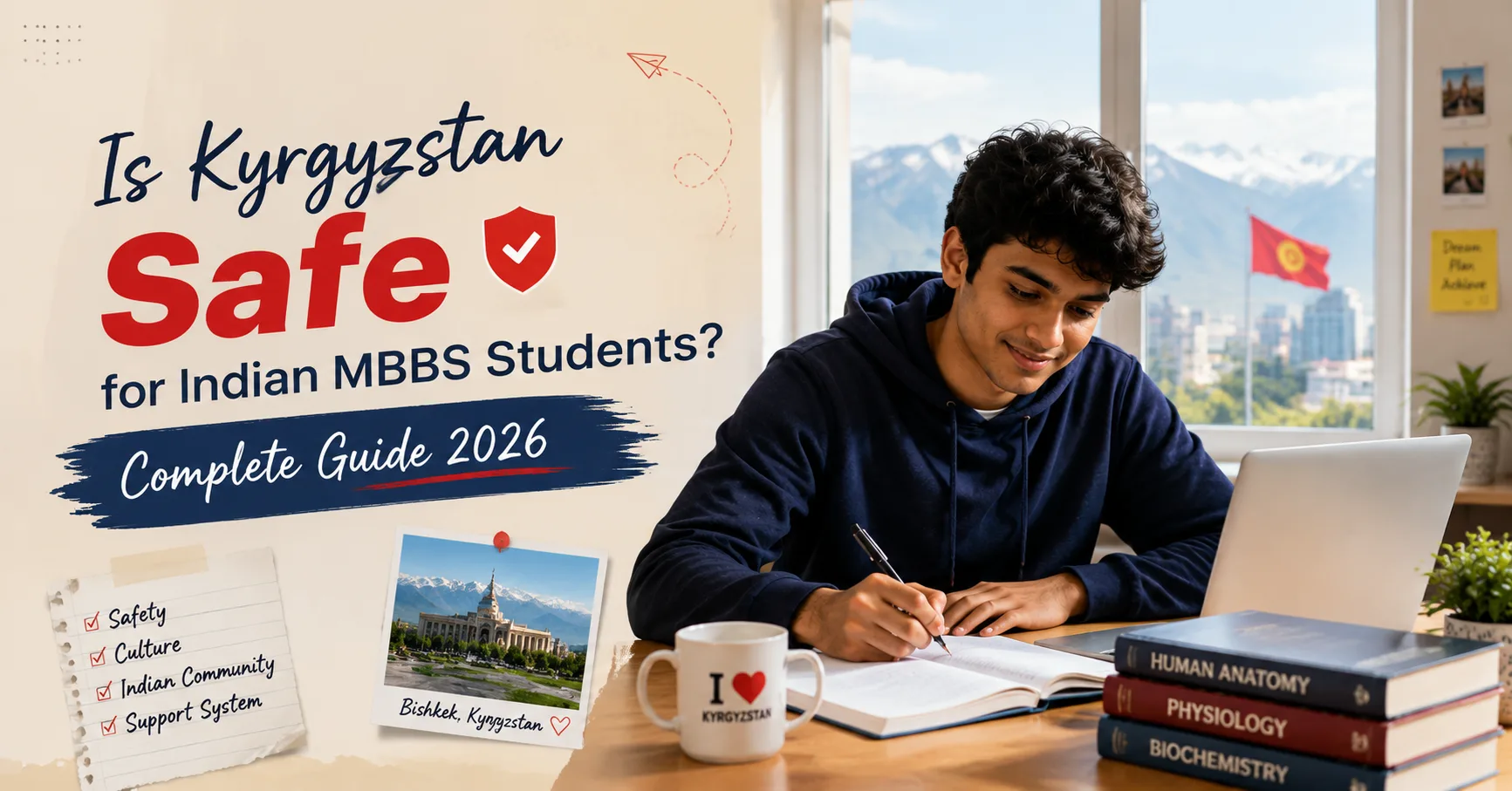
Yes, Kyrgyzstan is generally safe for Indian students. It ranks 61st of 163 countries on the 2026 Global Peace Index, and the February 2026 US travel advisory places it at Level 1, Exercise Normal Precautions, the lowest of four risk levels. Safety then depends on your university, your hostel and your night-time habits.

Kyrgyzstan is also one of the most affordable places in the world to study medicine, which is why thousands of Indian students apply here every year. But affordability is only half the decision. The other half is the question every parent asks first: is Kyrgyzstan safe for Indian students once they actually land?

Beyond the headline rankings, the wider picture matters too. There is no ongoing conflict in Kyrgyzstan, and it sits in the relatively peaceful band globally. As an Indian MBBS student, your safety depends on both that stable national environment and the precautions you take in your daily life.

Kyrgyzstan can be a safe MBBS abroad destination if you take the following measures:

  • Choose an authorised university with an on-campus secured hostel facility.
  • Keep your essential documents (i.e., passport, visa) under your control
  • Follow basic night rules and personal-safety habits, especially around crowded markets and nightlife areas
  • Stay connected with the Indian Embassy
  • Keep emergency numbers saved offline
  • Confirm if the university meets current NMC accreditation requirements

The day-to-day life is far more ordinary than the shocking news headlines. Here is a complete guide for Indian MBBS aspirants considering MBBS in Kyrgyzstan in 2026.

Breaking It DownCreated with Ai. Errors are possible
  • Yes. Bishkek has Indian restaurants and Indian grocery stores, halal meat is widely available, and most hostels let students cook. Local menus are meat-heavy, so vegetarian students usually cook a share of their own meals - which is also the cheaper option.

  • Central, well-lit areas are generally fine, but both the US and UK advisories specifically flag muggings and night-time robbery. Avoid walking alone late at night, stay away from nightlife districts and crowded markets after dark, and use university transport or a pre-booked taxi rather than an unmarked cab.

  • Police 102, ambulance 103, fire 101 and the general emergency line 112. Also save the Indian Embassy's emergency contacts, 055 571 0041 and 055 500 5538. Keep all of them in three places: your phone, a paper card in your wallet, and with a family member back in India.

What Do International Travel Advisories Say About Safety in Kyrgyzstan?

We have already established that safety depends on two factors: the national environment and personal safety measures. Here, we have added a few more suggestions from the international travel advisories that may help you get a wider perspective about safety in Kyrgyzstan.

  • In the 2026 US advisory published in February, Kyrgyzstan is described as generally safe for tourists and travellers, and it sits at Level 1: Exercise Normal Precautions, the lowest of the four US advisory levels. They only recommend some usual precautions to keep you safe against petty crimes like pickpocketing, muggings and nighttime robberies in Bishkek.
  • They warn you to stay within 30 kilometres of the Kyrgyzstan-Tajikistan border, as the area has a history of clashes.
  • Similarly, the UK Foreign, Commonwealth & Development Office warns about street crime and advises you to take additional care when travelling alone or using public transport at night.
  • You are recommended to avoid staying within 30 kilometres of the Kyrgyzstan-Tajikistan border as it carries a history of conflicts.

What Happened in Bishkek in May 2024 - and Is It Safe Now?

If you have searched this question, you have almost certainly seen the 2024 headlines. Skipping over them would not be honest, so here is exactly what happened, what was officially confirmed, and what it means for a student arriving in 2026.

It began with a hostel brawl on 13 May 2024 between a group of local men and Egyptian students. A video of the fight spread across local social media on 17 May, and that night crowds gathered outside buildings in Bishkek that housed international students. Several hostels and privately rented flats were attacked. Pakistani students were the main target, and Indian, Bangladeshi and Egyptian students were caught up in it as well.

Here is what was officially established afterwards:

  • At least 29 people were injured, according to Kyrgyz authorities.
  • Early reports that Pakistani students had been killed were denied by both the Pakistani and the Kyrgyz governments. No student deaths were confirmed.
  • The Kyrgyz Ministry of Internal Affairs detained ten people - six Kyrgyz nationals and four foreigners - and opened several criminal investigations.
  • Riot police were deployed, patrolling around student hostels was stepped up, and universities moved classes online for roughly a week.
  • The Embassy of India in Bishkek advised Indian students to stay indoors, and confirmed within days that conditions had returned to normal with no restrictions on movement.

Pakistan flew home more than 3,000 of its students, a large share of whom returned once the situation stabilised. No comparable incident has been reported in the years since, and the February 2026 US advisory still places Kyrgyzstan at its lowest risk level.

So what should you actually take from it? Two things. First, this was a sudden outbreak of mob violence rather than an ongoing pattern; the everyday risk in Bishkek is still petty crime, which is what every current advisory emphasises. Second, and far more useful to you: the students most exposed that night were those living in unguarded accommodation away from campus. That is exactly why your choice of hostel, and of an accredited university in Kyrgyzstan, matters more than any national safety ranking.

Also Read: Planning MBBS in Kyrgyzstan? Fees, colleges and admission in one place

Your Hostel Matters as Much as Your University

Your hostel security is as important as choosing the right university. The hostel will be your second home for the next 6 years; hence, it is important to check what safety and security infrastructure it provides.

Verify these factors before choosing any university:

  • The hostel should be located inside the campus
  • Hostel premises must have 24/7 security
  • The entry and exit points should be monitored
  • CCTV cameras are installed around the hostel
  • Every visitor is checked before entering the hostel
  • The university has a strong emergency communication system
  • Safe transportation is available for students travelling after classes

These questions are fundamental to understanding the living environment around your hostel premises, along with the realistic hostel and monthly cost of living in Kyrgyzstan. Whether Kyrgyzstan is safe for Indian students heavily depends on the locality and hostel facilities you choose.

Safety for Indian Girls in Kyrgyzstan

If you are a female student, you may have to take extra measures to ensure your safety when travelling alone, using transportation and going out at night.

We recommend a few simple habits that can significantly reduce risks:

  1. Choose university transport or pre-booked taxis while travelling at night.
  2. Avoid unfamiliar areas late at night.
  3. Share live location with a trusted friend or family member during long journeys.
  4. Keep emergency numbers saved offline.
  5. Avoid accepting rides from strangers.
  6. Choose university-approved accommodation.

So, Kyrgyzstan safety for girls should be judged based on the location they are residing in, their accommodation, hostel and campus security and personal routines rather than through a single label. You can also read our detailed guide on pursuing MBBS abroad from a girl's point of view.

How Can an Indian Community in Kyrgyzstan Be of Help?

When discussing safety in MBBS colleges in Kyrgyzstan, we must acknowledge the presence of an extensive Indian Student Community and the role of the Embassy of India in Bishkek.

  • The Indian community in Kyrgyzstan has a substantial student population. Present across different cities and universities, it has become an informal support system for new students.
  • Senior students help newcomers understand the culture, local transportation, university regulations, and accommodation.
  • The Embassy of India in Bishkek is the strongest emergency contact available in times of need.

Financial Safety

Choosing a government-registered and well-known consultancy also comes under the safety measures. The Indian embassy itself has warned students about issues involving education consultants, fee payments and contractual obligations with universities.

In its April 2026 advisory, it strictly recommends that students or their parents verify the consultants' company credentials before signing agreements or transferring money. Always cross-check the official Kyrgyzstan MBBS fees before transferring any amount, so that you avoid any monetary scam.

How to Take Care of Your Digital Safety

You should also be careful about photographs and social media posts. Avoid posting anything related to public buildings, the Kyrgyz flag, national customs or other sensitive subjects. Such content can lead to fines or detention in certain circumstances.

You should avoid the following activities:

  • Photographing sensitive government or security zones.
  • Commenting provocatively about local political issues.
  • Sharing any unverified information about national issues.
  • Adding any communal post to their social media handles.
  • Spreading rumours without confirmation.

In today’s world, a student's digital behaviour can directly affect their physical safety if misinformation causes unnecessary turmoil.

What is Kyrgyzstan Student Life Really Like?

Let us take a look at real pictures of Kyrgyzstan student life. It might be a separate country, but the everyday experiences are usually much more ordinary than the headlines suggest.

  • Students attend lectures, practical classes, clinical training, shop for groceries, cook, socialise with classmates and travel around the city.
  • However, the lifestyle can be different from India in terms of weather, climate, culture, language, and food.
  • Here, winters are very cold and daylight hours are shorter during winter
  • Students may need time to adapt to local food, language and transportation.
  • According to the UK government's current travel guidance, students should be prepared for frequent power cuts during winter.

You should therefore prepare for practical challenges rather than focusing exclusively on crime statistics.

What Should Indian MBBS Students Do in an Emergency?

Save emergency numbers before travelling.

  • Police: 102
  • Ambulance: 103
  • Fire: 101
  • General emergency/rescue: 112

You should also save the Indian Embassy's emergency contacts mentioned below:

Emergency Contact: 055 571 0041, 055 500 5538

Email: cons[dot]Bishkek[at]mea[dot]gov[dot]in

The Embassy also lists other emergency contacts on its website.

Note: Always try to keep these numbers in three places: your phone, a paper card in your wallet and a trusted family member's phone.

Check NMC compliance: Safety of Your MBBS Degree

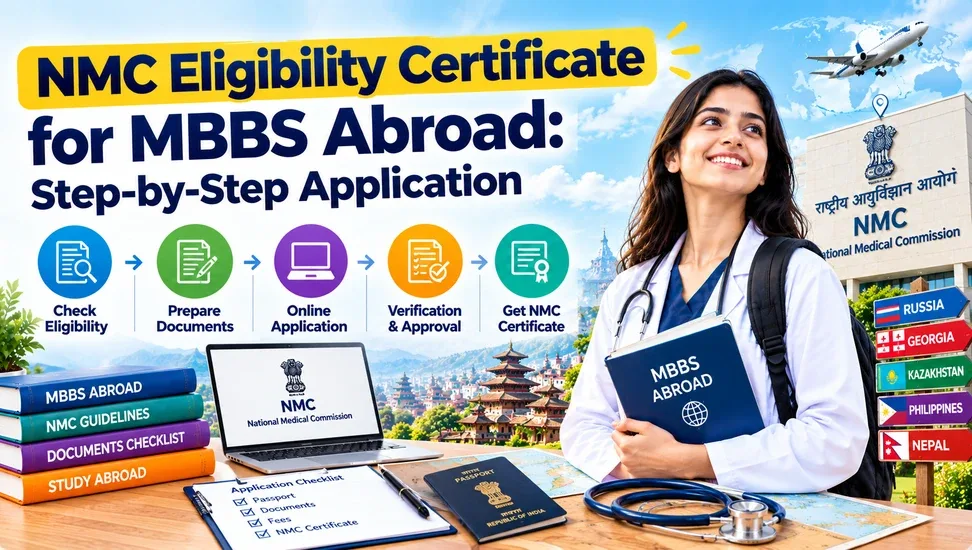
acquiring a degree that is recognised internationally The safety measures also include acquiring a degree that is recognised internationally and staying safe from academic scams. Many students blindly trust their consultant and consider any university as valid, but it can affect their future. They may not be eligible to practice in India if the university is not on the NMC-approved medical colleges abroad list. Students must check the criteria before enrolling in any university:

Practical Safety Rules for Indian Students in Kyrgyzstan

By now, you must have understood that Kyrgyzstan is generally a safe country if you keep your personal safety parameters in mind. Let us quickly go through all the safety measures that you need to keep in mind:

1. Choose your university and understand the MBBS admission process in Kyrgyzstan before choosing any consultant.

2. Check the hostel premises physically or through a reliable digital source.

3. Avoid protests or demonstrations.

4. Be extra cautious at night.

5. Keep your passport and residence documents secure - check the full list of documents required for MBBS abroad.

6. Don't carry all your cash together.

7. Use trusted transportation at night.

8. Follow university alerts during emergencies.

9. Stay connected with the Indian Embassy.

Wrapping Up

Now that you have come to the end of this blog, you must have a clear answer to the question: Is Kyrgyzstan safe for Indian students? Yes, it is a safe country, with a peaceful national environment. However, the overall safety of Indian MBBS students depends on more than the country's overall stability. It will depend on your choice of location, university, hostel, and your personal safety practices. If you are still comparing destinations, also see whether Georgia is safe for Indian students and how Russia compares on student safety.

Frequently Asked Questions

Is Kyrgyzstan safe for Indian students in 2026?

Yes, broadly. Kyrgyzstan ranks 61st out of 163 countries on the 2026 Global Peace Index and holds a Level 1 - Exercise Normal Precautions rating in the US travel advisory updated in February 2026. The realistic risks are petty crime, night-time robbery in Bishkek and the 30 km belt along the Tajik border, not organised violence.

Is Kyrgyzstan safe for Indian girls?

Female students study in Kyrgyzstan without major problems, provided they stay in university-approved accommodation, use university transport or pre-booked taxis after dark, share their live location on long journeys and avoid unfamiliar areas late at night. Judge Kyrgyzstan safety for girls by the specific campus and locality, not by the country as a whole.

Is it safer to live in a campus hostel or a private flat?

A hostel inside the campus with 24/7 security, monitored entry and exit points and CCTV is the safer default, particularly in your first year. Private flats offer more freedom but no security screening - and off-campus accommodation is where students were most exposed during the 2024 unrest. Weigh that against the cost of living in Kyrgyzstan before you decide.

Is an MBBS degree from Kyrgyzstan valid in India?

Only if both the university and the course meet NMC requirements: 54 months of curriculum, a 12-month internship at the same institution, the nine mandatory subjects, and recognition by the Kyrgyz government. Graduates must also clear the screening examination to practise in India, so plan your FMGE preparation early and verify your university's status before paying any fee.
Tags:Is Kyrgyzstan safe for Indian students

Our Newsletter

Stay updated with the latests news and exclusive content by and subscribing to our newsletter for education vibes.

Related Blogs

See All
FMGE Attempt Limit and Score Validity A Complete Guide
MBBS AbroadFMGE Attempt Limit and Score Validity A Complete Guide

As of September 2026, there is no FMGE attempt limit. Foreign medical graduates can appear for the Foreign Medical Graduate Examination as many times as needed until they qualify. A pass also does not come with a published expiry date, so your FMGE result stays usable for registration with the NMC or a State Medical Council.Many MBBS abroad aspirants still believe that FMGE allows only 6 attempts in 3 years. In this guide, we separate the facts from the rumours using official NBEMS and NMC information, and explain what the 2026 rule changes mean for your next attempt.Get Free FMGE Guidance from Our ExpertsFMGE Attempt Limit at a GlanceHere are the key facts every FMGE candidate should know:QuestionAnswerFMGE attempt limitNo cap. You can attempt as many times as needed until you pass.FMGE score validity periodNo published expiry. Once you pass, the result can be used for NMC or State Medical Council registration.Qualifying marks150 out of 300 (50%), with no negative markingExam frequencyThree sessions a year (from late 2026)Course completion ruleForeign MBBS and internship must be completed within 10 years of joining (NMC FMGL Regulations 2021)What Is FMGE and Who Needs to Take It?The Foreign Medical Graduate Examination (FMGE) is a screening test conducted by the National Board of Examinations in Medical Sciences (NBEMS) on behalf of the National Medical Commission (NMC). It assesses Indian citizens and Overseas Citizens of India (OCI) who obtained their primary medical qualification from a university outside India.You must qualify FMGE to get registered with the NMC or a State Medical Council and practise medicine legally in India. For graduates from popular destinations such as Russia, Georgia, the Philippines, Uzbekistan and Kazakhstan, FMGE is currently the only route to medical practice in India. For a detailed overview of the exam, read our complete guide on the

September 24, 2026
The Real Total Cost of MBBS Abroad: Tuition, Hostel, Visa, Flights and Exams
MBBS AbroadThe Real Total Cost of MBBS Abroad: Tuition, Hostel, Visa, Flights and Exams

The total cost of MBBS abroad for Indian students usually ranges from about ₹28 lakh to ₹50 lakh for the complete 6-year programme in popular budget destinations such as Russia, Kyrgyzstan, Kazakhstan and Uzbekistan, and can go up to about ₹65-70 lakh in Georgia. This includes tuition fees, hostel charges, food costs, and other miscellaneous expenses. The exact cost varies according to the foreign destination and medical institution chosen by a medical aspirant. In contrast to an overall cost of ₹60 lakh to well over ₹1 crore to pursue medicine at private medical colleges in India, overseas education offers students a more affordable and truly enriching experience.MBBS abroad has become a preferred option for many Indian students because of the intense competition for limited seats in government medical institutions and the high prices of private medical colleges. Still, calculating the total cost gives a realistic picture of how much different expense categories can account for in your overall budget. We are going to look at the actual, real cost of pursuing medicine overseas, accounting for accommodation, dining, renewals of the study visa, travel, documentation, and mandatory fees of licensing examinations after graduation.Get Your Free MBBS Abroad Cost BreakdownGeneral Overview of Pursuing an MBBS Abroad for Indian StudentsThe opportunity to pursue overseas education is filled with an array of academic and extracurricular experiences, opening up a different environment and enabling you to think from a wider perspective. Indian students and parents should get familiar with the key details of this opportunity before working out the total cost. The table below highlights the essential information:Course NameMBBS (called MD or MBBCh in some countries)Course LevelUndergraduate/Bachelor’sTotal DurationAbout 6 years (5 years of study + 1-year internship), in line with NMC’s Foreign Medical Graduate Licentiate (FMGL) Regulations, 2021Total CostAround ₹28 lakh to ₹50 lakh in

September 24, 2026
Cost of Living in Vietnam for Indian MBBS Students
MBBS AbroadCost of Living in Vietnam for Indian MBBS Students

Vietnam is becoming an increasingly relevant destination for international students looking for affordable education in an Asian cultural environment. For Indian students considering MBBS in Vietnam, tuition fees are only one part of the financial planning. Accommodation, food, transport, utilities, healthcare, study materials and personal expenses all belong in the same budget, and together they usually decide whether a family can sustain six years abroad - not the fee quote in the brochure.The cost of living in Vietnam varies significantly with the city, the accommodation type and the lifestyle. Hanoi and Ho Chi Minh City are more expensive than smaller cities, while sharing accommodation and eating local food pulls the monthly figure down sharply. For reference, RMIT Vietnam estimates monthly rent for international students in Hanoi and Ho Chi Minh City at about $250–600 and recommends around $250 per month for food.This guide explains the major expenses Indian MBBS students should plan for before choosing Vietnam, and how those numbers sit against the cost of MBBS abroad for Indian students generally. All conversions use the September 2026 rate of 1 USD ≈ ₹90 ≈ VND 25,700.MBBS Fees Structure and Cost of Living in VietnamThe MBBS fee structure and living costs in Vietnam are affordable compared with most other overseas destinations. Total six-year tuition generally runs ₹20 lakh to ₹30 lakh for the whole course, which is well below a private medical seat in India and broadly in line with the MBBS abroad fees charged in Central Asia and Eastern Europe. Living costs are reasonable but vary from student to student. Here is the expense picture for an aspiring student.Fees StructureType of ExpenseApprox. Cost (in USD)Approx. Cost (in INR)Annual Tuition Fee$4,000₹3,60,000Annual Hostel Fee$1,200₹1,08,000Annual Mess Fee$1,000₹90,000Medical Insurance$200₹18,000Visa Extension Fee$100₹9,000Note: Converted at the September 2026 rate of 1 USD ≈ ₹90. Fees differ

September 22, 2026
Tver State Medical University FMGE Pass Percentage and NMC Status 2026
MBBS AbroadTver State Medical University FMGE Pass Percentage and NMC Status 2026

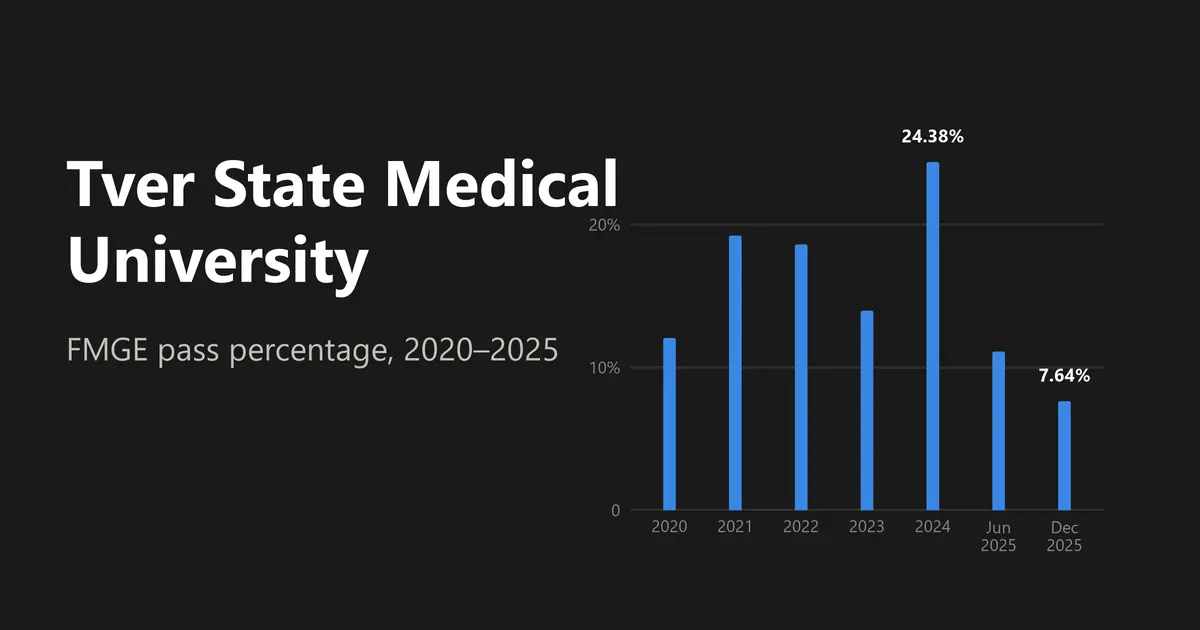
Choosing Tver State Medical University should not come down to tuition fees, rankings or campus photographs. For an Indian MBBS aspirant, two things decide whether the degree is usable at home: whether the course meets the NMC's conditions, and how the university's graduates actually perform in FMGE. According to the National Board of Examinations in Medical Sciences, Tver State Medical University's FMGE pass percentage has ranged from 7.64% to 24.38% between 2020 and 2025.This guide sets out the year-by-year FMGE record, the university's status against each NMC requirement, where NExT stands in 2026, and whether a Russian MBBS degree is valid in India. If you are still comparing universities, start with our guide to MBBS in Russia. Check if you qualify for the 2026 Tver intake Quick Facts of Tver State Medical UniversityFactorsInformationUniversity NameTver State Medical UniversityCountryRussiaCityTverPublic/PrivateFederal state medical universityCourse nameGeneral medicine programme (equivalent to MBBS)Course duration(5+1) years, including internshipCourse mediumEnglish for Indian studentsLicensing pathway in IndiaQualify for FMGE or upcoming NExTFMGE Pass Percentage in 202424.38%FMGE Pass Percentage in 2025In the June session, 11.11%, and in the December session, 7.64%Is Tver State Medical University NMC Approved?Previously, the Medical Council of India (MCI) issued a list of colleges and universities approved by the board. But now, the National Medical Commission of India (NMC) doesn't publish any list; rather, it announced guidelines for foreign medical graduates under the NMC Foreign Medical Graduate Licentiate (FMGL) Regulations, 2021. Our guide to the new NMC guidelines for MBBS abroad explains the regulations in full, and our list of NMC-compliant medical colleges abroad covers the other destinations.Here is Tver State Medical University measured against each requirement.FactorsDetailed Guidelines of the NMCStatus of Tver State Medical UniversityMinimum Course DurationThe minimum duration must be 54 months in a single universityConducts the MD program (equivalent to MBBS) for 6 years

September 21, 2026
Health and Travel Insurance for MBBS Students Abroad
MBBS AbroadHealth and Travel Insurance for MBBS Students Abroad

Imagine pursuing MBBS abroad far from home and suddenly requiring hospital treatment, emergency evacuation or urgent medical help. Who would cover the cost? An unexpected medical emergency can turn into a financial and logistical challenge within hours. That is why health and travel insurance for MBBS students abroad is an important part of planning, rather than an optional travel add-on. Choosing the right insurance policy can help cover medical expenses and provide access to emergency support.This guide covers everything MBBS students need to understand about health and travel insurance abroad.Talk to our CounsellorWhy MBBS Students Abroad Need Health and Travel InsurancePursuing an MBBS abroad is not a one-, two-, or four-year commitment. It takes around six years or more to complete and is one of the most demanding programmes for Indian students. During this journey, students may face illness, accidents, hospitalisation, travel delays, lost baggage or other emergencies. Appropriate health and travel insurance for MBBS students abroad can help cover eligible costs while they are away from home.Travel and health insurance policies do not offer the same protection. Insurance requirements can vary by country, visa category, and medical university. Students planning to study MBBS in Russia, or in other destinations such as Kazakhstan, Kyrgyzstan and other Central Asian countries, must check the requirements, policy exclusions, and claim procedures before purchasing cover.Is Insurance Mandatory for a Student Visa?Whether insurance is mandatory for a student visa depends on the destination country and the type of visa. Some countries may ask for approved health insurance before or after enrolment. Others may provide access to a national or university-linked healthcare system. For a UK Student visa, applicants have to pay the Immigration Health Surcharge as part of their visa application. This provides access to NHS healthcare, although some services may still involve charges. For

September 17, 2026
Education Loan for MBBS Abroad 2026: Bank-by-Bank Comparison
MBBS AbroadEducation Loan for MBBS Abroad 2026: Bank-by-Bank Comparison

Education loan for MBBS abroad interest rate currently ranges from about 8.65% to 14.50% per annum (p.a.). Public sector banks sit at the lower end with floating rates of roughly 8.65% to 11.25% p.a., while private banks and NBFCs price higher. Since a foreign medical degree costs INR 20 lakh to INR 40 lakh end to end, the loan is usually what decides whether the admission actually happens.A 6-year MBBS in Russia works out to roughly INR 25 lakh, and Georgia closer to INR 35 lakh once tuition, hostel and living costs are added. Very few families fund that from savings. An education loan covers tuition plus living expenses abroad and spreads repayment over a tenure of up to 15 years. You can see a country-wise breakdown in our guide to MBBS abroad fees.This guide breaks down a bank-by-bank comparison, collateral-free limits, required documents, moratorium terms and tax benefits, so you can pick the right medical education loan for studying abroad.Book Free Counselling SessionCan I Get an Education Loan for MBBS Abroad in 2026?Yes. Lenders actively fund MBBS abroad, provided you meet four conditions:Your university is recognised by the NMC or WHO and appears on the lender's approved list. Check our NMC-approved medical colleges abroad list before you shortlist.You hold a provisional or confirmed admission offer letter.Your co-applicant has a stable, documented income.Your co-applicant's CIBIL score is roughly 700 or above.The rate you are offered varies by lender and profile. Public sector banks quote floating rates of about 8.65% to 11.25% p.a. Private banks and Non-Banking Financial Companies (NBFCs) quote 10.25% to 14.50% p.a.Collateral is where lenders differ most. Most public sector banks lend up to INR 7.5 lakh unsecured and ask for tangible security above that. NBFCs and a few private lenders stretch the collateral-free limit to INR 40

September 17, 2026
MBBS in Uzbekistan Without NEET: The Honest Answer (2026)
MBBS AbroadMBBS in Uzbekistan Without NEET: The Honest Answer (2026)

no, you cannot do MBBS in Uzbekistan without NEET not if you are an Indian citizen or OCI who wants to come back and practise medicine in India. The National Medical Commission (NMC) requires you to qualify NEET-UG before you take admission to any primary medical qualification abroad. A university in Tashkent or Samarkand may happily accept your application without a NEET score, but that admission letter does not make your future degree usable in India.That gap, between what an Uzbek university will accept and what Indian regulations will recognise, is where students lose six years and ₹20–30 lakh. This guide explains where the line sits, what the NMC's April 2026 Uzbekistan advisory actually said, and the checks to run before you pay a single rupee.Book Your Free Counselling SessionIs NEET Required for MBBS in Uzbekistan?Yes. For Indian nationals and Overseas Citizens of India, qualifying NEET is a regulatory requirement under the NMC framework, and Uzbekistan is no exception.The NMC's guidance is clear: an Indian citizen or OCI who wants to obtain a primary medical qualification from a foreign institution must qualify NEET. The NEET result then forms the basis of the eligibility certificate, provided the other criteria are also met.The confusion arises because students collapse two separate questions into one:Will an Uzbek university admit me without a NEET score? Possibly — that is the university's own decision, made under its own rules.Will Indian regulations let me use that degree to register and practise here? That is the NMC's decision, and it requires NEET.Two different authorities answer those questions, and only the second one determines whether your degree is worth anything in India. So when an advertisement promises MBBS in Uzbekistan without NEET, at best it is describing a university's admission policy. It is not describing your eligibility under Indian

September 9, 2026
Is MBBS Abroad Worth It in 2026? Honest ROI Breakdown
MBBS AbroadIs MBBS Abroad Worth It in 2026? Honest ROI Breakdown

Every year, thousands of Indian students go to pursue MBBS abroad due to rising competition and limited government medical seats in the country. Choosing a foreign country to pursue medicine is a viable option these days. However, many students have a common question: Is MBBS abroad worth it? The honest answer is: Yes, an MBBS abroad is worth it in 2026 because of its quality education, affordability, and modern infrastructure. Additionally, the return on investment is much higher than that of Indian private medical colleges. An overseas medical degree offers a bright career with a high return and better career prospects. However, students must plan carefully due to rising tuition fees, stricter legal requirements, and longer degree durations. In this blog, you will learn why MBBS abroad is worth it in 2026. You will also get the honest Return on Investment breakdown.Talk to an MBBS Abroad ExpertIs MBBS abroad worth it in 2026?Pursuing MBBS abroad is worth it if you do not secure a seat in the Indian government colleges and want an affordable alternative. Hence, choosing an overseas university with a tight budget is a better option to consider. However, based on the location and university guidelines, the tuition fee for the MBBS programme may vary slightly. In Central Asian countries such as Uzbekistan, Kyrgyzstan, and Kazakhstan, students pay lower tuition fees than in many European countries, like the UK, the USA, or Poland.But one thing to keep in mind while choosing a medical college is that an MBBS degree must comply with NMC guidelines so you can practice medicine in India after graduation. Aside from affordability and NMC compliance, studying medicine abroad is better due to better employment opportunities, world-class education, and research opportunities. NMC guidelines to study medicine abroadIndian students must verify if the MBBS curriculum complies with the NMC

September 9, 2026
FMGE Pass Rate of Vietnam MBBS Graduates
MBBS AbroadFMGE Pass Rate of Vietnam MBBS Graduates

Vietnam has become a serious option for Indian students who want an English-taught medical degree at a lower cost than a private seat in India. But cost is only half the decision. If you intend to come back and practise in India, the question that actually matters is what happens after graduation and that means the Foreign Medical Graduate Examination. Before committing six years and several lakhs to MBBS in Vietnam, you need to understand what the FMGE pass rate for Vietnam graduates really tells you, and what it cannot tell you.This guide gives you the honest position: what the official data shows, what it does not, and how to get a number that actually applies to the university you are considering. Check Free eligibility What is the FMGE?The FMGE is a mandatory examination required to be undertaken by all Indian citizens or Overseas Citizen of India (OCI) cardholders who have pursued their medical education abroad and plan to practise medicine in India after an MBBS abroad by obtaining a provisional or permanent registration.PurposeThe FMGE is designed for overseas residents of India or overseas citizens of India who obtained their medical degrees from foreign medical institutes. It assesses their knowledge and skills to ensure they meet the standards required to practise medicine in India.EligibilityFor Indian students who have completed their medical education abroad.StructureThe exam consists of multiple-choice questions (MCQs) and is conducted twice a year, in June and December. The qualifying score is 150 out of 300 marks.OutcomesPassing the FMGE is a requirement for foreign medical graduates to obtain a licence to practise in India and to enrol in a postgraduate course. The FMGE is due to be replaced by the NExT exam, so students should confirm which screening pathway applies to their own graduating batch.AI Section — Breaking It DownFMGE

September 9, 2026
MBBS Abroad Fees 2026 - Country-Wise Comparison Table
MBBS AbroadMBBS Abroad Fees 2026 - Country-Wise Comparison Table

In recent years, studying medicine abroad has gained popularity among Indian students. One of the primary reasons for pursuing medicine abroad is the high cost of private medical colleges in India. MBBS abroad fees are far lower than what Indian private medical colleges charge. Where an Indian private college can charge ₹10 lakh to over ₹25 lakh a year, an MBBS seat in a popular budget destination costs roughly ₹3 lakh to ₹8 lakh a year. Living expenses do add to that figure, but for most families the total still lands well below the cost of a private seat in India.This blog breaks the numbers down country by country — tuition, hostel and mess charges — so you can shortlist a destination that actually fits your family’s budget. Read on to see where the cheapest MBBS seats are in 2026 and which universities offer them.Get Free MBBS Abroad CounsellingMBBS Abroad Fees 2026: Country-Wise ComparisonApart from tuition fees, the budget to study MBBS includes accommodation charges, mess charges, visa-related expenses, medical insurance, and other miscellaneous expenses. When you plan your budget to study MBBS abroad, tuition fees contribute a significant portion of the overall expenses. However, the MBBS fees vary depending on the chosen destination and university. The table below shows the MBBS fees abroad country wise:CountryMBBS tuition fee per year (local currency)MBBS tuition fee per year (in INR)Hostel fees (per year)Mess charges (per year)Russia300,000 RUB₹3,39,00018,000 RUB90,750 RUBGeorgia4,500 USD₹4,25,1151,800 USD1,200 USDUzbekistan3,000 USD₹2,83,410500 USD1,200 USDKyrgyzstan4,000 USD₹3,77,880500 USD1,200 USDKazakhstan4,000 USD₹3,77,880700 USD1,200 USDVietnam4,000 USD₹3,77,8801,000 USD1,000 USDEgypt7,000 USD₹6,61,2901,000 USD1,200 USDBelarus4,500 USD₹4,25,115600 USD1,200 USDArmenia3,500 USD₹3,30,645800 USD1,200 USDPhilippines4,500 USD₹4,25,1152,000 USD1,200 USDBangladesh6,800 USD₹6,42,3961,200 USD800 USDChina4,500 USD₹4,25,115800 USD1,200 USDMalaysia8,000 USD₹7,55,7601,500 USD1,200 USDNepal12,000 USD₹11,33,6401,200 USD900 USD*Note: Fees are converted at 1 USD = ₹94.47 and 1 RUB = ₹1.13 (rates as of September 2026). The rupee value shifts with currency movements,

September 9, 2026
Education VibesEducation Scholar

Get Expert Guidance to Study

MBBS Abroad