MBBS Abroad

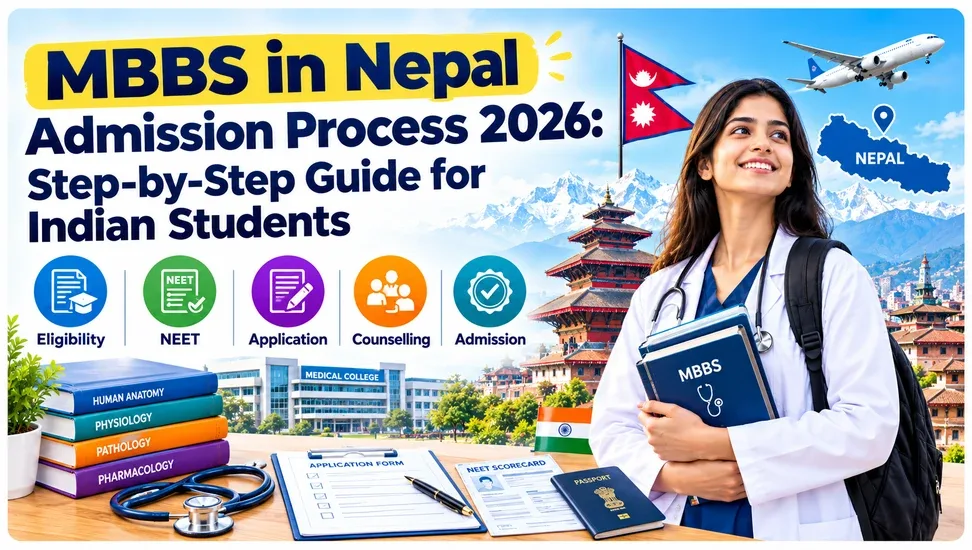
MBBS in Nepal Admission Process 2026: Step-by-Step

Shreya Chakraborty
· Senior Content WriterUpdated at - October 1, 20269 Min Read2 views
MBBS in Nepal Admission Process 2026: Step-by-Step

Table of Contents

Who Can Apply: MEC Admission Eligibility for 2026–27

Scroll Here

1. NEET-UG is mandatory — but not in the way most students think

Scroll Here

2. Academic eligibility

Scroll Here

3. Age

Scroll Here

Step-by-Step MBBS Admission Process in Nepal (2026–27 Intake)

Scroll Here

Step 1: Choose your entry route

Scroll Here

Step 2: Register on the official MEC portal

Scroll Here

Step 3: Submit documents and NEET score

Scroll Here

Step 4: Take the entrance exam (MECEE-BL route only)

Scroll Here

Step 5: Wait for the centralised merit list and matching

Scroll Here

Step 6: Biometric capture and document verification

Scroll Here

Step 7: Accept your seat and pay the first instalment

Scroll Here

Step 8: Travel and register at your college

Scroll Here

Can You Study MBBS in Nepal Without NEET? Correcting a Common Myth

Scroll Here

NMC Recognition: How to Check if a Nepal Medical College Is Valid in India

Scroll Here

Budget to Plan Before You Apply

Scroll Here

Documents Needed for the MEC Application

Scroll Here

Red Flags: How to Avoid Scams and Fake "Guaranteed Seat" Offers

Scroll Here

After MBBS in Nepal: FMGE/NExT Requirement

Scroll Here

Frequently Asked Questions

Scroll Here

What NEET score or rank do I need for MBBS in Nepal?

Scroll Here

Where do I apply for MBBS admission in Nepal?

Scroll Here

What is the MECEE-BL exam pattern?

Scroll Here

What is the application fee for MBBS admission in Nepal?

Scroll Here

What happens after the MEC merit list is published?

Scroll Here

How long does the entire Nepal MBBS admission process take?

Scroll Here

Are there Nepal medical colleges I should avoid?

Scroll Here

MBBS in Nepal admission process generally requires a valid NEET-UG qualifying percentage (50% for General; 40% for OBC/SC/ST) and a minimum of 50% aggregate in PCB subjects in your higher secondary. The application window is open from mid-August to early October. The Nepal MBBS admission process combines registration, documentation, the entrance exam (for a few universities), merit-based selection, biometric verification, and fee payment to the university. Indian students will not require a visa to fly to Nepal. In this article, we have discussed the entire MBBS process in detail.

ParticularsDetails
NEET-UG requirementYes
Entrance CriteriaMEC entrance exam (MECEE-BL) or NEET
Application Window10 August to early October 2026
Where you applyentrance.mec.gov.np (MEC's official portal)

Who Can Apply: MEC Admission Eligibility for 2026–27

1. NEET-UG is mandatory — but not in the way most students think

NMC’s 2021 regulations are clear: if you want to study MBBS abroad, Nepal included, you must qualify NEET before you take admission. Skip it, and you can’t come back and practise in India. The good news? You don’t need a high rank. You only need to cross the minimum NEET qualifying percentile for your category.

Here are the NEET-UG 2026 cut-offs (result released by NTA on 16 July 2026):

CategoryQualifying percentile2026 qualifying mark range
General / EWS50th percentile213–715 out of 720
OBC / SC / ST40th percentile177–212 out of 720

So if you scored 213 or more (General/EWS) or 177 or more (OBC/SC/ST) in 2026, you’re NEET-qualified and can apply to Nepal. Your all-India rank doesn’t matter here.

2. Academic eligibility

  • Class 12 (or equivalent) with Physics, Chemistry, Biology (PCB) and English as subjects.
  • Minimum 50% cumulative in PCB (45% for OBC / SC / ST)

3. Age

  • You must be at least 17 years old by 31 December of the admission year. Under MEC's foreign-candidate rules, there is no upper age limit.

Step-by-Step MBBS Admission Process in Nepal (2026–27 Intake)

Admissions to MBBS and other bachelor-level medical courses in Nepal are run by the Medical Education Commission (MEC). Foreign students, including Indians, can apply through one of two routes. Here’s how they differ.

Step 1: Choose your entry route

Route 1 – MECEE-BL: You sit Nepal’s own entrance test, the Medical Education Common Entrance Examination – Bachelor Level. It’s a 3-hour, 200-mark MCQ paper: +1 for every right answer, −0.25 for every wrong one.

Route 2 – NEET-based: No extra exam. You apply with your valid NEET-UG score, as long as you meet MEC’s conditions for this category.

Key dates and fees from MEC’s 2026–27 notice for foreign candidates:

Type of AdmissionApplication window (2026)Application Fee
MECEE-BL10 August, 9:00 AM – 31 August, 5:00 PM (NPT); double fee accepted until 7 September, 5:00 PM₹5,000
NEET Qualification10 August – 2 October, 5:00 PM (NPT)₹5,000 (regular); ₹10,000 (for late applications)

(Source: MEC's official 2026–27 foreign-candidate notice, published on the MEC website.)

Step 2: Register on the official MEC portal

Create your account on MEC’s official portal, entrance.mec.gov.np. This is the only place to apply, so ignore any other link you’re sent.

Step 3: Submit documents and NEET score

Upload a scan of your NEET-UG scorecard (or finish your MECEE-BL registration), along with your academic and ID documents. Check every upload before you submit. A mismatch in your name or date of birth across documents can hold up your application.

Step 4: Take the entrance exam (MECEE-BL route only)

Taking the MECEE-BL route? You’ll write Nepal’s entrance exam at a designated centre. On the NEET-based route, there’s no separate exam; MEC uses your NEET-UG score for the merit ranking.

Step 5: Wait for the centralised merit list and matching

MEC then publishes a central merit list. Seats are allotted through a computerised process based on your merit, your college preferences and the number of seats available.

Step 6: Biometric capture and document verification

If you’re selected, you’ll need to go in person to the MEC office in Sanothimi, Bhaktapur. They’ll capture your biometrics and check your original documents.

Step 7: Accept your seat and pay the first instalment

Once verification is done, confirm your seat and pay the first instalment directly into the university’s official bank account.

Step 8: Travel and register at your college

Indian citizens don’t need a visa for Nepal, but you do need a valid passport. When you arrive, your college will help you with local registration and residency paperwork.

Note: Expect the whole journey, from application to reporting at your college, to take about 10–14 weeks.

Quick Answers: Planning Your Nepal MBBS AdmissionCreated with Ai. Errors are possible
  • If you are already NEET-qualified and prefer not to sit another exam, the NEET-based route is simpler. Choose MECEE-BL if you are confident in a 200-mark MCQ test and want to compete on that score. Either way, you must be NEET-qualified for your Nepal MBBS degree to be valid in India.

  • For the 2026–27 cycle, MECEE-BL accepted applications with a double fee until 7 September, and the NEET-based route accepted applications until 2 October with a ₹10,000 late fee. Once these windows close, wait for the next MEC cycle — never apply through unofficial portals or agents promising a late seat.

  • Make sure you have a written seat allotment from MEC, verify the college on WHO WDOMS under its exact legal name, and pay only into the university’s official bank account. Keep every receipt and allotment document safe for future NMC and FMGE paperwork.

  • Carry all original documents you uploaded during registration, your passport, NEET-UG scorecard and passport-size photographs. Report on the date MEC announces at its office in Sanothimi, Bhaktapur, and plan your travel so you are not late.

Can You Study MBBS in Nepal Without NEET? Correcting a Common Myth

Some agents still tell students they can do MBBS in Nepal without NEET. A college might even admit you. But if you plan to come back and practise in India, it’s a dead end. Since the 2018 amendment to the Screening Test Regulations, every Indian citizen or OCI studying medicine abroad must qualify NEET-UG to be eligible for registration in India.

NMC Recognition: How to Check if a Nepal Medical College Is Valid in India

You may have seen an “NMC-approved list of Nepal medical colleges” being shared around. It doesn’t exist. NMC has said on its own website that it doesn’t keep a list of approved foreign medical universities. So how do you know your degree will count? Check your college against the conditions in NMC’s 2021 regulations:

  • Check if your university is listed in WDOMS
  • Minimum 54 months of theoretical instruction
  • 12-month clinical internship
  • English as the medium of instruction
  • All mandatory Schedule 1 subjects taught
  • Degree awarded is a Primary Medical Qualification
  • Internship completed at the university hospital

We’d also suggest applying for an NMC Eligibility Certificate (under the Eligibility Certificate Regulations, 2002) before you join. It’s the simplest way to avoid surprises later.

Once a college ticks every box, compare it with others on our list of top medical colleges in Nepal before you fill in your MEC preferences.

Budget to Plan Before You Apply

Have your full-course budget sorted before you accept a seat, since the first instalment is due soon after verification. Costs vary from college to college, and government and autonomous colleges usually cost less than private ones. For college-wise tuition, hostel and living costs, see our MBBS in Nepal fees and cost of living breakdown.

Documents Needed for the MEC Application

Get these ready before you start your application. For a broader checklist, see our guide to documents required for MBBS abroad.

  • Valid passport
  • NEET-UG scorecard
  • Marksheets & certificates of Class 10 and Class 12
  • Proof of Birth
  • Migration certificate
  • Medical fitness certificate
  • HIV-negative report
  • Police clearance certificate
  • Passport-size photographs
  • Proof of Nationality
  • MEA (Ministry of External Affairs) and Nepal Embassy notarised academic documents

Red Flags: How to Avoid Scams and Fake "Guaranteed Seat" Offers

Getting an MBBS seat in Nepal isn’t hard. But nobody, whether an agent or a college, can guarantee you one. Watch out for these warning signs:

  • A seat promised without NEET: NMC hasn’t allowed this since 2018.
  • A “guaranteed FMGE pass”: No one can promise this. Your result depends on your own preparation and the support your college gives you.
  • Colleges you can't find on WDOMS under their exact name, or that have recently changed names. Search both the old and new name — some institutions rebrand after losing standing.
  • Requests to pay fees into a personal account, an agent's account, or any account that isn't the university's own official bank account.
  • Application links other than entrance.mec.gov.np. MEC has warned candidates against unofficial third-party portals.
  • Pressure to pay large sums before you have a written offer letter, or before you’ve checked the college on WDOMS yourself.

After MBBS in Nepal: FMGE/NExT Requirement

Getting your degree is only half the job. To practise in India, you’ll need to clear the FMGE (which will be replaced by NExT once it’s rolled out).

  • FMGE (Foreign Medical Graduate Examination): Conducted by the National Board of Examinations in Medical Sciences (NBEMS), this is the screening test every Indian who studies medicine abroad must pass. You need 150 out of 300 (50%) to qualify.

Pass rates differ a lot between countries and between colleges, so ask for a college’s own FMGE record before you apply. To compare countries, see our guide to FMGE passing percentage of top countries.

Frequently Asked Questions

What NEET score or rank do I need for MBBS in Nepal?

There’s no fixed score and no rank requirement. You just need to cross the qualifying percentile for your category: 50th for General/EWS and 40th for OBC/SC/ST. Unlike government colleges in India, Nepal doesn’t ask for a competitive all-India rank.

Where do I apply for MBBS admission in Nepal?

Only on MEC’s official portal, entrance.mec.gov.np. If an agent or website asks you to apply anywhere else, don’t.

What is the MECEE-BL exam pattern?

It’s a 3-hour paper with 200 MCQs. You get +1 for each correct answer and lose 0.25 for each wrong one.

What is the application fee for MBBS admission in Nepal?

The regular fee is ₹5,000 under MEC’s 2026–27 notice. Apply late and you’ll pay more: double the fee for MECEE-BL, or ₹10,000 for the NEET-based route. The table under Step 1 has the exact dates.

What happens after the MEC merit list is published?

If you’re selected, you go to the MEC office in Sanothimi, Bhaktapur, for biometrics and original document checks. After that, you confirm your seat by paying the first instalment into the university’s official bank account.

How long does the entire Nepal MBBS admission process take?

Plan for 10–14 weeks from application to seat confirmation. Add another 2–3 weeks if your documents still need attestation.

Are there Nepal medical colleges I should avoid?

Stay away from any college you can’t find on WHO WDOMS under its exact legal name. And if a college or agent promises admission without NEET or a guaranteed FMGE pass, treat it as a red flag.
Tags:MBBS in Nepal Admission Process

Our Newsletter

Stay updated with the latests news and exclusive content by and subscribing to our newsletter for education vibes.

Related Blogs

See All
Paying MBBS Abroad Fees: Forex, TCS Rules, and Safe Transfers
MBBS AbroadPaying MBBS Abroad Fees: Forex, TCS Rules, and Safe Transfers

When you decide to study medicine abroad, one practical question soon follows: how do you pay MBBS abroad university fees from India? In 2026, the process is simple once you know the rules. Fees can be sent through a SWIFT international bank transfer or an RBI-authorised education payment platform, under the Reserve Bank of India's Liberalised Remittance Scheme (LRS).Before you send any money, you and your family should understand the LRS limit, the latest TCS rules, and how exchange rates affect your final cost. This guide covers all of it, including LRS limits, TCS rates, SWIFT transfers, forex cards, and how to transfer money safely.Get Free Fee Payment GuidanceHow to Pay MBBS Abroad University Fees from India?To pay MBBS abroad fees from India, use an Authorised Dealer Category-I bank or an RBI-authorised education payment platform. All such payments are made under RBI's Liberalised Remittance Scheme (LRS).Once you know the MBBS abroad fees for your chosen university, these are the most common payment methods:SWIFT / international bank transfer – for tuition and hostel feesEducation loan disbursement – sent by the lender directly to the universityAuthorised education payment platforms – such as Flywire or ConveraForex card – for daily living expenses, not for tuition feesUnderstanding RBI's LRS Limit for Education AbroadThe Liberalised Remittance Scheme (LRS) allows every resident Indian to send up to USD 250,000 abroad in each financial year (1 April to 31 March). MBBS abroad tuition fees, hostel fees and living expenses all count towards this limit.Essential LRS Compliance RulesPAN is mandatory: The person sending the money (remitter) must have a valid PAN linked with Aadhaar.Annual limit: The limit applies per financial year and resets on 1 April every year.Multiple remitters: Parents or other family members can each use their own LRS limit to pay for the same student.LRS Limit

October 1, 2026
FMGE Attempt Limit and Score Validity A Complete Guide
MBBS AbroadFMGE Attempt Limit and Score Validity A Complete Guide

As of September 2026, there is no FMGE attempt limit. Foreign medical graduates can appear for the Foreign Medical Graduate Examination as many times as needed until they qualify. A pass also does not come with a published expiry date, so your FMGE result stays usable for registration with the NMC or a State Medical Council.Many MBBS abroad aspirants still believe that FMGE allows only 6 attempts in 3 years. In this guide, we separate the facts from the rumours using official NBEMS and NMC information, and explain what the 2026 rule changes mean for your next attempt.Get Free FMGE Guidance from Our ExpertsFMGE Attempt Limit at a GlanceHere are the key facts every FMGE candidate should know:QuestionAnswerFMGE attempt limitNo cap. You can attempt as many times as needed until you pass.FMGE score validity periodNo published expiry. Once you pass, the result can be used for NMC or State Medical Council registration.Qualifying marks150 out of 300 (50%), with no negative markingExam frequencyThree sessions a year (from late 2026)Course completion ruleForeign MBBS and internship must be completed within 10 years of joining (NMC FMGL Regulations 2021)What Is FMGE and Who Needs to Take It?The Foreign Medical Graduate Examination (FMGE) is a screening test conducted by the National Board of Examinations in Medical Sciences (NBEMS) on behalf of the National Medical Commission (NMC). It assesses Indian citizens and Overseas Citizens of India (OCI) who obtained their primary medical qualification from a university outside India.You must qualify FMGE to get registered with the NMC or a State Medical Council and practise medicine legally in India. For graduates from popular destinations such as Russia, Georgia, the Philippines, Uzbekistan and Kazakhstan, FMGE is currently the only route to medical practice in India. For a detailed overview of the exam, read our complete guide on the

September 24, 2026
The Real Total Cost of MBBS Abroad: Tuition, Hostel, Visa, Flights and Exams
MBBS AbroadThe Real Total Cost of MBBS Abroad: Tuition, Hostel, Visa, Flights and Exams

The total cost of MBBS abroad for Indian students usually ranges from about ₹28 lakh to ₹50 lakh for the complete 6-year programme in popular budget destinations such as Russia, Kyrgyzstan, Kazakhstan and Uzbekistan, and can go up to about ₹65-70 lakh in Georgia. This includes tuition fees, hostel charges, food costs, and other miscellaneous expenses. The exact cost varies according to the foreign destination and medical institution chosen by a medical aspirant. In contrast to an overall cost of ₹60 lakh to well over ₹1 crore to pursue medicine at private medical colleges in India, overseas education offers students a more affordable and truly enriching experience.MBBS abroad has become a preferred option for many Indian students because of the intense competition for limited seats in government medical institutions and the high prices of private medical colleges. Still, calculating the total cost gives a realistic picture of how much different expense categories can account for in your overall budget. We are going to look at the actual, real cost of pursuing medicine overseas, accounting for accommodation, dining, renewals of the study visa, travel, documentation, and mandatory fees of licensing examinations after graduation.Get Your Free MBBS Abroad Cost BreakdownGeneral Overview of Pursuing an MBBS Abroad for Indian StudentsThe opportunity to pursue overseas education is filled with an array of academic and extracurricular experiences, opening up a different environment and enabling you to think from a wider perspective. Indian students and parents should get familiar with the key details of this opportunity before working out the total cost. The table below highlights the essential information:Course NameMBBS (called MD or MBBCh in some countries)Course LevelUndergraduate/Bachelor’sTotal DurationAbout 6 years (5 years of study + 1-year internship), in line with NMC’s Foreign Medical Graduate Licentiate (FMGL) Regulations, 2021Total CostAround ₹28 lakh to ₹50 lakh in

September 24, 2026
Cost of Living in Vietnam for Indian MBBS Students
MBBS AbroadCost of Living in Vietnam for Indian MBBS Students

Vietnam is becoming an increasingly relevant destination for international students looking for affordable education in an Asian cultural environment. For Indian students considering MBBS in Vietnam, tuition fees are only one part of the financial planning. Accommodation, food, transport, utilities, healthcare, study materials and personal expenses all belong in the same budget, and together they usually decide whether a family can sustain six years abroad - not the fee quote in the brochure.The cost of living in Vietnam varies significantly with the city, the accommodation type and the lifestyle. Hanoi and Ho Chi Minh City are more expensive than smaller cities, while sharing accommodation and eating local food pulls the monthly figure down sharply. For reference, RMIT Vietnam estimates monthly rent for international students in Hanoi and Ho Chi Minh City at about $250–600 and recommends around $250 per month for food.This guide explains the major expenses Indian MBBS students should plan for before choosing Vietnam, and how those numbers sit against the cost of MBBS abroad for Indian students generally. All conversions use the September 2026 rate of 1 USD ≈ ₹90 ≈ VND 25,700.MBBS Fees Structure and Cost of Living in VietnamThe MBBS fee structure and living costs in Vietnam are affordable compared with most other overseas destinations. Total six-year tuition generally runs ₹20 lakh to ₹30 lakh for the whole course, which is well below a private medical seat in India and broadly in line with the MBBS abroad fees charged in Central Asia and Eastern Europe. Living costs are reasonable but vary from student to student. Here is the expense picture for an aspiring student.Fees StructureType of ExpenseApprox. Cost (in USD)Approx. Cost (in INR)Annual Tuition Fee$4,000₹3,60,000Annual Hostel Fee$1,200₹1,08,000Annual Mess Fee$1,000₹90,000Medical Insurance$200₹18,000Visa Extension Fee$100₹9,000Note: Converted at the September 2026 rate of 1 USD ≈ ₹90. Fees differ

September 22, 2026
Tver State Medical University FMGE Pass Percentage and NMC Status 2026
MBBS AbroadTver State Medical University FMGE Pass Percentage and NMC Status 2026

Choosing Tver State Medical University should not come down to tuition fees, rankings or campus photographs. For an Indian MBBS aspirant, two things decide whether the degree is usable at home: whether the course meets the NMC's conditions, and how the university's graduates actually perform in FMGE. According to the National Board of Examinations in Medical Sciences, Tver State Medical University's FMGE pass percentage has ranged from 7.64% to 24.38% between 2020 and 2025.This guide sets out the year-by-year FMGE record, the university's status against each NMC requirement, where NExT stands in 2026, and whether a Russian MBBS degree is valid in India. If you are still comparing universities, start with our guide to MBBS in Russia. Check if you qualify for the 2026 Tver intake Quick Facts of Tver State Medical UniversityFactorsInformationUniversity NameTver State Medical UniversityCountryRussiaCityTverPublic/PrivateFederal state medical universityCourse nameGeneral medicine programme (equivalent to MBBS)Course duration(5+1) years, including internshipCourse mediumEnglish for Indian studentsLicensing pathway in IndiaQualify for FMGE or upcoming NExTFMGE Pass Percentage in 202424.38%FMGE Pass Percentage in 2025In the June session, 11.11%, and in the December session, 7.64%Is Tver State Medical University NMC Approved?Previously, the Medical Council of India (MCI) issued a list of colleges and universities approved by the board. But now, the National Medical Commission of India (NMC) doesn't publish any list; rather, it announced guidelines for foreign medical graduates under the NMC Foreign Medical Graduate Licentiate (FMGL) Regulations, 2021. Our guide to the new NMC guidelines for MBBS abroad explains the regulations in full, and our list of NMC-compliant medical colleges abroad covers the other destinations.Here is Tver State Medical University measured against each requirement.FactorsDetailed Guidelines of the NMCStatus of Tver State Medical UniversityMinimum Course DurationThe minimum duration must be 54 months in a single universityConducts the MD program (equivalent to MBBS) for 6 years

September 21, 2026
Health and Travel Insurance for MBBS Students Abroad
MBBS AbroadHealth and Travel Insurance for MBBS Students Abroad

Imagine pursuing MBBS abroad far from home and suddenly requiring hospital treatment, emergency evacuation or urgent medical help. Who would cover the cost? An unexpected medical emergency can turn into a financial and logistical challenge within hours. That is why health and travel insurance for MBBS students abroad is an important part of planning, rather than an optional travel add-on. Choosing the right insurance policy can help cover medical expenses and provide access to emergency support.This guide covers everything MBBS students need to understand about health and travel insurance abroad.Talk to our CounsellorWhy MBBS Students Abroad Need Health and Travel InsurancePursuing an MBBS abroad is not a one-, two-, or four-year commitment. It takes around six years or more to complete and is one of the most demanding programmes for Indian students. During this journey, students may face illness, accidents, hospitalisation, travel delays, lost baggage or other emergencies. Appropriate health and travel insurance for MBBS students abroad can help cover eligible costs while they are away from home.Travel and health insurance policies do not offer the same protection. Insurance requirements can vary by country, visa category, and medical university. Students planning to study MBBS in Russia, or in other destinations such as Kazakhstan, Kyrgyzstan and other Central Asian countries, must check the requirements, policy exclusions, and claim procedures before purchasing cover.Is Insurance Mandatory for a Student Visa?Whether insurance is mandatory for a student visa depends on the destination country and the type of visa. Some countries may ask for approved health insurance before or after enrolment. Others may provide access to a national or university-linked healthcare system. For a UK Student visa, applicants have to pay the Immigration Health Surcharge as part of their visa application. This provides access to NHS healthcare, although some services may still involve charges. For

September 17, 2026
Education Loan for MBBS Abroad 2026: Bank-by-Bank Comparison
MBBS AbroadEducation Loan for MBBS Abroad 2026: Bank-by-Bank Comparison

Education loan for MBBS abroad interest rate currently ranges from about 8.65% to 14.50% per annum (p.a.). Public sector banks sit at the lower end with floating rates of roughly 8.65% to 11.25% p.a., while private banks and NBFCs price higher. Since a foreign medical degree costs INR 20 lakh to INR 40 lakh end to end, the loan is usually what decides whether the admission actually happens.A 6-year MBBS in Russia works out to roughly INR 25 lakh, and Georgia closer to INR 35 lakh once tuition, hostel and living costs are added. Very few families fund that from savings. An education loan covers tuition plus living expenses abroad and spreads repayment over a tenure of up to 15 years. You can see a country-wise breakdown in our guide to MBBS abroad fees.This guide breaks down a bank-by-bank comparison, collateral-free limits, required documents, moratorium terms and tax benefits, so you can pick the right medical education loan for studying abroad.Book Free Counselling SessionCan I Get an Education Loan for MBBS Abroad in 2026?Yes. Lenders actively fund MBBS abroad, provided you meet four conditions:Your university is recognised by the NMC or WHO and appears on the lender's approved list. Check our NMC-approved medical colleges abroad list before you shortlist.You hold a provisional or confirmed admission offer letter.Your co-applicant has a stable, documented income.Your co-applicant's CIBIL score is roughly 700 or above.The rate you are offered varies by lender and profile. Public sector banks quote floating rates of about 8.65% to 11.25% p.a. Private banks and Non-Banking Financial Companies (NBFCs) quote 10.25% to 14.50% p.a.Collateral is where lenders differ most. Most public sector banks lend up to INR 7.5 lakh unsecured and ask for tangible security above that. NBFCs and a few private lenders stretch the collateral-free limit to INR 40

September 17, 2026
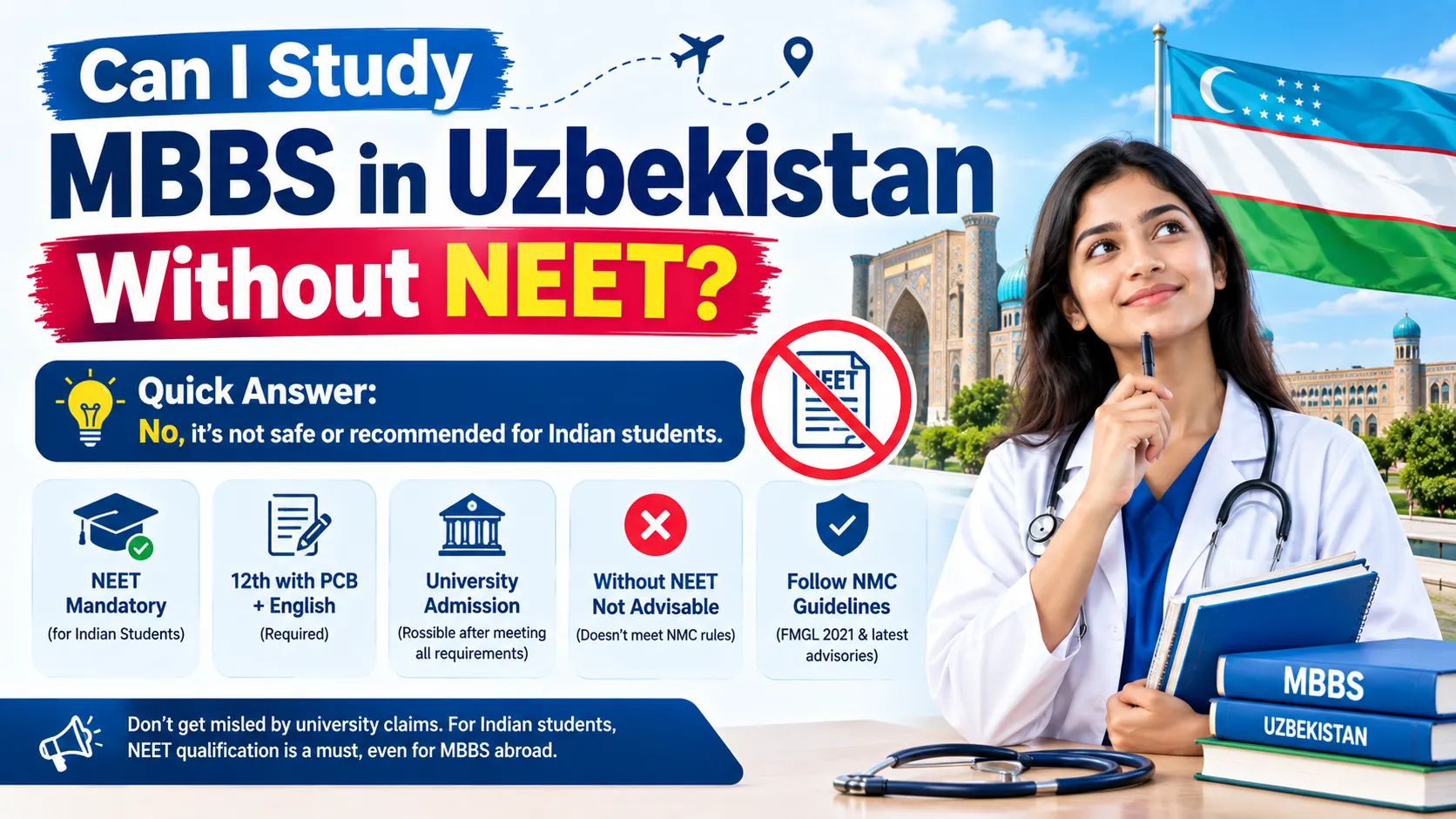
MBBS in Uzbekistan Without NEET: The Honest Answer (2026)
MBBS AbroadMBBS in Uzbekistan Without NEET: The Honest Answer (2026)

no, you cannot do MBBS in Uzbekistan without NEET not if you are an Indian citizen or OCI who wants to come back and practise medicine in India. The National Medical Commission (NMC) requires you to qualify NEET-UG before you take admission to any primary medical qualification abroad. A university in Tashkent or Samarkand may happily accept your application without a NEET score, but that admission letter does not make your future degree usable in India.That gap, between what an Uzbek university will accept and what Indian regulations will recognise, is where students lose six years and ₹20–30 lakh. This guide explains where the line sits, what the NMC's April 2026 Uzbekistan advisory actually said, and the checks to run before you pay a single rupee.Book Your Free Counselling SessionIs NEET Required for MBBS in Uzbekistan?Yes. For Indian nationals and Overseas Citizens of India, qualifying NEET is a regulatory requirement under the NMC framework, and Uzbekistan is no exception.The NMC's guidance is clear: an Indian citizen or OCI who wants to obtain a primary medical qualification from a foreign institution must qualify NEET. The NEET result then forms the basis of the eligibility certificate, provided the other criteria are also met.The confusion arises because students collapse two separate questions into one:Will an Uzbek university admit me without a NEET score? Possibly — that is the university's own decision, made under its own rules.Will Indian regulations let me use that degree to register and practise here? That is the NMC's decision, and it requires NEET.Two different authorities answer those questions, and only the second one determines whether your degree is worth anything in India. So when an advertisement promises MBBS in Uzbekistan without NEET, at best it is describing a university's admission policy. It is not describing your eligibility under Indian

September 9, 2026
Is MBBS Abroad Worth It in 2026? Honest ROI Breakdown
MBBS AbroadIs MBBS Abroad Worth It in 2026? Honest ROI Breakdown

Every year, thousands of Indian students go to pursue MBBS abroad due to rising competition and limited government medical seats in the country. Choosing a foreign country to pursue medicine is a viable option these days. However, many students have a common question: Is MBBS abroad worth it? The honest answer is: Yes, an MBBS abroad is worth it in 2026 because of its quality education, affordability, and modern infrastructure. Additionally, the return on investment is much higher than that of Indian private medical colleges. An overseas medical degree offers a bright career with a high return and better career prospects. However, students must plan carefully due to rising tuition fees, stricter legal requirements, and longer degree durations. In this blog, you will learn why MBBS abroad is worth it in 2026. You will also get the honest Return on Investment breakdown.Talk to an MBBS Abroad ExpertIs MBBS abroad worth it in 2026?Pursuing MBBS abroad is worth it if you do not secure a seat in the Indian government colleges and want an affordable alternative. Hence, choosing an overseas university with a tight budget is a better option to consider. However, based on the location and university guidelines, the tuition fee for the MBBS programme may vary slightly. In Central Asian countries such as Uzbekistan, Kyrgyzstan, and Kazakhstan, students pay lower tuition fees than in many European countries, like the UK, the USA, or Poland.But one thing to keep in mind while choosing a medical college is that an MBBS degree must comply with NMC guidelines so you can practice medicine in India after graduation. Aside from affordability and NMC compliance, studying medicine abroad is better due to better employment opportunities, world-class education, and research opportunities. NMC guidelines to study medicine abroadIndian students must verify if the MBBS curriculum complies with the NMC

September 9, 2026
FMGE Pass Rate of Vietnam MBBS Graduates
MBBS AbroadFMGE Pass Rate of Vietnam MBBS Graduates

Vietnam has become a serious option for Indian students who want an English-taught medical degree at a lower cost than a private seat in India. But cost is only half the decision. If you intend to come back and practise in India, the question that actually matters is what happens after graduation and that means the Foreign Medical Graduate Examination. Before committing six years and several lakhs to MBBS in Vietnam, you need to understand what the FMGE pass rate for Vietnam graduates really tells you, and what it cannot tell you.This guide gives you the honest position: what the official data shows, what it does not, and how to get a number that actually applies to the university you are considering. Check Free eligibility What is the FMGE?The FMGE is a mandatory examination required to be undertaken by all Indian citizens or Overseas Citizen of India (OCI) cardholders who have pursued their medical education abroad and plan to practise medicine in India after an MBBS abroad by obtaining a provisional or permanent registration.PurposeThe FMGE is designed for overseas residents of India or overseas citizens of India who obtained their medical degrees from foreign medical institutes. It assesses their knowledge and skills to ensure they meet the standards required to practise medicine in India.EligibilityFor Indian students who have completed their medical education abroad.StructureThe exam consists of multiple-choice questions (MCQs) and is conducted twice a year, in June and December. The qualifying score is 150 out of 300 marks.OutcomesPassing the FMGE is a requirement for foreign medical graduates to obtain a licence to practise in India and to enrol in a postgraduate course. The FMGE is due to be replaced by the NExT exam, so students should confirm which screening pathway applies to their own graduating batch.AI Section — Breaking It DownFMGE

September 9, 2026
Education VibesEducation Scholar

Get Expert Guidance to Study

MBBS Abroad