MBBS Abroad

Kyrgyzstan MBBS Accreditation 2026: Which Universities Passed & Failed

Aryan Raj
Aryan Raj · Senior Content WriterUpdated at - June 27, 20265 Min Read67 views
Kyrgyzstan MBBS Accreditation 2026: Which Universities Passed & Failed

Table of Contents

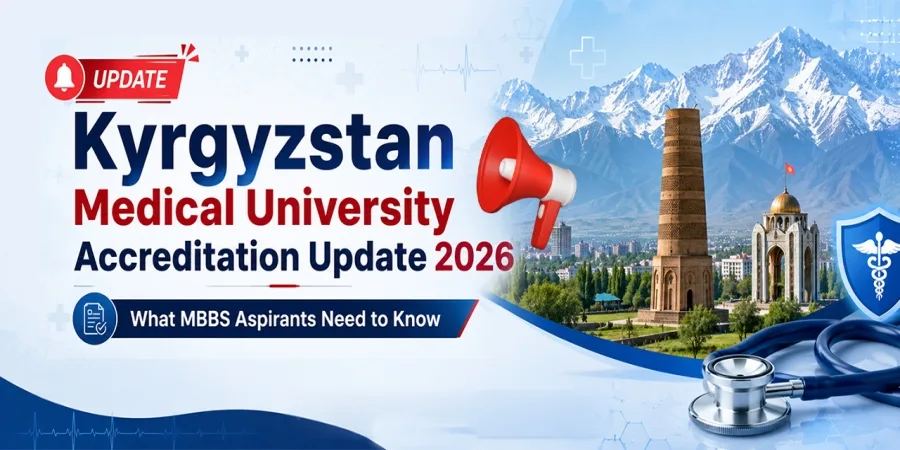
In June 2026, the Ministry of Health of the Kyrgyz Republic (MoH) announced the results of a nationwide accreditation review of medical universities in Kyrgyzstan. This Kyrgyzstan mbbs accreditation 2026 is intended to standardise medical education. The evaluation was done using the rules of a government order (Presidential Decree) passed on August 28, 2025. This order states that the government has full, sole control over medical education.

The outcome was significant: 13 medical institutions failed state accreditation, while only 4 universities received full six-year accreditation, and 7 received partial accreditation. Kyrgyzstan currently has 34 institutions training medical personnel, 12 of which are state-owned and 22 are private. In this blog, you will know about the accreditation review, which universities were affected, and what Indian MBBS aspirants should do before applying.

Why Kyrgyzstan MBBS Accreditation 2026 Conducted?

The accreditation review was conducted by the Ministry of Health of the Kyrgyz Republic (MoH) to examine the standard of medical education in Kyrgyzstan universities. The outcome was significant: 13 medical institutions failed state accreditation, while 11 universities received full and partial accreditation status. The Kyrgyzstan mbbs accreditation 2026 was conducted to:

  • Improve the quality and standard of medical education nationwide
  • Strengthen clinical and practical training of medical students
  • Ensure the availability of qualified teaching faculty for students
  • Enhance patient safety through better-trained & skilled doctors
  • Increase recognition and credibility of Kyrgyz medical degrees

Landscape of Current Medical Education in Kyrgyzstan

Medical universities in Kazakhstan have always been in the limelight due to the affordability of education, quality education, and authorised MBBS degrees. It boasts a huge portion of the international student community, particularly from India, Pakistan, Bangladesh, Nepal, and several African countries. As per the recent data, Kyrgyzstan's medical education is currently undergoing a strict accreditation review. Below are the key attributes mentioned.

  • 34 institutions currently offer medical education programs.
  • 12 are public universities.
  • 22 are private universities.
  • 24 institutions participated in the accreditation review process.
  • Seven universities did not participate in the accreditation process.
  • Three major universities were exempt from the review due to their special legal status.
Breaking It DownCreated with Ai. Errors are possible
  • There are 34 institutions training medical personnel, 12 state-owned (public) and 22 private. 24 took part in the review, 7 did not participate, and 3 major universities were exempt due to their special legal status.

  • To improve the quality of medical education, strengthen clinical and practical training, ensure qualified faculty, enhance patient safety, and increase the global recognition and credibility of Kyrgyz medical degrees.

  • Verify the latest accreditation status, NMC eligibility requirements, WHO/WDOMS listing, faculty qualifications, infrastructure and labs, teaching hospital affiliations, clinical training and internship opportunities, graduate licensing exam results, and international recognition.

University Got Full & Partial Accreditation 2026

In total, there are only 11 universities that got accreditation under the review process out of 24 universities nationwide. Below is the list of universities that got the Kyrgyzstan MBBS Accreditation 2026.

Universities Receiving Full 6-Year Accreditation

Only four medical universities in Kyrgyzstan get full 6-year accreditation. It is the highest accreditation, which means these universities' strong performance in areas such as faculty qualifications, clinical training facilities, infrastructure, and academic quality. Here are the universities mentioned.

  1. Osh State University (OshSU)
  2. International University of Kyrgyzstan (MUK)
  3. International Higher School of Medicine (IHSM)
  4. Asian International University (AIU)

Universities Granted 1-Year Conditional Accreditation

Seven universities granted 1 year of conditional accreditation. To qualify for a longer accreditation, these institutions are required to correct the noted deficiencies. The universities are:

  1. Kyrgyz National University
  2. Jalal-Abad State University
  3. Kyrgyz-Uzbek International University
  4. Issyk-Kul State University
  5. Jalal-Abad International University
  6. University of South Asia
  7. International European University

13 Medical Universities That Failed State Accreditation in 2026

Below is the list of universities mentioned that fail the Kyrgyzstan mbbs accreditation 2026. Let’s have a look at them.

University NameAccreditation Status
Avicenna International Medical UniversityFailed
ADAM UniversityFailed
Royal Metropolitan UniversityFailed
Altamimi International UniversityFailed
Ala-Too International UniversityFailed
Eurasian International UniversityFailed
International Medical UniversityFailed
Kyrgyz Medical and Dental InstituteFailed
Salymbekov UniversityFailed
Bishkek International Medical InstituteFailed
International University of Medicine and ScienceFailed
Central Asian International Medical UniversityFailed
Central Asian Medical InstituteFailed

Impact on Current Medical Students

When we talk about what will happen to existing students who are currently study medicine abroad, institutions that failed the Kyrgyzstan MBBS Accreditation 2026. So, according to the official advisory conveyed by the Indian Embassy in Bishkek, Kyrgyzstan, if your university loses its accreditation, you can transfer to the Kyrgyz State Medical Academy or another approved school. You don't need to panic, but you should pay close attention and wait for official announcements.

Overall Checklist for Students Before Applying to MBBS in Kyrgyzstan

Medical applicants seeking an MBBS in Kyrgyzstan must check the following checklist, which is mentioned below. It will ensure their degree validity, global prospects, and degree validity to practice medicine. Key aspects are as follows:

  • Infrastructure and laboratory facilities
  • Latest accreditation status
  • NMC eligibility requirements
  • Clinical training opportunities
  • Faculty qualifications
  • WHO/WDOMS listing
  • Teaching hospital affiliations
  • Internship opportunities
  • Graduate licensing examination outcomes
  • International recognition and partnerships

Conclusion

The Ministry of Health of the Kyrgyz Republic (MoH) have conducted a survey to examine the standard of medical education at Kyrgyz medical universities. The result was shocking: only 11 universities got accreditation (4 universities got full-6 year accreditation and 7 universities granted 1 year of conditional accreditation), while 13 medical universities failed the Kyrgyzstan MBBS Accreditation 2026.

Frequently Asked Questions

Q1. What is the Kyrgyzstan MBBS Accreditation 2026?

It is a nationwide accreditation review of medical universities announced by the Ministry of Health of the Kyrgyz Republic (MoH) in June 2026. It was conducted under a Presidential Decree passed on August 28, 2025, to standardise medical education and place it fully under government control.

Q2. How many universities passed and failed the accreditation?

Out of 24 universities that participated, only 11 received accreditation — 4 got full 6-year accreditation and 7 got 1-year conditional accreditation. 13 medical institutions failed state accreditation.

Q3. Which universities received full 6-year accreditation?

- Osh State University (OshSU)
- International University of Kyrgyzstan (MUK)
- International Higher School of Medicine (IHSM)
- Asian International University (AIU)

Q4. Which universities received 1-year conditional accreditation?

Kyrgyz National University, Jalal-Abad State University, Kyrgyz-Uzbek International University, Issyk-Kul State University, Jalal-Abad International University, University of South Asia, and International European University. They must fix the noted deficiencies to qualify for longer accreditation.

Tags:kyrgyzstan mbbs accreditation 2026

Our Newsletter

Stay updated with the latests news and exclusive content by and subscribing to our newsletter for education vibes.

Related Blogs

See All
MBBS in Uzbekistan Without NEET: The Honest Answer (2026)
MBBS AbroadMBBS in Uzbekistan Without NEET: The Honest Answer (2026)

no, you cannot do MBBS in Uzbekistan without NEET not if you are an Indian citizen or OCI who wants to come back and practise medicine in India. The National Medical Commission (NMC) requires you to qualify NEET-UG before you take admission to any primary medical qualification abroad. A university in Tashkent or Samarkand may happily accept your application without a NEET score, but that admission letter does not make your future degree usable in India.That gap, between what an Uzbek university will accept and what Indian regulations will recognise, is where students lose six years and ₹20–30 lakh. This guide explains where the line sits, what the NMC's April 2026 Uzbekistan advisory actually said, and the checks to run before you pay a single rupee.Book Your Free Counselling SessionIs NEET Required for MBBS in Uzbekistan?Yes. For Indian nationals and Overseas Citizens of India, qualifying NEET is a regulatory requirement under the NMC framework, and Uzbekistan is no exception.The NMC's guidance is clear: an Indian citizen or OCI who wants to obtain a primary medical qualification from a foreign institution must qualify NEET. The NEET result then forms the basis of the eligibility certificate, provided the other criteria are also met.The confusion arises because students collapse two separate questions into one:Will an Uzbek university admit me without a NEET score? Possibly — that is the university's own decision, made under its own rules.Will Indian regulations let me use that degree to register and practise here? That is the NMC's decision, and it requires NEET.Two different authorities answer those questions, and only the second one determines whether your degree is worth anything in India. So when an advertisement promises MBBS in Uzbekistan without NEET, at best it is describing a university's admission policy. It is not describing your eligibility under Indian

September 9, 2026
Is MBBS Abroad Worth It in 2026? Honest ROI Breakdown
MBBS AbroadIs MBBS Abroad Worth It in 2026? Honest ROI Breakdown

Every year, thousands of Indian students go to pursue MBBS abroad due to rising competition and limited government medical seats in the country. Choosing a foreign country to pursue medicine is a viable option these days. However, many students have a common question: Is MBBS abroad worth it? The honest answer is: Yes, an MBBS abroad is worth it in 2026 because of its quality education, affordability, and modern infrastructure. Additionally, the return on investment is much higher than that of Indian private medical colleges. An overseas medical degree offers a bright career with a high return and better career prospects. However, students must plan carefully due to rising tuition fees, stricter legal requirements, and longer degree durations. In this blog, you will learn why MBBS abroad is worth it in 2026. You will also get the honest Return on Investment breakdown.Talk to an MBBS Abroad ExpertIs MBBS abroad worth it in 2026?Pursuing MBBS abroad is worth it if you do not secure a seat in the Indian government colleges and want an affordable alternative. Hence, choosing an overseas university with a tight budget is a better option to consider. However, based on the location and university guidelines, the tuition fee for the MBBS programme may vary slightly. In Central Asian countries such as Uzbekistan, Kyrgyzstan, and Kazakhstan, students pay lower tuition fees than in many European countries, like the UK, the USA, or Poland.But one thing to keep in mind while choosing a medical college is that an MBBS degree must comply with NMC guidelines so you can practice medicine in India after graduation. Aside from affordability and NMC compliance, studying medicine abroad is better due to better employment opportunities, world-class education, and research opportunities. NMC guidelines to study medicine abroadIndian students must verify if the MBBS curriculum complies with the NMC

September 9, 2026
FMGE Pass Rate of Vietnam MBBS Graduates
MBBS AbroadFMGE Pass Rate of Vietnam MBBS Graduates

Vietnam has become a serious option for Indian students who want an English-taught medical degree at a lower cost than a private seat in India. But cost is only half the decision. If you intend to come back and practise in India, the question that actually matters is what happens after graduation and that means the Foreign Medical Graduate Examination. Before committing six years and several lakhs to MBBS in Vietnam, you need to understand what the FMGE pass rate for Vietnam graduates really tells you, and what it cannot tell you.This guide gives you the honest position: what the official data shows, what it does not, and how to get a number that actually applies to the university you are considering. Check Free eligibility What is the FMGE?The FMGE is a mandatory examination required to be undertaken by all Indian citizens or Overseas Citizen of India (OCI) cardholders who have pursued their medical education abroad and plan to practise medicine in India after an MBBS abroad by obtaining a provisional or permanent registration.PurposeThe FMGE is designed for overseas residents of India or overseas citizens of India who obtained their medical degrees from foreign medical institutes. It assesses their knowledge and skills to ensure they meet the standards required to practise medicine in India.EligibilityFor Indian students who have completed their medical education abroad.StructureThe exam consists of multiple-choice questions (MCQs) and is conducted twice a year, in June and December. The qualifying score is 150 out of 300 marks.OutcomesPassing the FMGE is a requirement for foreign medical graduates to obtain a licence to practise in India and to enrol in a postgraduate course. The FMGE is due to be replaced by the NExT exam, so students should confirm which screening pathway applies to their own graduating batch.AI Section — Breaking It DownFMGE

September 9, 2026
MBBS Abroad Fees 2026 - Country-Wise Comparison Table
MBBS AbroadMBBS Abroad Fees 2026 - Country-Wise Comparison Table

In recent years, studying medicine abroad has gained popularity among Indian students. One of the primary reasons for pursuing medicine abroad is the high cost of private medical colleges in India. MBBS abroad fees are far lower than what Indian private medical colleges charge. Where an Indian private college can charge ₹10 lakh to over ₹25 lakh a year, an MBBS seat in a popular budget destination costs roughly ₹3 lakh to ₹8 lakh a year. Living expenses do add to that figure, but for most families the total still lands well below the cost of a private seat in India.This blog breaks the numbers down country by country — tuition, hostel and mess charges — so you can shortlist a destination that actually fits your family’s budget. Read on to see where the cheapest MBBS seats are in 2026 and which universities offer them.Get Free MBBS Abroad CounsellingMBBS Abroad Fees 2026: Country-Wise ComparisonApart from tuition fees, the budget to study MBBS includes accommodation charges, mess charges, visa-related expenses, medical insurance, and other miscellaneous expenses. When you plan your budget to study MBBS abroad, tuition fees contribute a significant portion of the overall expenses. However, the MBBS fees vary depending on the chosen destination and university. The table below shows the MBBS fees abroad country wise:CountryMBBS tuition fee per year (local currency)MBBS tuition fee per year (in INR)Hostel fees (per year)Mess charges (per year)Russia300,000 RUB₹3,39,00018,000 RUB90,750 RUBGeorgia4,500 USD₹4,25,1151,800 USD1,200 USDUzbekistan3,000 USD₹2,83,410500 USD1,200 USDKyrgyzstan4,000 USD₹3,77,880500 USD1,200 USDKazakhstan4,000 USD₹3,77,880700 USD1,200 USDVietnam4,000 USD₹3,77,8801,000 USD1,000 USDEgypt7,000 USD₹6,61,2901,000 USD1,200 USDBelarus4,500 USD₹4,25,115600 USD1,200 USDArmenia3,500 USD₹3,30,645800 USD1,200 USDPhilippines4,500 USD₹4,25,1152,000 USD1,200 USDBangladesh6,800 USD₹6,42,3961,200 USD800 USDChina4,500 USD₹4,25,115800 USD1,200 USDMalaysia8,000 USD₹7,55,7601,500 USD1,200 USDNepal12,000 USD₹11,33,6401,200 USD900 USD*Note: Fees are converted at 1 USD = ₹94.47 and 1 RUB = ₹1.13 (rates as of September 2026). The rupee value shifts with currency movements,

September 9, 2026
Is MBBS in Malaysia Recognised in India? Fees, Duration, and FMGE Reality
MBBS AbroadIs MBBS in Malaysia Recognised in India? Fees, Duration, and FMGE Reality

Of the various pros and cons you’ve considered between MBBS in Malaysia and others like the Philippines or Russia, there’s one question likely weighing heavily: Is MBBS in Malaysia recognised in India? The honest answer isn't a simple yes or no. It depends on which university you select, the specific nature of the course curriculum, and more importantly, whether you, a prospective student, know what "recognition," for the National Medical Commission (NMC), actually refers to.Let's dig into the true picture of Malaysia recognition, fees, course duration, and the reality faced by those who’ve trained in Malaysia and appear for the FMGE.Is MBBS in Malaysia Recognised in India? The Direct AnswerTo answer directly: Yes, an MBBS degree awarded by a Malaysian medical university is acceptable in India if the university abides by the Foreign Medical Graduate Licentiate (FMGL) Regulations, 2021 of the National Medical Commission.To ensure your degree is valid for practising in India, your chosen university must satisfy these essential criteria:The minimum duration of the basic medical degree course should be not less than 54 months, i.e., 4.5 years.The medical degree program shall provide for an additional compulsory rotating clinical internship period of 12 months at the attached teaching hospital.The entire curriculum shall be conducted in the English language exclusively.The degree should qualify candidates to be registered to practice medicine in Malaysia (Malaysia Medical Council).Upon selecting the institution, ensure that it is listed in the World Directory of Medical Schools (WDOMS) and meets all NMC compliance requirements for practising medicine in India.Planning MBBS in Malaysia? Check Your Eligibility FirstMBBS in Malaysia DurationThe standard MBBS in Malaysia duration is 5 years, divided into 10 semesters, followed by a mandatory internship. It is similar to the Indian MBBS but structured somewhat differently. In India, a 1-year internship applies everywhere equally. In Malaysia,

September 7, 2026
How many Government MBBS Seats in India? State-Wise 2026 Details
MBBS AbroadHow many Government MBBS Seats in India? State-Wise 2026 Details

As per the National Medical Commission (NMC)’s official MBBS seat matrix, the total MBBS seats in India for the 2026 medical enrolment are 1,36,939. For every medical aspirant in India, the clearance of the National Eligibility cum Entrance Test (NEET-UG) is a golden gateway for a medical career. However, the story is that instead of scoring well, students face the challenge of securing government MBBS seats in India. India has more than 400 government medical colleges, and every medical aspirant dreams of securing a government college seat. But why? The answer is high patient flow, low course fees, and experienced faculty members. Here, we have shared all the information on government MBBS seats in India. Different sections will include the number of government seats, the top states with higher government seats, reservation, and so on. Check Government MBBS Seats How Many Government MBBS Seats in 2026 in India? As per NMC, 63,296 seats are available in government medical colleges among the total MBBS seats in 2026. It also indicates 61,185 renewed seats from the previous year and 2,111 additional newly approved government seats. Central Universities, JIPMER, AIIMS, and ESIC institutions are included in government medical seats. The total MBBS seats in India for the academic session 2026-27 have increased by 9911 compared to the total seats of 2025. This shows the commitment of the Ministry of Health and Family Welfare in India to increase the number of medical seats in India. All medical aspirants can find an increase in government seats with newly developed medical colleges and increased intakes in the existing institutions. Government vs Private MBBS Seats in India If you make a comparison, you can find 441 government medical colleges and 382 private and deemed universities in India. Check the following key differences between government vs private

September 3, 2026
FMGE Pass Percentage of Perm State Medical University Graduates
MBBS AbroadFMGE Pass Percentage of Perm State Medical University Graduates

The Perm State Medical University FMGE pass percentage was 27.70% in the December 2025 session, when 131 of 473 Indian graduates cleared the exam. Across both 2025 sessions combined, PSMU's rate was 24.33%. That places the university above the 23.94% all-country FMGE average but below Russia's 30.94% national average. PSMU's best recorded result is 31.25%, reached in both 2022 and 2024.The FMGE is the compulsory licensing examination that Indian citizens and OCI holders with a foreign medical degree must clear before they can register and practise as doctors in India. This page tracks PSMU's year-wise FMGE results, compares them against other Russian medical universities and the national average, explains what actually drives the numbers, and sets out what they mean if you are considering MBBS at Perm State Medical University.Key figures at a glanceLatest reported pass percentage: 27.70% (December 2025) - 131 of 473 candidates passedBest performance year: 31.25% (2024)Weakest performance year: 25.84% (2023).Candidates in latest session: 473 candidates (2025)Russia national average: 30.94% (December,2025)Qualifying score: 150 out of 300 marks (50% aggregate) Comparing Russian universities on FMGE performance? What Is the Perm State Medical University FMGE Pass Percentage?The Perm State Medical University FMGE pass percentage has changed in recent FMGE sessions. According to the National Board of Examinations in Medical Sciences (NBEMS) university-wise performance data, the following table showcases how PSMU performed in recent years.FMGE YearAppearedPassedPass%20221605031.25%202365817025.84%202494429531.25%2025 (June session)3537019.83%2025 (December session)47313127.70%A notable change is present in the historical performance trend of PSMU’s FMGE performance. From 2023 to 2024, there is a strong recovery from 25.84% to 31.25% in FMGE pass percentage. Additionally, there is also an increase in the December 2025 session compared to the June session.AI Section — Breaking It DownPSMU FMGE Results Year by YearThe national FMGE pass rate is different every year. Comparison of the PSMU FMGE pass

September 2, 2026
Study Medicine in UK: Courses, Requirements & Career Opportunities
MBBS AbroadStudy Medicine in UK: Courses, Requirements & Career Opportunities

Securing a seat to study medicine in UK is a rewarding investment for an outstanding future global career. Whether the awarded medical degree is MBChB, MBBS, BMBS, or BM BCh, depending on your university, the UK has a long tradition of educating medical students. All UK medical degrees are 100% equivalent for General Medical Council (GMC) provisional registration.Indian students prefer UK to study medicine, as graduates have broader opportunities to practice medicine globally. Students access world-class clinical training integrated directly with the National Health Service (NHS). From undergrad UCAT, interviews, to managing tuition costs to NHS career progression, this blog will elaborate on every single step.Book Your Free Counselling Session TodayWhy Study Medicine in the UK?Choosing to study medicine in UK and pursuing MBBS in UK sets you on the pathway to becoming a globally accredited physician. Here is why thousands of international students apply every year.Global recognition: GMC-recognised degree usable across the Commonwealth, UK, India, and beyond.5 years duration: Most undergraduate medical programs in the UK are 5 years compared to 5.5 years MBBS pathway in India.Early patient contact: Most of the medical schools begin clinical communication with patients as early as Year 1.100% English-taught program: Lectures, exams, clinical practice, and all are in English.NHS clinical training: Students get practical training experience through placement in NHS and healthcare settings.World-class research: UK medical schools are among the top institutes in the world for clinical research.Types of Medical Courses in the UKMedical schools in UK for international students use different names to award the primary medical degree, but all qualifications have identical clinical weight. Whether your degree is MBBS, MBChB, BMBS, or BM BCh, you have to complete a core curriculum and clinical rotation in NHS hospitals to graduate as a certified doctor.Degree TitleFull Official Degree NameExample UK UniversitiesMBBSBachelor of Medicine,

September 2, 2026
Safest Countries for MBBS Abroad for Indian Students 2026
MBBS AbroadSafest Countries for MBBS Abroad for Indian Students 2026

There is no single safest country for MBBS abroad; however, all Indian students can study medicine in countries like Georgia and Kazakhstan, as these have lower crime rates, larger communities of Indian students, and an overall friendly environment for all international students. Safety encompasses physical security, political stability, social comfort, and reliable legal protection for all international medical aspirants. According to global benchmarks like the Institute for Economics and Peace (IEP) Global Peace Index and Numbeo Safety Rankings, understanding which country is safe for MBBS requires analysing both macro-level peace indicators and micro-level campus security. Pursuing an MBBS abroad has evolved in recent times, and more Indian medical aspirants are choosing to lay the foundation for their clinical future in foreign universities. With intense competition to find a seat in government colleges, while dealing with the soaring tuition fees at private colleges in India, Indian students are pursuing overseas medical education. It offers them access to international exposure, world-class medical infrastructure, cost-effective fee structures, and an advanced clinical experience. However, along with verifying eligibility and budget constraints, identifying the safest country for MBBS abroad is today’s biggest concern for any Indian student and their parents.AI Section — Breaking It DownParameters for Evaluating Student Safety in a CountryMany Indian students and their parents ponder over the question, “Is it safe to study MBBS abroad”? Evaluating certain parameters can help them to make a mindful decision. When evaluating and shortlisting options of foreign countries, students and parents must look beyond promotional materials and analyse independent metrics, such as global peace and political stability. Here are some of the major parameters to examine when determining which country is safe for MBBS: Global Peace and Crime IndicesWhat is the ranking of a country in global safety metrics? Does it have low rates of violent crime? Is

August 31, 2026
MBBS Abroad Without Donation / Management Quota - The Truth
MBBS AbroadMBBS Abroad Without Donation / Management Quota - The Truth

While private Indian medical colleges charge high capitation fees, studying MBBS abroad without donation is definitely a viable option for eligible aspirants. Students get chances based on their academic scores in senior secondary standard (12th class). Check the full MBBS abroad eligibility criteria for 2026 before you shortlist any university. But the most important factor is that the chosen university aligns its course structure with NMC guidelines in 2026. Foreign medical graduates have to meet all the requirements to receive medical registration in India.“Without donation” doesn't mean “no additional charges”. You need to pay extra costs for pursuing medicine from overseas countries. Here is the 2026 reality of MBBS abroad without donation, including the actual costs, NMC compliance requirements, and potential hidden traps students should check before taking admission. Confused About Donation-Free MBBS Options? Talk to Our CounsellorWhat Does MBBS Abroad Without Donation Mean? MBBS abroad without paying any donation fees or hidden charges means you get admission through the actual admission procedures. You pay the tuition fees, hostel fees, and other required fees mentioned in the brochure. In Indian private medical colleges, the tuition fees are extremely high due to donation fees. In foreign countries, students are shortlisted and pay according to the fixed fee structure.As the fee structure is mentioned in the brochure, transparency is maintained for all. All the payments are made through the university's bank account. No third party is involved during the payment.Does MBBS Abroad Have a Management Quota? In many overseas countries like Russia, Georgia, and Kazakhstan, there is no such “Management Quota”. In most cases, seats are reserved for international students, and the admission procedures are different from domestic candidates. In India, top private medical colleges reserve seats in the management quota. Usually, the overall course fees for those quota seats are extremely high. If you want to explore top private medical colleges

August 31, 2026
Education VibesEducation Scholar

Get Expert Guidance to Study

MBBS Abroad