MBBS Abroad

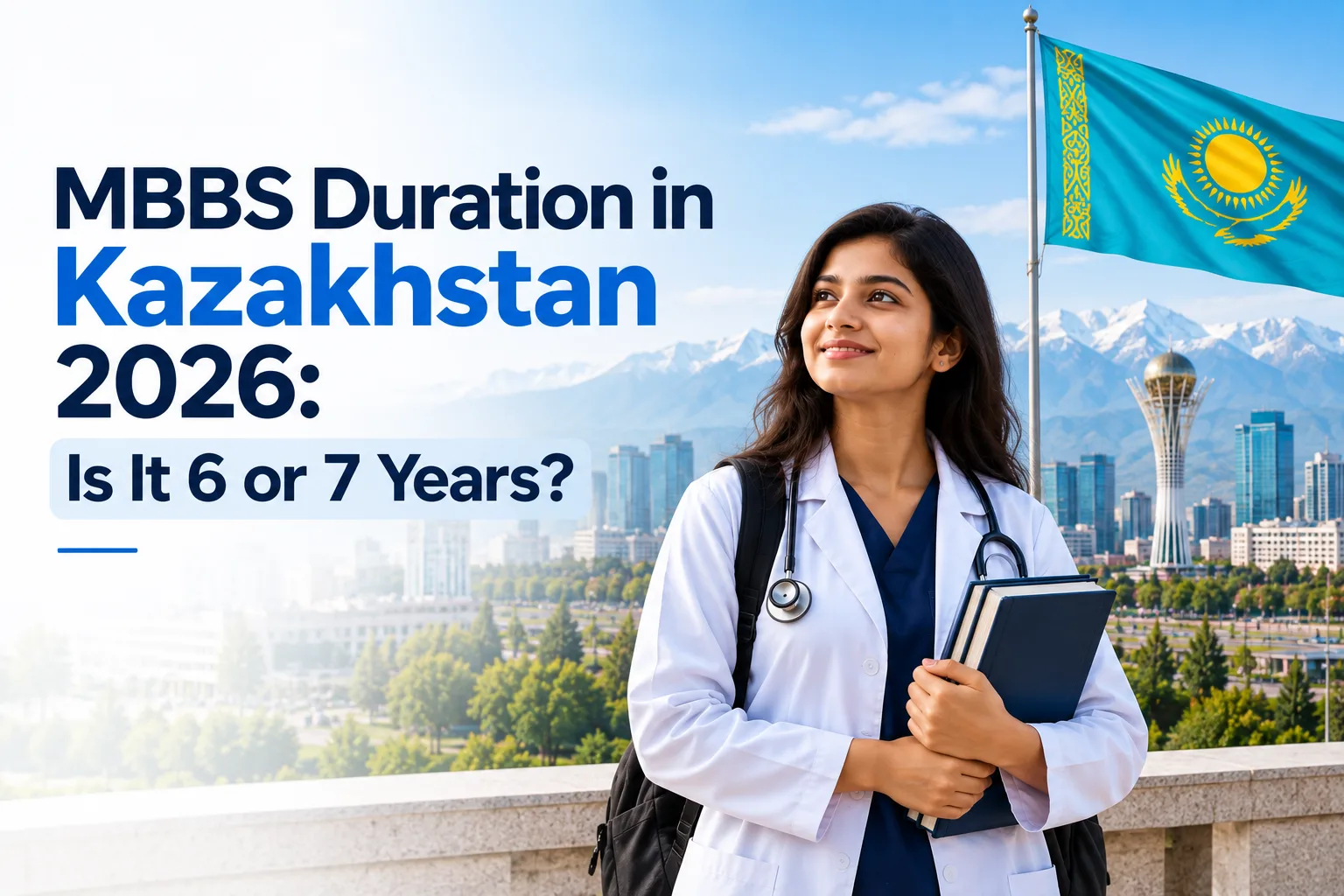
MBBS Duration in Kazakhstan 2026: Is It 6 or 7 Years?

Aryan Raj
· Senior Content WriterUpdated at - October 1, 20269 Min Read304 views
MBBS Duration in Kazakhstan 2026: Is It 6 or 7 Years?

Table of Contents

Quick answer: For Indian students joining in the 2026-27 intake, the MBBS (General Medicine) program at Kazakhstan universities is still listed as 6 years (72 months), including a 12-month internship. The “7 years” you are hearing about comes from a law signed on 12 June 2026. It sets a new model of 6 years of university study + 1 year of full internship for Kazakhstan’s medical education, and its detailed rules are still being finalised. Which duration applies to you depends on your university and your admission batch, so always get it in writing.

Many aspirants considering MBBS in Kazakhstan are confused now. A circular was circulated related to MBBS duration in Kazakhstan; this circular states that the MBBS program at Kazakhstan universities has now become 7 years (6 years of academic study + 1 year of clinical training). Several universities also published their notice related to the duration expansion of the MBBS program.

But the latest information is more subtle. Kazakhstan introduced a six-year Continuous Integrated Medical Education (CIME) structure for Medicine from the 2023–24 academic year. In 2026, the country is again reforming medical education, with a stronger focus on clinical and practical training.

For example, Ualikhanov University’s official information for international applicants for the 2026–27 academic year specifies a 6-year (72-month) Medicine program, including at least 54 months of academic medical education and 12 months of clinical internship. So, Indian students should not assume that every medical program in Kazakhstan is automatically seven years.

What Is the Current MBBS Duration in Kazakhstan in 2026?

The current MBBS duration in Kazakhstan is 6 years, integrating 5 years of academic studies + 1 year of clinical training. Ualikhanov University, for its 2026–27 international intake, officially states that its Integrated Educational Program "Medicine" runs from 2026 to 2032, with a total duration of 6 years (72 months). The program includes:

Component

Duration

Academic medical education

At least 54 months

Clinical internship

12 months

Total program duration

72 months / 6 years

Why Was Kazakhstan MBBS Reported as 7 Years?

The standard duration of MBBS in Kazakhstan is 6 years (5 years of academic and clinical study plus 1 year of compulsory internship), though some specific universities have begun shifting to or piloting a 7-year model with extended clinical modules.

The curriculum was updated to sync with global medical standards and to ensure that graduates possess stronger clinical, hands-on training. The Ministry stated that the volume of internship would increase from 30 to 70 academic credits. It also ensures complete compliance with the NMC's strict guidelines, requiring a total study duration of at least 54 months plus a mandatory 12-month rotating internship.

What Changed in Kazakhstan Medical Education in 2026?

The change is not about duration; the government is focusing on increasing practical and clinical training. Below are the key facts mentioned briefly.

Kazakhstan's Ministry of Health announced that the volume of internship would increase from 30 to 70 academic credits under the new practice-oriented medical education model. That represents an increase of 40 academic credits, compared with the previous 30-credit volume.

The Ministry says the new model is designed to strengthen clinical preparation and improve graduates' readiness for independent professional activity. The reforms also provide for a legally defined status of the intern doctor, clinical-based training, mentorship and supervised participation in medical care.

The Ministry also announced the removal of the mandatory master's component from the clinical physician training pathway, with educational time redirected toward professional and practical preparation. These changes explain why the structure of medical education in Kazakhstan should not be evaluated only by counting calendar years.

Kazakhstan MBBS: 6 Years or 7 Years?

The answer depends on the specific educational program and student cohort. A dedicated table is crafted below showing the difference between the 6-year course duration and the 7-year course duration.

Factor

Six-Year Program

Seven-Year Program

Total duration

6 years / 72 months in current examples

Exists for some program/cohort structures

Current status

Current 2026–27 university programs include 6-year structures

Kazakhstan's 2026 system still includes graduates from 7-year programs

Internship

Can be incorporated within the 6-year structure

May be presented separately depending on program

Applicability

Depends on university and intake

Depends on university, cohort and applicable curriculum

What students should do

Verify official curriculum

Verify official curriculum

Is the 6-Year MBBS Program Available for Indian Students?

Yes, as per the current official information, the 6-year MBBS program is available for Indian and international students in Kazakhstan. Universities like Astana Medical University and the Ualikhanov University have published specific information for international applicants for the 2026–27 academic year.

Its Integrated Educational Program "Medicine" is conducted in English and lasts 6 years (72 months). The university specifies at least 54 months of academic medical education plus 12 months of clinical internship.

ComponentDuration
Academic medical education60 months (at least 54 months, the NMC minimum)
Clinical internship12 months
Total program duration72 months / 6 years
Shortlisting universities? Compare Top Medical Colleges in Kazakhstan

Which Kazakhstan Medical Universities Have a CIME Licence?

The Embassy of India in Kazakhstan published an addendum to its advisory for Indian students listing medical universities possessing a licence in the field of Continuous Integrated Medical Education (CIME). The universities are:

Sr. No.UniversityCity

1

Al-Farabi Kazakh National UniversityAlmaty

2

Khoja Akhmet Yassawi International Kazakh-Turkish UniversityTurkestan

3

Caspian Public UniversityAlmaty

4

Asfendiyarov Kazakh National Medical UniversityAlmaty

5

West Kazakhstan Marat Ospanov Medical UniversityAktobe

6

Semey Medical UniversitySemey

7

Karaganda Medical UniversityKaraganda

8

South Kazakhstan Medical AcademyShymkent

9

Astana Medical UniversityAstana

10

Kazakh-Russian Medical UniversityAlmaty

11

Kokshetau University named after Sh. UalikhanovKokshetau

12

Manas Kozybayev North Kazakhstan UniversityPetropavl

13

Kenzhegali Sagadiyev University of International BusinessAlmaty


Also check a university’s standing in our NMC approved medical colleges abroad list before you pay any fee.

What Does NMC Require: 6 Years or 7 Years

NMC does not restrict 6 years or 7 years. The National Medical Commission's Foreign Medical Graduate Licentiate (FMGL) Regulations, 2021 specify requirements that foreign medical graduates must meet for registration in India. The provisions include:

  • Minimum 54 months of education in a single institution
  • 12-month internship at the same foreign university
  • Clinical training should not be split across different countries
  • Medium of instruction should be English
  • Required medical subjects must be studied
  • The graduate must be registered with the relevant medical regulatory authority in the country where the degree is awarded.

What Should Indian Students Verify Before MBBS Admission in Kazakhstan?

Before paying tuition or signing an admission agreement, students should obtain the following information directly from the university.

  • Exact Course Duration
  • Internship Duration
  • Clinical Training
  • Medium of Instruction
  • Curriculum
  • University Licence
  • Degree/Qualification
  • Local Medical Registration
  • NMC Compliance

MBBS Duration in Kazakhstan: Key Numbers at a Glance

Particular

Current verified information

Current six-year program example

6 years / 72 months

Academic medical education in Ualikhanov example

At least 54 months

Clinical internship in Ualikhanov example

12 months

CIME Medicine structure

6 years

CIME academic load under earlier framework

At least 360 credits

Internship volume under 2026 reform

70 academic credits

Earlier internship volume cited by Ministry

30 academic credits

Increase in internship credits

40 credits / ~133%

CIME-licensed institutions listed by Indian Embassy

13


Source: Kazakhstan Ministry of Health, Embassy of India in Astana and official university information.

Ready to compare universities and fees? Get Kazakhstan MBBS Fees for Indian Students

Conclusion

The MBBS duration in Kazakhstan should not be described simply as a universal 6-year or 7-year course. In the 2023-24 academic year, Georgia introduced a 6-year Continuous Integrated Medical Education model for Medicine with 360 academic credits. In 2026, Kazakhstan introduced further reforms focused on practical medical education and increased the internship volume from 30 to 70 academic credits.

At the same time, current 2026–27 university information confirms that six-year programs remain available. Ualikhanov University officially lists a 72-month (6 years) Medicine program, including at least 54 months (4.5 years) of academic medical education and 12 months (1 year) of clinical internship.

The safest approach is not to choose a Kazakhstan medical university based on a “6-year” or “7-year” advertisement alone; verify the exact program that applies to your admission batch.

Frequently Asked Questions

Is MBBS in Kazakhstan 6 years or 7 years in 2026?

For the 2026-27 intake, university notices for international students still list a 6-year (72-month) program that includes a 12-month internship. A law signed on 12 June 2026 sets a new 6-year study + 1-year internship model for Kazakhstan’s medical education, and its implementing rules are still being finalised. Confirm the exact duration for your batch in writing from the university.

Does the 7-year rule apply to Indian students already studying in Kazakhstan?

No official notice so far moves current international students onto a longer program. Students already admitted normally finish under the curriculum they joined. Ask your university for a written confirmation of your batch’s total duration.

Is a 7-year MBBS from Kazakhstan valid in India?

Yes, if it meets the NMC Foreign Medical Graduate Licentiate Regulations 2021: at least 54 months of study, a 12-month internship at the same foreign institution, English medium, and eligibility for a licence to practise in Kazakhstan. A longer course is not a problem in itself.

What is the NMC minimum duration for MBBS abroad?

NMC requires a course of at least 54 months (4.5 years) plus an internship of at least 12 months, both at the same foreign university. After returning, the graduate must clear FMGE (to be replaced by NExT) and complete a 12-month internship in India.

What is CIME in Kazakhstan?

CIME stands for Continuous Integrated Medical Education. Kazakhstan introduced a 6-year integrated Medicine program under CIME from the 2023-24 academic year. The Embassy of India in Astana lists 13 universities licensed for CIME.

Tags:Kazakhstan MBBS Duration Update 2026

Our Newsletter

Stay updated with the latests news and exclusive content by and subscribing to our newsletter for education vibes.

Related Blogs

See All
MBBS vs MD: Full Form, Difference, Duration and Career Scope
MBBS AbroadMBBS vs MD: Full Form, Difference, Duration and Career Scope

The full form of MBBS and MD is Bachelor of Medicine, Bachelor of Surgery, and Doctor of Medicine. In India, they sit at different levels of education: while MBBS is an undergraduate medical qualification, MD is a postgraduate qualification. With lakhs of NEET aspirants in India aiming to secure their medical seats (depending on their academic and professional objectives), these two are distinct career pathways for aspiring doctors. Both are part of the same structured ladder and represent fundamentally different milestones to achieve. Let’s talk about both degrees in terms of their syllabus, entrance requirements, duration, and more.MBBS vs MD at a GlanceUnderstanding the MBBS vs MD debate will help you to build a clearer picture of your academic journey. Most often, students and parents assume that both are the same kind of qualification, working as alternative pathways to each other. If you don’t do MBBS, pursue an MD. In reality, an MBBS is a 5.5-year foundational primary medical qualification required to become a licensed doctor in India; an MD is a 3-year postgraduate specialisation pursued after completing the MBBS degree programme. Both are regulated by the National Medical Commission (NMC), the sole authority overseeing related medical conduct in India.ParameterMBBSMDFull FormBachelor of Medicine, Bachelor of Surgery (Medicinae Baccalaureus, Baccalaureus Chirurgiae)Doctor of Medicine (Medicinae Doctor)Course LevelUndergraduate (primary medical qualification)Postgraduate (speciality master’s level)Overall Duration5.5 years (4.5 + 1)3 yearsEntrance ExamNEET-UGNEET-PG / INI-CETEligibility12th with PCB & English (minimum 50% general)Valid MBBS degree and CRMI completion with the NMCFocusGeneral medicine, surgery, and primary careClinical or academic expertise in one medical branchRegulatory BodyNational Medical CommissionNational Medical CommissionHow to Become a Doctor in India: Complete Step-by-Step GuideMBBS Full Form and MeaningUnderstanding the full form of MBBS and MD offers a foundational head start for their differences. Both qualifications have Latin academic roots, explained as follows:What

November 14, 2026
World Directory of Medical Schools (WDOMS): How to Check a Foreign Medical University
MBBS AbroadWorld Directory of Medical Schools (WDOMS): How to Check a Foreign Medical University

The World Directory of Medical Schools (WDOMS) is a free, searchable online database of medical schools around the world. If you are planning MBBS abroad, WDOMS is the first place to check whether a foreign medical university exists, where it is located and what it teaches, before you pay any registration fee.WDOMS does not approve or accredit any medical school, though. It confirms that an institution is listed, and the sponsor notes on each profile add recognition details for specific countries. This guide explains what WDOMS is, how to search it step by step, how it relates to NMC rules, and how to spot the “WHO approved” claims some agents use.Get Free MBBS Abroad CounsellingWhat Is WDOMS? (WDOMS Full Form)The WDOMS full form is World Directory of Medical Schools. It is a registry of higher education institutions that offer medical training, and it serves as the main global database of medical schools. Students also search for it as the world medical directory, WDMS, WDOM or the world directory of medical college, but the official name and website are the same.WDOMS does not endorse or approve institutions or their programmes. It records that a school exists and shows an operational status, along with alternate names, school type, the year instruction started, affiliations, contact information and programme details compiled with its sponsoring organisations.Who Runs WDOMS?WDOMS is a joint effort of the World Federation for Medical Education (WFME) and the Foundation for directory, update institutional details and set the standards for listing schools. It was formed in 2014 by merging FAIMER’s IMED with WFME’s Avicenna Directory, and the evolution of the WDOMS is covered in the timeline below. Sponsors such as ECFMG, the Australian Medical Council and the Medical Council of Canada add notes to school profiles. You can see the full list

November 14, 2026
Russia vs Kazakhstan vs Kyrgyzstan for MBBS: Which to Pick?
MBBS AbroadRussia vs Kazakhstan vs Kyrgyzstan for MBBS: Which to Pick?

Did your NEET score fall short of a government seat, and are Indian private medical colleges beyond your budget? If you are now looking at MBBS abroad, three names come up again and again: Russia, Kazakhstan and Kyrgyzstan. All three have NMC-compliant universities, English-medium programmes and fees well below Indian private colleges.So which one should you pick? There is no single "best" country. The right choice depends on your budget, academic profile, climate preference and how much risk you are comfortable with. This guide compares the three side by side so you can decide with facts, not sales pitches.Get My Free Country ComparisonQuick Checklist Before You Choose a CountryTotal 6-year cost (tuition + hostel + living)NMC compliance and WDOMS listing of the universityUniversity-wise FMGE pass recordSafety for international studentsClimate you can live with for six yearsRussia vs Kazakhstan vs Kyrgyzstan: At a GlanceFactorRussiaKazakhstanKyrgyzstanApprox. 6-year tuition₹18–40 lakh₹20–29 lakh₹19–25 lakhChoice of NMC-compliant universitiesWidestModerate (10+)Limited (about 10)FMGE pass rate (2024)29.54%25.13%25.05%ClimateLong, harsh wintersContinental; milder in the southContinental; moderate in BishkekIndian student communityLarge, city-dependentSmaller but growingVery large (Bishkek)Figures are indicative. Hostel and living costs are extra, and fees vary by university and year.1. Tuition Fees and Total CostCost is usually the first filter, so start here.Kyrgyzstan is generally the most affordable, with tuition of roughly ₹3–4 lakh per year.Kazakhstan sits slightly higher, with 6-year tuition of around ₹20–29 lakh.Russia has the widest range. Mid-tier universities are comparable to Central Asia, while top-ranked universities in Moscow and St. Petersburg cost considerably more.Practical takeaway: On a tight budget, Kyrgyzstan and selected Kazakh universities give the best value. With a higher budget, Russia offers more choice of established universities. For university-wise fee structures, see our detailed guides on MBBS in Russia, MBBS in Kazakhstan and MBBS in Kyrgyzstan.Check My Budget Fit2. NMC Compliance and University ChoiceIf you plan

October 26, 2026
NMC Eligibility Certificate for MBBS Abroad: Step-by-Step Application
MBBS AbroadNMC Eligibility Certificate for MBBS Abroad: Step-by-Step Application

If you aim at studying MBBS abroad, there's one crucial certificate you must know: the NMC eligibility certificate for MBBS abroad. This certificate, issued by the National Medical Commission (NMC), states that you meet the India-based requirements to study medicine abroad and, ultimately, to practise it back in India. Surprisingly, many students come to know its importance only after getting admitted to a foreign university, which can create complications later.In this guide, we cover what the certificate is used for, whether it is required, what papers you will need, the cost, and the step-by-step NMC EC application process online, so you can complete it correctly the first time.Check Your NMC EC Eligibility FreeIs an Eligibility Certificate Mandatory for MBBS Abroad?A major concern for most candidates planning to study abroad is: is an eligibility certificate mandatory for MBBS abroad? The simple answer is yes, you need proof of eligibility. However, how you get it depends on your NEET-UG qualification.According to the Foreign Medical Graduate Licentiate (FMGL) Regulations, 2021, and later NMC guidelines, every Indian citizen or OCI cardholder who wants to earn a primary medical qualification from a foreign university must meet the eligibility norms before starting the course.If you have qualified NEET-UG in the year of admission, or within the 3-year validity period allowed for studying abroad, your NEET scorecard is generally treated as your eligibility certificate. However, if you fall into a category that needs explicit approval, or the NMC opens a portal window for manual verification of documents, you must complete the NMC EC application online before leaving India.What Is the NMC Eligibility Certificate?The NMC eligibility certificate is the official clearance from the National Medical Commission for Indian citizens who study medicine abroad. It is often called the eligibility certificate for foreign medical studies. It confirms that you

October 13, 2026
Cost of Living in Nepal for Indian Medical Students: Hostel, Food and Monthly Budget
MBBS AbroadCost of Living in Nepal for Indian Medical Students: Hostel, Food and Monthly Budget

Besides tuition fees, Indian students planning MBBS in Nepal need to budget for hostel, food, local travel and personal expenses. Living costs in Nepal are generally affordable compared to big Indian metro cities, especially for students who stay in the college hostel and use the college mess. However, the exact monthly budget depends on the medical college, city and lifestyle.This guide explains hostel fees in Nepal medical colleges, food expenses, daily costs and a realistic monthly budget for Indian MBBS students. For tuition fees, eligibility, universities and the admission process, read our complete guide on MBBS in Nepal.Note: The figures in this blog are estimates. Always confirm hostel and mess charges from the latest fee notice of the concerned medical college before making financial arrangements.Get a Free Nepal MBBS Budget PlanCost of Living in Nepal for Indian Students: At a GlanceThe cost of living in Nepal for Indian MBBS students is approximately INR 1.2 lakh to INR 3.6 lakh per year, i.e. about ₹10,000–₹30,000 per month, depending on location and lifestyle. This excludes tuition fees.ExpenseApprox. Amount (USD)Approx. Amount (INR)Hostel fee (annual)$1,100₹99,700 per year (about ₹8,300 per month)Mess fee (annual)$900₹81,500 per year (about ₹6,800 per month)Food (per month, if eating outside the mess)$150₹13,590Bus pass (per day)$1.5₹136Utilities (per month)$30₹2,720Personal expenses (per month)$120₹10,870Total living expenses (per month, average)$300₹27,200Note: INR values are based on the INR–USD exchange rate of February 2026. Actual hostel and mess charges differ from college to college.Hostel Fees in Nepal Medical CollegesHostel accommodation is one of the biggest parts of the monthly budget for MBBS students in Nepal. On average, the hostel fee is around ₹99,700 per year (about ₹8,300 per month).Some colleges charge separately for accommodation and food, while others offer different room types at different prices. Students should confirm whether the hostel fee includes electricity, water, internet, laundry

October 12, 2026
MBBS in Nepal Admission Process 2026: Step-by-Step
MBBS AbroadMBBS in Nepal Admission Process 2026: Step-by-Step

MBBS in Nepal admission process generally requires a valid NEET-UG qualifying percentage (50% for General; 40% for OBC/SC/ST) and a minimum of 50% aggregate in PCB subjects in your higher secondary. The application window is open from mid-August to early October. The Nepal MBBS admission process combines registration, documentation, the entrance exam (for a few universities), merit-based selection, biometric verification, and fee payment to the university. Indian students will not require a visa to fly to Nepal. In this article, we have discussed the entire MBBS process in detail.Get Free Nepal MBBS Admission GuidanceParticularsDetailsNEET-UG requirementYes Entrance CriteriaMEC entrance exam (MECEE-BL) or NEETApplication Window10 August to early October 2026Where you applyentrance.mec.gov.np (MEC's official portal)Who Can Apply: MEC Admission Eligibility for 2026–271. NEET-UG is mandatory — but not in the way most students thinkNMC’s 2021 regulations are clear: if you want to study MBBS abroad, Nepal included, you must qualify NEET before you take admission. Skip it, and you can’t come back and practise in India. The good news? You don’t need a high rank. You only need to cross the minimum NEET qualifying percentile for your category.Here are the NEET-UG 2026 cut-offs (result released by NTA on 16 July 2026):CategoryQualifying percentile2026 qualifying mark rangeGeneral / EWS50th percentile213–715 out of 720OBC / SC / ST40th percentile177–212 out of 720So if you scored 213 or more (General/EWS) or 177 or more (OBC/SC/ST) in 2026, you’re NEET-qualified and can apply to Nepal. Your all-India rank doesn’t matter here.2. Academic eligibilityClass 12 (or equivalent) with Physics, Chemistry, Biology (PCB) and English as subjects.Minimum 50% cumulative in PCB (45% for OBC / SC / ST)3. AgeYou must be at least 17 years old by 31 December of the admission year. Under MEC's foreign-candidate rules, there is no upper age limit.Step-by-Step MBBS Admission Process in Nepal (2026–27 Intake)Admissions

October 1, 2026
Paying MBBS Abroad Fees: Forex, TCS Rules, and Safe Transfers
MBBS AbroadPaying MBBS Abroad Fees: Forex, TCS Rules, and Safe Transfers

When you decide to study medicine abroad, one practical question soon follows: how do you pay MBBS abroad university fees from India? In 2026, the process is simple once you know the rules. Fees can be sent through a SWIFT international bank transfer or an RBI-authorised education payment platform, under the Reserve Bank of India's Liberalised Remittance Scheme (LRS).Before you send any money, you and your family should understand the LRS limit, the latest TCS rules, and how exchange rates affect your final cost. This guide covers all of it, including LRS limits, TCS rates, SWIFT transfers, forex cards, and how to transfer money safely.Get Free Fee Payment GuidanceHow to Pay MBBS Abroad University Fees from India?To pay MBBS abroad fees from India, use an Authorised Dealer Category-I bank or an RBI-authorised education payment platform. All such payments are made under RBI's Liberalised Remittance Scheme (LRS).Once you know the MBBS abroad fees for your chosen university, these are the most common payment methods:SWIFT / international bank transfer – for tuition and hostel feesEducation loan disbursement – sent by the lender directly to the universityAuthorised education payment platforms – such as Flywire or ConveraForex card – for daily living expenses, not for tuition feesUnderstanding RBI's LRS Limit for Education AbroadThe Liberalised Remittance Scheme (LRS) allows every resident Indian to send up to USD 250,000 abroad in each financial year (1 April to 31 March). MBBS abroad tuition fees, hostel fees and living expenses all count towards this limit.Essential LRS Compliance RulesPAN is mandatory: The person sending the money (remitter) must have a valid PAN linked with Aadhaar.Annual limit: The limit applies per financial year and resets on 1 April every year.Multiple remitters: Parents or other family members can each use their own LRS limit to pay for the same student.LRS Limit

October 1, 2026
FMGE Attempt Limit and Score Validity A Complete Guide
MBBS AbroadFMGE Attempt Limit and Score Validity A Complete Guide

As of September 2026, there is no FMGE attempt limit. Foreign medical graduates can appear for the Foreign Medical Graduate Examination as many times as needed until they qualify. A pass also does not come with a published expiry date, so your FMGE result stays usable for registration with the NMC or a State Medical Council.Many MBBS abroad aspirants still believe that FMGE allows only 6 attempts in 3 years. In this guide, we separate the facts from the rumours using official NBEMS and NMC information, and explain what the 2026 rule changes mean for your next attempt.Get Free FMGE Guidance from Our ExpertsFMGE Attempt Limit at a GlanceHere are the key facts every FMGE candidate should know:QuestionAnswerFMGE attempt limitNo cap. You can attempt as many times as needed until you pass.FMGE score validity periodNo published expiry. Once you pass, the result can be used for NMC or State Medical Council registration.Qualifying marks150 out of 300 (50%), with no negative markingExam frequencyThree sessions a year (from late 2026)Course completion ruleForeign MBBS and internship must be completed within 10 years of joining (NMC FMGL Regulations 2021)What Is FMGE and Who Needs to Take It?The Foreign Medical Graduate Examination (FMGE) is a screening test conducted by the National Board of Examinations in Medical Sciences (NBEMS) on behalf of the National Medical Commission (NMC). It assesses Indian citizens and Overseas Citizens of India (OCI) who obtained their primary medical qualification from a university outside India.You must qualify FMGE to get registered with the NMC or a State Medical Council and practise medicine legally in India. For graduates from popular destinations such as Russia, Georgia, the Philippines, Uzbekistan and Kazakhstan, FMGE is currently the only route to medical practice in India. For a detailed overview of the exam, read our complete guide on the

September 24, 2026
The Real Total Cost of MBBS Abroad: Tuition, Hostel, Visa, Flights and Exams
MBBS AbroadThe Real Total Cost of MBBS Abroad: Tuition, Hostel, Visa, Flights and Exams

The total cost of MBBS abroad for Indian students usually ranges from about ₹28 lakh to ₹50 lakh for the complete 6-year programme in popular budget destinations such as Russia, Kyrgyzstan, Kazakhstan and Uzbekistan, and can go up to about ₹65-70 lakh in Georgia. This includes tuition fees, hostel charges, food costs, and other miscellaneous expenses. The exact cost varies according to the foreign destination and medical institution chosen by a medical aspirant. In contrast to an overall cost of ₹60 lakh to well over ₹1 crore to pursue medicine at private medical colleges in India, overseas education offers students a more affordable and truly enriching experience.MBBS abroad has become a preferred option for many Indian students because of the intense competition for limited seats in government medical institutions and the high prices of private medical colleges. Still, calculating the total cost gives a realistic picture of how much different expense categories can account for in your overall budget. We are going to look at the actual, real cost of pursuing medicine overseas, accounting for accommodation, dining, renewals of the study visa, travel, documentation, and mandatory fees of licensing examinations after graduation.Get Your Free MBBS Abroad Cost BreakdownGeneral Overview of Pursuing an MBBS Abroad for Indian StudentsThe opportunity to pursue overseas education is filled with an array of academic and extracurricular experiences, opening up a different environment and enabling you to think from a wider perspective. Indian students and parents should get familiar with the key details of this opportunity before working out the total cost. The table below highlights the essential information:Course NameMBBS (called MD or MBBCh in some countries)Course LevelUndergraduate/Bachelor’sTotal DurationAbout 6 years (5 years of study + 1-year internship), in line with NMC’s Foreign Medical Graduate Licentiate (FMGL) Regulations, 2021Total CostAround ₹28 lakh to ₹50 lakh in

September 24, 2026
Cost of Living in Vietnam for Indian MBBS Students
MBBS AbroadCost of Living in Vietnam for Indian MBBS Students

Vietnam is becoming an increasingly relevant destination for international students looking for affordable education in an Asian cultural environment. For Indian students considering MBBS in Vietnam, tuition fees are only one part of the financial planning. Accommodation, food, transport, utilities, healthcare, study materials and personal expenses all belong in the same budget, and together they usually decide whether a family can sustain six years abroad - not the fee quote in the brochure.The cost of living in Vietnam varies significantly with the city, the accommodation type and the lifestyle. Hanoi and Ho Chi Minh City are more expensive than smaller cities, while sharing accommodation and eating local food pulls the monthly figure down sharply. For reference, RMIT Vietnam estimates monthly rent for international students in Hanoi and Ho Chi Minh City at about $250–600 and recommends around $250 per month for food.This guide explains the major expenses Indian MBBS students should plan for before choosing Vietnam, and how those numbers sit against the cost of MBBS abroad for Indian students generally. All conversions use the September 2026 rate of 1 USD ≈ ₹90 ≈ VND 25,700.MBBS Fees Structure and Cost of Living in VietnamThe MBBS fee structure and living costs in Vietnam are affordable compared with most other overseas destinations. Total six-year tuition generally runs ₹20 lakh to ₹30 lakh for the whole course, which is well below a private medical seat in India and broadly in line with the MBBS abroad fees charged in Central Asia and Eastern Europe. Living costs are reasonable but vary from student to student. Here is the expense picture for an aspiring student.Fees StructureType of ExpenseApprox. Cost (in USD)Approx. Cost (in INR)Annual Tuition Fee$4,000₹3,60,000Annual Hostel Fee$1,200₹1,08,000Annual Mess Fee$1,000₹90,000Medical Insurance$200₹18,000Visa Extension Fee$100₹9,000Note: Converted at the September 2026 rate of 1 USD ≈ ₹90. Fees differ

September 22, 2026
Education VibesEducation Scholar

Get Expert Guidance to Study

MBBS Abroad