MBBS Abroad

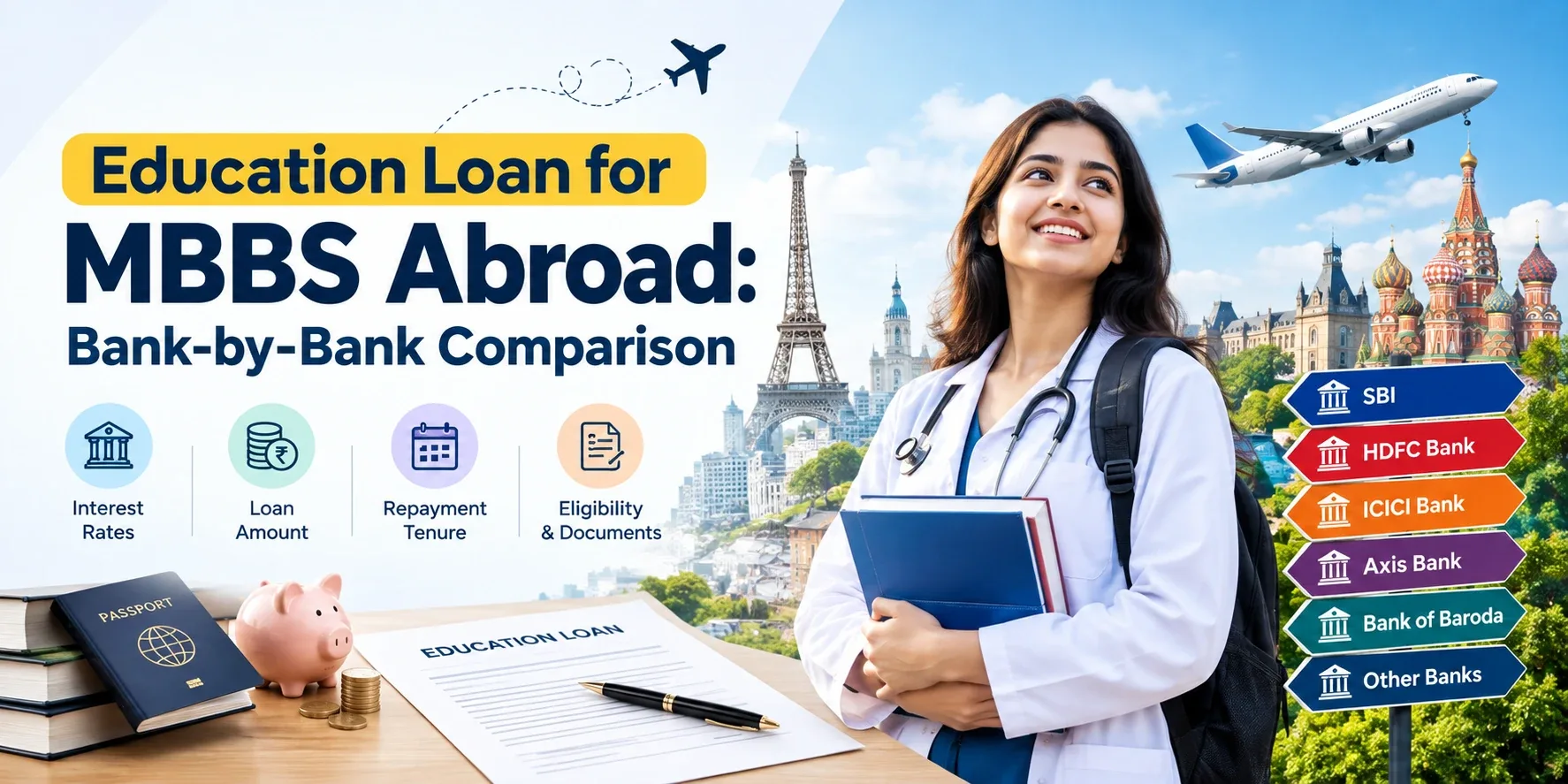
Education Loan for MBBS Abroad 2026: Bank-by-Bank Comparison

Oishani Mitra
Oishani Mitra · Senior Content WriterUpdated at - September 17, 202610 Min Read1 views
Education Loan for MBBS Abroad 2026: Bank-by-Bank Comparison

Table of Contents

Education loan for MBBS abroad interest rate currently ranges from about 8.65% to 14.50% per annum (p.a.). Public sector banks sit at the lower end with floating rates of roughly 8.65% to 11.25% p.a., while private banks and NBFCs price higher. Since a foreign medical degree costs INR 20 lakh to INR 40 lakh end to end, the loan is usually what decides whether the admission actually happens.

A 6-year MBBS in Russia works out to roughly INR 25 lakh, and Georgia closer to INR 35 lakh once tuition, hostel and living costs are added. Very few families fund that from savings. An education loan covers tuition plus living expenses abroad and spreads repayment over a tenure of up to 15 years. You can see a country-wise breakdown in our guide to MBBS abroad fees.

This guide breaks down a bank-by-bank comparison, collateral-free limits, required documents, moratorium terms and tax benefits, so you can pick the right medical education loan for studying abroad.

Can I Get an Education Loan for MBBS Abroad in 2026?

Yes. Lenders actively fund MBBS abroad, provided you meet four conditions:

  • Your university is recognised by the NMC or WHO and appears on the lender's approved list. Check our NMC-approved medical colleges abroad list before you shortlist.
  • You hold a provisional or confirmed admission offer letter.
  • Your co-applicant has a stable, documented income.
  • Your co-applicant's CIBIL score is roughly 700 or above.

The rate you are offered varies by lender and profile. Public sector banks quote floating rates of about 8.65% to 11.25% p.a. Private banks and Non-Banking Financial Companies (NBFCs) quote 10.25% to 14.50% p.a.

Collateral is where lenders differ most. Most public sector banks lend up to INR 7.5 lakh unsecured and ask for tangible security above that. NBFCs and a few private lenders stretch the collateral-free limit to INR 40 lakh or INR 50 lakh, but at higher, risk-adjusted interest rates.

Still shortlisting your university? Lender approval depends heavily on which college you pick. Browse NMC-recognised universities and country-wise costs on our MBBS abroad page before you apply for the loan.

Key Factors to Compare in Banks Before Taking an Education Loan

Before signing, compare these five factors across every lender you are considering. Together they decide the real cost of the loan, not just the headline rate.

Interest Rate and Benchmark

  • Check whether the rate is fixed or floating.
  • Check whether it is linked to an external benchmark (EBLR or repo rate) or an internal one (MCLR). External benchmarks reprice faster in both directions.

Loan Amount and Collateral Security

  • Confirm the maximum sanction the scheme allows.
  • The collateral-free cap at most public sector banks is INR 7.5 lakh.
  • Collateral-free lending extends to INR 40 lakh or INR 50 lakh only at NBFCs, select private banks, and SBI's premier-institution list.
  • Secured loans require tangible assets such as land, residential property or fixed deposits.

Margin Money

  • Margin money on a foreign education loan above INR 4 lakh at a public bank is typically 15%.
  • The bank funds 85% of total expenses.
  • You fund the remaining 15% yourself.

Moratorium Period

  • Check that the grace period covers the full 6-year MBBS abroad course duration.
  • Confirm the additional 6 to 12 months allowed before principal repayment begins.

Fees, Tenure and Tax Benefits

  • Compare processing fees across public banks, private banks and NBFCs.
  • Look for a flexible repayment tenure of up to 15 years.
  • Confirm your eligibility for the Section 80E deduction on interest paid.

Education Loan for MBBS Abroad: Bank-by-Bank Comparison

Every lender prices risk differently. Public sector options such as the SBI education loan for MBBS abroad offer lower benchmark-linked floating rates with stricter collateral rules and longer sanction timelines. Private banks and NBFCs compete on processing speed and collateral-free limits instead. Here is how they compare.

LenderInterest Rate (p.a.)Max Loan Limit (Secured)Collateral-free LimitMargin MoneyProcessing Fees
SBI (Global Ed-Vantage)8.65% to 9.40% (Floating)Up to INR 3 CroreUp to INR 50 Lakh (SBI-listed premier institutes only)10%0.50% (min INR 10,000, max INR 50,000) + GST
Union Bank of India9.25% to 10.75% (Floating)Up to INR 1.5 CroreUp to INR 7.5 Lakh15%Nil
Bank of Baroda (Baroda Scholar)9.20% to 10.70% (Floating)Up to INR 1.5 CroreUp to INR 7.5 Lakh10% to 15%1% (max INR 10,000, refundable)
Punjab National Bank (PNB Udaan)9.25% to 11.25% (Floating)Up to INR 1 CroreUp to INR 7.5 Lakh15% (above INR 4 Lakh)1% of loan amount
Canara Bank (IBA Model Scheme)9.25% to 11.25% (Floating)Up to INR 1 CroreUp to INR 7.5 Lakh15% (above INR 4 Lakh)1% of loan amount
Private banks (ICICI, Axis, IDFC FIRST, Yes Bank)10.25% to 12.50% (Floating)Up to INR 1 CroreINR 15 Lakh to INR 25 Lakh0% to 15%1% to 2% of loan amount
NBFCs (Avanse, Auxilo, InCred, HDFC Credila)10.50% to 14.50% (Fixed/Floating)Up to INR 1 CroreINR 40 Lakh to INR 50 Lakh0% to 10%1% to 2% of loan amount

Note: Figures are indicative and current as of September 2026. Floating rates move with the RBI repo rate, and the final offer depends on borrower profile, collateral, and the lender's university category. Confirm the sanction letter terms with the bank before you commit.

Public sector banks clearly win on interest rate. The trade-off is collateral and time: apart from SBI's premier-institution list, PSU unsecured lending stops at INR 7.5 lakh, and sanction takes 4 to 8 weeks.

Private banks and NBFCs reverse that equation. They charge 2 to 5 percentage points more, but they sanction in 1 to 3 weeks and offer the largest collateral-free limits. That is exactly why they become the fallback when there is no property to pledge and a visa deadline is closing in.

Not sure which lender fits your university and budget? Ask our MBBS abroad loan counsellors. WhatsApp Ask

How Much Education Loan Without Collateral Can You Get for MBBS Abroad?

At most public sector banks, the education loan without collateral for MBBS abroad is capped at INR 7.5 lakh. That threshold comes from the IBA model education loan scheme that PSU banks follow. Above it, they ask for tangible security.

NBFCs and select private lenders go much higher, sanctioning INR 40 lakh to INR 50 lakh unsecured, provided the university is on their approved list and the co-applicant's income comfortably supports the EMI. SBI's Global Ed-Vantage also offers up to INR 50 lakh unsecured, but only for institutions on its own premier list, and most MBBS-abroad universities do not appear there.

If you have no property to pledge, read our detailed walkthrough on how to get an education loan for abroad studies without collateral.

Understanding the Education Loan Moratorium Period

The education loan moratorium period is the window in which you are not required to pay EMIs. For MBBS abroad, it usually covers the entire course duration plus an additional 6 to 12 months. That buffer gives graduates time to find a job or clear the FMGE or NExT licensing examination in India before repayment starts.

You have two options during this window:

  • Full moratorium: Pay nothing during the course. The accrued interest is capitalised into your principal.
  • Pre-EMI (interest-only): Pay just the interest each month during the moratorium.

If your family can manage the interest as it accrues, it never compounds into the principal. On a INR 30 lakh loan over six years, servicing interest during the moratorium can cut several lakh rupees off what you eventually repay.

Documents Required for MBBS Abroad Education Loan

Assemble your education loan for MBBS abroad documents by July. That gives the lender time to verify everything and release the sanction before university deadlines. Our complete checklist of documents required for MBBS abroad covers the admission side too.

  • Provisional admission offer letter from the university, along with its fee structure
  • NEET scorecard
  • Academic transcripts for Class 10 and Class 12
  • Aadhaar card (student and co-applicant)
  • PAN card (student and co-applicant)
  • Passport (student and co-applicant)
  • Co-applicant income proof
  • Co-applicant CIBIL report
  • Collateral documents, where applicable

How to Choose the Best Bank for a Medical Education Loan

There is no single best bank for a medical education loan abroad. The right lender depends on your specific situation.

  • Loan amount needed: Above INR 30 lakh, PSU banks such as SBI, Union Bank or Canara give better rates, though they will usually require collateral.
  • Collateral availability: With no property to pledge, NBFCs and private banks (HDFC Credila, Avanse, ICICI, Axis) become the practical option, at higher interest rates.
  • Speed of disbursal: If a visa deadline is fixed, private lenders and NBFCs sanction in 1 to 3 weeks against 4 to 8 weeks at PSU banks.
  • University eligibility: Confirm the lender funds your destination country and that your college is NMC or WHO listed. Not every bank covers every country.
  • Total cost: Add processing fees, loan insurance, and the interest that accrues during the moratorium to the headline rate before comparing two offers. The cheaper rate is not always the cheaper loan.

Tax Benefits and Repayment Tips

Under Section 80E of the Income Tax Act, the entire interest paid on an education loan is deductible, with no upper limit, for up to 8 consecutive assessment years from the year repayment begins. Loans taken for study abroad qualify.

One important caveat: Section 80E is available only under the old tax regime. The new regime under Section 115BAC does not allow it, so your co-applicant must weigh the deduction against the lower slab rates before choosing a regime.

Repayment tips:

  • Prepay when possible: Even small prepayments reduce the outstanding principal, which cuts total interest over the tenure. Most education loans carry zero foreclosure charges.
  • Run the numbers before you sign: Use an EMI calculator, then ask the lender for a written amortisation schedule so you know exactly what the loan costs across the full tenure.
  • Reduce the borrowing: Applying for a MBBS scholarship abroad lowers the amount you need to finance in the first place.

Bottom Line

Choosing the right education loan for MBBS abroad is not only about the lowest interest rate. It is about matching the lender to your situation. Public sector banks such as SBI, Union Bank, Canara Bank and PNB offer the lowest floating rates, but beyond INR 7.5 lakh they need collateral and take 4 to 8 weeks to sanction. Private banks and NBFCs charge more, yet they sanction faster and lend far more without security.

Map your loan requirement, collateral position and visa timeline against the comparison table above, and the shortlist usually narrows to two lenders. If you are still deciding, the Education Vibes team can walk you through the MBBS abroad admission process and the loan paperwork together.

Need education loan guidance for MBBS abroad? Talk to our counsellors today.

Ask on WhatsApp
NEW

Frequently Asked Questions

Breaking It DownCreated with Ai. Errors are possible
  • Education loan interest rates currently range from about 8.65% to 14.50% p.a., depending on the lender, the collateral offered and the borrower profile.

  • Yes. SBI's Global Ed-Vantage scheme funds studies abroad up to INR 3 crore against collateral, with floating rates starting around 8.65% p.a.

  • Yes, up to INR 7.5 lakh at most PSU banks. NBFCs and select private lenders go up to INR 40 lakh to INR 50 lakh unsecured if the university is on their approved list.

  • It depends on your loan amount, collateral and timeline. PSU banks suit larger secured loans at lower rates, while NBFCs and private banks suit urgent or collateral-free cases.

  • Typically the full course duration plus 6 to 12 months after graduation, giving you time before EMI repayment begins.

  • The provisional admission letter and fee structure, NEET scorecard, Class 10 and 12 transcripts, Aadhaar, PAN, passport, co-applicant income proof and CIBIL report, plus collateral papers where applicable.

  • Yes. Lenders require a co-applicant with a stable income, ideally with a CIBIL score above 700.

  • Yes. Under Section 80E, the full interest paid is deductible for up to 8 years with no upper limit, but only if you file under the old tax regime.

  • Banks generally ask for tangible security such as property or fixed deposits covering roughly 90% to 100% of the loan amount.

  • PSU banks take 4 to 8 weeks. Private banks and NBFCs typically sanction within 1 to 3 weeks.

Tags:education loan for MBBS abroadeducation loan for MBBS abroad interest rateSBI education loan for MBBS abroadeducation loan without collateral for MBBS abroadbest bank for medical education loaneducation loan moratorium periodeducation loan for MBBS abroad documents

Our Newsletter

Stay updated with the latests news and exclusive content by and subscribing to our newsletter for education vibes.

Related Blogs

See All
MBBS in Uzbekistan Without NEET: The Honest Answer (2026)
MBBS AbroadMBBS in Uzbekistan Without NEET: The Honest Answer (2026)

no, you cannot do MBBS in Uzbekistan without NEET not if you are an Indian citizen or OCI who wants to come back and practise medicine in India. The National Medical Commission (NMC) requires you to qualify NEET-UG before you take admission to any primary medical qualification abroad. A university in Tashkent or Samarkand may happily accept your application without a NEET score, but that admission letter does not make your future degree usable in India.That gap, between what an Uzbek university will accept and what Indian regulations will recognise, is where students lose six years and ₹20–30 lakh. This guide explains where the line sits, what the NMC's April 2026 Uzbekistan advisory actually said, and the checks to run before you pay a single rupee.Book Your Free Counselling SessionIs NEET Required for MBBS in Uzbekistan?Yes. For Indian nationals and Overseas Citizens of India, qualifying NEET is a regulatory requirement under the NMC framework, and Uzbekistan is no exception.The NMC's guidance is clear: an Indian citizen or OCI who wants to obtain a primary medical qualification from a foreign institution must qualify NEET. The NEET result then forms the basis of the eligibility certificate, provided the other criteria are also met.The confusion arises because students collapse two separate questions into one:Will an Uzbek university admit me without a NEET score? Possibly — that is the university's own decision, made under its own rules.Will Indian regulations let me use that degree to register and practise here? That is the NMC's decision, and it requires NEET.Two different authorities answer those questions, and only the second one determines whether your degree is worth anything in India. So when an advertisement promises MBBS in Uzbekistan without NEET, at best it is describing a university's admission policy. It is not describing your eligibility under Indian

September 9, 2026
Is MBBS Abroad Worth It in 2026? Honest ROI Breakdown
MBBS AbroadIs MBBS Abroad Worth It in 2026? Honest ROI Breakdown

Every year, thousands of Indian students go to pursue MBBS abroad due to rising competition and limited government medical seats in the country. Choosing a foreign country to pursue medicine is a viable option these days. However, many students have a common question: Is MBBS abroad worth it? The honest answer is: Yes, an MBBS abroad is worth it in 2026 because of its quality education, affordability, and modern infrastructure. Additionally, the return on investment is much higher than that of Indian private medical colleges. An overseas medical degree offers a bright career with a high return and better career prospects. However, students must plan carefully due to rising tuition fees, stricter legal requirements, and longer degree durations. In this blog, you will learn why MBBS abroad is worth it in 2026. You will also get the honest Return on Investment breakdown.Talk to an MBBS Abroad ExpertIs MBBS abroad worth it in 2026?Pursuing MBBS abroad is worth it if you do not secure a seat in the Indian government colleges and want an affordable alternative. Hence, choosing an overseas university with a tight budget is a better option to consider. However, based on the location and university guidelines, the tuition fee for the MBBS programme may vary slightly. In Central Asian countries such as Uzbekistan, Kyrgyzstan, and Kazakhstan, students pay lower tuition fees than in many European countries, like the UK, the USA, or Poland.But one thing to keep in mind while choosing a medical college is that an MBBS degree must comply with NMC guidelines so you can practice medicine in India after graduation. Aside from affordability and NMC compliance, studying medicine abroad is better due to better employment opportunities, world-class education, and research opportunities. NMC guidelines to study medicine abroadIndian students must verify if the MBBS curriculum complies with the NMC

September 9, 2026
FMGE Pass Rate of Vietnam MBBS Graduates
MBBS AbroadFMGE Pass Rate of Vietnam MBBS Graduates

Vietnam has become a serious option for Indian students who want an English-taught medical degree at a lower cost than a private seat in India. But cost is only half the decision. If you intend to come back and practise in India, the question that actually matters is what happens after graduation and that means the Foreign Medical Graduate Examination. Before committing six years and several lakhs to MBBS in Vietnam, you need to understand what the FMGE pass rate for Vietnam graduates really tells you, and what it cannot tell you.This guide gives you the honest position: what the official data shows, what it does not, and how to get a number that actually applies to the university you are considering. Check Free eligibility What is the FMGE?The FMGE is a mandatory examination required to be undertaken by all Indian citizens or Overseas Citizen of India (OCI) cardholders who have pursued their medical education abroad and plan to practise medicine in India after an MBBS abroad by obtaining a provisional or permanent registration.PurposeThe FMGE is designed for overseas residents of India or overseas citizens of India who obtained their medical degrees from foreign medical institutes. It assesses their knowledge and skills to ensure they meet the standards required to practise medicine in India.EligibilityFor Indian students who have completed their medical education abroad.StructureThe exam consists of multiple-choice questions (MCQs) and is conducted twice a year, in June and December. The qualifying score is 150 out of 300 marks.OutcomesPassing the FMGE is a requirement for foreign medical graduates to obtain a licence to practise in India and to enrol in a postgraduate course. The FMGE is due to be replaced by the NExT exam, so students should confirm which screening pathway applies to their own graduating batch.AI Section — Breaking It DownFMGE

September 9, 2026
MBBS Abroad Fees 2026 - Country-Wise Comparison Table
MBBS AbroadMBBS Abroad Fees 2026 - Country-Wise Comparison Table

In recent years, studying medicine abroad has gained popularity among Indian students. One of the primary reasons for pursuing medicine abroad is the high cost of private medical colleges in India. MBBS abroad fees are far lower than what Indian private medical colleges charge. Where an Indian private college can charge ₹10 lakh to over ₹25 lakh a year, an MBBS seat in a popular budget destination costs roughly ₹3 lakh to ₹8 lakh a year. Living expenses do add to that figure, but for most families the total still lands well below the cost of a private seat in India.This blog breaks the numbers down country by country — tuition, hostel and mess charges — so you can shortlist a destination that actually fits your family’s budget. Read on to see where the cheapest MBBS seats are in 2026 and which universities offer them.Get Free MBBS Abroad CounsellingMBBS Abroad Fees 2026: Country-Wise ComparisonApart from tuition fees, the budget to study MBBS includes accommodation charges, mess charges, visa-related expenses, medical insurance, and other miscellaneous expenses. When you plan your budget to study MBBS abroad, tuition fees contribute a significant portion of the overall expenses. However, the MBBS fees vary depending on the chosen destination and university. The table below shows the MBBS fees abroad country wise:CountryMBBS tuition fee per year (local currency)MBBS tuition fee per year (in INR)Hostel fees (per year)Mess charges (per year)Russia300,000 RUB₹3,39,00018,000 RUB90,750 RUBGeorgia4,500 USD₹4,25,1151,800 USD1,200 USDUzbekistan3,000 USD₹2,83,410500 USD1,200 USDKyrgyzstan4,000 USD₹3,77,880500 USD1,200 USDKazakhstan4,000 USD₹3,77,880700 USD1,200 USDVietnam4,000 USD₹3,77,8801,000 USD1,000 USDEgypt7,000 USD₹6,61,2901,000 USD1,200 USDBelarus4,500 USD₹4,25,115600 USD1,200 USDArmenia3,500 USD₹3,30,645800 USD1,200 USDPhilippines4,500 USD₹4,25,1152,000 USD1,200 USDBangladesh6,800 USD₹6,42,3961,200 USD800 USDChina4,500 USD₹4,25,115800 USD1,200 USDMalaysia8,000 USD₹7,55,7601,500 USD1,200 USDNepal12,000 USD₹11,33,6401,200 USD900 USD*Note: Fees are converted at 1 USD = ₹94.47 and 1 RUB = ₹1.13 (rates as of September 2026). The rupee value shifts with currency movements,

September 9, 2026
Is MBBS in Malaysia Recognised in India? Fees, Duration, and FMGE Reality
MBBS AbroadIs MBBS in Malaysia Recognised in India? Fees, Duration, and FMGE Reality

Of the various pros and cons you’ve considered between MBBS in Malaysia and others like the Philippines or Russia, there’s one question likely weighing heavily: Is MBBS in Malaysia recognised in India? The honest answer isn't a simple yes or no. It depends on which university you select, the specific nature of the course curriculum, and more importantly, whether you, a prospective student, know what "recognition," for the National Medical Commission (NMC), actually refers to.Let's dig into the true picture of Malaysia recognition, fees, course duration, and the reality faced by those who’ve trained in Malaysia and appear for the FMGE.Is MBBS in Malaysia Recognised in India? The Direct AnswerTo answer directly: Yes, an MBBS degree awarded by a Malaysian medical university is acceptable in India if the university abides by the Foreign Medical Graduate Licentiate (FMGL) Regulations, 2021 of the National Medical Commission.To ensure your degree is valid for practising in India, your chosen university must satisfy these essential criteria:The minimum duration of the basic medical degree course should be not less than 54 months, i.e., 4.5 years.The medical degree program shall provide for an additional compulsory rotating clinical internship period of 12 months at the attached teaching hospital.The entire curriculum shall be conducted in the English language exclusively.The degree should qualify candidates to be registered to practice medicine in Malaysia (Malaysia Medical Council).Upon selecting the institution, ensure that it is listed in the World Directory of Medical Schools (WDOMS) and meets all NMC compliance requirements for practising medicine in India.Planning MBBS in Malaysia? Check Your Eligibility FirstMBBS in Malaysia DurationThe standard MBBS in Malaysia duration is 5 years, divided into 10 semesters, followed by a mandatory internship. It is similar to the Indian MBBS but structured somewhat differently. In India, a 1-year internship applies everywhere equally. In Malaysia,

September 7, 2026
How many Government MBBS Seats in India? State-Wise 2026 Details
MBBS AbroadHow many Government MBBS Seats in India? State-Wise 2026 Details

As per the National Medical Commission (NMC)’s official MBBS seat matrix, the total MBBS seats in India for the 2026 medical enrolment are 1,36,939. For every medical aspirant in India, the clearance of the National Eligibility cum Entrance Test (NEET-UG) is a golden gateway for a medical career. However, the story is that instead of scoring well, students face the challenge of securing government MBBS seats in India. India has more than 400 government medical colleges, and every medical aspirant dreams of securing a government college seat. But why? The answer is high patient flow, low course fees, and experienced faculty members. Here, we have shared all the information on government MBBS seats in India. Different sections will include the number of government seats, the top states with higher government seats, reservation, and so on. Check Government MBBS Seats How Many Government MBBS Seats in 2026 in India? As per NMC, 63,296 seats are available in government medical colleges among the total MBBS seats in 2026. It also indicates 61,185 renewed seats from the previous year and 2,111 additional newly approved government seats. Central Universities, JIPMER, AIIMS, and ESIC institutions are included in government medical seats. The total MBBS seats in India for the academic session 2026-27 have increased by 9911 compared to the total seats of 2025. This shows the commitment of the Ministry of Health and Family Welfare in India to increase the number of medical seats in India. All medical aspirants can find an increase in government seats with newly developed medical colleges and increased intakes in the existing institutions. Government vs Private MBBS Seats in India If you make a comparison, you can find 441 government medical colleges and 382 private and deemed universities in India. Check the following key differences between government vs private

September 3, 2026
FMGE Pass Percentage of Perm State Medical University Graduates
MBBS AbroadFMGE Pass Percentage of Perm State Medical University Graduates

The Perm State Medical University FMGE pass percentage was 27.70% in the December 2025 session, when 131 of 473 Indian graduates cleared the exam. Across both 2025 sessions combined, PSMU's rate was 24.33%. That places the university above the 23.94% all-country FMGE average but below Russia's 30.94% national average. PSMU's best recorded result is 31.25%, reached in both 2022 and 2024.The FMGE is the compulsory licensing examination that Indian citizens and OCI holders with a foreign medical degree must clear before they can register and practise as doctors in India. This page tracks PSMU's year-wise FMGE results, compares them against other Russian medical universities and the national average, explains what actually drives the numbers, and sets out what they mean if you are considering MBBS at Perm State Medical University.Key figures at a glanceLatest reported pass percentage: 27.70% (December 2025) - 131 of 473 candidates passedBest performance year: 31.25% (2024)Weakest performance year: 25.84% (2023).Candidates in latest session: 473 candidates (2025)Russia national average: 30.94% (December,2025)Qualifying score: 150 out of 300 marks (50% aggregate) Comparing Russian universities on FMGE performance? What Is the Perm State Medical University FMGE Pass Percentage?The Perm State Medical University FMGE pass percentage has changed in recent FMGE sessions. According to the National Board of Examinations in Medical Sciences (NBEMS) university-wise performance data, the following table showcases how PSMU performed in recent years.FMGE YearAppearedPassedPass%20221605031.25%202365817025.84%202494429531.25%2025 (June session)3537019.83%2025 (December session)47313127.70%A notable change is present in the historical performance trend of PSMU’s FMGE performance. From 2023 to 2024, there is a strong recovery from 25.84% to 31.25% in FMGE pass percentage. Additionally, there is also an increase in the December 2025 session compared to the June session.AI Section — Breaking It DownPSMU FMGE Results Year by YearThe national FMGE pass rate is different every year. Comparison of the PSMU FMGE pass

September 2, 2026
Study Medicine in UK: Courses, Requirements & Career Opportunities
MBBS AbroadStudy Medicine in UK: Courses, Requirements & Career Opportunities

Securing a seat to study medicine in UK is a rewarding investment for an outstanding future global career. Whether the awarded medical degree is MBChB, MBBS, BMBS, or BM BCh, depending on your university, the UK has a long tradition of educating medical students. All UK medical degrees are 100% equivalent for General Medical Council (GMC) provisional registration.Indian students prefer UK to study medicine, as graduates have broader opportunities to practice medicine globally. Students access world-class clinical training integrated directly with the National Health Service (NHS). From undergrad UCAT, interviews, to managing tuition costs to NHS career progression, this blog will elaborate on every single step.Book Your Free Counselling Session TodayWhy Study Medicine in the UK?Choosing to study medicine in UK and pursuing MBBS in UK sets you on the pathway to becoming a globally accredited physician. Here is why thousands of international students apply every year.Global recognition: GMC-recognised degree usable across the Commonwealth, UK, India, and beyond.5 years duration: Most undergraduate medical programs in the UK are 5 years compared to 5.5 years MBBS pathway in India.Early patient contact: Most of the medical schools begin clinical communication with patients as early as Year 1.100% English-taught program: Lectures, exams, clinical practice, and all are in English.NHS clinical training: Students get practical training experience through placement in NHS and healthcare settings.World-class research: UK medical schools are among the top institutes in the world for clinical research.Types of Medical Courses in the UKMedical schools in UK for international students use different names to award the primary medical degree, but all qualifications have identical clinical weight. Whether your degree is MBBS, MBChB, BMBS, or BM BCh, you have to complete a core curriculum and clinical rotation in NHS hospitals to graduate as a certified doctor.Degree TitleFull Official Degree NameExample UK UniversitiesMBBSBachelor of Medicine,

September 2, 2026
Safest Countries for MBBS Abroad for Indian Students 2026
MBBS AbroadSafest Countries for MBBS Abroad for Indian Students 2026

There is no single safest country for MBBS abroad; however, all Indian students can study medicine in countries like Georgia and Kazakhstan, as these have lower crime rates, larger communities of Indian students, and an overall friendly environment for all international students. Safety encompasses physical security, political stability, social comfort, and reliable legal protection for all international medical aspirants. According to global benchmarks like the Institute for Economics and Peace (IEP) Global Peace Index and Numbeo Safety Rankings, understanding which country is safe for MBBS requires analysing both macro-level peace indicators and micro-level campus security. Pursuing an MBBS abroad has evolved in recent times, and more Indian medical aspirants are choosing to lay the foundation for their clinical future in foreign universities. With intense competition to find a seat in government colleges, while dealing with the soaring tuition fees at private colleges in India, Indian students are pursuing overseas medical education. It offers them access to international exposure, world-class medical infrastructure, cost-effective fee structures, and an advanced clinical experience. However, along with verifying eligibility and budget constraints, identifying the safest country for MBBS abroad is today’s biggest concern for any Indian student and their parents.AI Section — Breaking It DownParameters for Evaluating Student Safety in a CountryMany Indian students and their parents ponder over the question, “Is it safe to study MBBS abroad”? Evaluating certain parameters can help them to make a mindful decision. When evaluating and shortlisting options of foreign countries, students and parents must look beyond promotional materials and analyse independent metrics, such as global peace and political stability. Here are some of the major parameters to examine when determining which country is safe for MBBS: Global Peace and Crime IndicesWhat is the ranking of a country in global safety metrics? Does it have low rates of violent crime? Is

August 31, 2026
MBBS Abroad Without Donation / Management Quota - The Truth
MBBS AbroadMBBS Abroad Without Donation / Management Quota - The Truth

While private Indian medical colleges charge high capitation fees, studying MBBS abroad without donation is definitely a viable option for eligible aspirants. Students get chances based on their academic scores in senior secondary standard (12th class). Check the full MBBS abroad eligibility criteria for 2026 before you shortlist any university. But the most important factor is that the chosen university aligns its course structure with NMC guidelines in 2026. Foreign medical graduates have to meet all the requirements to receive medical registration in India.“Without donation” doesn't mean “no additional charges”. You need to pay extra costs for pursuing medicine from overseas countries. Here is the 2026 reality of MBBS abroad without donation, including the actual costs, NMC compliance requirements, and potential hidden traps students should check before taking admission. Confused About Donation-Free MBBS Options? Talk to Our CounsellorWhat Does MBBS Abroad Without Donation Mean? MBBS abroad without paying any donation fees or hidden charges means you get admission through the actual admission procedures. You pay the tuition fees, hostel fees, and other required fees mentioned in the brochure. In Indian private medical colleges, the tuition fees are extremely high due to donation fees. In foreign countries, students are shortlisted and pay according to the fixed fee structure.As the fee structure is mentioned in the brochure, transparency is maintained for all. All the payments are made through the university's bank account. No third party is involved during the payment.Does MBBS Abroad Have a Management Quota? In many overseas countries like Russia, Georgia, and Kazakhstan, there is no such “Management Quota”. In most cases, seats are reserved for international students, and the admission procedures are different from domestic candidates. In India, top private medical colleges reserve seats in the management quota. Usually, the overall course fees for those quota seats are extremely high. If you want to explore top private medical colleges

August 31, 2026
Education VibesEducation Scholar

Get Expert Guidance to Study

MBBS Abroad