Table of Contents
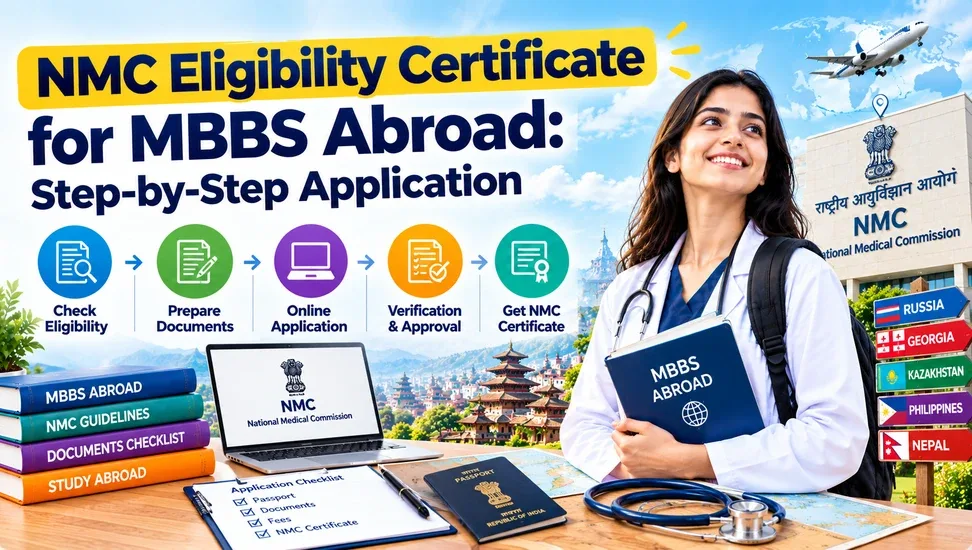
Key NMC Requirements for MBBS Abroad
Scroll HereUnderstanding the NMC Guidelines: A Brief
Scroll HereWhat If My Abroad College does not follow NMC Guidelines?
Scroll HereCompromising NMC recognition is compromising Your Degree
Scroll HereNMC Guidelines vs NMC-Approved University: What Is the Difference?
Scroll HereNMC Guidelines for MBBS Abroad 2026: Quick Checklist
Scroll HereHow to Check NMC Eligibility of a Foreign Medical University
Scroll HereCan Indian Students Transfer Their MBBS Course to Another Country?
Scroll HereConclusion
Scroll HereFrequently Asked Questions
Scroll HereIs an MBBS abroad valid in India?
Scroll HereIs NMC approval required for MBBS abroad?
Scroll HereWhat is the minimum duration of MBBS abroad according to NMC?
Scroll HereIs internship abroad compulsory after MBBS?
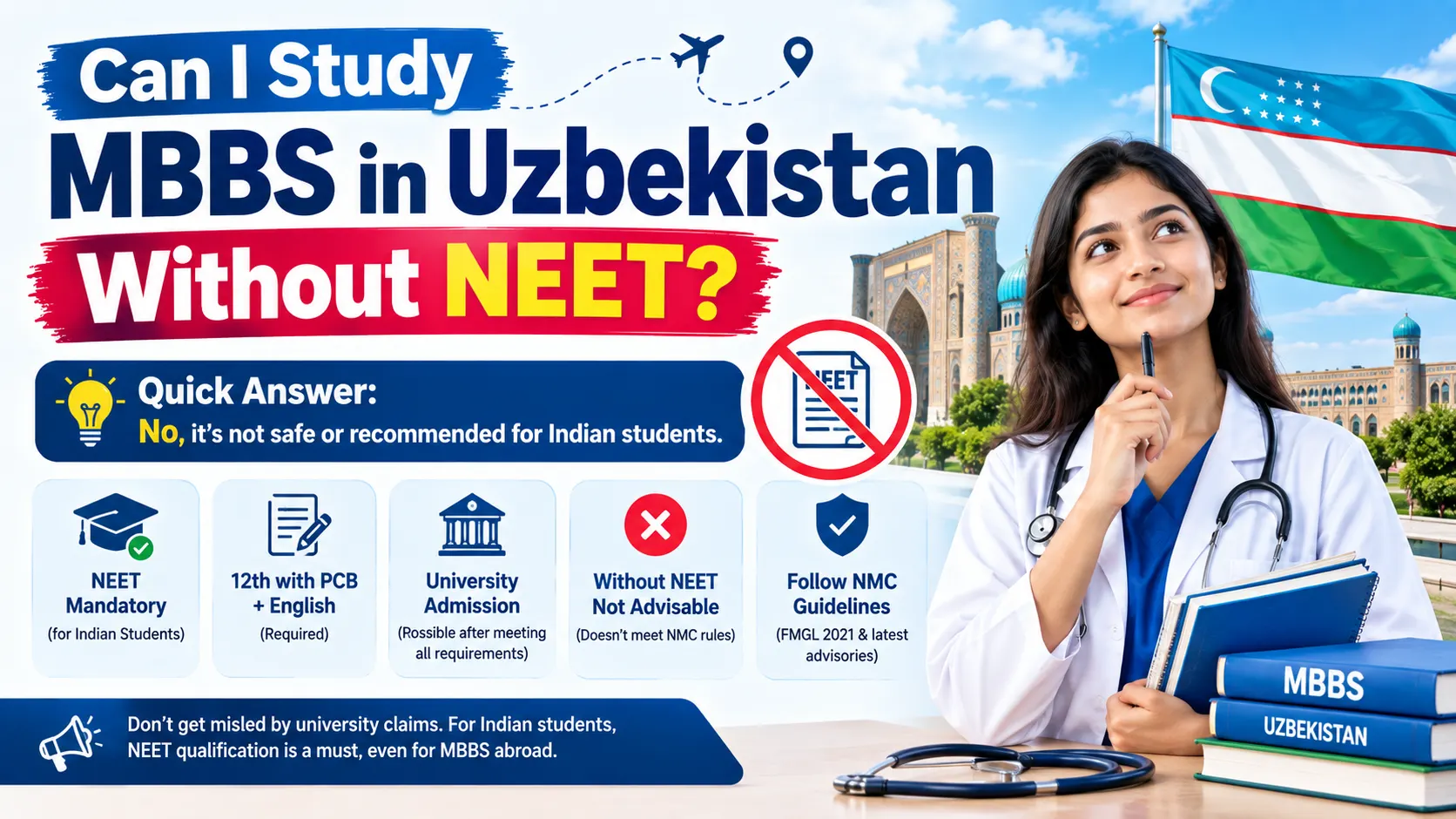
Scroll HereIs NEET compulsory for Indian students studying MBBS abroad?
Scroll HereWhat are the latest NMC guidelines for MBBS abroad in 2026?
Scroll HereThe new NMC guidelines and their effects on MBBS abroad are one of the biggest concerns for Indian medical aspirants. The National Medical Commission of India has published a set of guidelines including a minimum 54-month course duration, English-medium curriculum, proper clinical training, internship opportunities, and recognition of the degree in the host country. Meeting all of these requirements is mandatory for Indian aspirants who want to practice as a registered doctor with a valid license in India. With the current update in 2026 under the Foreign Medical Graduate Licentiate (FMGL) Regulations, students should have accurate knowledge of compliances before selecting a medical university abroad. Proper verification and authentication of NMC guidelines to study MBBS can help students avoid difficulties during the FMGE exam upon completion of the course.
Under the NMC Foreign Medical Graduate Licentiate (FMGL) Regulations 2021, Indian students must qualify NEET-UG, study for at least 54 months in English at one foreign university, complete a 12-month internship at that same university, and be eligible for a medical licence in that country.
Usually no. The FMGL Regulations require the full course, clinical training and internship at the same foreign institution, so a transfer normally makes a student ineligible to practise in India. The NMC has allowed only specific one-time relaxations.
Key NMC Requirements for MBBS Abroad
Students who want to pursue MBBS abroad should check these highlights for accurate knowledge and information.
| Requirement | What Students Should Check |
|---|---|
| Minimum course duration | At least 54 months of theoretical education |
| Internship | 12 months of compulsory internship at affiliated hospitals |
| Medium of instruction | English should be the medium of instruction |
| Curriculum | Theory, practical, and clinical training should be aligned with the Indian MBBS course structure |
| Degree recognition | The medical degree should be recognised in the host country |
| Location of internship | The internship must be completed in the same foreign country |
Understanding the NMC Guidelines: A Brief
Medical aspirants are required to follow NMC guidelines to be eligible for MBBS Abroad Admission. NMC Guidelines were earlier known as the MCI (Medical Council of India). The new NMC guidelines for studying MBBS Abroad have been mentioned in 2021.
Let’s cover the NMC Guidelines for Universities given below.
- The MBBS course duration - a minimum of 54 months.
- The internship duration - a minimum of 12 months.
- The Learning Language - English.
- The curriculum must include 19 subjects mentioned in NMC guidelines.
- The university must be NMC-approved and must provide medical licenses for Indian students after course completion.
Let’s uncover the NMC Eligibility Criteria for MBBS Abroad Students given below.
- Age of Students - 17 years
- The NEET (entrance exam) - qualifying marks required.
- 10+2 degree marks - 50% in Physics, Chemistry, and Biology.
Indian aspirants must follow these NMC Guidelines to study MBBS abroad. There are fixed consequences if you study MBBS Abroad at a non-NMC-guidelines.
What If My Abroad College does not follow NMC Guidelines?
The NMC guidelines are the ultimate guide for Indian students who want to enrich their medical careers in foreign universities. The NMC guidelines are the most important requirement to continue their career in India after completing an MBBS abroad.
Indian students must be attentive while choosing the university and country for their higher education abroad. They must ensure they study MBBS at an NMC-approved university.
Compromising NMC recognition is compromising Your Degree
Your MBBS degree will not be considered valid in India if you somehow compromised any one guideline of NMC. The validity of an MBBS abroad degree is only valid until you and your MBBS university are recognized as per NMC guidelines.
These types of students will not be eligible to apply for the Indian licensing exam, which is popularly known as the Foreign Medical Graduates Examination. Soon, it will be going to be replaced by the NExT Exam, which will be a combination of FMGE and NEET-PG. Students will not be eligible to get the Indian medical license if they and their MBBS Abroad university do not follow the NMC guidelines accurately.
NMC Guidelines vs NMC-Approved University: What Is the Difference?
One of the most common terms among Indian medical aspirants is “NMC approved university”. It is misleading. The National Medical Commission of India does not publish any university or college lists for MBBS or equivalent medical courses. Instead, the NMC has published guidelines for foreign medical graduates under the FMGL requirements. If a university aligns its course with NMC compliance and students meet all the requirements, the degree is valid under the National Medical Commission of India.
Students should not rely on the fact mentioned as “NMC-approved university”. It is necessary to verify the curriculum. So that it is understood whether the medical curriculum aligns with the FMGL requirements. This confirms that students are eligible for FMGE or upcoming NExT to receive the licence.
NMC Guidelines for MBBS Abroad 2026: Quick Checklist
To meet the NMC regulations, students have to follow the checklist.
- Minimum 54 months of course
- Compulsory 12 months of internship
- Complete the internship at the same foreign university and in the same country
- English should be the medium of instruction
- Exposure to extensive clinical training
- Recognition of the medical degree in the host country
- Cross-country clinical training should not be accepted
- Verify the latest NMC guidelines before admission
How to Check NMC Eligibility of a Foreign Medical University
Before paying the admission fees to a university, students should verify the following factors to get accurate information.
- University recognition - Is the university accredited by the host country’s legal body?
- Degree recognition - Is the MBBS degree (or the equivalent degree) recognised as the primary medical qualification to practice in the host country?
- Duration of the course - Does the course align with the minimum duration of the NMC guidelines?
- Medium of instruction - Is the entire course provided in English?
- Clinical training - Does the university offer appropriate theoretical and practical clinical training?
- Internship - Does the internship meet the NMC guidelines, including the same country and institution requirements?
Can Indian Students Transfer Their MBBS Course to Another Country?
Students may have queries regarding transferring the MBBS course to another country and university. According to the FMGL requirements 2021, the academic course, clinical training, and internship should be completed in the same country and the same university. Transferring the course from one country to another may create difficulties in meeting the licensing eligibility requirements in India.
So, while planning for a transfer, students should verify-
- The medical course will meet the mentioned duration requirements of the NMC guidelines
- The receiving university is legally accredited in the host country
- Clinical training is provided with appropriate infrastructure
- As per the guidelines, the internship should be completed at the same foreign medical university
Conclusion
Indian aspirants are required to follow the NMC guidelines mentioned in the Gazette of India in 2021 after replacing the Medical Council of India. They must study at an NMC-approved medical university that provides a valid MBBS degree along with a medical license in that particular country. It allows Indian aspirants to enhance their education and attain a globally acceptable and accredited medical degree within the affordable range of the MBBS fee structure. Before applying for MBBS admission abroad, students must ensure they fulfil the NMC guidelines to study MBBS abroad, along with the eligibility criteria.
Frequently Asked Questions
Is an MBBS abroad valid in India?
A foreign medical degree does not automatically grant the right to practise medicine in India. Graduates must fulfil the applicable NMC licensing and registration requirements.
Is NMC approval required for MBBS abroad?
Students should not rely on the phrase “NMC-approved university.” NMC itself states that it does not endorse a list of foreign medical universities. Students should verify the specific programme against applicable requirements.
What is the minimum duration of MBBS abroad according to NMC?
The FMGL framework specifies a minimum of 54 months of medical education, along with the applicable 12-month internship requirement.
Is internship abroad compulsory after MBBS?
The FMGL framework requires the applicable 12-month internship arrangement, including completion at the same foreign university under the specified conditions.
Is NEET compulsory for Indian students studying MBBS abroad?
Indian students must meet the applicable NEET-UG requirements for foreign medical education. The exact eligibility should be checked for the relevant admission year.
What are the latest NMC guidelines for MBBS abroad in 2026?
The FMGL Regulations, 2021 remain a key framework, while NMC has issued subsequent notices and clarifications, including the 8 June 2026 FMGL FAQ and the 1 April 2026 advisory concerning foreign medical education.