Table of Contents
The National Testing Agency is the supreme medical council in India which has the power to make the rules and regulations to govern the students. It is responsible for maintaining the discipline and reputation of the Indian Medical Department. The NEET (National Eligibility cum Entrance Exam) is a highly competitive medical exam in India and it is important to follow NEET Dress Code while appearing for the exam. Around 25 lakh students appear in the NEET exam yearly because qualifying for NEET is important to pursue a medical degree in India in any department. There are high chances of malpractice during the NEET Exam.
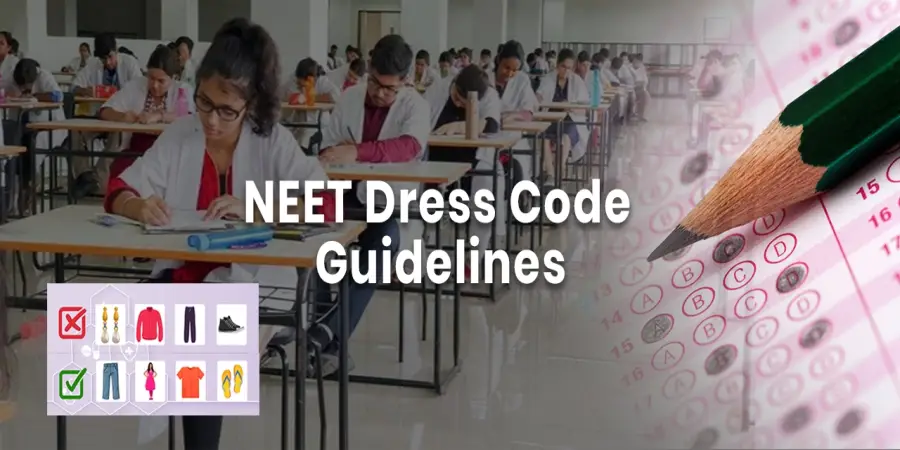
NEET Dress Code Guidelines in 2026 for Indian Students by NTA
To maintain discipline and restrict malpractices like paper leaks, cheating, etc, the NTA has stated the Dress Code Guidelines, which must be strictly followed by the students appearing in NEET 2026.
These NEET (UG) 2026 dress codes must be followed by every aspiring NEET (UG) aspirant. Considering it liberally will lead to last-time restrictions from the NEET(ug) exam. These NEET dress code guidelines differ for both male and female candidates. Both of them are detailed below.
NEET(UG) Dress Code for Female Candidates
Here are some of the NEET (UG) Dress Codes for Female Candidates that must be followed by the students while appearing for the NEET-UG 2026.
- Consider wearing lightweight, comfortable, but decent clothes.
- Avoid wearing extra clothes like a scarf and long sleeves.
- Jewellery and Hair accessories are strictly prohibited.
- No heel or metal buckles are allowed. Students are advised to wear simple slippers.
- Try to avoid wearing haircuts, clips, caps, heavy rubber bands, etc.
- Try to wear casual pants and T-shirt, and simple slippers, and it is important to avoid making buns.
NEET(UG) Dress Code for Male Candidates
Here are some of the NEET (UG) Dress Codes for Male Candidates that must be followed by the students while appearing for the NEET-UG 2026.
- Wear lightweight, comfortable, and half-sleeve shirts and t-shirts.
- Avoid wearing long sleeves, ties, belts, and extra clothes like a scarf.
- Jewellery like bracelets, any type of thread, ring, or earrings, are strictly prohibited.
- Wear no-heeled shoes without any metal buckles. Students are advised to wear simple slippers.
- Try to avoid wearing caps, hats, goggles etc.
- Try to wear casual pants and a shirt, and simple slippers.
Prohibited Items for NEET 2026
NTA also has provided a list of elements that must not be carried by the students at the examination centre. The list of prohibited items for NEET 2026 is given below.
- Students should not carry any written or empty paper with them which is not necessary.
- They should not carry any eating and drinking materials.
- They must avoid digital gadgets like mobile phones, digital watches, etc.
- Skip wearing any thread, watch, bracelet, chain, etc.
- Avoid carrying pens and any stationary kit.
Note: According to the Delhi High Court, students are allowed to wear their customary dresses like burkhas for Muslims and Sikhs can carry their cultural elements like Kangha, kirpan, etc with them. However, they are advised to visit their respective NEET 2026 exam centres before 1.5 to 2 hours. This facilitates to maintenance of discipline in the NEET exam.
Things to carry for NEET 2026?
Here is finally, what things to carry for NEET 2026 at the examination centres are given below.
- NEET 2026 Admit Card
- Government-issued Identification Proof
- Two Passport size photographs
- A transparent water bottle
These are the necessities while appearing for the NEET 2026 Exam.
Note: There is an important update regarding the NEET Exam Pattern 2025 by NTA. Students who are preparing for NEET 2025 are advised to read the guidelines carefully.
Conclusion
This is the ultimate NEET Dress Code which is provided by the NTA (National Testing Agency) for NEET 2025 aspirants to maintain the decorum of the NEET examination. This prevents any malfunctioning and junk practices. The students need to follow every pointer of the NEET(UG) Dress Code for Male Candidates and Female Candidates to avoid last-minute restrictions.
All the NEET 2025 aspirants are advised to follow all the NTA instructions decently for validity and authenticity. For detailed guidance on NTA updates and instructions, students should consult Education Vibes at +91 7217219100.
FAQs
1. Are jeans allowed in NEET 2024?
No, jeans are strictly prohibited for the students. They must wear loose and casual clothes while appearing in the NEET Ug 2025 exam.
2. Is a tattoo allowed in the NEET exam 2025?
No, the students are not allowed to appear for the NEET 2025 exam with a Tattoo. They should be aware that tattoo is not allowed in any competitive examinations.
3. Are calculators allowed for NEET 2025?
No, Calculators are not allowed in NEET 2025. Also, there is no purpose for a calculator in the medical entrance exam.
4. What things are not allowed in NEET 2025?
Things like written or unneeded papers, hats, caps, bracelets, jeans, any type of thread, rings, electronic gadgets, watches, stationery items, food items, chains, etc are strictly prohibited in the NEET 2025 exam.
5. What is the Reporting Time for NEET 2025?
In the NEET exam 2025, the timings are supposed to be 2 pm to 5 pm. The entry for the exam closes half an hour before the exam time. The entry for the exam begins at 11:30 am and closes at 1:30 pm. Students should report before 1:30 pm to appear in the NEET Exam 2025.
6. Are leggings allowed in NEET 2025?
No, leggings and denim pants are not allowed in the NEET exam. Students are advised to wear simple, loose, and casual clothing while appearing for the NEET exam.