Table of Contents
1. A Century of Teaching Medicine in Siberia
Scroll Here2. Is Omsk NMC-Recognised?
Scroll Here3. English-Medium Teaching: Does It Hold Up in Clinical Years
Scroll Here4. Clinical Exposure in Working Hospitals, Not Demonstration Rooms
Scroll Here5. What Families Actually Spend (Full Breakdown on Our Fees Page)
Scroll Here6. Indian Community and Food You Recognise
Scroll Here7. Life in Omsk: Climate, Safety, Transport and Student Experience
Scroll Here8. Who Omsk Suits, and Who Should Look Elsewhere
Scroll HereThe Short Version
Scroll HereEvery year, thousands of Indian students who narrowly miss a government medical seat start looking seriously at Russia. Omsk State Medical University comes up in almost every one of those searches. That popularity alone is not a reason to commit six years of your life to a city in Siberia.
This guide sets out eight practical reasons Indian students choose Omsk, written around what actually matters once you land: how the teaching is structured, how much time you spend on a ward instead of in a lecture hall, what daily life looks like through a Siberian winter, and who this university genuinely suits.
1. A Century of Teaching Medicine in Siberia
Omsk State Medical University opened in 1920 and has been training doctors without interruption ever since. That matters more than it sounds. A hundred-year-old faculty means the teaching hospitals, the department structure and the examination system have been through several generations of reform, and the university did not appear recently to serve the international student market.
The university operates under the Russian Ministry of Health and the Ministry of Science and Higher Education. Its curriculum follows the Federal State Educational Standards, the same framework Russian domestic medical students study under. You are not enrolled in a separate, lighter track built for foreigners, and you are examined by the same departments.
That institutional weight shows up in ordinary ways. Departments have permanent faculty rather than visiting staff, the anatomy and pathology collections have been built up over decades, and the university has its own clinical bases instead of renting ward time from whichever hospital has space. If you are still comparing institutions across the country, our guide to the top medical universities in Russia for Indian students sets Omsk against the alternatives.
2. Is Omsk NMC-Recognised?
Omsk State Medical University is recognised by the National Medical Commission of India and is listed in the World Directory of Medical Schools and with the World Health Organization. For an Indian student, those three listings are the ones that decide whether your degree is worth anything when you come home.
One point worth clearing up, because older articles still get it wrong: the Medical Council of India was dissolved in September 2020 and replaced by the National Medical Commission. Any page still telling you a university is "MCI approved" has not been updated in years. Every foreign medical qualification today is assessed under NMC regulations.
In practice, recognition means you are eligible to sit the screening examination and register to practise in India once you complete the course and the required internship. The NMC framework sets conditions on course length, on the language of instruction, on completing the whole degree at a single institution, and on an internship served in the same country where you studied. Omsk is structured to meet them, but the responsibility for checking your own eligibility sits with you.
One more thing worth doing before you commit anywhere: qualifying NEET is mandatory for an Indian student taking a primary medical qualification abroad, and it is not a formality you can arrange afterwards. The rules have changed more than once in recent years, so read the current version carefully in our breakdown of the latest NMC guidelines for studying MBBS abroad before you pay any deposit.
3. English-Medium Teaching: Does It Hold Up in Clinical Years
Plenty of universities advertise an English-medium programme and then quietly switch to the local language once students reach the wards. At Omsk the international programme is delivered in English across the full course, with faculty who teach the same subjects to Russian cohorts.
Here is the honest part, and any counsellor who skips it is not doing their job. Lectures, notes and examinations run in English, but your patients will not speak it. Russian language classes are built into the early years precisely so you can take a history and follow a ward round by the time clinical rotations begin. Students who treat those classes as a formality struggle later. The ones who take them seriously get far more out of their hospital time. The sequencing of all this is set out in our note on MBBS course duration and structure.
4. Clinical Exposure in Working Hospitals, Not Demonstration Rooms
Omsk is a regional healthcare hub of well over a million people, and the university is attached to city and regional hospitals that carry a genuine patient load. That volume is the single biggest advantage of studying in a large provincial city rather than a small campus town.
Teaching follows the standard progression. The first two years are pre-clinical, covering anatomy, physiology, biochemistry and histology. The middle years bring pathology, pharmacology and microbiology. From there you move into clinical departments, rotating through internal medicine, surgery, paediatrics, obstetrics and gynaecology and the specialities, under supervision. Departments have simulation labs for procedural practice, but the point of the simulation work is to prepare you for the ward, not to replace it.
What that adds up to over six years is case variety. A regional hospital in a city this size sees seasonal infectious disease, trauma, chronic cardiovascular and endocrine cases, and a full obstetric load, all of which you will meet again in an Indian hospital. Students who ask questions on rounds and volunteer for the unglamorous shifts finish with a far better case log than students who treat rotations as attendance. The opportunity is the same for everyone; what you take from it is not.
5. What Families Actually Spend (Full Breakdown on Our Fees Page)
Cost is why most families start looking abroad in the first place. Set against private medical colleges in India, and against medical schools in the United States, the United Kingdom or Western Europe, Omsk sits within reach for a middle-income household without a management quota payment or a donation.
Omsk also helps on the living side. It is a large city but not a capital, so accommodation, food and local transport cost noticeably less than they would in Moscow or St Petersburg. Over six years that difference compounds into a meaningful amount.
Fees change from one intake to the next and rupee conversions move with the exchange rate, so we keep a single verified figure in one place rather than repeating stale numbers across the site. For the current year-wise tuition, hostel, mess, visa and insurance breakdown, along with the total six-year cost, see Omsk State Medical University Fees 2026 (complete cost breakdown)
6. Indian Community and Food You Recognise
Homesickness ends more foreign medical degrees than academics do. Omsk has had Indian students for long enough that the support structure is already in place rather than something you have to build from scratch in your first winter.
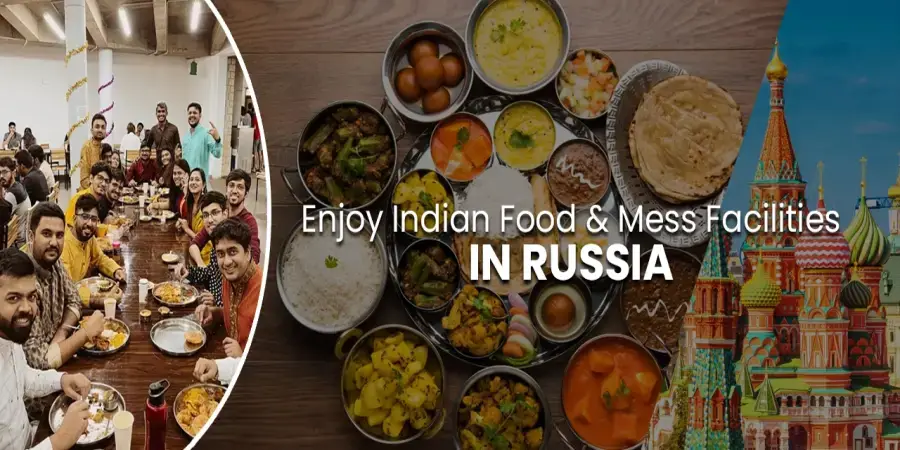
Seniors run informal orientation for every new batch, which is how most students actually learn to register with the local authorities, open a bank account and find their way around the hospital. Indian messes near the hostels serve familiar vegetarian and non-vegetarian food daily, and grocery shops stock Indian spices and staples. We have written separately about Indian food and mess arrangements at Omsk and about hostel and accommodation for Indian students in Omsk, because those two questions come up in nearly every counselling call we take.
7. Life in Omsk: Climate, Safety, Transport and Student Experience
Omsk sits in south-western Siberia on the Irtysh river, with a population of roughly 1.2 million. It is an industrial and academic city rather than a tourist one, which suits students. Public transport is cheap and reliable, the university district is walkable, and the city runs on GMT +6, so a call home is straightforward.
The climate deserves a straight answer. Summers are pleasant and genuinely warm. Winters are long and severe, and temperatures fall well below anything you have experienced in India. Every building you spend time in is centrally heated, and students adapt within a season, but the first December is a shock and it is better to expect it than to be sold a milder version. Budget for proper winter clothing in your first month rather than trying to bring it from home, and plan on buying it locally where it is made for the conditions.
On safety, the practical picture is what you would expect of a large university city. The campus and hostel areas are settled, students move around in the evenings without much difficulty, and the main adjustments are administrative rather than personal: registering your stay, keeping your documents in order and renewing your visa on time. Outside the lecture timetable there is a real city to live in, including the Vrubel Museum of Fine Arts, the Omsk Drama Theatre and the Tara Gates.
8. Who Omsk Suits, and Who Should Look Elsewhere
A university is a fit, not a ranking, and it is worth being direct about both sides.
Omsk suits a student who wants a government university with a long teaching record, who is planning to return to India and sit the screening examination, who will put in the work on Russian language early, and who is comfortable in a cold climate away from a metro city.
Omsk is the wrong choice for a student who expects to practise abroad without clearing the relevant licensing examination, who wants a mild climate or a capital-city social life, or who is being told that a foreign degree removes the need to study hard for the screening exam. It does not. Passing rates depend far more on your own preparation than on the name of your university. If you are still weighing countries rather than universities, start with our overview of MBBS in Russia and the wider MBBS abroad guide.
The Short Version
Omsk State Medical University earns its place on an Indian student shortlist through a century of continuous teaching, NMC and WHO recognition, an English-medium programme that holds through the clinical years, hospitals with real patient volume, a cost structure a middle-income family can plan around, and an Indian community already established on the ground. The trade-off is the Siberian winter and the language work, and both are manageable if you go in knowing about them.