Table of Contents
Can you study in Germany without IELTS?
Scroll HereGerman Universities without IELTS: Full List
Scroll HereMOI certificate for Germany: What it is and how to get one
Scroll HereWho issues the certificate?
Scroll HereWhat must be stated to be accepted?
Scroll HereCommon reasons for its rejection
Scroll HereWhen MOI may not be enough: the reality of Indian students
Scroll HereIELTS Alternatives accepted by German universities
Scroll HereGerman language levels A1 to C2: What you actually need
Scroll HereTestDaF exam vs DSH exam vs Goethe Certificate
Scroll HereEligibility and requirements
Scroll HereAPS certificate Germany for Indian students
Scroll HereStudy in Germany without IELTS: Bachelor’s, Master’s, and PhD
Scroll HereBachelor’s degree
Scroll HereMaster’s degree
Scroll HereMBA
Scroll HerePhD programme
Scroll HereUniversity acceptance vs Visa acceptance: What students should verify
Scroll HereHow to apply: Step-by-step
Scroll HereStep 1: Select a university with an English-taught programme
Scroll HereStep 2: Academic transcripts
Scroll HereStep 3: Apply for an APS certificate
Scroll HereStep 4: Submission of university application
Scroll HereStep 5: Open a blocked account
Scroll HereStep 6: Apply for a student visa
Scroll HereStep 7: Fly to Germany
Scroll HereFrequently Asked Questions (FAQs)
Scroll HereBefore We Conclude
Scroll HereMany students who want to study in Germany have a question: Is it possible to study in Germany without IELTS for Indian students? The honest answer is: yes, it is possible, provided you meet certain conditions. Many universities accept alternative forms of English proficiency, including TOEFL, PTE, and Duolingo. Many universities also accept a Medium of Instruction (MOI certificate). This certificate proves that you have studied English to demonstrate your English proficiency. Also, students should know that, in Germany, admission requirements and student Visa requirements are separate and handled by different authorities.
Can you study in Germany without IELTS?
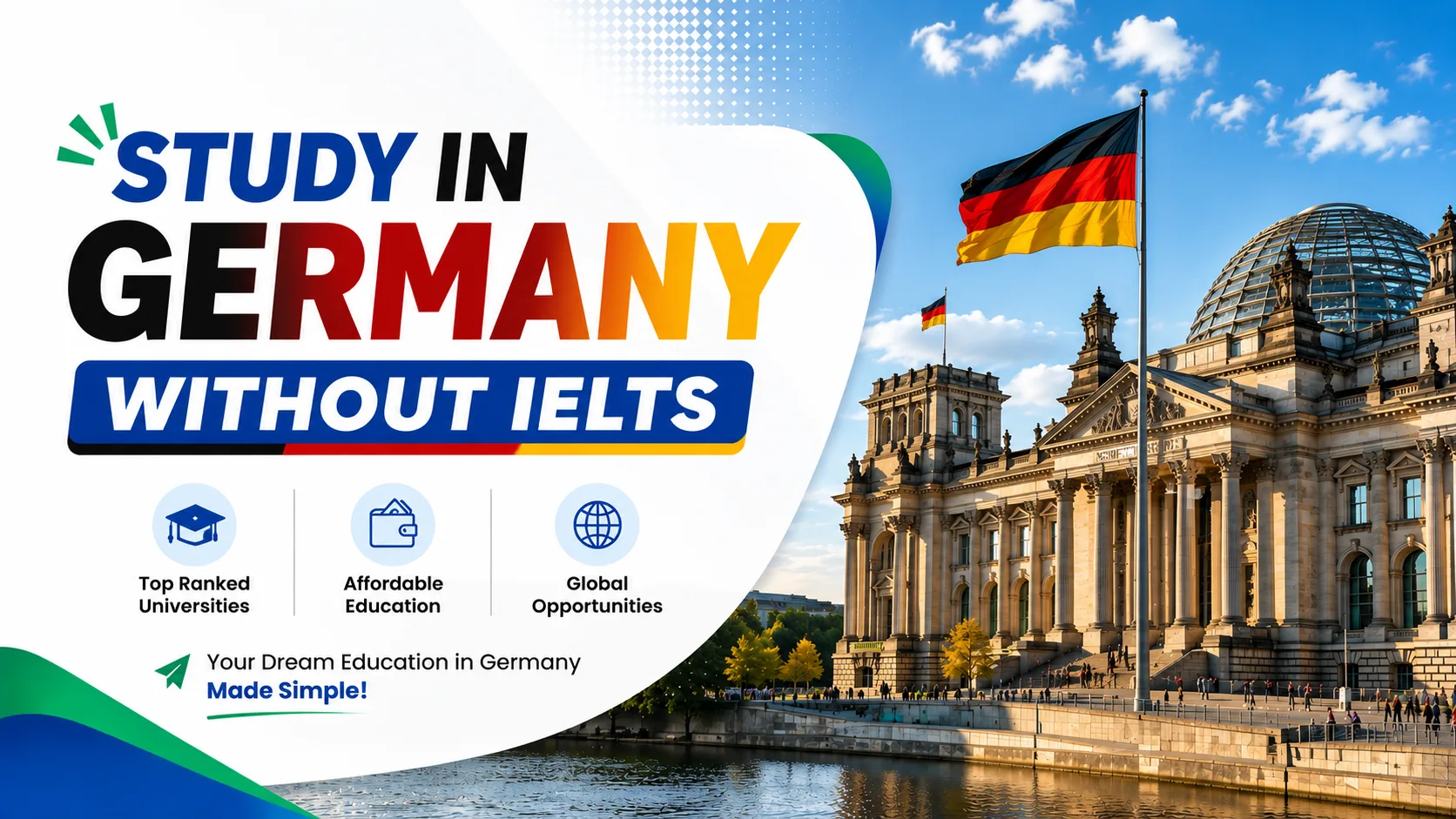
Many Indian students are confused by the belief that the German Embassy requires IELTS for admission to the country. But the truth is: IELTS is not required at the national level. Each university sets its own English proficiency requirements. Concluding this, yes, you can study in Germany without IELTS, as it does not depend on the country, but rather on the programme and the university. There are two paths to study in Germany; let’s delve into them:
- English-taught programmes: Students who are choosing to study an English-taught programme can study without IELTS if the chosen university accepts an alternative proof of English-language proficiency.
- German-taught programmes: To study in German-language programmes, you do not need to provide an IELTS certificate as it tests English proficiency rather than German. However, students need to provide German language certificates, such as TestDaF, DSH, and Goethe-Zertifikat.
German Universities without IELTS: Full List
Many German universities allow Indian students to enrol in the English language programmes without IELTS if they provide an accepted alternative to IELTS. There are almost 200+ public and private universities that offer an English language programme with an alternative to IELTS. Universities without IELTS in Germany require alternatives, such as TOEFL, PTE, Duolingo, and MOI certificates.
We have provided below a list of a few top universities in Germany with major English-taught programmes:
University | Major English-taught Programmes | TOEFL iBT Min | PTE Min |
Technical University of Munich | Aerospace Engineering, Management and Technology, etc. | 88 | 65 |
Ludwig Maximilian University of Munich (LMU Munich) | Software Engineering, Statistics and Data Science, etc. | 87-109 | 65 to 70 |
Heidelberg University | Economics, Data and Computer Science, Molecular Biosciences, etc. | 90-100 | 65+ |
RWTH Aachen University, North Rhine-Westphalia | Computer Engineering, Data Science, Robotic Systems Engineering, etc | 90-120 | 60+ |
Free University of Berlin | Finance and Marketing, Finance, Accounting and Taxation, etc. | 95+ | 76+ |
NOTE: The Duolingo and MOI acceptance vary by universities and specific programmes.
MOI certificate for Germany: What it is and how to get one
A Medium of Instruction (MOI) is a document issued by one’s college or university as proof that students have completed their education in English. This document serves as proof of your English language proficiency for study, work, or immigration to an English-speaking country.
Who issues the certificate?
The MOI certificate is issued by the higher authority of the school or university. In the case of a school, it is issued by the principal or head. In the case of a college or university, the MOI is issued and signed by the registrar, controller of examinations, or the principal.
What must be stated to be accepted?
Although the MOI certificate is just a one-page document, it must contain the following information to be reliable and complete:
- Student’s full details, including full name and enrolment number.
- Official institution letterhead
- Formal statement declaring medium of instruction
- English-medium study duration
- Signature of the college authority
- Official seal of the institution
- Date of issue
- Contact information of the institution
Common reasons for its rejection
The MOI can be rejected by foreign embassies for several reasons, including not aligning with immigration laws, lacking the specific wording required to prove total language immersion, or more. Here are a few of the reasons for an MOI rejection:
- No verification contact of the institution
- Missing exact duration of studies
- Partial language claim rather than entire curriculum
- Missing stamp or seal
- Missing attestation or MEA apostille
When MOI may not be enough: the reality of Indian students
When an MOI certificate is accepted by a German university for admission, but the German embassy may reject it and may demand official language proof during the visa process. The MOI may not be enough in the following circumstances:
- Strict Institutional policies: Some universities might have different and strict policies regarding language acceptance. They may require other standard langugae certificates such as Duolingo, TOEFL, etc.
- University acceptance vs Visa acceptance: Universities may accept an MOI certificate, but it does not mean it will be accepted by Visa officers. Visa authorities are independent of universities’ requirements.
IELTS Alternatives accepted by German universities
Without IELTS, students can get admission in a vast range of English-taught programmes, provided they have to provide an alternative to the IELTS certificate.
Test | Cost in India | Result timeline |
TOEFL iBT | INR 18,000 | Approx 3 days |
PTE | INR 18,900 | Approx 24 to 48 hours |
Duolingo English Test | INR 5,000 to INR 6,700 ( for a single attempt) | 12 hours to 48 hours |
Cambridge English (C1 Advanced) | INR 17,000 to INR 20,000 | 5 to 10 days (for digital exam) 4 to 6 weeks (for paper-based test) |
MOI Certificate | INR 100 to INR 1000 | 7 to 20 working days |
German language levels A1 to C2: What you actually need
German language structure follows the CEFR (Common European Framework of Reference for Languages) scale from A1 to C2. The scale is used to measure language ability and proficiency. There are 6 levels: A1, A2, B1, B2, C1, and C2. A1 and A2 are for basic users, B1 and B2 are intermediate, and C1 and C2 are advanced.
If your degree is taught in English, you need A1 level for daily life. Beginners use A1 and A2 to introduce themselves and ask or answer basic questions. Hence, it also becomes useful for part-time work. A German-language programme usually needs B2 or C1 via TestDaF or DSH, while specialist roles like medicine and engineering need C2.
TestDaF exam vs DSH exam vs Goethe Certificate
To study in the German language, international students have a common question: Which exam is the best to take? The answer lies in the individual’s future goals and personal preference.
TestDaF (Test Deutsch als Fremdsprache) is required for university admission in Germany at the B2 to C1 levels. The test is valid globally and does not expire, which makes it suitable for those who want to use it for future academic purposes. With a price range of approximately €125 to € 210, the test is held only 7 times a year.
The DSH is a German language exam specifically organised by individual German universities for the B2 to C2 proficiency levels. The test certificate is valid for only 2 years and is recognised only in Germany. With a price ranging from € 40 to € 170, it becomes an affordable option for budget-conscious students.
With global recognition, Goethe-Institut exams are known for their high-quality and long-term validity. The cost of the exam ranges from € 100 to € 300, depending on the location and exam level.
Eligibility and requirements
Students who want to study in Germany without IELTS must meet the required academic and language requirements. If the university does not ask for IELTS, students have to present an alternative language certificate.
- A MOI Certificate: Students must present a Medium of Instruction certificate, confirming that their previous qualification was taught in English.
- German language proficiency: Students who want to study a German language course must submit a German language proficiency certificate.
- English language assessment: Certain German universities conduct their own language assessment or interview.
- Alternative English language test: If students are planning to study without IELTS, some universities may accept TOEFL, Duolingo, PTE, or Cambridge English qualifications.
- Academic qualifications: Students must meet the programme-specific academic requirements.
APS certificate Germany for Indian students
Akademische Prüfstelle, or Academic Evaluation Centre, known as APS, is an official document issued by the German Embassy in New Delhi. It confirms that your academic qualifications are valid and meet the German higher education standards.
The documents required are class 10th and 12th marksheet, all semester marksheets, degree certificate, and proof of language proficiency. To get an APS certification,
Study in Germany without IELTS: Bachelor’s, Master’s, and PhD
Indian students can study Bachelor’s, Master’s, and PhD without IELTS, provided they provide an alternative to the IELTS test.
Bachelor’s degree
For a Bachelor’s degree, students are required to keep in mind certain things:
- The 12th board result must match the German education standard.
- If your education does not match their standard, you must complete the 1-year foundational course, known as Studienkolleg.
- Language proficiency in German and English.
- APS certification
Master’s degree
In Germany, every university sets its own eligibility criteria to pursue a Master’s programme. Candidates must visit the university’s official website to check basic prerequisites. The following are eligibility criteria for Master’s studies in Germany:
- A 4-year Bachelor's degree holder from many Asian countries, including India, is treated as par with a German Bachelor’s degree.
- Some universities may ask for an entrance test to admit to one of their Master’s degrees. For example, to study Law or Economics, students may need to pass the GMAT exam.
MBA
To study an MBA in Germany, Indian students need to meet the following eligibility criteria:
- Students must have completed 3 or 4 years of a Bachelor's degree from a recognised university.
- Must have 1 or 3 years of work experience
- An APS certificate to verify academic credentials
- Top business schools in the country require an entrance test to get enrolled in an MBS programme.
- English proficiency alternatives (if the candidate does not have an IELTS certificate)
- German language requirement for daily life.
PhD programme
For a PhD programme, students need to meet the following prerequisites:
- A recognised Master’s degree equivalent to a German degree
- A strong academic record
- An APS certificate to verify academic credentials
- Proof of English language proficiency
- Proof of German language, if your degree is taught in German
University acceptance vs Visa acceptance: What students should verify
University admission and visa requirements are not the same. Here, students need to be careful. Universities have their own rules for language requirements. They could waive IELTS and instead accept other language proficiency certificates. On the other hand, visa officers handle your profile independently and enforce the rules of local German authorities. They may have stricter and different rules. Hence, there is no mandatory requirement for IELTS for Germany student visa; instead, your chosen university demands it for admission.
Students who want to apply must submit the following documents during the visa process:
- University Admission Letter: The university admission letter must show that language proof is already accepted by the university.
- APS certificate: An APS certificate shows that your academic qualification is authentic and reliable for studying in Germany.
- Alternative language proof: If you are going to study without an IELTS certificate, you are required to get alternative language proof, such as TOEFL, Duolingo test, and others.
- Financial proof: As financial proof, students need to have a blocked account with at least €11,904 to cover one year of living expenses.
How to apply: Step-by-step
Applying to study in Germany involves several important stages, from choosing the right programme to obtaining a student visa. International students should begin by researching suitable universities and courses that match their academic qualifications, career goals, budget, and preferred language of study.
Go through the following steps to apply to one of the reputed German universities:
Step 1: Select a university with an English-taught programme
Selecting the right German university is the first step to studying in Germany. Check whether the university offers an English-taught programme. While submitting your application, check whether the university accepts an alternative language certificate in place of IELTS.
Step 2: Academic transcripts
Gather all of your academic documents, including high school transcripts. Request an MOI certificate from your school authority.
Step 3: Apply for an APS certificate
Indian students must apply for an APS certificate to verify academic documents with the required fees.
Step 4: Submission of university application
Apply at the university through the central or the university’s official portal. Make sure to apply at the beginning of the application timeline to avoid obstacles.
Step 5: Open a blocked account
Students planning to study in Germany without IELTS must open a blocked account with at least €11,904 as one year of living expenses.
Step 6: Apply for a student visa
After getting the official admission letter from the university with an alternative to IELTS, students must apply for a student visa with the required documents. These documents include a passport, admission letter, APS certificate, and blocked account confirmation.
Step 7: Fly to Germany
In the final step, you will fly to Germany to complete the final enrollment at the university.
Frequently Asked Questions (FAQs)
If you are well-prepared, getting a German student visa is not difficult. However, the visa process requires strict attention to detail. You may go through bureaucratic delays.
Yes, studying in Germany is cheap, as most public universities do not charge tuition fees from national and international students.
International students from non-EU countries like India can work up to 140 full days or 240 half days per year. During the semester, they can work 20 hours per week.
With careful planning and complete documentation, the German Visa seems straightforward. There is no easy concept; you just need to prepare all the necessary documents.
Yes, you can get a job on a student visa in Germany. The work hour limit is 140 full days or 280 half days. Additionally, you can work up to 20 hours per week.
Yes, you can study in Germany without IELTS, provided you are required to submit other alternatives for language proficiency as per the university’s rules.
You need to provide IELTS alternatives, such as Duolingo, PTE, TOEFL, and MOI, if asked by a specific university.
Before We Conclude
Study in Germany without IELTS is possible for international students, but the English language requirements vary by university and specific programme. It also depends on previous education and accepted proof of language proficiency. Many universities may accept alternatives such as a Medium of Instruction (MOI) certificate or other proof of English proficiency. However, students should carefully check the language requirements of their chosen programme before applying. Germany offers top universities, low-cost education, and a wide range of programmes for international students. From selecting a university to completing the admission and visa process, proper planning is essential at every step.