Table of Contents
What Is TOPIK?
Scroll HerePurpose of the Test of Proficiency in Korean
Scroll HereWho Should Take the TOPIK Exam?
Scroll HereTOPIK and the Korean Language Learning Journey
Scroll HereTOPIK Levels Explained: Understanding Levels 1 to 6
Scroll HereTOPIK Level 1 and Level 2: Beginner Proficiency
Scroll HereTOPIK Level 3 and Level 4: Intermediate Proficiency
Scroll HereTOPIK Level 5 and Level 6: Advanced Proficiency
Scroll HereTOPIK I vs TOPIK II: What Is the Difference?
Scroll HereExam Structure and Sections
Scroll HereListening, Reading and Writing Requirements
Scroll HereScoring and Proficiency Classification
Scroll HereHow to Prepare for the TOPIK Exam
Scroll HereTOPIK Exam Registration, Fees and Results
Scroll HereTOPIK Exam Registration Process
Scroll HereTOPIK Exam Fees and Results
Scroll HereConclusion
Scroll HereFrequently Asked Questions About TOPIK
Scroll HereIs TOPIK compulsory for all international students in South Korea?
Scroll HereIs TOPIK I easier than TOPIK II?
Scroll HereHow long does it take to reach TOPIK Level 3?
Scroll HereCan I prepare for TOPIK without attending a language institute?
Scroll HereHow long is a TOPIK score valid?
Scroll HereSouth Korea is becoming a popular destination for international education, with 253,434 international students enrolled in its higher education institutions in 2025, according to South Korea's Ministry of Education. For students planning to study in Korea or work there, learning Korean can help improve communication and meet programme-specific language requirements.
Getting to know TOPIK levels explained is essential for international students who want to prepare for university admission, scholarship applications, or career opportunities in South Korea. The Test of Proficiency in Korean (TOPIK) is an official examination that assesses Korean language proficiency across six levels, from beginner to advanced.
This guide covers TOPIK levels, TOPIK I vs TOPIK II, scoring requirements, registration, and preparation strategies to help you choose the right proficiency target.
What Is TOPIK?
TOPIK (Test of Proficiency in Korean) is an official, standardised exam that measures the Korean language skills of non-native speakers. It is managed by the National Institute for International Education (NIIED) under the South Korean Ministry of Education.
Purpose of the Test of Proficiency in Korean
Korean language proficiency test is administered by South Korea's National Institute for International Education (NIIED), under the Ministry of Education. It evaluates the Korean language skills of non-native speakers and provides standardised results for academic and professional purposes.
TOPIK scores are used for university admission, employment applications, certain visa procedures, and Global Korea Scholarship (GKS) applications. However, the requirements differ depending on the institution, programme, and purpose.
Who Should Take the TOPIK Exam?
TOPIK suits international students, foreign nationals, and overseas Koreans who need formal proof of Korean language proficiency. Students applying to Korean-taught undergraduate or postgraduate programmes may need a recognised TOPIK score. It can also benefit scholarship applicants and job seekers who want to demonstrate their language skills.
However, TOPIK is not compulsory for every international student. Applicants to English-taught programmes may be required to submit English proficiency results instead. Students should check their chosen university's admission guidelines before registering.
TOPIK and the Korean Language Learning Journey
Learning Korean involves progressing from basic expressions and everyday vocabulary to advanced reading, writing, and comprehension. TOPIK provides a structured way to measure this progress through six proficiency levels.
The examination is divided into TOPIK I for beginner learners and TOPIK II for intermediate and advanced learners. Students can choose their examination based on their existing knowledge and academic or professional goals.
TOPIK Levels Explained: Understanding Levels 1 to 6
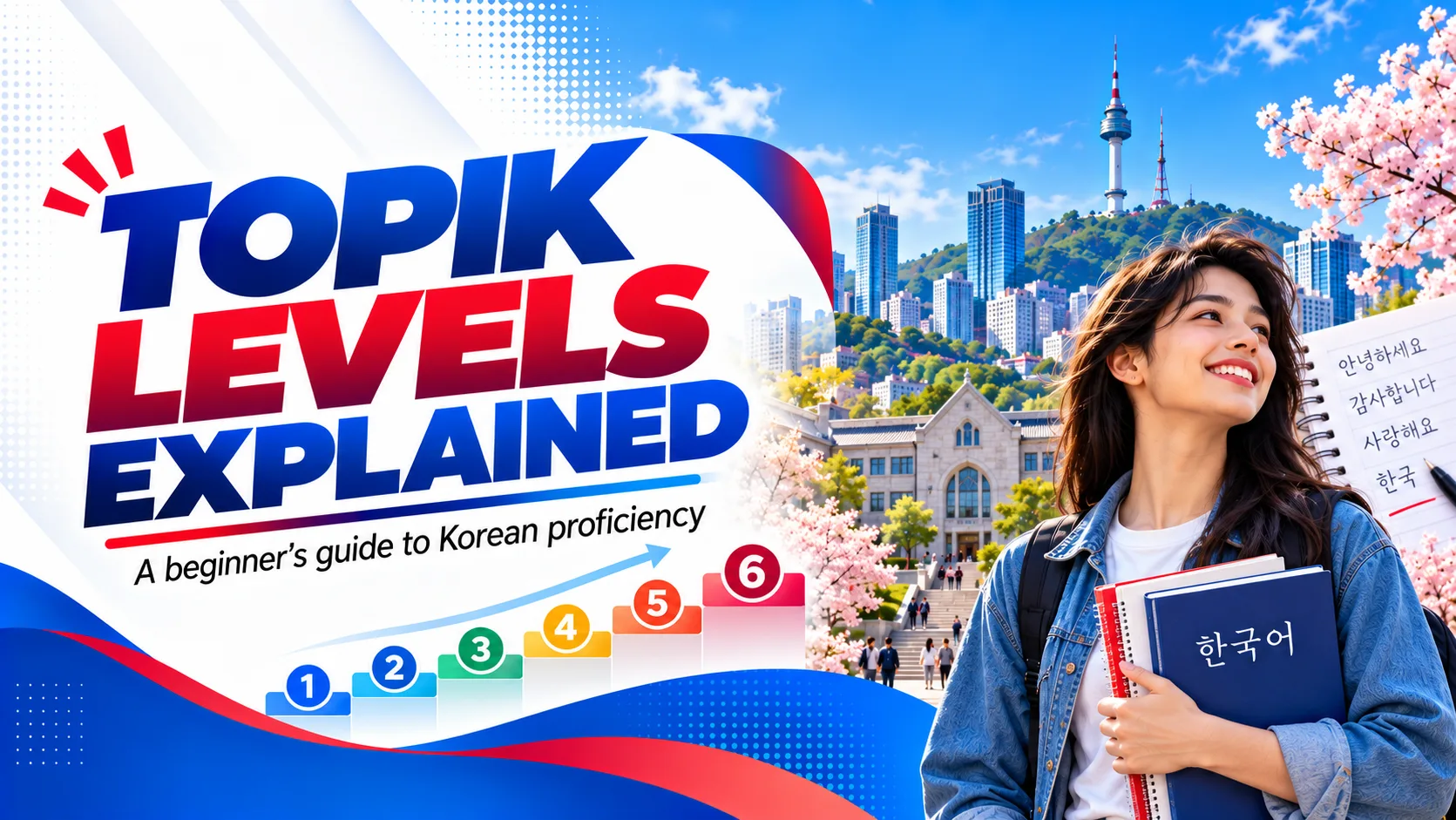
TOPIK has six proficiency levels, classified into beginner, intermediate, and advanced categories. TOPIK I assesses Levels 1 and 2, while TOPIK II assesses Levels 3 to 6. Below are the TOPIK exam levels explained.
| TOPIK Level | Proficiency | General Language Ability |
|---|---|---|
| Level 1 | Beginner | Understands basic greetings, simple expressions, and everyday phrases. |
| Level 2 | Beginner | Communicates about familiar subjects and routine situations. |
| Level 3 | Intermediate | Handles everyday interactions and understands familiar social topics. |
| Level 4 | Intermediate | Understands broader social subjects and expresses ideas with greater fluency. |
| Level 5 | Advanced | Communicates about academic, professional, and social topics. |
| Level 6 | Advanced | Demonstrates strong comprehension and expression across complex subjects. |
TOPIK Level 1 and Level 2: Beginner Proficiency
TOPIK Levels 1 and 2 are designed for learners developing foundational Korean language skills.
At Level 1, students can understand basic greetings, introduce themselves, and use simple expressions while shopping, ordering food, or asking basic questions. Level 2 involves broader vocabulary and the ability to communicate in familiar situations, such as discussing hobbies and daily routines.
Students preparing for these levels should focus on Hangul, basic grammar, sentence formation, everyday vocabulary, and listening comprehension.
TOPIK Level 3 and Level 4: Intermediate Proficiency
TOPIK Levels 3 and 4 represent intermediate Korean proficiency. Learners at these levels can understand a wider range of conversations and communicate about familiar educational, social, and practical topics.
Level 3 generally supports everyday communication and basic social interactions. Level 4 requires stronger comprehension of longer passages, general news, and discussions involving broader social subjects.
For international students, these levels may be relevant when applying to Korean-taught degree programmes. However, the required level depends on the university, department, and course.
TOPIK Level 5 and Level 6: Advanced Proficiency
TOPIK Levels 5 and 6 indicate advanced Korean proficiency. Level 5 learners can understand and express ideas about a wide range of professional, academic, and social topics. Level 6 represents a higher degree of comprehension and expression, including the ability to handle complex material with greater accuracy.
These levels may benefit students pursuing advanced academic work or employment requiring strong Korean language skills. However, a high TOPIK score does not automatically guarantee university admission, employment, or visa approval.
TOPIK I vs TOPIK II: What Is the Difference?
TOPIK I and TOPIK II differ in difficulty, assessment sections, total scores, and proficiency classifications. The examination format is also important because paper-based testing and internet-based testing use different scoring scales.
Exam Structure and Sections
TOPIK I contains 30 listening questions and 40 reading questions. TOPIK II contains 50 listening questions, 50 reading questions, and four writing tasks. The standard paper-based TOPIK exam pattern is as follows:
| Feature | TOPIK I (PBT) | TOPIK II (PBT) |
|---|---|---|
| Proficiency | Beginner | Intermediate to advanced |
| Sections | Listening and Reading | Listening, Reading and Writing |
| Total Questions | 70 | 104 |
| Duration | 100 minutes | 180 minutes |
| Maximum Score | 200 | 300 |
| Levels Awarded | 1–2 | 3–6 |
Listening, Reading and Writing Requirements
Both TOPIK I and TOPIK II assess listening and reading comprehension. TOPIK I focuses on basic vocabulary, grammar, and everyday situations, while TOPIK II includes more complex passages and language use.
Writing is a key difference in TOPIK II. Its four paper-based writing tasks require candidates to complete sentences and produce more developed written responses. Students preparing for TOPIK II should practise grammar, sentence structure, passage analysis, and timed writing exercises alongside listening and reading.
Scoring and Proficiency Classification
Candidates are classified according to their total score in the relevant examination. TOPIK I awards Levels 1 and 2, while TOPIK II awards Levels 3 to 6. The official TOPIK score requirements ranges are as follows:
| TOPIK Level | Required Score | Maximum Score |
|---|---|---|
| Level 1 | 80–139 | 200 |
| Level 2 | 140–200 | 200 |
| Level 3 | 120–149 | 300 |
| Level 4 | 150–189 | 300 |
| Level 5 | 190–229 | 300 |
| Level 6 | 230–300 | 300 |
Note: These thresholds apply to their respective examination formats. Check the official TOPIK guidelines before registering.
How to Prepare for the TOPIK Exam
How to prepare for TOPIK? For the TOPIK exam, master the Hangul script, build core vocabulary daily, practice past exam papers under timed conditions, and focus on writing structures if taking TOPIK II.
- Building Korean Vocabulary and Grammar
- Practising Listening and Reading Comprehension
- Improving Writing Skills for TOPIK II
- Using Mock Tests and Official Practice Materials
TOPIK Exam Registration, Fees and Results
International students planning to take the Test of Proficiency in Korean (TOPIK) should check the registration schedule, examination fees, and result dates in advance.
TOPIK Exam Registration Process
Students in India can visit the official TOPIK India website to check exam dates, available centres, and registration guidelines. The general process includes:
- Check the latest examination notification.
- Complete the registration form with the required details.
- Submit the requested documents and pay the applicable fee.
- Confirm your registration and examination instructions.
TOPIK Exam Fees and Results
TOPIK fees vary by country and examination format. Candidates in India should check the official local notice for the latest fee details.
| Examination Type | TOPIK I | TOPIK II |
|---|---|---|
| Paper-Based Test (PBT) | ₩40,000 | ₩55,000 |
| Internet-Based Test (IBT) | ₩70,000 | ₩95,000 |
Results are available through the official TOPIK website. TOPIK scores are generally valid for two years from the result announcement date. Students should ensure their scores meet university admission or scholarship requirements.
Conclusion
Understanding TOPIK levels helps international students select the right Korean proficiency target for university admission, scholarships, and career opportunities. TOPIK I covers beginner Levels 1 and 2, while TOPIK II assesses intermediate & advanced Levels 3 to 6. The paper-based exams have maximum scores of 200 and 300, respectively, while the internet-based exams use separate scales of 400 and 600.
Before registering, verify the current examination format, score requirements, fees, and deadlines through official sources. Consistent vocabulary, grammar, listening, reading, and writing practice can help you prepare effectively for TOPIK.
Frequently Asked Questions About TOPIK
Is TOPIK compulsory for all international students in South Korea?
No. TOPIK is not compulsory for every student. Requirements depend on the university, course, and language of instruction.
Is TOPIK I easier than TOPIK II?
Yes. TOPIK I tests beginner-level Korean, while TOPIK II covers intermediate and advanced proficiency.
How long does it take to reach TOPIK Level 3?
It may take around 6–12 months of regular study, depending on your starting level, practice, and study hours.
Can I prepare for TOPIK without attending a language institute?
Yes. You can prepare through textbooks, online lessons, practice tests, and regular listening and reading practice.
How long is a TOPIK score valid?
A TOPIK score is generally valid for two years from the result announcement date.