Table of Contents
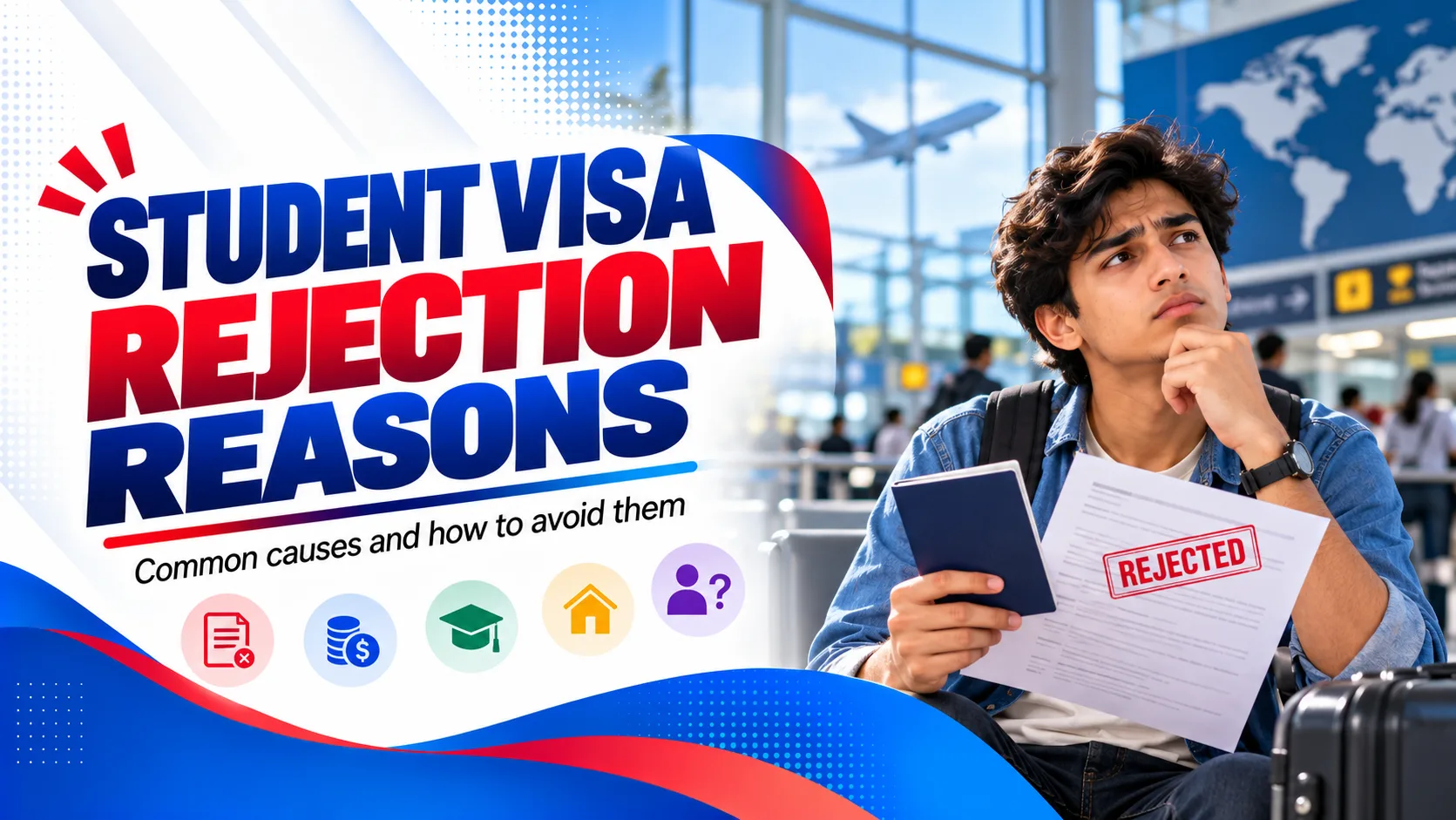
Student Visa Rejection Reasons and How to Avoid Them
Scroll HereA Look at the Global Visa Landscape: Student Visa Trends and Rejection Statistics
Scroll HereUnderstanding the 7 Critical Student Visa Rejection Reasons
Scroll HereInadequate or Unverified Financial Documentation
Scroll HereFailure to Prove Non-Immigrant Intent
Scroll HereWeak, Generic or Flagged Statement of Purpose (SOP)
Scroll HereInconsistent, Inaccurate or Unverified Documentation
Scroll HereUnexplained Academic Gaps or Inconsistent Records
Scroll HerePoor Performance in the Visa Interview
Scroll HereLow Language Proficiency Test Scores
Scroll HereDestination-Specific Analysis: US, UK, Canada, and Australia
Scroll HereUnited States: F-1 Visa Focus
Scroll HereUnited Kingdom: Points-Based System Guidelines
Scroll HereCanada: Study Permit Considerations
Scroll HereAustralia: The Genuine Student (GS) Standard
Scroll HereBlueprint: How to Avoid Student Visa Rejection
Scroll HereConduct a Thorough Financial Audit
Scroll HereDraft a Compelling SOP
Scroll HereEstablish Strong Ties to Your Home Country
Scroll HerePrepare for the Visa Interview
Scroll HereWhat to Do If Your Student Visa Is Rejected
Scroll HereFinal Thoughts
Scroll HereStudent Visa Rejection Reasons and How to Avoid Them
Getting the official university offer letter is a big step towards your dream of studying overseas, but it doesn’t guarantee that you will securely get through the visa process. Some of the common student visa rejection reasons include insufficient or inaccurate information, a poorly written statement of purpose (or one flagged as AI-generated or plagiarised), and a weak visa interview. Country-specific factors can also leave the visa officer doubting whether you are a genuine student who will benefit from the course and comply with the visa conditions. Financial factors such as insufficient funds or the UK’s “28-day” holding period, or geopolitical factors such as fractured bilateral relations with a country, can also reveal why student visa gets rejected.
As we analyse the student visa rejection reasons, we find that visa outcomes across the applicants vary significantly based on destination country, chosen institution, and the applicant’s own admission profile. We understand that it can be frustrating and disappointing when you have secured a conditional or unconditional offer letter from your chosen university, but you fail to obtain a student visa. The entire process and your invested time and money go down the drain. Immigration policies across major countries have become stricter in recent years. We are here to help you understand and, in the process, find the best possible ways to avoid a visa rejection.
A Look at the Global Visa Landscape: Student Visa Trends and Rejection Statistics
Identifying possible student visa rejection reasons through the lens of an immigration officer can be challenging for a student but entirely possible by understanding trends and statistical references. Over the past two years, several countries’ governments have implemented strict immigration policies to align international student intake with the available local capacities.
No country wants an immigrant who consumes its resources but does not contribute to the country’s growth and development. The list of visa rejection reasons for students has expanded, showing increased scrutiny and tightened regulations.
We delved into historical trends of the student visa rejection rate for India, which revealed that fluctuations in policy frameworks across destination countries were the primary contributor to rejections. The table below shows how visa approval dynamics between major and popular countries have led to rejections by highlighting key student visa rejection reasons, retrieved from the recent official immigration reports from the respective countries:
| Country | Primary Visa Type | Baseline Rejection Rate | Officers’ Key Focus Area |
|---|---|---|---|
| United States | F-1 Visa | 30-36% | Non-immigrant intent [Section 214(b)] |
| Canada | Study Permit | 55-65% | Financial capacity and applicant’s intent |
| United Kingdom | Student Visa | 3-8% | CAS and 28-day funds rule |
| Australia | Student Visa (Subclass 500) | 15-25% | Genuine Student (GS) criteria |
Sources: Compiled from the US Department of State (Bureau of Consular Affairs), Immigration, Refugees and Citizenship Canada (Standing Committee on Citizenship and Immigration), UK Home Office (Immigration System Statistics), and the Australian Department of Home Affairs (Study Visa Statistics).
These national-level statistics have indicated that there are very robust student visa rejection reasons. According to sources utilising the data released by the US Department of State, global F-1 visa rejection rates reached between 30% and 36% across recent fiscal years. According to Canada’s IRCC reports, study permit rejection rates climbed to nearly 60% in 2025, and reports put the refusal rate for Indian applicants even higher, following the national study permit caps. Meanwhile, as seen in Australia's Department of Home Affairs statistics, there has been a steep rejection trend across South Asian nations after initiating the Genuine Student (GS) framework.
For Indian students, these regulatory shifts require some due diligence to prepare well. Official statistics highlight that the student visa rejection rate for India has fluctuated largely due to applicants not meeting regulatory requirements. Understanding the probable cause for why student visa gets rejected in today’s strict regulatory environment worldwide has become all the more important for every aspiring student aiming for overseas studies. We will try to analyse several underlying factors that lead to visa rejections and help our fellow Indian students to address specific consular expectations effectively.
Understanding the 7 Critical Student Visa Rejection Reasons
While each country maintains its own migration regulations, the primary student visa rejection reasons remain interestingly consistent across the global embassies. Let’s look at the 7 critical reasons for the rejection of a student visa:
Inadequate or Unverified Financial Documentation
Showing proof of having a strong financial standing is important when applying for a study visa. Visa officers need to be confident that you will be able to comfortably manage your finances, including tuition fees and living expenses, without relying on working and earning. Immigration authorities scrutinise financial statements, so omitting a clear paper trail is one of the most common student visa refusal reasons, as mentioned by immigration officers. Some of the discrepancies related to the financial documentation that occur are as follows:
- Insufficient Funds
Liquid funds failing to meet the embassy’s requirements for having the required threshold to cover tuition fees and living costs
- Unexplained Recent Deposits
Large sums of money deposited into bank accounts right before applying for a visa without having any authentic proof of origin
- Unclear Sponsoring Sources
Relying on distant relatives or unverified third parties without formal legal guarantees
Failure to Prove Non-Immigrant Intent
In the USA, one of the most common student visa rejection reasons is failing to prove non-immigrant intent. Temporary student visas are granted under the assumption that the applicant will return to their country of origin after completion of their studies. This regulation is strictly enforced under Section 214(b) of the Immigration and Nationality Act of the US Department of State guidelines.
Immigration officers frequently point out that the weak socio-economic status of the applicant in their home country is why student visa gets rejected. If you cannot show and prove that you have strong family bonds, property ownership, or promising career opportunities in your country of origin, officers may conclude that you intend to overstay your visa.
Weak, Generic or Flagged Statement of Purpose (SOP)
Your statement of purpose (SOP), or Genuine Student essay represents your personal story to the visa officer. It must clearly explain why you chose your specific course of study, that particular university/institution, and how that supports your long-term career goals. Writing a generic or plagiarised SOP or personal statement is one of the most critical student visa rejection reasons in recent times. If your SOP fails to justify your reason for studying overseas in that particular country when similar academic pathways (courses) exist locally or in other countries, officers will question your academic sincerity and intent otherwise.
Inconsistent, Inaccurate or Unverified Documentation
Submitting a complete and accurate document portfolio is fundamental to visa success. Inconsistent documents, with mismatched names across your academic record/certificates, issues with birth dates, or unverified work experience, raise instant red flags to the authorities. Submitting documents that are either forged or altered leads to immediate rejection and can cause an immigration ban for many years. Maintaining transparency is non-negotiable, as documentation discrepancies are very critical visa rejection reasons for students across all major countries.
Unexplained Academic Gaps or Inconsistent Records
While top grades are not always strictly mandatory, visa officers evaluate your academic history to determine your eligibility and readiness for studies. Unexplained gaps between studies or employment create significant doubt and are one of the student visa rejection reasons. If you have gaps in your records that are not due to official employment certification, skill upgrading courses, or valid medical records, officers may see your academic journey as unfocused. Unjustified academic backlogs are another one of the most common student visa refusal reasons, undermining an applicant’s credibility.
Poor Performance in the Visa Interview
A face-to-face or online interview is one of the most common ways authorities assess your application. For countries like the United States, the face-to-face interview is more critical. Applicants are prone to stumbling when they provide rehearsed answers or fail to answer some simple questions about their chosen academic programme. One of the student visa rejection reasons points out that if an applicant cannot explain their course curriculum, universities, tuition structure, or career objectives clearly, the officers may determine that the applicant lacks genuine academic motivation. Failure to communicate your thoughts and opinions during the interview explains why student visa gets rejected.
Low Language Proficiency Test Scores
All international applicants enrolling in an English-medium programme must show the required English language proficiency through standardised English tests, such as IELTS, TOEFL, PTE, or Duolingo English Test (DET). Several international universities and colleges, along with visa authorities, require clear evidence of English proficiency. Even if your university provides you with a conditional or unconditional offer letter, failing to meet the embassy’s guidelines creates a weak spot in your application. Insufficient proficiency to meet the language requirements still remains one of the main student visa rejection reasons across English-speaking countries, such as the US, UK, Canada, or Australia.
Destination-Specific Analysis: US, UK, Canada, and Australia
Understanding the specific nuances for a particular country allows students to customise their applications to the exact requirements and expectations of immigration authorities.
United States: F-1 Visa Focus
The US’s F-1 visa process primarily focuses on the consular interview. As seen in the US Department of State 2025 data for visa refusal rates by country, consular officers possess wide discretionary authority to reject visa applications. Common F1 visa rejection reasons are as follows:
- Failure to show strong ties to your country to the consular officer
- Lack of clarity on why you selected a particular American institution
- Inability to explain your financial situation and funding during the interview process
How to avoid F-1 visa rejection?
Thoroughly prepare for the F-1 visa interview that addresses the aforementioned student visa rejection reasons to ensure that you are able to articulate your academic and professional objectives, even under pressure or feeling nervous during the interview. Focus on giving authentic and concise answers to the questions coming from the immigration authorities.
United Kingdom: Points-Based System Guidelines
According to the UK Visas and Immigration (UKVI) policy guidelines report, the UK Student Visa utilises a points-based system where applicants must earn 70 points for the issuance of Confirmation of Acceptance for Studies (CAS), financial proof, and English proficiency. Based on the UKVI guidelines, some UK student visa refusal reasons are as follows:
- Violation of the strict “28-day rule” that requires the student to maintain mandatory funds in their bank account for 28 consecutive days before the application
- Discrepancies between your CAS letter details and submitted supporting documents
- Poor performance during the general UKVI credibility-assessing interviews
How to avoid UK student visa refusal?
Comply strictly with the “28-day rule” and financial requirements from the UKVI guidelines. This can greatly reduce refusal, as it is one of the prominent student visa rejection reasons in the UK. Before starting the application process, ensure that your bank statements match the UKVI guidelines.
Canada: Study Permit Considerations
Canada’s study permit application is primarily paper-based and is evaluated by the Immigration, Refugees and Citizenship Canada (IRCC) officers using standardised evaluation methods and protocols. Some of the main Canada study permit refusal reasons are as follows:
- Doubts regarding whether the applicant will leave at the end of their stay
- Insufficient proof of financial support under Canada’s living expense thresholds
- Lack of logical connection between academic qualifications and selected Canadian programmes
How to avoid a Canada study permit refusal?
Take careful consideration and proactively address the student visa rejection reasons within your study plan. It will significantly improve your chances of study permit approval. Think logically about your career transition and practise communication skills.
Australia: The Genuine Student (GS) Standard
According to the Australian Department of Home Affairs guidelines, Australia has replaced its Genuine Temporary Entrant requirement with the Genuine Student (GS) assessment since March 23, 2024. Australia has made it stricter to obtain a student visa, so you must consider the following visa rejection reasons when applying for a programme:
- Failing to logically connect your course with your career goals leads to a weak GS
- Failing to show stable, traceable funds to cover tuition fees, travel, and living expenses
- Having previous visa refusals, immigration breaches, or overstays in Australia or other countries
How to avoid Australia study visa rejection?
Applicants must meet all Australia study visa requirements, provide evidence as per the Australian Department of Home Affairs guidelines and have comprehensive answers to show the value of their selected course in relation to their future career objectives. Provide thorough evidence of academic progression.
Blueprint: How to Avoid Student Visa Rejection
Even if the visa landscape looks tough to crack, the silver lining here is that you can obtain a valid study visa with proper documentation, prior planning for the application process, and paying attention to detail. We have provided simple ways to explain how to avoid student visa rejection:
Conduct a Thorough Financial Audit
Organise your financial portfolio to provide involved visa authorities with a strong set of paper trails to present a clear picture of your finances. Follow these suggestions:
- Maintain liquid bank savings consistently for the required period
- If required, get the official loan sanctions from recognised financial institutions only
- Keep proof of a stable income source for all mentioned sponsors and Income Tax Returns (ITR)
Draft a Compelling SOP
Write a customised Statement of Purpose (SOP) that specifies your motivation behind the chosen course and institution. It should speak directly to the concerned authorities. These are some tips we offer to students who ask how to avoid student visa rejection with regard to the SOP:
- Talk about why you selected the particular course and institution over your own country
- Explain logically how the degree connects with your educational background and experience
- Provide clear details on your career aspirations and how you plan to achieve them
Establish Strong Ties to Your Home Country
Recalling one of the student visa rejection reasons, we advise you to clearly show how your socioeconomic background is strongly tied to your home country. Establishing a strong tie to your home country can address recurring student visa refusal reasons raised by consular officers. Here are some examples of how you can show strong country ties:
- Inherited family assets, real estate, or established family businesses
- Specialised job demand for your specific field of interest in your home country
- Deep familial connections that require your return after studies
Prepare for the Visa Interview
If your study destination requires an interview with visa authorities, you can practise prior to your application process to build confidence and trust your abilities to crack the interview. Practising verbal communication is one of the most effective ways to learn how to avoid student visa rejection during a high-stakes interview. Here are some tips to prepare for a visa interview:
- Participate in mock interview sessions with an experienced advisor
- Practise your communication skills to clearly describe your academic plans
- Practise clear, honest answers (not memorised scripts) to some of the most commonly asked questions about tuition fees, sponsor income, and career goals
What to Do If Your Student Visa Is Rejected
Due to a multitude of student visa rejection reasons, some students face the unfortunate news. Facing a visa rejection can be disheartening at first, but it's not the end of your abroad experience. Here is what to do if your student visa is rejected:
- Obtain an official refusal note from the visa office to know how to avoid rejections by tackling real issues
- Never reapply the same way; learn from your previous rejection, identify the weaknesses and address them properly
- Request your full case notes where available (for example, GCMS notes for a Canadian study permit) to see the officer’s exact reasoning
- Check your review or appeal options: the UK allows an Administrative Review for eligible refusals, Canada allows a Federal Court judicial review, and Australia allows a tribunal review for some onshore refusals, while a US F-1 refusal under Section 214(b) can only be overcome with a fresh application
- Strengthen the weak areas before reapplying, such as topping up and seasoning your funds, rewriting your SOP, or adding evidence of home ties
- Make sure your offer letter, CAS, I-20 or CoE is still valid for the intake you are targeting, and ask your university about deferring if needed
- Get expert help to review your file before you submit a new application
WhatsApp Ask
Final Thoughts
With strict standards and regulatory requirements, there are multiple student visa rejection reasons. By presenting authentic financial proof, strong ties to your home country, writing a compelling statement of purpose, and understanding the country-specific regulations, you can avoid receiving a rejection letter. As trends evolve, evaluating the student visa rejection rate for India can help you stay informed and be prepared for your visa application process. Addressing all the official student visa refusal reasons systematically ensures that you enter the visa interview (if applicable) with confidence, paving the way for your academic success.
Weak or unverified financial documentation and failure to prove genuine student or non-immigrant intent are the most common student visa rejection reasons across the US, UK, Canada and Australia.
Yes. Most countries let you reapply immediately, but you should first read the refusal letter carefully and fix the issues the officer raised. Reapplying with the same documents usually leads to the same result.
You must declare earlier refusals, and officers will review them. A past rejection does not automatically block a new visa if you clearly address the earlier concerns, but hiding a refusal can lead to a fresh rejection or even a ban.
Under the UK’s 28-day rule, the required funds must stay in your account for 28 consecutive days, and the bank statement must be dated within 31 days before you apply.
No. A refusal under Section 214(b) cannot be appealed. You need to submit a fresh application, pay the fee again and show stronger evidence of your ties to your home country.