Table of Contents
Disclaimer: This video explains the MBBS in Russia process based on the 2026 admission cycle for basic understanding. The latest MBBS in Russia 2026 admission details, updated fees, eligibility criteria, and guidelines are fully explained in the article below.
MBBS in Russia 2026: Overview of Medical Education
Are you planning to study mbbs in russia? Russia is one of the most popular destinations for Indian students pursuing medical education abroad due to its affordable tuition fees, globally recognized universities, and structured medical curriculum.
Over 18,000 Indian students chose to study MBBS in Russia in recent years, making it one of the top preferred countries for medical education. Russian medical universities approved by the National Medical Commission (NMC) and recognized by the World Health Organization (WHO) offer a 6-year MBBS program with strong clinical exposure and modern infrastructure.
Many public universities in Russia provide English-medium MBBS programs with tuition fees significantly lower than private medical colleges in India. The long-standing diplomatic relationship between India and Russia further enhances trust and student safety.
With affordable education, global recognition, and extensive clinical training, Russia continues to be a strong choice for Indian students seeking MBBS abroad.
MBBS in Russia For Indian Students 2026: Quick Overview
A bunch of top-notch NMC and WHO-recognised medical universities in Russia offer 5+1 year(include internship) MBBS programs. The MBBS in Russia fees are much more affordable than those at top private medical schools in India and Europe. This makes it one of the best places to study medicine abroad.
Here is a quick overview of studying MBBS in Russia for Indian students.
|
Capital |
Moscow |
|
Official Language |
Russian |
|
Degree Awarded |
MD Physician Equivalent to MBBS in India |
|
Intake |
September (Fall Season: Availability of more seats); February (Spring Season: Fewer seats available) |
|
Duration of the course |
6 Years (5 years academic and 1 year clinical training) |
|
Eligibility |
50% in 10+2 with PCB and NEET qualified |
|
English Language Test |
Not required |
|
Medium of Teaching |
English (for Indian students) |
|
Total Budget for MBBS |
1188000 RUB (Approximate Total for 6-year course) or ₹14,00,000 |
Why Choose MBBS in Russia For Indian Students?
Russian Universities are recognised as world leaders in training chemists, geologists, physicists, mathematicians, doctors, engineers, programmers, and specialists in other natural sciences. When it comes to studying Russia for mbbs, rest assured, you will get fundamentals and in-depth knowledge in all medical subjects, including bespoke clinical training.
According to the WHO and Directory of World Medical Schools, Russia is one of the countries that claims to occupy almost 30 positions among the top 100 ranking Medical Schools. If you plan to study medicine at a global medical school, the best university in Russia for MBBS is just a few steps away.
Let’s see what sets Russia apart from studying MBBS in other countries.
Low Tuition Fees
Low tuition fees and affordable living costs are the first and foremost things that set MBBS in Russia apart. The MBBS in Russia fees start from ₹15 lakhs. It is the total course fee for 6 years of MBBS. The fees may vary across Universities.
No Donation
Besides yearly tuition fees, private medical schools in India have huge capitation fees or donations. This is not the case with any MBBS University in Russia. You don’t need to pay a single penny, other than the actual tuition fees, to study medicine in Russian medical schools.
Admission to Russian medical Universities is strictly based on your 10+2 score with NEET qualification, and it is first-cum-first serve basis. Along with that, students have to qualify the entrance examination that has Multiple Choice Questions (MCQs) of subjects like Chemistry, Biology and English. This exam is conducted either online in India or offline in Russia.
Worldwide Recognition of the Degree
Most medical schools in Russia are NMC and WHO-recognised. Also, they are approved by other medical bodies, like UNESCO, FAIMER, and ECFMGE, so your degree is valid worldwide.
Quality Education & World Class Infrastructure
The top MBBS colleges in Russia are known for offering high-quality education and world-class infrastructure. They have modern medical equipment in hospitals. Small classes with a student-teacher ratio of 20:1 set Russia as one of the trusted destinations for studying medicine among international students.
FMGE Coaching Facility
One more advantage of studying MBBS in Russian medical schools is that Indian students get an FMGE coaching facility. This helps them prepare for the FMGE exam before they finish their medical education. The passing rate of the Indian students in Russia for the FMGE Examination has significantly increased from 29-30% in recent years.
English Medium of Instruction
You can study MBBS in Russia entirely in English. Choose any of the best universities in Russia that offer English medium degree programs, like Omsk State Medical University, Kazan State Medical University, Bashkir State Medical University and many others.
Non-Requirement of Language Proficiency Tests
As an Indian student, you are not required to clear any language proficiency tests like IELTS or TOEFL. However, you should always check the official websites of the universities, as they can vary.
What Medical Courses Can You Study in Russia?
Medical courses in Russia are known for academic excellence. Bespoke education, quality clinical internships, and global exposure make Russia a sought-after destination for studying medicine. Here is a list of medical courses, including MBBS, offered by top medical schools in Russia.
|
Course |
Duration |
|---|---|
|
MD (Physician) Equivalent to MBBS |
6 Years |
|
DDS (Dentistry) |
5 Years |
|
Pharmacy |
4 Years |
|
Nursing |
4 Years |
Recognition & Approval of MBBS in Russia (NMC, WHO, WFME)
Russia has a long list of NMC and WHO-recognised medical Universities that offer MBBS and are also listed in the World Medical Directory. The top MBBS Colleges in Russia are also approved and accredited by the world’s best medical bodies, such as:
- Ministry of Higher Education, Russia
- ECFMGE (Educational Commission for Foreign Medical Graduates)
- FAIMER (The Foundation for Advancement of International Medical Education and Research)
- WFME (World Federation for Medical Education)
Eligibility Criteria for MBBS From Russia
The MBBS in Russia eligibility for Indian students is largely similar to the eligibility for MBBS in India. However, given below are the basic eligibility criteria you must meet if you plan to study MBBS in any top medical college in Russia.
Academic Requirement
- 50% in Physics, Chemistry, and Biology as core subjects
- The NEET-qualified score is compulsory
Age Requirement
- Applicant must be 17 years old during the admission
- No upper age limit to study MBBS in Russia
NMC Gazette
Before getting into the top universities in Russia for MBBS, you are required to check the NMC Guidelines of the particular medical schools you want to get into. The National Medical Commission of India often changes rules for international MBBS students, so always view the updated NMC Gazette. What is NMC Gazette? This is the legal rule book that is updated by the Government of India, which makes rules regarding the medical eligibility and licensure to practise in India.
Compulsory Requirements for Foreign MBBS Course As Per NMC
- The MBBS course from a foreign university should be a minimum of 54 months.
- Get the foreign medical degree with the medium of instruction in English, including the course guidelines, lectures, books and examinations.
- A compulsory internship period of 12 months in the same foreign university.
- The medical college should be registered with the Ministry of Health of the Russian Federation and grant a license to international students to practise in Russia.
- The subjects covered in the foreign degree should be specified in Schedule I, including Anatomy, Physiology, Biochemistry and many others.
Important Note: These NMC guidelines are altered by the medical commission set up by the Government of India, so please read the current year NMC Guidelines before applying to any foreign academic institution for MBBS.
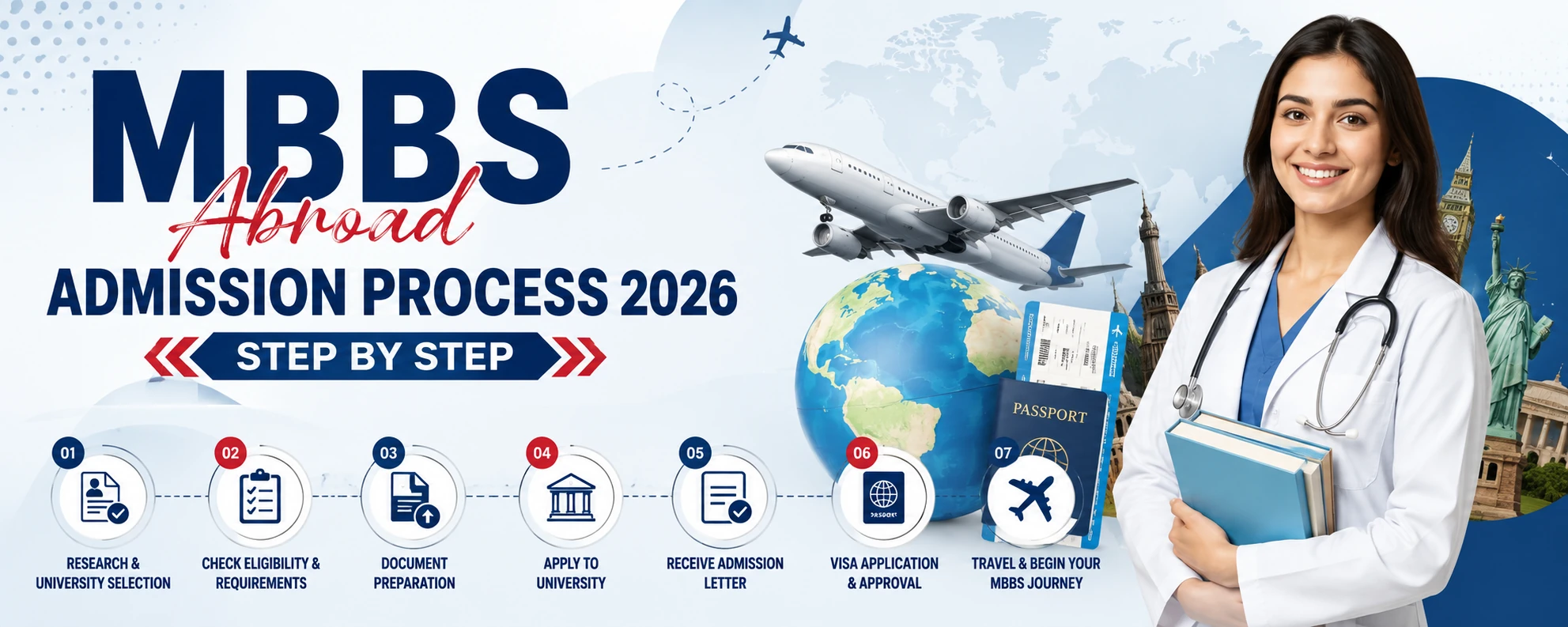
MBBS in Russia Admission Process 2026 (Step-by-Step)
MBBS admission in Russia is quite straightforward. We help students get admission into MBBS at their chosen medical schools. Let’s see how to get admission to Russia for MBBS and how Education Vibes can help in each step of your application.
Step 1 - We will help you choose your dream medical school in Russia according to your budget and academic background, considering factors such as eligibility, location, and recognition.
Step 2 - Once you have the list of top universities in Russia for MBBS education, we help you shortlist a university based on our budget, preference, and eligibility.
Step 3 - It’s time for the application. We will help you fill out the application forms for one or more medical universities, keeping track of the deadlines of each University. The registration doesn’t take too long; we will inform you about the admission confirmation, which normally takes about 15 official days.
Step 4 - After evaluating your documents for studying MBBS in Russia, the medical university will send you an admission confirmation letter.
Step 5 - After you receive your admission letter, our MBBS abroad counsellors will help you consolidate original documents, like 10th, 12th, and NEET scorecards, for translation.
Step 6 - As soon as your academic credentials are received by the medical school, you will be required to pay the tuition fee for the 1st semester. Once you clear the required tuition fees, you will have an invitation letter from the medical university.
Step 7 - Now, your dedicated MBBS abroad counsellor will help you unite and submit all the important documents (academic, personal, and university) for processing your student visa. Normally, you receive your visa in a maximum of 2 days.
Step 8 - The last phase is arranging your flight ticket and booking accommodation from your destination to Russia.
‘You’re not alone in this; we will be right there beside you throughout every step in your journey’
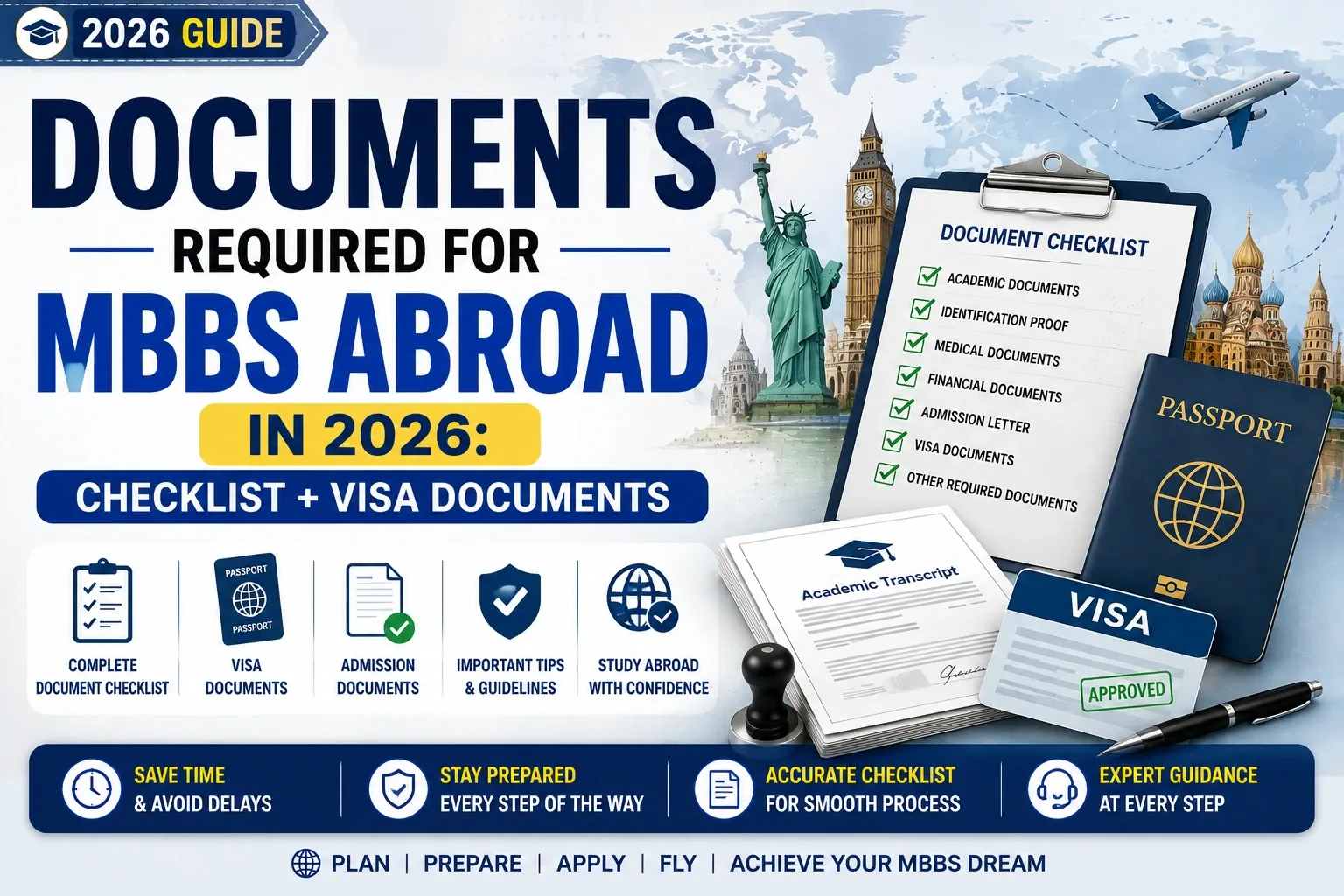
Documents Required for MBBS Admission in Russia
You are required to submit a set of documents to apply for admission into the MBBS in Russia 2026. Here they are:
- Attested copies of 10th and 12th Mark Sheets
- A valid NEET scorecard
- A valid passport with at least 18 months of validity
- Recent colored Passport-Sized Photographs
- A format of an Admission Letter from your chosen University
- A fitness certificate from an authorised medical authority, including an HIV test report
- Visa Documents, including an invitation letter from your chosen University
MBBS in Russia Syllabus & Curriculum (Year-Wise)
Here are the subjects taught in the MBBS course in Russian medical schools. The MBBS syllabus in Russia or the curriculum covers around 15-20 major subjects.
|
Year |
Subjects |
|---|---|
|
1st Year |
Biology, Anatomy, Latin, Physical Education, Nursing, Histology |
|
2nd Year |
Russian Language, Biology, Anatomy, Biochemistry, Physiology, Microbiology, Immunology |
|
3rd Year |
Microbiology, Immunology, Radiology, Surgery, Pharmacology, Internal Medicine, Ophthalmology, Paediatrics, Psychiatry |
|
4th Year |
Topo Anatomy, Hygiene, Oncology, Gynaecology, Neurology, Ophthalmology, Pediatrics, Psychiatry |
|
5th Year |
Therapy, Paediatrics, Psychiatry, Ophthalmology, Hospital Surgery, Clinical Anatomy, Dermatology, Obstetrics |
|
6th Year |
Obstetrics, Gynaecology, Therapy, Lab Diagnostics, Surgery, Emergency Medicine |
Medium of Teaching for MBBS in Russia
Most top medical universities in Russia offer MBBS in English medium. This set Russia as a top choice for many Indian and international medical aspirants to study medicine there. The Russian language is a part of the MBBS curriculum. The flair for the Russian language will help graduates work in local hospitals and communicate with Russians easily.
MBBS in Russia Intakes 2026 (Fall & Spring)
There are usually two intake periods in Russia- the fall intake and the spring intake. Students should be aware of these details to avoid any future hassle while applying for MBBS in Russia.
Main Intake (September Intake)
The main admission cycle kicks off in September, marking the start of the first semester for nearly all universities. This is the preferred intake for international students because:
|
Activity |
Timeline |
Details. |
|---|---|---|
|
Applications Open |
Jan – Mar |
Many universities begin their application process at this time. |
|
Last Application Deadline |
Jul – Aug |
This can differ as per the varying medical schools present in Russia. |
|
Offer Letters Issued |
May – Aug |
After your profile is shortlisted, you will receive an offer letter. |
|
Invitation Letter Issued (for Visa) |
Jun – Aug |
Document required before applying for the Student Visa. |
|
Visa Application & Processing |
Jul – Aug |
Start your Application Process at the Russian Embassy/Consulate. |
|
Arrival in Russia |
Late Aug – Early Sep |
Students arrive in Russia before the beginning of classes. |
|
Academic Session Begins |
Sep – Oct |
The start of the first semester. |
Secondary Intake (February Intake)
|
Activity |
Timeline |
Notes |
|---|---|---|
|
Starting Date of Application |
Nov |
Very few candidates are taken in the time of spring. |
|
Deadline |
Dec – Jan |
The submissions are not accepted after January. |
|
Offer Letters Issued |
Dec– Jan |
Depends on application timing. |
|
Invitation Letter |
Jan – Feb |
Significant document for further visa processing. |
|
Visa Process |
Jan – Feb |
Apply for the visa process. |
|
Beginning of Semester |
Feb – Mar |
Classes start for the spring intake. |
Note: Most of the international candidates are selected during the fall intake season, that is, in October. Meanwhile, very few applicants are selected in the spring intake, which is in February or March. Therefore, Indian students should apply during the fall intake season for high chances of getting an MBBS seat.
Important Practical Advice
Many students mistakenly believe that admission closes in August, but the truth is that the safe preparation window wraps up much earlier. Delays often occur due to:
- Corrections needed on passports
- Notarization of documents
- Late medical tests
- Waiting for visa appointments
Corrections needed on passports Notarization of documents Late medical tests Waiting for visa appointments.
MBBS in Russia Course Duration
The medicine study programme is a 6 years integrated course in Russia with an curriculum specially designed to meet the standard of the world wide medical system. The course is mainly in two phases , acadmic ground work and clincal training
First 5 Years - acadmic & practial training
Students study the basic medicine science and all major clinical subjects:
- Human Anatomy & Histology
- Physiology & Biochemistry
- Pathology & Microbiology
- Pharmacology
- Internal Medicine
- General Surgery
- Pediatrics
- Obstetrics & Gynecology
- Community medicine
Starting form 3rd year the universities do hospitals based practical training of its students where they will have the opportunity of dealing with the real patients of the doctor and gain them clinical judgements and diagnostic skills.
Final 1 Year - Mandatory Clinical Internship
The essential core of the 6 year course is the final year mandatory clinical internships which are full time in the associated government hospitals. During the internship, the students will do rotations the final 5 major branches in their hospital:
- Medicine
- Surgery
- Pediatrics
- emergency care
- Obstetrics & Gynecology
The students are expected to actively participate in the treatment of the patients of the doctors. In this year the students are expected to examine the patients and prepare case-history and learn the total treatment process .During the final year the students are not only taught the medicine but also given the opportunity to become real doctors instead of just listeners in the lecture hall.
Note (after completing the 6 year degree program,the students are eligible to apply for the medicine Licensing Examination in their respective home country as per the rules of that country.)
MBBS in Russia Fees for Indian Students 2026 (university-wise table)
Russian MBBS fees for Indian students vary across Medical Universities. Normally, the fees for public universities are lower, but they vary. Here are the top medical schools offering MBBS, ranked from lowest to highest in 2026.
University Name |
Fees Structure |
|---|---|
|
Kabardino-Balkarian State University |
1st year tuition fee and hostel charge are 342000 RUB (INR ₹400000 INR). 2nd to 6th year is 339000 RUB (₹396000 INR) |
|
Kemerovo State University |
1st year tuition fee and hostel charge are 302000 RUB (INR ₹354000 INR). 2nd to 6th year is 302000 RUB (₹354000 INR) |
|
Yaroslavl State Medical University |
1st year tuition fee and hostel charge are 440000 RUB (INR ₹514000 INR). 2nd to 6th year is 430000 RUB (₹500000 INR) |
|
Omsk State Medical University |
1st year tuition fee and hostel charge are 360000 RUB (INR ₹420000 INR). 2nd to 6th year is 360000 RUB (₹420000 INR) |
|
Crimea Federal University |
1st year tuition fee and hostel charge are 348000 RUB (INR ₹400000 INR). 2nd to 6th year is 364120 RUB (₹425000 INR) |
|
Orel State Medical University |
1st year tuition fee and hostel charge are 395100 RUB (INR ₹462000 INR). 2nd to 6th year is 375000 RUB (₹438000 INR) |
|
Krasnoyarsk State Medical University |
1st year tuition fee and hostel charge are 372000 RUB (INR ₹435000 INR). 2nd to 6th year is 372000 RUB (₹435000 INR) |
|
Tver State Medical University |
1st year tuition fee and hostel charge are 550000 RUB (INR ₹643000 INR). 2nd to 6th year is 490000 RUB (₹573000INR) |
|
Samara State Medical University |
1st year tuition fee and hostel charge are 482000 RUB (INR ₹564000 INR). 2nd to 6th year is 450000 RUB (₹525000INR) |
|
North Western State Medical University |
1st year tuition fee and hostel charge are 526000 RUB (INR ₹615000 INR). 2nd to 6th year is 526000 RUB (₹615000 INR) |
|
Kazan State Medical University |
1st year tuition fee and hostel charge are 660000 RUB (INR ₹772000 INR). 2nd to 6th year is 620000 RUB (₹725000 INR) |
|
Bashkir State Medical University |
1st year tuition fee and hostel charge are 427000 RUB (INR ₹500000 INR). 2nd to 6th year is 427000 RUB (₹500000 INR) |
|
Kazan Federal University |
1st year tuition fee and hostel charge are 610000 RUB (INR ₹710000 INR). 2nd to 6th year is 610000 RUB (₹710000 INR) |
|
Orenburg State Medical University |
1st year tuition fee and hostel charge are 464000 RUB (INR ₹542000 INR). 2nd to 6th year is 464000 RUB (₹542000 INR) |
|
First Moscow State University |
1st year tuition fee and hostel charge are 1300000 RUB (INR ₹1500000 INR). 2nd to 6th year is 1300000 RUB (₹1500000 INR) |
|
Volgograd State Medical University |
1st year tuition fee and hostel charge are 540000 RUB (INR ₹631000 INR). 2nd to 6th year is 550000 RUB (₹640000 INR) |
|
Rostov State Medical University |
1st year tuition fee and hostel charge are 350000 RUB (INR ₹400000 INR). 2nd to 6th year is 350000 RUB (₹400000 INR) |
|
Saratov State Medical University |
1st year tuition fee and hostel charge are 516000 RUB (INR ₹600000 INR). 2nd to 6th year is 516000 RUB (₹600000 INR) |
|
Perm State Medical University |
1st year tuition fee and hostel charge are 464000 RUB (INR ₹542000 INR). 2nd to 6th year is 425000 RUB (₹497000 INR) |
|
Far Eastern Federal University |
1st year tuition fee and hostel charge are 550000 RUB (INR ₹640000 INR). 2nd to 6th year is 535000 RUB (₹625000 INR) |
|
Saint Petersburg State Medical University |
1st year tuition fee and hostel charge are 558200 RUB (INR ₹650000 INR). 2nd to 6th year is 567200 RUB (₹662000 INR) |
|
Ivanovo State Medical University |
1st year tuition fee and hostel charge are 310000 RUB (INR ₹362000 INR). 2nd to 6th year is 310000 RUB (₹362000 INR) |
|
Voronezh State Medical University |
1st year tuition fee and hostel charge are 492000 RUB (INR ₹572000 INR). 2nd to 6th year is 462000 RUB (₹542000 INR) |
|
Pirogov Russian National Research Medical University |
1st year tuition fee and hostel charge are 778000 RUB (INR ₹900000 INR). 2nd to 6th year is 778000 RUB (₹900000 INR) |
|
Kursk State Medical University |
1st year tuition fee and hostel charge are 489000 RUB (INR ₹572000 INR). 2nd to 6th year is 479000 RUB (₹560000 INR) |
NMC-Approved Medical Universities in Russia 2026
When you choose to study MBBS in Russia, you have ample options to select one of the top medical Universities in Russia, given hereunder. These are all NMC and WHO-recognised medical Universities known for academic excellence.
Kabardino-Balkarian State University
A leading medical school in Russia offers bespoke MBBS education at affordable costs with a range of UG and PG medical programs in the English language, making it one of the best medical Universities in Russia for international students.
- Founded In: 1957
- Location: Nalchik, Kabardino-Balkaria
- MBBS Fees: 1944000 RUB (6 years)
- Deadline For Admission: Mid-July to August
Kemerovo State University
Established in 1973, Kemerovo State Medical University is one of the trusted medical schools, with five branches in Russia. Hundreds of Indian medical aspirants choose this University to pursue medicine.
- Founded In: 1973
- Location: Kemerovo, Oblast
- MBBS Fees: 1662000 RUB (6 years)
- Deadline For Admission: August
Yaroslavl State Medical University
YSMU is a leader in medical training and post-graduate education and the biggest regional centre of excellence for providing quality medical education and biomedical research in Russia.
- Founded In: 1944
- Location: Yaroslavl, Oblast
- MBBS Fees: 2100000 RUB (6 years)
- Deadline For Admission: July
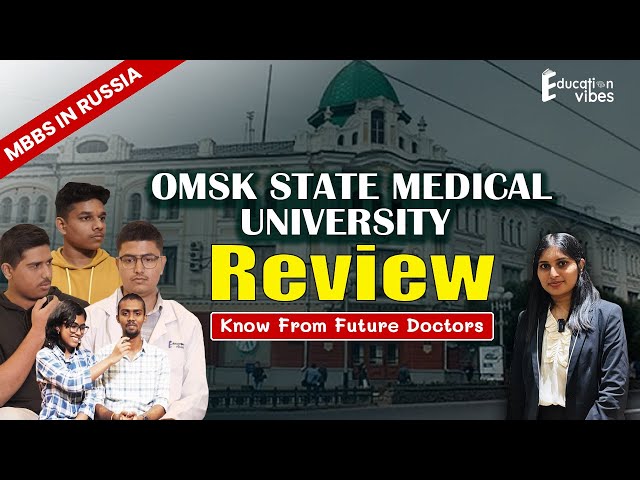
Omsk State Medical University
It is a hundred-year-old University in Russia. Omsk maintains a strong relationship with top-notch educational institutions in Western Europe, the USA, and other countries. It is known to offer a low cost of MBBS in Russia, but better education and exposure.
- Founded In: 1920
- Location: Omskaya City, Oblast
- MBBS Fees: 1980000 RUB (6 years)
- Deadline For Admission: August
Crimea Federal University
Crimea Federal has been conferred as an AA-ranked medical school by the International Education Society for providing high-quality medical education. When you think of choosing one of the top 10 universities in Russia for MBBS, Crimea Federal University stands at the top.
- Founded In: 2014
- Location: Simferopol
- MBBS Fees: 1980000 RUB (6 years)
- Deadline For Admission: October
Orel State Medical University
Orel is considered one of the top medical schools in Russia. It is a flagship medical school that implements 110 basic educational courses, has 17 departments, and has 100-plus qualified teachers.
- Founded In:1931
- Location: Oryol
- MBBS Fees: 1950000 RUB (6 years)
- Deadline For Admission: May- August
Krasnoyarsk State Medical University
Krasnoyarsk State Medical University is a trusted destination for Indian medical aspirants. It is a reputed public university located in the city of Krasnoyarsk.
- Founded In: 1942
- Location: Krasnoyarsk City
- MBBS Fees: 2160000 RUB (6 years)
- Deadline For Admission: July
Tver State Medical University
It is one of the oldest and most reputed medical Universities in Russia. NMC and WHO-recognised Tver Medical School is a coeducational Russian higher education institution commendable for providing high-standard MBBS education to international students.
- Founded In: 1936
- Location: Tver Oblast
- MBBS Fees: 2580000 RUB (6 years)
- Deadline For Admission: August
Samara State Medical University
Samara State Medical University, popularly known as SamSMU, is a reputed global medical school that offers top-notch MBBS education to international students.
- Founded In: 1919
- Location: Samara
- MBBS Fees: 2700000 RUB (6 years)
- Deadline For Admission: August
Northwestern State Medical University
NWSMU is a public university in St. Petersburg, Russian Federation. It is one of the largest and oldest Russian higher medical schools, often called the Second Medical College in St. Petersburg. To date, almost 35,000 doctors have graduated from this medical school.
- Founded In: 1907
- Location: St. Petersburg
- MBBS Fees: 2940000 RUB (6 years)
- Deadline For Admission: August
Kazan State Medical University
Ranked as third nationally, it has 60+ departments with well-designed clinical laboratories and quality academic education. Especially aiming to take in international students with mostly English-medium courses.
- Founded In: 1814
- Location: Kazan City
- MBBS Fees: 3600000 RUB (6 years)
- Deadline For Admission: August
Bashkir State Medical University
Hub for medical research studies, along with recognition from global bodies, making it one of the top 10 universities of medicine in Russia. Renowned for its clinical training and usage of problem-solving methods while teaching.
- Founded In: 1814
- Location: Ufa
- MBBS Fees: 2394000 INR (6 years)
- Deadline For Admission: August
Kazan Federal University
Has a diverse student body that promotes a significant multicultural environment for international students. Collaborates with countries like Japan for team projects, and also opens a varied number of opportunities for the future.
- Founded In: 1804
- Location: Kazan City
- MBBS Fees: 3564000 RUB (6 years)
- Deadline For Admission: July
Orenburg State Medical University
A renowned government university in Russia that offers low tuition fees and expert clinical training. Home to 3000+ students every year and 500 or more teaching professionals who are experts in the medical domain.
- Founded In: 1944
- Location: Orenburg
- MBBS Fees: 2760000 INR (6 years)
- Deadline For Admission: August
First Moscow State Medical University
Practical training in some of the top hospitals situated in Moscow, giving the students exposure to a varied number of cases. It has more than 100+ laboratories and 25+ research institutes reflecting the wide campus structure.
- Founded In: 1758
- Location: Moscow
- MBBS Fees: 7080000 RUB (6 years)
- Deadline For Admission: August
Volgograd State Medical University
Usually, no entrance examination is required to enrol in the MBBS Course of this university. It is one of the top 10 universities for MBBS in Russia, and it is also recognised globally for its educational standards.
- Founded In 1935
- Location: Volgograd
- MBBS Fees: 2940000 RUB (6 years)
- Deadline For Admission: August
Rostov State Medical University
Premier institute with lifelong access to education for individuals from medical backgrounds. Seamless balance of traditional learning along with modern methods to align with the educational standards.
- Founded In: 1930
- Location: Rostov-on-Don
- MBBS Fees: 1956000 RUB (6 years)
- Deadline For Admission: August
Saratov State Medical University
One of the top medical universities in Russia, where new age technologies are taught, like Virtual Reality, 3-D Modelling, and others, in relation to the medical studies. Record of 1800+ students from overseas countries with better placement opportunities and practical training exposure.
- Founded In: 1909
- Location: Saratov
- MBBS Fees: 3100000 RUB (6 years)
- Deadline For Admission: September
Perm State Medical University
Follows a simplified admission process usually requiring no language proficiency tests like IELTS or TOEFL. Its one of the oldest universities based in Russia and has a significant record in excellent educational facilities.
- Founded In: 1916
- Location: Perm City
- MBBS Fees: 3184000 RUB (6 years)
- Deadline For Admission: August
Far Eastern Federal University
Belongs to a list of universities that have some of the lowest MBBS Fees in Russia. International bodies such as the World Health Organisation (WHO), the National Medical Commission and many others, give recognition to this university in Russia.
- Founded In: 1899
- Location: Vladivostok
- MBBS Fees: 2970000 RUB (6 years)
- Deadline For Admission: July- August
Saint Petersburg State Pediatric Medical University
This is one of the premier medical institutes that specialises in paediatrics and has been ranked as 176th in Russia. It usually focuses on providing the best clinical training to the students in the initial years.
- Founded In 1925
- Location: St. Petersburg
- MBBS Fees: 2956200 RUB (6 years)
- Deadline For Admission: August
Ivanovo State Medical University
Good hostel facilities and a strong network of student groups make this institution one of the most convenient ones for international students. It has around 410+ teachers who give academic as well as practical knowledge of medicine.
- Founded In: 1930
- Location: Ivanovo
- MBBS Fees: 1710000 RUB (6 years)
- Deadline For Admission: August
Voronezh State Medical University
Provides scholarships to the students and uses modern teaching methods like online learning and a simulation software environment. Training in varying departments such as Dentistry, Medical Psychology, Paediatrics, and others, to increase the career opportunities for learners.
- Founded In: 1930
- Location: Voronezh
- MBBS Fees: 2562000 RUB (6 years)
- Deadline For Admission: August
Pirogov Russian National Research Medical University
Amongst the top medical colleges in Russia with specialised departments and high-tech clinical laboratories for systemic learning. Options for students to take up volunteering activities and improve their leadership skills that will be beneficial in the long-run.
- Founded In: 1906
- Location: Moscow
- MBBS Fees: 4500000 RUB (6 years)
- Deadline For Admission: August
Kursk State Medical University
With an acceptance rate of more than 73%, it offers scaling career opportunities to medical aspirants from various parts of the globe. Ranked as 196th in Europe for its unique teaching methods and a comprehensive student network.
- Founded In: 1935
- Location: Kursk
- MBBS Fees: 2592000 RUB (6 years)
- Deadline For Admission: July- August
MBBS in India vs MBBS in Russia: A Full Comparison 2026
If we compare MBBS in Russia and MBBS in India, we will see that they are utterly similar and utterly distinct in some ways. Here is a comparison between Russian MBBS and Indian MBBS education.
|
Points |
MBBS in Russia |
MBBS in India |
|---|---|---|
|
Degree Offered |
MD-Physician, equivalent to MBBS |
MBBS |
|
Recognized By |
NMC, WHO, ECFMG, FAIMER, WFME |
NMC |
|
Entrance Test |
By University |
NEET UG |
|
Type of Medical Schools |
Government |
Public and Private |
|
Average Tuition Fees |
15 to 40 lakhs INR |
50L to 1.2 Cr INR |
|
Average Cost of Living |
2,500 to 3,300 INR per month |
5,000 to 15,000 INR per month |
|
Duration of MBBS |
6 years, including 1 year of clinical internship |
5.5 years, including a 1-year clinical internship |
|
Language of Teaching |
English |
English |
|
Pattern of Study |
Asian Pre, Para, and Clinical |
European ECTS |
|
Cultural Factors |
Different cultures, languages, and lifestyles |
Familiar with Indian culture, lifestyle, and language |
Student Life in Russia for Indian Students
Cultural diversity, accommodation choice, and an excellent academic environment set student life in Russia up exceptionally well for international students. As per the Russian Ministry of Science and Higher Education, around 85% of international students in Russia prefer to stay in university hostels due to their affordable fee structure and campus facilities. Almost all Russian Universities offer on-campus accommodation for international students, but they offer basic amenities for living, such as beds, mattresses, study table, fans, electricity, hot water, internet, etc. If you don’t want to stay at the University hostel, you can choose private accommodation, which is a bit expensive. This generally costs around USD 150-250 months that varies according to quality of life, city and other factors.
You may question if there are the lowest MBBS fees in Russia, then what would be the standard of the academic environment? The standard of the academic environment in Russia is excellent. Russia is an educational hub with more than 70+ universities, including the government med-schools that have been recognised by international bodies such as WHO and EFMG. Students get top-notch education, training, and well-organised facilities for intellectual exploration and innovations. You will have the opportunity to explore Russian culture. You can visit Russian museums, galleries, theatres, and other places to explore new things. It has globally famous landmarks, including the Hermitage Museum, Kremlin, and Bolshoi Theatre, which showcase its cultural diversity. Furthermore, student life in Russia is enriched by the hospitality and warmth of the amicable Russian people. For Indian students, there is the existence of temples and mosques as well. Some of them are the Moscow Cathedral Mosque, ISKON Moscow and many others.
In summary, student life in Russia can be a transformative experience. You will immerse yourself in a rich tapestry of social, cultural, and academic experiences that foster professional and personal growth. If you choose to study MBBS in Russia, rest assured that you are investing in the future!
Hostel & Mess Facilities for MBBS Students in Russia
Almost all medical universities in Russia provide hostel and mess facilities to international students with furnished rooms and a quiet study environment surrounded by recreation centres. Commonly, 3 to 4 bedded rooms are available at different costs but vary in size and number of conveniences. Normally, the hostel charges vary between 9000 RUB and 45000 RUB per year. Students get delicious meals catering to diverse tastes, ensuring students feel at home while studying in Russia.
Mess Facilities Offered to Indian Students from Education Vibes
Education Vibes provides mess facilities for Indian students who are enrolled in some Russian universities for MBBS in Russia, who have received counselling and guidance from them. These universities are:
- Kemerovo State University
- Omsk State Medical University
- The North Ossetian State Medical University
(Note: This mess facility is provided solely by Education Vibes, and not by universities.
Facilities
- Indian Menu: The menu is usually Indian that will give the students the comfort of their homes. It has vegetarian and non-vegetarian options for varied choices.
- Maintenance of Hygiene: We at Education Vibes ensure that proper cleanliness is maintained in the mess to prevent any health issues.
- Location Convenience: Most of our mess facilities are in the hostels, so that students have a hassle-free commute and save their time for academic study.
(Tip: Please do check with Education Vibes regarding the recent menu options and other mess facilities.
Address:
4th Severnaya Street, 13, Office 29, Omsk, Omsk Oblast, Russia, 644033
Phone:
+89895 45415
Email:
admission@educationvibes.in
Hours:
24/7 Working Hours
Representative:
Pranay Mishra
FMGE Passing Percentage of Russia (University-Wise)
The Foreign Medical Graduate Examination (FMGE) is a screening test conducted in India for students who complete their medical education abroad and wish to practice in the country.
For students planning medical studies overseas, understanding screening test performance trends is important because it reflects academic structure, clinical exposure and student adaptation — not just the university name.
Based on performance data released by the Embassy of India in Moscow from recent FMGE screening sessions, the passing ratio differs widely between universities. This variation usually depends on teaching methodology, language adaptation support and student preparation level rather than only institutional ranking.
|
Name of the University |
Appeared |
Total Passed |
FMGE Percentage |
|---|---|---|---|
|
Bashkir State Medical University |
118 |
15 |
12.7% |
|
Crimea Federal University |
221 |
48 |
21.72% |
|
First Moscow |
54 |
04 |
7.41% |
|
Kazan State Medical University |
450 |
68 |
15.11% |
|
Tver State Medical University |
501 |
70 |
13.97% |
|
Yaroslavl State Medical University |
34 |
04 |
11.8% |
Career Opportunities & ROI After MBBS in Russia
After completing MBBS in Russia, medical graduates have many career options. In a recent study conducted by the Russian Ministry of Health, it was found that there is a shortage of 100,000 doctors in Russia. Here’s a look at the different career opportunities after completing medical studies in this country along with the average pay per year.
|
Career Opportunities |
Average Salary (Per Year in RUB) |
Average Salary (Per Year in INR) |
|---|---|---|
|
General Physician |
720,000 – 1,200,000 RUB |
₹8.8– ₹14 Lakhs |
|
Specialist Consultant |
1,800,000 – 3,600,000 RUB |
₹23 – ₹43 Lakhs |
|
Hospital Administrator |
2,500,000 – 4,800,000 RUB |
₹29 – ₹56 Lakhs |
|
Research Specialist |
900,000 – 1,500,000 RUB |
₹11– ₹18 Lakhs |
NEET Requirement for MBBS in Russia
Indian students must clear the NEET exam to study MBBS in Russia, and understanding the NEET 2026 syllabus is important for proper preparation. The minimum score for general category candidates is 164, and for reserved (OBC, SC, and ST) categories, it is 129. Passing the NEET is essentially compulsory to be eligible for MBBS in Russia
Here is the NEET cut-off from 2022 to 2025 to study MBBS in Russia for Indian students.
|
NEET Cutoff |
General Category |
Reserved Category |
|---|---|---|
|
2025 |
686 to 144 |
143-113 |
|
2024 |
720 to 164 |
163 to 129 |
|
2023 |
720 to 138 |
137 to 108 |
|
2022 |
715 to 117 |
116 to 93 |
Scholarships for MBBS in Russia
MBBS in Russia for Indian students will become more affordable with the availability of scholarships. According to the Indian Ministry of Education, most of the hospitals in Russia provide scholarships to international students. However, these scholarships are funded by the Government of Russia, and the costs are not borne by the universities. Except for Lomonosov Moscow State University and MGIMO, in many medical colleges, scholarships are provided.
(Note: Indian students should visit the official website of the Russian Government for such details. You can also go through the sites of the medical universities for more information regarding scholarships and funds. )
How to get an educational loan for studying MBBS in Russia?
Indian students also have the facility of educational loans in India from banks or some reliable financial institutions. The steps to get the loan are outlined below:
- Take the Admission Letter: Decide to apply for the educational loan if you get the admission letter for the MBBS programme in Russia.
- Select the Bank for the Loan Application: There are many public and private banks where you can apply for educational loans in India, such as State Bank, ICICI and many others. Choose your bank according to the loan interest rates and repayment options.
- Submit the Application: Attach all your educational documents such as NEET Scorecard, Senior Secondary Certificate, Aadhar Card, PAN Card and others as required by different universities.
- Evaluation of Collateral Property: Your collateral property, such as land or other tangible assets, will be evaluated.
(Note: After following the above-mentioned stages, the bank will decide on further loan approval.
Key Considerations Before Choosing MBBS in Russia
- Check the Guidelines of the National Medical Commission (NMC): Before applying to any MBBS university in Russia, check the NMC Guidelines. If you are planning to practise in India post your medical degree, you need to clear the FMGE Examination. But, there are some criteria to sit for that examination, like the 54-month course, completion of 12-months of internship in Russia, and a licensing certificate to practise in Russia.
- Analyse the Total Cost of Studying MBBS in Russia: Check the complete fees structure of the university, the loan application process, as well as scholarship opportunities beforehand.
- Accreditation List of the University: As an international student, please check that the Russian university is recognised by the global bodies like the National Medical Commission (NMC), the World Health Organisation (WHO) and more. This will lead you to freely practise medicine in any part of the world and advance your career.
Disadvantages & Challenges of Studying MBBS in Russia
There are some challenges that Indian students can face while studying MBBS in Russia, and they are listed as follows:
- Communication Barriers in Practical Training
Though the initial years of the MBBS Degree in Russia are quite smooth, with English medium instruction. However, a little knowledge of the Russian language will lead them to communicate effectively with the patients during their internship journey.
- Different Teaching Approach
In India, the medical competitive examinations, such as NEET, generally have multiple-choice questions (MCQs). However, in Russia, Indian students will have to go through the Oral Tests, which is a new approach to assessments for them.
- Climate-Issue
The students from India may experience extremely low climatic conditions in Russia, probably -30 degree celsius. In the initial days, it can be difficult to bear, but as time passes by, the students become habituated with the climate. Also, there’s availability of home heaters, so learners will not face any issues.
A Word From Education Vibes
MBBS in Russia stands as a beacon of high-standard education. We have covered almost all the important details in this blog to help you make informed decisions. If you plan to study MBBS in Russia at a top medical University, remember that we are here to guide you from start to finish on your admission journey.
Our dedicated team of expert MBBS abroad counsellors at Education Vibes is committed to providing you with comprehensive support. We understand that choosing the right medical school in Russia is a significant decision, and we want to ensure that you have the best possible support and guidance throughout your academic journey.
Feel free to contact us anytime – we are here to empower your medical dreams and help you achieve your goals! Look no further!
MBBS in Russia FAQs
-
Is the NEET Exam compulsory to study for MBBS in Russia?
Yes, the NEET is mandatory for Indian students to study MBBS in Russia. You can’t study medicine in any Russian medical school without qualifying for the NEET, according to the regulations of the National Medical Commission. -
Is an MBBS in Russia good?
MBBS in Russia is a good choice as it offers high-standard education at relatively low tuition fees. Medical schools are NMC and WHO-recognised and accepted in many countries, including India. - Is an MBBS from Russia valid in India?
Yes, an MBBS degree from Russia is valid in India. The NMC (National Medical Commission) recognises many top Russian medical schools and their MBBS programs. - MBBS salary in Russia
A fresh MBBS graduate from Russia can expect an average salary between 42000 to 50,000 RUB per month, but this salary varies depending on location and experience. - How much does it cost to study MBBS in Russia?
The cost of studying MBBS in Russia for Indian students is usually around 20 to 30 lakh INR for the entire program. This includes tuition fees, hostel charges, medical insurance, and other expenses. - How to apply for MBBS in Russia?
To apply for an MBBS education in Russia, you must meet the eligibility requirements, like 50% in 10+2 with PCB, submit educational and other documents, and apply to a medical school. - Salary of an MBBS doctor in Russia in rupees
Normally, the salary of an MBBS doctor in Russia varies depending on his/her location and experience. Usually, a recent medical graduate can earn up to 60,000 Indian rupees monthly, which grows with experience and specialisation. - Is an MBBS in Russia worth it?
Very high-standard medical education at low tuition fees makes MBBS in Russia a top choice among Indian students. Every year, Russian medical schools welcome over 2 lakh international students from 100+ countries. This shows Russia is a worthy destination for MBBS education. - MBBS internship salary in Russia
The MBBS internship salary in Russia ranges between 20,000 and 40,000 RUB, equivalent to 17991 and 35982 INR monthly. In major cities, such as St. Petersburg, Moscow, etc., salaries may be slightly higher than in smaller towns. - MBBS in Russia, how many years?
The MBBS in Russia is 6 years long, including 1 year of compulsory clinical internship. The course is five years of classroom learning and one year of clinical training in university-affiliated hospitals. - Do all MBBS universities in Russia follow the NMC Guidelines?
Most of the universities in Russia follow the NMC Guidelines. However, please visit the official websites of the universities for more details and clarity. - Can I opt for higher studies in India after MBBS in Russia?
Yes, you can opt for higher studies in India after pursuing MBBS in Russia. But you have to check that the universities follow the NMC Guidelines, which will let you apply for the FMGE Examination that allows you to practise in India. - Can I Study MBBS in Russia Without NEET?
Indian students can get admission to MBBS in Russia without NEET in some universities. However, as per the National Medical Commission (NMC) guidelines, qualifying the NEET examination is mandatory for Indian students who wish to obtain an Eligibility Certificate (where applicable) and practice medicine or appear for the Foreign Medical Graduate Examination (FMGE)/National Exit Test (NExT), subject to the applicable regulations after completing their MBBS abroad. Therefore, Indian students planning to return and practice in India should qualify NEET before pursuing MBBS in Russia.




.webp "NEET Marks / Percentile Required for MBBS Abroad 2026")