Table of Contents
MBBS in India - Quick Facts
Scroll HereDifferent Types of Medical Colleges/Institutions in India
Scroll HereGovernment
Scroll HerePrivate
Scroll HereDeemed
Scroll HereWhy Study MBBS in India?
Scroll HereMBBS Course Duration in India
Scroll HereMBBS Syllabus in India
Scroll HerePhase 1: Pre-Clinical (1 Year, 2 Semesters)
Scroll HerePhase 2: Paraclinical (1.5 Years, 3-5 Semesters)
Scroll HerePhase 3: Clinical (2 Years, 6-9 Semesters)
Scroll HereCRMI [Internship] (12 Months)
Scroll HereTeaching Methodology for MBBS in India
Scroll HereCompetency-Based Medical Education (CBME)
Scroll HereEarly Clinical Exposure (ECE)
Scroll HereAttitude, Ethics, and Communication (AETCOM)
Scroll HereFamily Adoption Programme (FAP)
Scroll HereSimulation and Skill Laboratory Training
Scroll HereMBBS Eligibility Criteria in India
Scroll HereEligibility for Different Types of Colleges
Scroll HereGovernment
Scroll HerePrivate
Scroll HereDeemed
Scroll HereDocuments Required for MBBS Admission in India
Scroll HereNEET-UG for MBBS Admission in India
Scroll HereOverview
Scroll HereIs NEET Mandatory?
Scroll HereNEET Score vs NEET Rank
Scroll HereHow NEET Influences MBBS Admission
Scroll HereNEET 2025 Top 10 AIR Candidates List
Scroll HereMBBS Admission Process in India
Scroll HereStep 1
Scroll HereStep 2
Scroll HereStep 3
Scroll HereStep 4
Scroll HereStep 7
Scroll HereCounselling Sessions in India
Scroll HereMCC Counseling
Scroll HereState Counseling
Scroll HereAll India Quota (AIQ)
Scroll HereState Quota
Scroll HereTuition Fees to Pursue MBBS in India
Scroll HereGovernment MBBS Fees
Scroll HerePrivate MBBS Fees
Scroll HereDeemed MBBS Fees
Scroll HereOther Expenses
Scroll HereTotal Cost of MBBS in India
Scroll HereMBBS Seats in India
Scroll HereTop Medical Colleges for MBBS in India
Scroll HereTop Government Medical Colleges
Scroll HereTop Private Medical Colleges
Scroll HereTop Deemed Medical Institutions
Scroll HereCareer Opportunities After MBBS in India
Scroll HereCareer Options
Scroll HereHigher Studies
Scroll HereMBBS Doctor Salary in India
Scroll HereBenefits and Realities of Pursuing an MBBS in India
Scroll HereBenefits
Scroll HereChallenges
Scroll HereHow to Choose the Right MBBS College in India
Scroll HereCommon Mistakes to Avoid During MBBS Admission
Scroll HereFrequently Asked Questions
Scroll HereAn MBBS in India offers a 5.5-year programme, comprising 4.5 years of academics and a 1-year clinical internship. The MBBS is an undergraduate degree programme, governed by the National Medical Commission (NMC). Depending on seat availability, more than 1 lakh students pursue their MBBS across different types of medical colleges in India each year. Tuition fees vary across different types of colleges/institutions (government, private and deemed), with government colleges being the most affordable option for Indian students, costing about ₹1-2 lakh per year, on average.
Pursuing an MBBS in India is a unique academic opportunity for medical aspirants, paving the way for a successful career as a doctor. To pursue this academic pathway and realise their final career goals, one needs to qualify for the NEET-UG (National Eligibility cum Entrance Test - Undergraduate). More than 20 lakh students register for the official medical entrance examination across the country, marking the first step towards their career goals.
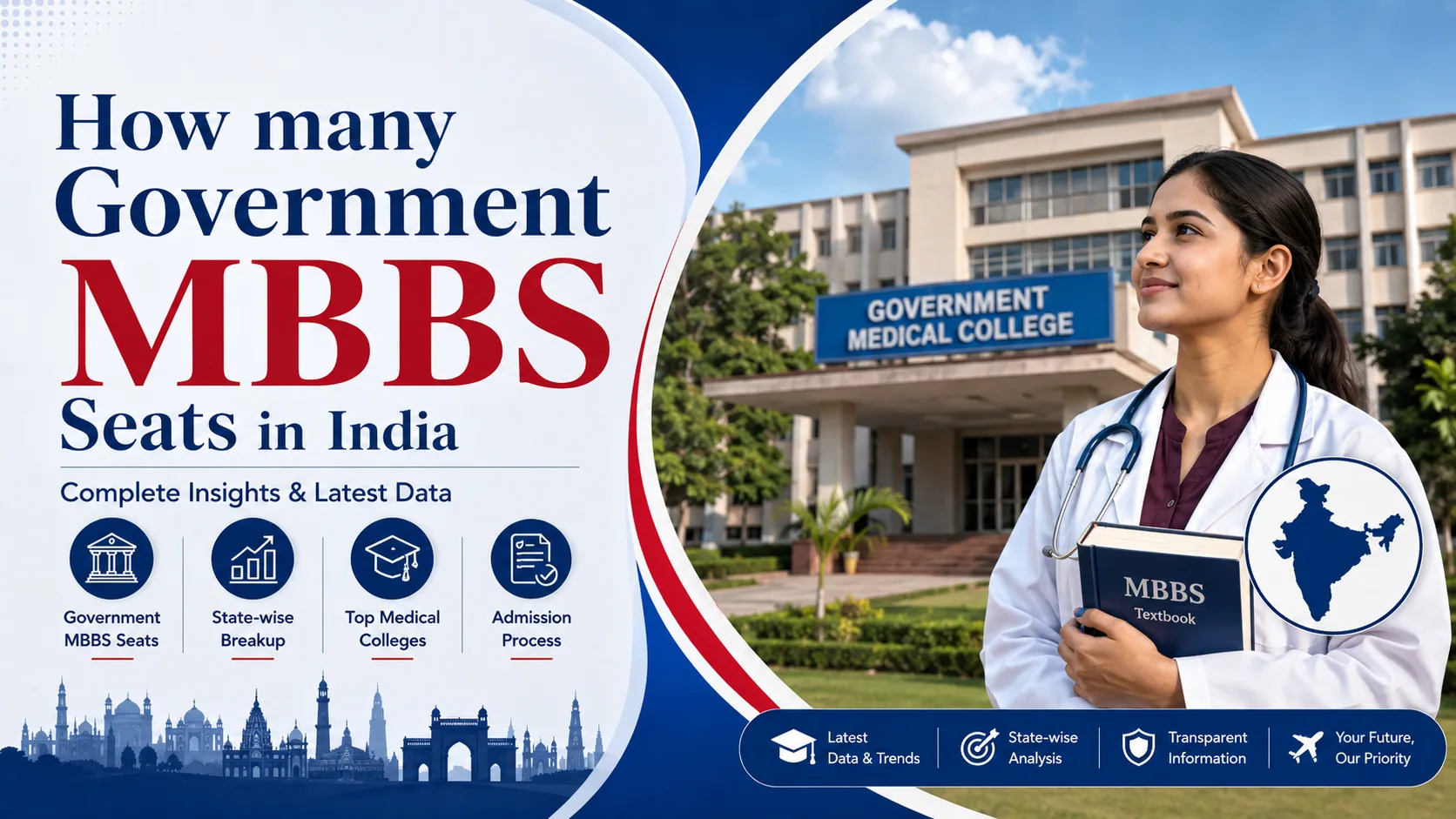
Among these NEET candidates, the available medical seats are distributed based on their All India Rank (AIR) and category rank, allocating each student to a particular medical college. As of August 2026, based on the NMC information desk, the total number of MBBS seats in India is 1,36,939 across approximately 823 medical colleges/institutions, excluding AIIMS, JIPMER, and other Institutions of National Importance (INIs). After the MCC and state counselling process, students can begin pursuing MBBS in India.
MBBS in India - Quick Facts
For Indian students, studying MBBS in India offers a unique opportunity to complete a rigorous 5.5-year program of academic study and clinical experience that opens doors to becoming a successful medical professional.
|
Course Name |
MBBS |
|---|---|
|
Full Form |
Bachelor of Medicine, Bachelor of Surgery |
|
Total Duration |
5.5 Years |
|
Academic Duration |
4.5 Years |
|
Internship Duration |
1 Year |
|
Entrance Exam |
National Entrance cum Eligibility Test - Undergraduate (NEET-UG) |
|
Basic Eligibility Criteria |
50% in 10+2 with PCB, 17 Years Old |
|
Regulatory Authority |
National Medical Commission (NMC) |
|
Medium of Instruction |
Primarily English |
|
Types of Medical Institutions |
Government, Private, Deemed |
|
Avg. Tuition Fee Per Year |
₹10,000-1.5L (govt.), ₹7-30L (private & deemed) |
|
Number of MBBS Seats |
1,36,939 (as per NMC MBBS Seat Matrix 2026-27) |
Note: Tuition fees are an estimate from the online source providing a range, while the number of seats is based on the figures reflected on the NMC’s “Information Desk” page.
Different Types of Medical Colleges/Institutions in India
To ensure a smooth academic journey and successful career development, students must carefully consider their college type. The kind of college you choose determines your next 5-6 years beyond just completing your MBBS in India and being awarded the degree. In India, there are mainly three different types of colleges/institutions: government, private and deemed. Each one has its own merits and drawbacks, depending on what a student seeks.
|
Factor |
Government (including central, state & ESIC) |
Private & Deemed (self-financed) |
|---|---|---|
|
Total Colleges in India |
441 |
382 |
|
Avg. Tuition Fee |
₹10,000-1.5 L/Year |
₹7-30 L/Year |
|
Level of Competition |
Very High |
High to Moderate |
|
Seat Availability |
63,296 |
73,643 |
|
Typical Quotas |
AIQ: 15%, State: 85% |
State, Management & NRI Quotas |
Note: The table is compiled from the official list of colleges and institutions from the NMC’s website and its 2026-27 MBBS seat matrix. The NMC classifies colleges under its “Management of College” field as Government, Private, Trust, or Society. The matrix divides seats into government & private while counting deemed institutions together with the private category. The list does not include the count of Trust and Society-classified institutions.
Government
Government medical colleges are fully funded by state or central governments, offering top-tier clinical education on highly subsidised tuition fees. The selection of medical students in government colleges is purely merit-based and largely considers NEET-UG performance.
Merits:
- Highly subsidised tuition fees offering affordable education
- High patient load in hospitals offering clinical experience
- Reputation & state recognition offering global validation
- Taught by experienced and senior government professors
Drawbacks:
- Extremely high competition due to student-to-seat ratio
- Older state colleges may lack modern facilities and hostels
- An overcrowded patient load can lead to intense workload
- Possible mandatory 1-3 year rural service bond after graduation
|
College Name |
Location |
Ranking |
|---|---|---|
|
All India Institute of Medical Sciences (AIIMS) |
New Delhi, Delhi |
1 |
|
Christian Medical College (CMC) |
Vellore, Tamil Nadu |
3 |
|
Jawaharlal Institute of Postgraduate Medical Education & Research (JIPMER) |
Puducherry |
4 |
|
Institute of Medical Sciences, Banaras Hindu University (IMS-BHU) |
Varanasi, Uttar Pradesh |
6 |
|
King George's Medical University (KGMU) |
Lucknow, Uttar Pradesh |
8 |
Note: The data presented is based exclusively on the NIRF (National Institutional Ranking Framework) rankings, published by the Ministry of Education of India.
Private
Private colleges in India are owned and managed by self-funded trusts or societies. These institutions offer modern infrastructure, advanced facilities, and an elite environment. Students study MBBS in India at private institutions with tuition fees determined by state authorities.
Merits:
- Offers modern infrastructure and updated technology
- Moderate cutoffs and NEET rank threshold for admission
- Provides better comfort with upgraded hostel facilities
- Structured administrative and academic timelines
Drawbacks:
- Higher tuition and fee structures than public universities
- Lower patient volume than in government civil hospitals
- The quality of practical training varies across the institutions
- Might include extra charges for clinical equipment and fees
|
College Name |
Location |
Ranking |
|
Christian Medical College (CMC) |
Vellore, Tamil Nadu |
3 |
|
St John's Medical College |
Bengaluru, Karnataka |
30 |
|
Dayanand Medical College |
Ludhiana, Punjab |
36 |
|
PSG Institute of Medical Sciences and Research |
Coimbatore, Tamil Nadu |
43 |
|
Jawaharlal Nehru Medical College |
Belagavi, Karnataka |
46 |
Note: The data presented is based exclusively on the NIRF (National Institutional Ranking Framework) rankings, published by the Ministry of Education of India.
Deemed
Deemed institutions are authorised to operate as a full-fledged university by the central government on the advice of the University Grants Commission (UGC). Deemed universities offer state-of-the-art research facilities and the highest form of academic autonomy. Deemed colleges cannot grant their own degrees unless they're associated with a particular university.
Merits:
- No state domicile registration; open to all MCC counselling
- World-class universities with an elite study environment
- Higher academic autonomy to adapt its own standards
- Transparent allotment for admission through MCC rounds
Drawbacks:
- Highest tuition fees among all different types of institutions
- Fluctuating patient inflow with private tertiary hospitals
- Very expensive transition due to high fees for specialisations
- Strict penalties for seat forfeiture during late counselling rounds
|
College Name |
Location |
Ranking |
|---|---|---|
|
Amrita Vishwa Vidyapeetham |
Coimbatore, Tamil Nadu |
9 |
|
Kasturba Medical College Manipal |
Manipal, Karnataka |
10 |
|
Saveetha Institute of Medical and Technical Sciences |
Chennai, Tamil Nadu |
11 |
|
Dr D. Y. Patil Vidyapeeth |
Pune, Maharashtra |
12 |
|
Siksha ‘O’ Anusandhan |
Bhubaneswar, Odisha |
15 |
Note: The data presented is based exclusively on the NIRF (National Institutional Ranking Framework) rankings, published by the Ministry of Education of India.
Why Study MBBS in India?
Pursuing an MBBS in India offers several advantages to aspiring doctors, preparing them for the next academic phase after completing their senior secondary education. In a country where doctors are seen as almost like God, the MBBS is not only a rewarding academic experience but also a highly respected and responsible profession in India.
High Clinical Exposure
A massive inflow of patients across Indian hospitals provides students with extensive, hands-on clinical training. Interacting and treating with a diverse group of patients exposes them to a variety of real-world medical conditions.
NMC-Regulated Education
All students receive a regulated, highly structured academic curriculum under the governance and supervision of the National Medical Commission, ensuring that students are practically and legally paving their career pathways.
Affordable Government Fee
Pursuing an MBBS in India through government medical institutions offers highly regulated, structured medical education with subsidised and budget-friendly tuition fees compared to most international medical destinations.
Global Degree Recognition
Validated by India’s National Medical Commission, Indian MBBS degrees are recognised globally by major international bodies, including the WHO, WFME, and ECFMG, enabling graduates to practise or study internationally.
Unified Entrance Systems
The MBBS admission process is streamlined and unified across all government, private, and deemed institutions through the National Eligibility cum Entrance Test – Undergraduate (NEET-UG) examination, providing a structured system.
Community Health Focus
Students gain early hospital exposure and participate in mandatory hospital-based clinical rotations, rural healthcare programmes, and preventive care training, equipping them with critical clinical skills to address and solve complex public health challenges.
MBBS Course Duration in India
MBBS duration in India is 5.5 years (66 months), comprising 4.5 years (54 months) of coursework and 1 year (12 months) of a compulsory rotatory medical internship (CRMI). As mandated by the National Medical Commission (NMC) under the Graduate Medical Education Regulations (GMER 2023), the 4.5-year academic phase is divided mainly into three phases and four periods. Here is a visual representation of the MBBS course duration in India:
Total Duration of MBBS in India: 5.5 Years (66 Months)
Academic Coursework: 4.5 Years (54 Months)
- Phase 1 (Pre-Clinical): 12 Months
- Phase 2 (Para-Clinical): 12 Months
- Phase 3 Part I (Clinical): 12 Months
- Phase 3 Part II (Clinical): 18 Months
Mandatory Internship: 1 Year (12 Months)
[visually showing the duration chart above]
MBBS Syllabus in India
Regulated by the NMC’s Competency-Based Medical Education guidelines, the MBBS syllabus in India standardises medical training across pre-clinical, para-clinical, clinical, and internship stages. Here is a complete list of subjects based on the complementary volumes of the official Competency-Based Undergraduate Curriculum from 2018:
Phase 1: Pre-Clinical (1 Year, 2 Semesters)
Covers foundational knowledge of human body structure, physiology fundamentals, biochemistry, and early clinical exposure.
- Anatomy (82 topics, 409 outcomes)
- Physiology (11 topics, 137 outcomes)
- Biochemistry (11 topics, 89 outcomes)
Phase 2: Paraclinical (1.5 Years, 3-5 Semesters)
Examine disease mechanisms, infectious agents, drug responses, and forensic concepts with an introductory understanding of clinical postings.
- Pathology (36 topics, 182 outcomes)
- Microbiology (8 topics, 54 outcomes)
- Pharmacology (5 topics, 85 outcomes)
- Forensic Medicine & Toxicology (14 topics, 162 outcomes)
Phase 3: Clinical (2 Years, 6-9 Semesters)
Offers comprehensive clinical, surgical, and diagnostic training for managing patient care and treatment, rotating across different specialities and departments.
- Medicine & Allied: General Medicine, Respiratory Medicine, Paediatrics, Psychiatry, Dermatology, Community Medicine, PMR (129 topics, 1,299 outcomes)
- Surgery & Allied: General Surgery, Ophthalmology, ENT, Obstetrics & Gynecology, Orthopedics, Anesthesiology, Radiology, Radiotherapy, Dentistry (116 topics, 532 outcomes)
CRMI [Internship] (12 Months)
Integrate a compulsory rotational medical internship (CRMI), providing practical clinical training in hospital wards, emergency departments, and rural healthcare centres.
- Community Medicine: 2 Months
- Medicine (including Psychiatry): 2 months
- Surgery (including Orthopedics, Anesthesia): 2 Months
- Obstetrics and Gynecology: 2 Months
- Paediatrics: 1 Month
- Elective postings (Dermatology, Radiology, Emergency, etc.): 3 Months
Teaching Methodology for MBBS in India
The teaching methodology utilised during MBBS in India follows a competency-based framework. It comprises lectures, clinical exposure, skills development, ethical communication training and community-based healthcare programmes.
Competency-Based Medical Education (CBME)
CBME focuses on helping students acquire real-world clinical skills, gain an upper hand in practical clinical application, and achieve continuous improvement through evaluation rather than constantly delivering passive theoretical knowledge.
Early Clinical Exposure (ECE)
ECE introduces students to real clinical practice in real clinical environments while engaging in direct patient interaction that usually starts from Year 1. This helps them understand their basic contextual medical education with the real clinical complexities.
Attitude, Ethics, and Communication (AETCOM)
Clinical training is conducted in consideration of professional ethics, empathetic doctor-patient relationships and communication, enabling students to learn how to address all legal responsibilities across all clinical phases.
Family Adoption Programme (FAP)
Students participate in family adoption programmes where each rural family is assigned to a single student, allowing them to learn about primary healthcare, public sanitation, and factors influencing social healthcare.
Simulation and Skill Laboratory Training
Utilises medical laboratories, mannequins, and other medical equipment to train students in a simulated clinical environment, learning under task trainers, helping students build essential skills prior to the internship.
MBBS Eligibility Criteria in India
Pursuing MBBS in India requires basic eligibility that includes qualifications, age requirements, NEET qualifications, and other major factors. Here are some commonly valid and applicable MBBS eligibility criteria in India:
- Academic Qualifications
Passed higher secondary education (10+2) or equivalent examination from a recognised education board or state board.
- Age Requirement
The minimum age requirement for an MBBS in India is 17 years old, with no maximum age limit.
- NEET Qualification
Qualify for and clear the NEET-UG examination conducted by the NTA each year, meeting NMC specifications.
- Subject Requirements
Mandatory courses studied in 10+2 include physics, chemistry, and biology (PCB), along with English in some cases.
- Category-wise Eligibility
The general category must have a minimum PCB aggregate of 50%, while the reserved category (SC/ST/OBC) requires a 40% aggregate.
Eligibility for Different Types of Colleges
Different medical college types in India operate on different levels; though most eligibility criteria are almost identical in each college type, here are the specific eligibility criteria for an MBBS in India across different college types:
Government
-
Completed 10+2 with PCB, scoring at least 50% (general) or 40% (reserved)
- Must be at least 17 years of age on or before December 31 of the admission year
- Meet the minimum qualifying NEET percentile and cutoffs in the same year
- 15% quota for All India Ranking (AIR) NEET qualifying medical aspirants
- 85% state quota for candidates fulfilling the domicile, nativity, or local schooling rules
Private
-
Standard 10+2 completion with PCB, meeting 50% (or 40% for SC/ST/OBC)
- The minimum age requirement remains the same for candidates, i.e., 17 years old
- Indian nationals, Non-Resident Indians (NRIs), Overseas Citizens of India (OCI), and Persons of Indian Origin (PIO) are eligible
- Clearing the specified NEET qualifying percentile as per the NMC is mandatory
- Even for the management and NRI quotas, basic NEET qualification is mandatory
- Allocated state quota (100%) with management and NRI quota seats (up to 15%)
Deemed
-
Standard qualification of 50% (general) or 40% (reserved) in 10+2 with PCB
- Minimum age requirement is 17 years old, with no bar on the maximum age
- Eligible for NRIs, Overseas Citizens of India (OCI), Persons of Indian Origin (PIO), and students sponsored by eligible close NRI relatives
- Open to candidates from all states and union territories on a 100% AIQ quota with no requirement of a domicile certificate
- With a 15% NRI quota and complete AIQ quota, NEET qualification is mandatory
Documents Required for MBBS Admission in India
To pursue an MBBS in India, all Indian medical candidates must submit the required set of documentation according to the specific requirements of the university and NMC regulatory requirements. Here are the generally accepted documents used to process MBBS admissions in India:
- Class 10 marksheet
- Class 12 marksheet
- NEET admit card
- NEET score card
- ID Proof (Aadhaar/PAN/Driving Licence/Passport)
- 6-8 passport-size photographs (same as on the application form)
- DOB certificate (if metric certificate is not available)
- Category certificate (if applicable)
- Disability certificate (if applicable)
- Domicile certificate (if applicable)
- Counselling documents
- Medical fitness certificate
- Provisional allotment letter
NEET-UG for MBBS Admission in India
NEET-UG is a mandatory national-level entrance examination conducted by the NTA to regulate the enrolment process of the undergraduate medical courses in India. Many students across the country take this entrance exam to pursue their MBBS in India.
Overview
The National Eligibility cum Entrance Test - Undergraduate (NEET-UG) is the single, official entrance examination to facilitate admission to undergraduate medical programmes in India. Conducted by the National Testing Agency (NTA) every year across the country, it has been set up as the official window; AIIMS, PGIMER, and JIPER were conducted before the NEET was officially introduced and implemented in 2016 (originally introduced in 2013). Every year, lakhs of applicants appear for the entrance exam to pursue their medical education in a preferred or suitable institution. Here is an overview of the exam pattern and marks scheme:
- Total number of questions - 180
- Total marks - 720
- Per correct answer is +4 marks
- Per wrong answer is -1 mark
- Physics - 45 Questions
- Chemistry - 45 Questions
- Biology - 90 Questions
- 45 Questions from Zoology
- 45 Questions from Botany
Is NEET Mandatory?
Yes, qualifying for the NEET is mandatory for all Indian students to pursue their MBBS in an Indian medical college/institution. It is the sole entrance exam to regulate and facilitate the distribution of medical seats across all government, private, management and NRI quota seats. While there are state-level entrance exams (such as Kerala’s) and institutional-level ones (such as AIIMS'), no other examination can bypass the significance and widespread use of the NEET-UG for MBBS admissions in India.
NEET Score vs NEET Rank
NEET scores and marks are different but correlated. A candidate's NEET score is one of the determinants for what their All India Ranking (AIR) will be. While general estimates show that a NEET score of 700+ secures an AIR under 100, the evaluation of specific ranking based on the NEET score keeps changing each year due to different determinants of the AIR, including the difficulty level of the exam in a particular year, the total number of NEET candidates appearing, previous trends in the NEET, etc.
How NEET Influences MBBS Admission
NEET is the single gateway to pursue an MBBS in India. The All India Ranking (AIR) changes each year due to the different determinants of the AIR evaluation, including the difficulty level, number of appearing candidates, and other factors. The final NEET scores influence the entire admission process and its components, including seat allocation through centralised MCC counselling, college selection, and resolving ties (same scores with subject-specific scores). Lower scores often restrict one’s options for college selection, while higher scores offer a wider range of options to choose from.
NEET 2025 Top 10 AIR Candidates List |
|||||
|---|---|---|---|---|---|
|
Name |
Gender |
Category |
Percentile |
All India Rank |
State |
|
Mahesh Kumar |
Male |
General |
99.9999547 |
1 |
Rajasthan |
|
Utkarsh Awadhiya |
Male |
General |
99.9999095 |
2 |
Madhya Pradesh |
|
Krishang Joshi |
Male |
General |
99.9998189 |
3 |
Maharashtra |
|
Mrinal Kishore Jha |
Male |
General |
99.9998189 |
4 |
Delhi |
|
Avika Aggarwal |
Female |
General |
99.9996832 |
5 |
Delhi |
|
Jenil Vinodbhai Bhayani |
Male |
General |
99.9996832 |
6 |
Gujarat |
|
Keshav Mittal |
Male |
General |
99.9996832 |
7 |
Punjab |
|
Jha Bhavya Chirag |
Male |
General |
99.9996379 |
8 |
Gujarat |
|
Harsh Kedawat |
Male |
General |
99.9995474 |
9 |
Delhi |
|
Aarav Agrawal |
Male |
General |
99.9995474 |
10 |
Maharashtra |
MBBS Admission Process in India
The MBBS admission process in India is a transparent, merit-based centralised system governed and administered by the National Medical Commission (NMC). Two major components that all Indian medical aspirants must complete successfully to study MBBS in India are NEET-UG and the MCC (Medical Counselling Committee) counselling process.
Step 1
NEET-UG Registration
Check who can apply for the NEET-UG and enter the registration process. Register online for the entrance examination through the official website of the National Testing Agency (NTA).
Step 2
NEET-UG Examination
Appear for the NEET-UG examination on the date and time officially announced by the NTA at the specifically assigned examination centre, following the guidelines for all candidates.
Step 3
Result & Merit List
Wait for the official NEET-UG results (typically announced in less than a month). NTA publishes the results on their website. It contains the cut-off percentile, AIR, and other details.
Step 4
Counselling Registration
NEET-UG qualified students register for the counselling process on the MCC website or their respective state counselling websites by uploading the required documents and paying the non-refundable security deposit.
Step 5
Choice Filling and Locking
The counselling process will allow students to select their preferred medical colleges and course streams with priority on the official MCC portal, locking their final choices before the deadline.
Step 6
Seat Allocation of Students
Counselling authorities process choice preferences based on NEET-UG results, including All India Rank (AIR), category, and seat availability to publish final round-wise seat allotment results.
Step 7
Document Verification & Reporting
Students download their allotment letters, undergo physical verification of all submitted documents, pay the required admission tuition fee, and report physically to the assigned college.
Counselling Sessions in India
Counselling sessions are conducted by the Medical Counselling Committee (MCC) in India. MBBS seats are distributed through different rounds (Round 1 & Round 2; Mop-up/Round 3; Stray Vacancy Round). They manage 15% AIQ seats in government colleges and 100% seats in AIIMS, JIPMER, central universities (such as BHU and AMU), and deemed universities. On the other hand, state counselling authorities manage 85% of state-quota seats and 100% of seats in private medical colleges within students’ respective states.
MCC Counseling
MCC conducts central online allocation for 15% AIQ seats, deemed universities, and central institutions.
State Counseling
State counselling authorities conduct admissions for 85% of state quota seats in government and private colleges within their respective states.
All India Quota (AIQ)
MCC handles the standard 15% seat reservation in government medical colleges across the country, with no domicile limits and open to all candidates.
State Quota
State counselling authorities allocate 85% of reserved seats in respective states’ government colleges, with strict domicile criteria for students.
Choice Filling and Seat Allotment
Whether through MCC or a state counselling portal, students register and fill in their preferred colleges and courses, processed according to the applicable counselling rules.
Tuition Fees to Pursue MBBS in India
MBBS fees in India vary significantly depending on the type of college/institution, admission category, and quota allocation. Government colleges generally have the lowest tuition fees, while private colleges and deemed universities have considerably higher tuition fees. While budgeting for their MBBS in India, students must also take into account the cost of their accommodation, food, examination fees, and other miscellaneous expenses.
Government MBBS Fees
Government medical colleges offer highly subsidised medical education, inviting many students to prepare for the competition. Annual tuition in government colleges in India can range from a few thousand rupees to several lakhs, depending on the specific institution. On average, government MBBS tuition fees can range from ₹10,000 to ₹1,50,000 per year.
Private MBBS Fees
Private medical colleges charge higher tuition fees than government colleges, ranging from ₹7 lakh to ₹20 lakh per year to allow merit-based MBBS admissions. For NRI and management quota seats, tuition fees can range from several lakh rupees to ₹25 lakh or more, reaching an average value of 2 crore for the complete duration.
Deemed MBBS Fees
Deemed universities/institutions generally have the highest MBBS tuition fees in India, as compared to other types of universities and colleges. Tuition fees on merit-based MBBS admission can range from ₹10 lakh to ₹30 lakh per year, depending on the exact institution, category and admission quota. The minimum budget for NRI admission is ₹90 lakh to ₹2 crore.
Other Expenses
Other than tuition fees, Indian students, especially those who are going to live in a different city for the first time, should account for hostel and mess charges; examination fees; cost of books, instruments, insurance, and travel expenses; and one-time refundable security deposits.
Total Cost of MBBS in India
The overall cost to pursue an MBBS in India depends on the college type and its fee structures. While government colleges can be relatively affordable, private colleges and deemed universities/institutions may require ₹50L to over ₹20,000.
|
College |
Type |
State/UT |
Avg. Annual Tuition Fee |
Avg. Annual Hostel/Mess Fee |
Tuition for 4.5 Academic Years |
Hostel/Mess for 5.5 Years |
Approx. Range for MBBS (5.5 Years) |
|---|---|---|---|---|---|---|---|
|
All India Institute of Medical Sciences (AIIMS) |
Government |
New Delhi |
₹1,350 |
₹990 - ₹1,200 |
₹6,075 |
₹5,445 - ₹6,600 |
₹11,52 - ₹12,675 |
|
Maulana Azad Medical College (MAMC) |
Government |
New Delhi |
₹240 |
₹4,000 - ₹5,000 |
₹1,080 |
₹22,000 - ₹27,500 |
₹23,080 - ₹28,580 |
|
Christian Medical College (CMC) |
Private |
Tamil Nadu |
₹3,000 (plus ₹50,000) |
₹90,000 - ₹1,00,000 |
₹2,38,500 |
₹4,95,000 - ₹5,50,000 |
₹7,33,500 - ₹7,88,500 |
|
St John's Medical College |
Private |
Karnataka |
₹6,75,000 |
₹1,50,000 - ₹2,00,000 |
₹30,37,500 |
₹8,25,000 - ₹11,00,000 |
₹38,62,500 - ₹41,37,500 |
|
Kasturba Medical College (KMC), Manipal |
Deemed |
Karnataka |
₹17,80,000 |
₹1,48,500 - ₹1,97,000 |
₹80,10,000 |
₹8,16,750 - ₹10,83,500 |
₹88,26,750 - ₹90,93,500 |
|
Dr D. Y. Patil Medical College |
Deemed |
Maharashtra |
₹26,50,000 |
₹3,40,000 |
₹1,19,25,000 |
₹18,70,000 |
₹1.38 Crore - ₹1.45 Crore |
Note: The values are subject to change depending on tuition fees, quota admission policy, inflation rate, and other relevant factors. Some values are estimations or approximations of a larger value and hence do not reflect the actual and accurate values.
MBBS Seats in India
According to the latest MBBS Seat Matrix 2026-27 published by the Medical Assessment and Rating Board (MARB) on the official website of the National Medical Commission (NMC), the total number of MBBS seats in India stands at about 1,36,939 across 823 medical colleges, excluding AIIMS, JIPMER, and other Institutions of National Importance (INIs). Of these numbers, 63,296 seats are allocated to 441 government medical colleges, while 73,643 seats are allocated to 382 private colleges and deemed institutions.
As per the NEET 2026 state-wise seat matrix, Karnataka currently has the highest number of MBBS seats in India with approximately 15,395 seats, followed by Uttar Pradesh with approximately 14,000 seats, Tamil Nadu with 13,999 seats, Maharashtra with 13,099 seats, Telangana with 10,250 seats, Rajasthan with 8,080 seats, and Gujarat with 7,750 seats. Look at the table below for a state-wise distribution of the available seats across the country:
|
State/UT |
Total Colleges/Institutions |
Total Seats |
Government Colleges & Seats |
Private Colleges & Seats |
|
Andaman & Nicobar Islands |
1 |
114 |
1 (114) |
0 (0) |
|
Andhra Pradesh |
40 |
7,465 |
19 (3,515) |
21 (3,950) |
|
Arunachal Pradesh |
1 |
100 |
1 (100) |
0 (0) |
|
Assam |
15 |
1,875 |
15 (1,875) |
0 (0) |
|
Bihar |
26 |
4,160 |
12 (1,710) |
14 (2,450) |
|
Chandigarh |
1 |
200 |
1 (200) |
0 (0) |
|
Chhattisgarh |
21 |
2,925 |
15 (1,725) |
6 (1,200) |
|
Dadra & Nagar Haveli |
1 |
177 |
1 (177) |
0 (0) |
|
Delhi |
10 |
1,415 |
8 (1,165) |
2 (250) |
|
Goa |
1 |
250 |
1 (250) |
0 (0) |
|
Gujarat |
42 |
7,750 |
23 (4,250) |
19 (3,500) |
|
Haryana |
18 |
2,960 |
8 (1,060) |
10 (1,900) |
|
Himachal Pradesh |
7 |
871 |
6 (721) |
1 (150) |
|
Jammu & Kashmir |
11 |
1,675 |
10 (1,525) |
1 (150) |
|
Jharkhand |
10 |
1,500 |
6 (800) |
4 (700) |
|
Karnataka |
75 |
15,395 |
24 (4,400) |
51 (10,995) |
|
Keralam |
36 |
5,704 |
14 (1,855) |
22 (3,849) |
|
Madhya Pradesh |
34 |
6,020 |
20 (3,020) |
14 (3,000) |
|
Maharashtra |
86 |
13,099 |
42 (6,000) |
44 (6,000) |
|
Manipur |
4 |
550 |
3 (400) |
1 (150) |
|
Meghalaya |
3 |
250 |
2 (100) |
1 (100) |
|
Mizoram |
1 |
100 |
1 (100) |
0 (0) |
|
Nagaland |
1 |
100 |
1 (100) |
0 (0) |
|
Odisha |
20 |
2,950 |
14 (1,850) |
6 (1,100) |
|
Puducherry |
8 |
1,780 |
1 (180) |
7 (1,600) |
|
Punjab |
12 |
1,850 |
5 (900) |
7 (950) |
|
Rajasthan |
51 |
8,080 |
33 (4,480) |
18 (3,600) |
|
Sikkim |
2 |
200 |
1 (100) |
1 (100) |
|
Tamil Nadu |
78 |
13,999 |
37 (5,349) |
41 (8,650) |
|
Telangana |
66 |
10,250 |
36 (4,000) |
30 (5,850) |
|
Tripura |
3 |
500 |
1 (200) |
2 (300) |
|
Uttar Pradesh |
88 |
14,000 |
49 (5,700) |
39 (8,300) |
|
Uttarakhand |
9 |
1,475 |
5 (625) |
4 (850) |
|
West Bengal |
41 |
7,200 |
25 (4,350) |
16 (2,850) |
|
TOTAL |
823 |
136,939 |
441 (63,296) |
382 (73,643) |
Note: The data is presented based on the NMC information desk. "Deemed" is a subset, not an additional management category. Most deemed institutions in this NMC dataset are marked Private under "Management of College". Deemed institutions are included within the NMC’s Private or Government management categories and are not counted separately.
Top Medical Colleges for MBBS in India
Pursuing MBBS in India at top medical colleges opens up the door to multiple opportunities. India has numerous well-regarded and established institutions to provide authentic medical education, including AIIMS, MAMC, CMC Vellore, St John’s Medical College, and leading deemed universities, such as KMC Manipal. We will look at some of the top medical colleges and institutions in India across different types that offer quality education and training:
Top Government Medical Colleges
Government medical colleges have the highest demand among the medical aspirants in India. Some of the most-demanding and leading institutions include AIIMS New Delhi (enrolling 125 students every year), Maulana Azad Medical College (enrolling 250 students every year), AIIMS Jodhpur, JIPMER Puducherry, and King George’s Medical University.
|
College |
Location |
Type |
Affiliation |
Approx. Annual Tuition Fee |
|
All India Institute of Medical Sciences (AIIMS) |
New Delhi |
Autonomous/INI |
Autonomous |
₹1,350 |
|
Jawaharlal Institute of Postgraduate Medical Education & Research (JIPMER) |
Puducherry |
Autonomous/INI |
Autonomous |
₹6,700 |
|
Maulana Azad Medical College (MAMC) |
New Delhi |
State Government |
University of Delhi (DU) |
₹240 |
|
Institute of Medical Sciences, BHU (IMS-BHU) |
Varanasi, Uttar Pradesh |
Central University Institute |
Banaras Hindu University (BHU) |
₹33,214 |
|
King George's Medical University (KGMU) |
Lucknow, Uttar Pradesh |
State Government University |
Autonomous State University |
₹54,600 |
Note: The values are subject to change depending on tuition fees, quota admission policy, inflation rate, and other relevant factors. These are the lowest possible tuition fees.
Top Private Medical Colleges
Some of the prominent and well-renowned private medical colleges in India include Christian Medical College, Vellore; St John’s Medical College, Bengaluru; Kasturba Medical College, Manipal; and other established institutions recognised for their education and clinical training.
|
College |
Location |
Type |
Affiliation |
Approx. Annual Tuition Fee |
|---|---|---|---|---|
|
Christian Medical College (CMC) |
Vellore, Tamil Nadu |
Private Unaided (Trust) |
The Tamil Nadu Dr M.G.R. Medical University |
3,000 |
|
St John's Medical College |
Bengaluru, Karnataka |
Private Unaided (Trust/Society) |
Rajiv Gandhi University of Health Sciences (RGUHS) |
6,75,000 |
|
Dayanand Medical College & Hospital (DMC) |
Ludhiana, Punjab |
Private Unaided (Trust) |
Baba Farid University of Health Sciences (BFUHS) |
4,26,000 |
|
PSG Institute of Medical Sciences & Research |
Coimbatore, Tamil Nadu |
Private Unaided (Trust) |
The Tamil Nadu Dr M.G.R. Medical University |
4,50,000 |
|
MS Ramaiah Medical College |
Bengaluru, Karnataka |
Private Unaided (Trust) |
Rajiv Gandhi University of Health Sciences (RGUHS) |
1,44,000 |
Note: The values are subject to change depending on tuition fees, quota admission policy, inflation rate, and other relevant factors. These are the lowest possible tuition fees.
Top Deemed Medical Institutions
Some of the leading deemed medical institutions in India include Kasturba Medical College Manipal, Hamdard Institute of Medical Sciences & Research, Amrita School of Medicine, Sri Ramachandra Institute of Higher Education and Research, DY Patil, and a few others.
|
College |
Location |
Type |
Affiliation |
Avg. Annual Tuition Fees |
|
Kasturba Medical College (KMC) |
Manipal, Karnataka |
Deemed University Institution |
Manipal Academy of Higher Education (MAHE) |
₹17,80,000 |
|
Hamdard Institute of Medical Sciences & Research (HIMSR) |
New Delhi |
Deemed University Institution |
Jamia Hamdard |
₹16,00,000 |
|
Amrita School of Medicine |
Kochi, Keralam & Faridabad, Haryana |
Deemed University Institution |
Amrita Vishwa Vidyapeetham |
₹25,00,000 |
|
Saveetha Medical College |
Chennai, Tamil Nadu |
Deemed University Institution |
Saveetha Institute of Medical and Technical Sciences (SIMATS) |
₹31,00,000 |
|
Dr D. Y. Patil Medical College |
Pune, Maharashtra |
Deemed University Institution |
Dr D. Y. Patil Vidyapeeth |
₹26,50,000 |
Note: The values are subject to change depending on tuition fees, quota admission policy, inflation rate, and other relevant factors. These are the lowest possible tuition fees.
Career Opportunities After MBBS in India
Pursuing and completing an MBBS in India opens diverse professional pathways in India. Graduates can choose any career path they are interested in, ranging from direct clinical practice and government healthcare opportunities to advanced academic specialisation, clinical research, medical administration, and public health management.
Career Options
After completing your MBBS in India and earning your medical degree, you can pursue any career aspirations you have or find ones suitable for your goals.
- Medical Officer
Primary care physician roles in public health centres (PHCs/CHCs), government bodies, and state health services.
- Junior Resident
Entry-level clinical positions in hospitals offering hands-on patient care and diagnostic experience.
- General Practice
Set up an independent clinic to treat patients, delivering primary medical care and routine diagnoses within local communities.
- Government Healthcare
Clinical positions in Central Health Services (CHS), Indian Railways, Armed Forces Medical Services (AFMS), and ESIC hospitals.
- Private Hospitals
Clinical roles in multi-speciality hospitals, private nursing homes, and corporate healthcare chains.
- Clinical Research
Roles as a medical investigator and evaluator in pharmaceutical companies and contract research organisations (CROs) and conducting clinical trials.
- Public Health
Engage in creating strategic plans to improve public health, design policy, and do epidemiological tracking with international agencies like the WHO, national bodies like ICMR, and healthcare NGOs.
Higher Studies
Other than directly engaging in a clinical profession, you can pursue further education to gain a specialisation in a particular medical field and advanced medical expertise.
- MD
A Doctor of Medicine (MD) is a 3-year postgraduate clinical degree focusing on non-surgical branches like general medicine, paediatrics, radiodiagnosis, and dermatology.
- MS
Master of Surgery (MS) is a 3-year postgraduate surgical degree covering fields like general surgery, orthopaedics, ophthalmology, and otorhinolaryngology (ENT).
- Other Pathways
Diplomate of National Board (DNB) programmes, Fellowship of National Board (FNB), postgraduate diplomas, or management master's programmes, such as MHA or MPH.
- Super-specialisation
Clear the NEET-SS (super specialisation examination) and pursue 3-year advanced doctorate degrees (DM for medical specialities or MCh for surgical sub-specialities) after MD/MS.
MBBS Doctor Salary in India
MBBS in India offers a 5.5-year academic journey, followed by regular medical trials and efforts to gain permanent medical registration from the NMC. Once an MBBS graduate becomes a doctor, they can expect to earn anywhere between ₹50,000 and ₹90,000 per month as a fresh graduate, depending on the sector, regional location, and clinical experience. In addition to this, government positions also offer structured pay commission scales and further allowances.
|
Role |
Avg. Salary Per Year |
|---|---|
|
Junior Resident |
₹7 Lakhs - ₹12 Lakhs |
|
Medical Officer |
₹8 Lakhs - ₹14 Lakhs |
|
General Physician |
₹6 Lakhs - ₹12 Lakhs |
|
Government Doctor |
₹9 Lakhs - ₹18 Lakhs |
|
Specialist |
₹15 Lakhs - ₹30 Lakhs |
|
Senior Consultant |
₹30 Lakhs - ₹60 Lakhs (or higher) |
Note: Annual salary ranges vary across the country, largely depending on the specific state/union territory policies, pay scale standards, type of employment, and other relevant factors.
Benefits and Realities of Pursuing an MBBS in India
Pursuing an MBBS in India offers both benefits and challenges to prospective students. It offers high patient exposure, affordable education in government colleges, and awards degrees recognised globally, but also intense competition, a heavy workload, and strict academic requirements.
Benefits
✅ Access to extensive patient exposure and diverse disease profiles
✅ Recognised globally by the WHO, ECFMG, and other medical boards
✅ Highly subsidised tuition fee in government medical colleges in India
✅ Ultimate comfort in cultural, geographical and other relevant factors
Challenges
⚠️ Fierce competition for a limited number of government medical seats
⚠️ Demanding studies, heavy patient management duties, and workload
⚠️ Obsolete medical equipment and facilities in rural and tier-2 institutions
⚠️ Rural service obligations before full medical registration are mandatory
How to Choose the Right MBBS College in India
Selecting the right medical college/institution is an important consideration to ensure a successful MBBS in India. It comprises evaluating accreditations, verifying clinical exposure, checking fee structures, and ensuring career success after graduation. Some important points to consider when selecting a medical college/institution during your counselling:
- It must hold a valid licence from the National Medical Commission to practise legally.
- It is affiliated with a recognised state health university or reputable autonomous body.
- It has an active multi-speciality teaching hospital, preferably connected to the campus.
- It offers daily OPD and IPD patient volume with a variety of medical cases.
- It offers ward postings, hands-on emergency training, and clinical rotation opportunities.
- It features a stable, experienced, and qualified team of faculty members.
- It boasts several useful practical tools and equipment, including dissection halls, diagnostic laboratories, digital libraries, and simulation skills laboratories.
- It should present clear information on annual tuition fees, security deposits, and other charges that match your family budget.
- It offers safety, connectivity, a living residence, clean mess facilities, and amenities.
- Determine the seat eligibility across AIQ, state, management, and NRI quotas.
- Be realistic when expecting admission success in a particular medical college/institution; check the previous trends of opening and closing rank cutoffs.
Common Mistakes to Avoid During MBBS Admission
- Failing to verify if new or private institutions have valid NMC seat recognition.
- Errors in lock filling, such as placing low-priority colleges higher or failing to lock choices before the specified counselling deadline.
- Applying for state quota seats in other states without fulfilling local domicile criteria.
- Ignoring bond conditions, such as compulsory rural service or high financial penalties enforced by state governments.
- Engaging with unverified and fraudulent agents promising guaranteed MBBS seats.
- Overlooking hostel charges, security deposits, and annual increases in tuition fees.
- Submitting incomplete or inaccurate documents (caste certificate, domicile certificate, etc.).
Frequently Asked Questions
How many years does it take to complete MBBS?
Pursuing an MBBS in India is a 5.5-year journey, comprising 4.5 years of coursework, followed by a 1-year clinical internship at regional hospitals.
Is NEET mandatory for the MBBS?
Yes, qualifying for the NEET-UG is mandatory for all Indian medical aspirants to be eligible for pursuing their MBBS in India. Other factors are also considered for admission, such as qualifications and age.
What are the eligibility criteria for the MBBS?
The basic eligibility criteria for an MBBS in India are completing 10+2 in PCB (Physics, Chemistry, and Biology as core subjects) with a 50% aggregate score, or 40% for the reserved category (SC/ST/OBC), and the minimum age for an MBBS is 17 years.
How much is the overall cost for pursuing an MBBS?
The overall cost of pursuing an MBBS in India depends on the college/institution type, location, and seat category. Government colleges are the most affordable, as you can complete your education for, on average, ₹1-2 lakh. Private colleges and deemed universities are high-end options with an average budget of ₹65 lakh and ₹90 lakh, respectively, which can be higher for the NRI and management seats, depending on the particular medical institution.
Is MBBS harder than NEET?
Both MBBS and the NEET test require completely different skills but are interrelated, as without clearing the NEET-UG, one cannot apply for an MBBS in India. While NEET requires speed, precision, and competitive filtering among millions of candidates, MBBS requires a lot of patience, understanding and endurance to go through a 5.5-year journey consisting of clinical experience, night duties at hospitals, and an intense workload.
Can I get an MBBS with a 50,000 rank in NEET?
Yes, you can get an MBBS in India with a 50,000 AIR, but your college options depend on your category and quota you're applying for. It's unlikely to find a seat in general merit for government colleges, though it's possible in certain low-cutoff state quotas. There are high chances for reserved category candidates to secure a seat in a government college, while both private colleges (on a management quota) and deemed universities offer excellent opportunities to pursue medical education.
Which is India's no. 1 college for MBBS?
All India Institute of Medical Sciences (AIIMS) in New Delhi has been consistently ranked as the number 1 medical institution in India by the Ministry of Education through its official National Institutional Ranking Framework (NIRF).
Is MBBS safe for girls?
Yes, generally all NMC-recognised medical institutions have a safe and secure campus for all students, with dedicated assistance for female students. However, pursuing an MBBS in India is naturally challenging because it demands sustained dedication, unbreakable endurance, and physical stamina to engage in academic activities, late-night hospital duties and demanding work hours, requiring careful selection of the college/institution.
In which state is MBBS cheapest?
Pursuing an MBBS in India is the cheapest if you're enrolling in a government college. You can pursue your entire MBBS at AIIMS New Delhi for less than ₹20,000 if you have controlled expenditure (live in Delhi or spend a minimal amount of money on accommodation and food with other lifestyle expenses). For private colleges, enrolling in Keralam medical colleges on a state quota can be affordable, as it offers an affordable range of tuition fees (₹7-₹9 lakhs per year).
Is 450 a bad score in NEET?
A NEET score of 450 is not bad; rather, it falls within the respectable and qualifying range. However, the outcomes of such a score will depend on the category, state domicile, and admission goals (whether you're targeting a government or private college seat).