Study Abroad

Masters in Artificial Intelligence in USA: Top Universities, Fees & Eligibility 2026

Neeraj Rajput
· Senior Content WriterUpdated at - September 11, 202611 Min Read5,295 views
Masters in Artificial Intelligence in USA: Top Universities, Fees & Eligibility 2026

Table of Contents

A masters in artificial intelligence in USA is booming in recent times, thanks to the rising use and reliance on artificial intelligence and related technologies. With the innovation of digital technology, our world is moving fast towards a “digital economy” where most tasks and operations are done with the integration of AI models and related technologies. The USA is at the forefront of all countries, offering quality education to all international students who want to learn and explore the fields of artificial intelligence and computer science.

The government is also taking certain measures to ensure that there is no exploitation of the constantly developing artificial intelligence technologies, giving way to the introduction of several new courses at top universities in the USA. Let’s take a deep dive into the world of artificial intelligence and look at important details regarding the Master’s in AI in the USA.

Course Overview: What Does a Master’s in AI Cover?

A masters in artificial intelligence in USA typically offers a comprehensive blend of academic and hands-on training, as well as ethical considerations related to intelligent systems, machine learning, and other relevant subjects. Core areas include:

  • Machine Learning & Deep Learning: Algorithms that allow systems to learn from data.
  • Natural Language Processing: Teaching the machine, i.e., computer, to understand and generate human language.
  • Computer Vision: Enabling computers to interpret and analyse visual information.
  • Robotics & Autonomous Systems: Designing systems that can perform tasks sans human input.
  • Neural Networks & Cognitive Computing: Inspired by the human brain, which is known as cognitive computing, which focuses on pattern recognition and prediction.
  • Data Science & Big Data Analytics: Processing and extracting insights from a large pool of datasets.
  • Ethics & AI Governance: Understanding the social, ethical, and legal implications of Artificial Intelligence.
  • Programming & Tools: Python, TensorFlow, PyTorch, and other important platforms used in real-world applications.

Many MS programs in AI and Robotics also offer capstone projects or research opportunities. This allows students to apply their hands-on skills to real-world issues, such as healthcare, finance, cybersecurity, or autonomous vehicles.

MS in Artificial Intelligence in USA provides students with a comprehensive structure in 1 of the 4 domains, such as Machine Learning, Knowledge Management and Reasoning, Computer Vision, and Intelligent Interaction, though it differs across universities. Top universities offering Masters in Artificial Intelligence in the USA cost around USD 30,000 to USD 60,000 per year in tuition fees (equivalent to 25 to 50 lakh INR), with some potentially higher depending on the specific college or university. It typically takes 1 to 2 years to complete. Universities in USA for MS offer several scholarships and financial aid for international students pursuing a Master’s program in AI to manage their studies and other expenses.

Why Study a Masters in Artificial Intelligence in the USA?

If you already have a bachelor’s degree in computer science, robotics, information technology, or a relevant domain, and want to pursue a master’s degree in AI in the USA, you have chosen the right career path. A Master's in Artificial Intelligence USA will put an extra feather in your cap. Yes, you heard it right. AI is a budding field now. When you choose the USA to study an MS in AI, rest assured, you will have a global career with unlimited potential and growth. Here is a close look at some of the reasons why to study a master's in Artificial Intelligence in the USA:

  • AI is widely regarded as the hottest domain at this moment, and the USA is one of the best places for academic and practical experience, research, and development in Artificial Intelligence.
  • The USA is a global leader in AI, ML, and Robotics. When you move to the USA to study artificial intelligence, you will discover some of the top universities offering bespoke quality education with outstanding infrastructure that is incomparable.
  • The job market for Artificial Intelligence professionals is booming in the United States and many developed countries around the world. The career prospects are huge. In-demand jobs are available in machine learning, data science, software engineering, AI research, AI data analysis, and more.
  • A masters in AI in USA has favourable outcomes, especially for STEM graduates under the guidelines of “H1-B Modernisation” and “O-1 Visa” that put focus on high-skilled AI researchers. A STEM-designated program can allow international students to stay and work in the USA for up to 36 months (3 years) on an OPT extension, which can potentially lead to obtaining an H1-B visa or PR pathways.
  • The United States is home to leading AI degree programs, taught in its top universities equipped with state-of-the-art infrastructure. The USA universities recruit faculty from all across the world to teach subjects such as machine learning, deep learning, NLP, supervised and unsupervised learning, reinforcement learning, GNNs, and multi-task and meta-learning.
  • The new generation of AI-oriented education is introducing a modern curriculum, which includes Generative AI, such as LLMs (ChatGPT or Gemini), Multimodal AI, and Agentic Workflows. Additionally, courses on AI Ethics, AI Policy, and Responsible AI Governance have also become core modules in some curricula due to the US Executive Order on increasing monitoring and safety over AI-infused technologies.

Top Universities Offering Masters in Artificial Intelligence in the USA

The United States is the destination of some of the world-renowned universities in the world that offer high-standard MS programs in AI. You get quality education, bespoke practical training, excellent faculty, and unmatched student support that is considered second to none. Here are the top universities offering the best academic programs in artificial intelligence in the USA.

University

Location

Avg. Tuition Fees (In USD)

Global Ranking in AI

Carnegie Mellon University

Pittsburgh

$57,420 - $60,000

#1

Massachusetts Institute of Technology

Cambridge

$64,310

#2

Stanford University

Stanford

$63,540

#3

University of California, Berkeley

Berkeley

$68,000 - $71,000

#4

University of Illinois Urbana-Champaign

Urbana

$39,344

#5

Georgia Institute of Technology

Atlanta

$36,000 - $38,500

#6

Cornell University

Ithaca

$71,266

#7

University of Washington

Seattle

$41,500 - 43,000

#8

University of Michigan-Ann Arbour

Ann Arbor

$60,634

#9

University of Texas-Austin

Austin

$37,138

#10

Note: The shown rankings for the university are based on the publicly available data on the official website of the US News and World Report. It is retrieved from the list of the “Best Artificial Intelligence Programs”, which was ranked in 2025, as part of the “Best Science Schools” category. Listed tuition fees for international students are based on the January 2026 data, showing an approximate value for each university. The tuition fees of each university are subject to change and may incur additional charges.

Cost of Studying AI in the USA

The cost of studying AI in the USA varies significantly based on the type of program you choose, the university, and the location you stay in. Generally, a Master’s degree in Artificial Intelligence can range from $27,180 to $79,056 for the entire course. The average tuition fees for an MS in AI, or a masters in robotics in USA, can range from $45,000 to $75,000 per year at top universities.

On the other hand, public universities like Georgia Tech or Purdue offer affordable tuition rates of $55,000 per year and $28,000 per year, respectively, when compared to the private Ivy League institutions. The University of California, Berkeley have significantly increased the tuition fees for the Master of Engineering in AI and the Master's in Computer Science for international students. Students must be advised to consider the cost of living, too, while budgeting.

Tips for Applying to AI Programs in the USA

Here are the tips for applying to AI programs in the USA for international students. We hope the tips we discussed here will help you keep yourself ahead of others. Also, it will maximise your chances of getting into a top artificial intelligence program at a respected university in the United States.

Build a Strong Academic Foundation

  • Core Math & Programming
  • Machine Learning Fundamentals
  • Practical Experience
  • Stay Updated

Craft a Compelling Application

  • Research Programs Thoroughly
  • Prepare for Standardised Tests
  • Highlight Your Strengths
  • Write a Strong Statement of Purpose (SOP)
  • Secure Strong Recommendation Letters
  • Prepare for Interviews

Demonstrate Passion and Purpose

  • Showcase Your Projects
  • Highlight Problem-Solving Skills
  • Network with AI Professionals
  • Consider AI-Related Certifications
  • Be Persistent and Adaptable

Admission Requirements

To meet the admission requirements for the Masters in Artificial Intelligence USA for international students, you need to meet the following requirements.

  • You need a bachelor’s degree in a related discipline, such as AI, ML, CS, or Robotics
  • You need to have a 1st class in your UG or higher
  • Official Transcripts
  • Submit at least two letters of recommendation (LORs)
  • Need a GRE or GMAT score (especially if you apply to a top-tier university)
  • Updated resume or CV
  • Work experience is desirable, but not mandatory for all universities
  • English proficiency tests, like IELTS, TOEFL, PTE, or Duolingo

Scholarships and Financial Aid

Several top scholarships and financial aid are offered by various organisations to Indian students pursuing a Master’s in AI in the USA. Almost 570 scholarships are offered to Study in USA to international students. Check some of the great scholarships offered:

Name of the Scholarships

Aid Offered to Eligible Applicants

K.C. Mahindra Scholarships For Postgraduate Studies Abroad

10 lakh (for Top 3 “Fellows”), 5 lakh (for other applicants)

Unimoni Student Stars

5 lakh (1st prize), 2 lakh (2nd prize), 12 lakh (total pool)

J.N. Tata Endowment Loan Scholarship

₹20 lakh of loan amount

Zolve Global Scholarship

Up to $10,000 (maximum merit award, amounting to approximately ₹8.5 lakh)

Central Sector Scheme of National Overseas Scholarship (strictly for minority categories)

Full funding with additional maintenance allowance of approximately ₹13.5 lakh

Note: The shown table represents the latest facts and figures regarding each scholarship, publicly available on the official websites of each entity for the academic year 2026.

Career Opportunities After Masters in AI

Master’s graduates in artificial intelligence can expect to earn salaries ranging between $115,000 and $140,000 per year, which translates to approximately ₹95 lakhs to ₹1.1 crore for Indian graduates working at entry-level positions. Here are the top in-demand jobs for graduates who completed masters in artificial intelligence in the USA in senior-level positions, which usually require 3-5 years of work experience:

Job Role After Master’s in AI

Average Pay (In INR)

AI Engineer

₹1,46,68,080 - ₹1,83,35,100

Software Engineer

₹91,67,550 - ₹2,29,18,875

Data Scientist

₹1,37,51,325 - ₹1,83,35,100

Machine Learning Engineer

₹2,29,18,875 - ₹4,58,37,750

Software Specialist

₹1,26,51,219 - ₹14,851,431

Note: The represented range of salaries for each job role is based on the current trends and pay standards in the USA’s job market for senior-level positions. The pay scale may vary depending on the location, degree level, employment type, contract, and other factors.

ROI After Completing an MS in AI in the USA

Completing an MS in Artificial Intelligence in the United States offers a strong ROI (return on investment) because of its high demand across industries, such as technology, healthcare, hospitality, and finance, to name a few. AI graduates sometimes secure roles with lucrative salaries, senior positions, rapid career growth, and international job opportunities. Thus, it makes a master’s in AI from the United States a valuable as well as rewarding long-term professional investment.

To Conclude

Masters in Artificial Intelligence USA is more than just obtaining a graduate degree. No doubt, it is a strategic investment for a lucrative career with unlimited potential and growth. With access to top-class education, bespoke training, and world-renowned institutes, AI graduates from the United States can expect high ROI and a successful career in this field. From data science to machine learning, an AI expert is in high demand across industries. The United States not only offers high-standard education and unmatched career growth, but also unparalleled exposure with lots of global opportunities. For aspiring MS in AI professionals, studying in the United States of America is a gateway to becoming a leader in one of the most transformative technologies of the time!

Are you ready to pursue your dreams and receive an overseas education? If you are one of those candidates who plan to pursue a graduate program in AI in the USA, you can get in touch with Education Vibes.


Tags:masters in artificial intelligence usams in artificial intelligence in usams in ai in usaai courses in usaartificial intelligence postgraduate coursesms in ai and ml in usaai jobs in usaai companies in usaai development companies in usa

Our Newsletter

Stay updated with the latests news and exclusive content by and subscribing to our newsletter for education vibes.

Related Blogs

See All
APS Germany 2027: Certificate Process, Fees & New dMAT Rule
Study AbroadAPS Germany 2027: Certificate Process, Fees & New dMAT Rule

APS Germany means Akademische Prüfstelle, or the Academic Evaluation Centre. It checks the school and college papers, marksheets, and degrees of Indian students who want to study in Germany. Most Indian students need an APS certificate to get a German student visa. The APS fee is ₹18,000. Starting from the Summer Semester 2027, some Master's applicants must also pass the new Digital Master Test (dMAT).This test is for students with Bachelor's degrees in Engineering, Commerce, Economics, Business, Management, or Tourism. The dMAT test fee is €150, and the 2027 test dates are January 16 and March 13. Students should check the rules by visiting the APS India official website, gather the right papers, and apply early. Applying early helps avoid delays in college admission and visa approval.In this blog, we will cover the key facts about APS (Akademische Prüfstelle) Germany for Indian applicants.APS Germany: Quick HighlightsHere are some quick facts about APS Germany (Akademische Prüfstelle) for Indian applicants planning to study in Germany. Check the facts below.ParticularsDetailsAPS Full formAkademische PrüfstelleSignificanceAcademic Evaluation CentreResponsible AuthorityScience Section of the German Embassy, New DelhiWho needs it?Applicants with relevant Indian academic qualifications planning higher studies in GermanyAPS verification fee₹18,000dMAT Fee€150 (about ₹16,000–16,500; for applicable Master's applicants)dMAT introductionFrom Summer Semester 2027 onwards for selected applicantsdMAT test dates16 January and 13 March 2027Processing timeAt least two weeks; may take longerCertificate formatDigitally signed PDFOfficial websiteaps-india.deWhat is APS Germany?APS full form is Akademische Prüfstelle (Academic Evaluation Centre). It is a mandatory official check run by the German Embassy in New Delhi for Indian students. It confirms that your school and college mark sheets, degrees, and certificates are genuine and meet Germany's education requirements. You cannot get an admission letter from a German university or apply for a student visa without it.Why APS Verification Is RequiredAPS verification is required to

November 19, 2026
How Much Will It Cost to Study in Canada? (2027 Breakdown for Indian Students)
Study AbroadHow Much Will It Cost to Study in Canada? (2027 Breakdown for Indian Students)

Studying in Canada, which is known as the Land of Opportunities, requires careful financial planning for Indian students. Before you plan for your educational journey, you naturally ask, " How much will it cost to study in Canada? On average, you need between CAD 30,000 and CAD 65,000 annually, which is approximately INR 18.6 Lakhs to INR 40.3 Lakhs. This amount is required to cover tuition and living expenses.From 1 September 2026, the official IRCC (Immigration, Refugees and Citizenship Canada) proof of funds notified the requirement for a single study permit applicant outside Quebec is CAD 23,448 for the cost of living, on top of 1st-year tuition as well as travel costs. For students who submit applications before 1st September 2026, the cost was CAD 22,895.CHECK TOTAL COST NOWTotal Cost of Studying in Canada at a GlanceThough the expenses varies by cities but the overall study in canada cost depends normally on your qualification level. It means that if you plan to study a 2-year programme, then the study cost will be lower than a 3-year programme; the cost of tuition and living will vary in this case. Here is a broad annual summary comparing tuition fees and cost of living in Canada:Qualification LevelAverage Tuition Fees Per Year in CADAverage Living Expenses Per Year in CADTotal Cost Per Year in CADTotal Cost Per Year in INRDiplomaCAD 15,000 – CAD 20,000CAD 23,448CAD 38,448 – CAD 43,448INR 23.8 L – INR 26.9 LUndergraduateCAD 35,000 – CAD 45,000CAD 23,448CAD 58,448 – CAD 68,448INR 36.2 L – INR 42.4 LPostgraduate DiplomaCAD 16,000 – CAD 22,000CAD 23,448CAD 39,448 – CAD 45,448INR 24.4 L – INR 28.1 LMaster’s degreeCAD 20,000 – CAD 30,000CAD 23,448CAD 43,448 – CAD 53,448INR 26.9 L – INR 33.1 LMaster of Business AdministrationCAD 30,000 – CAD 60,000CAD 23,448CAD 53,448 – CAD 83,448INR

November 18, 2026
Part-Time Jobs in Korea for Indian Students: D-2 Rules 2027
Study AbroadPart-Time Jobs in Korea for Indian Students: D-2 Rules 2027

Part-time jobs in Korea allow Indian students to earn money while studying, gain work experience and improve their Korean language skills. However, students cannot start working simply because they hold a student visa. They must obtain permission from Korean immigration and follow the conditions attached to it.Indian students enrolled in degree programmes generally hold a D-2 visa, while those attending Korean language training programmes may hold a D-4 visa. Both categories have specific rules regarding employment, working hours and eligibility.This guide explains part-time jobs in Korea for Indian students, including D-2 visa part-time work rules, permit application procedures, TOPIK requirements, the 2027 minimum wage, suitable student jobs and ways to find employment.Part-Time Job in Korea: Key HighlightsHere are the key highlights of part-time job in Korea for Indian students mentioned. Explore the key attributes in the table below.ParticularDetailsVisa categoriesD-2 (degree students) and eligible D-4 (non-degree training or with a Korean language course at a university-affiliated language institute)Work permissionMandatory before starting employmentPermit authorityKorean Immigration / Ministry of JusticePermit feeGenerally free for the part-time work permission itselfStarting eligibilityDepends on visa category and programme; D-4 students generally face a six-month waiting periodSemester working hoursDepends on programme, Korean proficiency and eligibility conditionsVacation working hoursMay be higher or unlimited for eligible students under applicable rules2027 minimum wage₩10,700 per hourCommon student jobsRestaurants, cafes, convenience stores and permitted campus rolesApplication platformHiKorea or the relevant immigration officeCan International Students Work in South Korea?Yes, International students can work part-time in South Korea if they meet the immigration requirements and receive permission. The government generally restricts student employment to suitable part-time activities that do not interfere with academic studies.According to the Korean government's Study in Korea information, D-2 and D-4 students must meet Korean-language proficiency requirements and obtain permission for part-time employment.Who Can Work: D-2 and D-4 Visa HoldersInternational students

November 17, 2026
Spring Intake in USA 2027: Top Universities, Admission, Courses & Deadlines
Study AbroadSpring Intake in USA 2027: Top Universities, Admission, Courses & Deadlines

The spring intake in USA is the 2nd major admission cycle of the academic year in the United States. It usually begins in the month of January 2027 and closes in the month of May 2027. Not all top UG and PG programmes are open during this intake. Universities have the authority to decide on their own which programmes should open for international student admission. If you missed the August or September admission cycle, you can apply for the January intake in USA, which permits you to start your course without waiting the full year.Start Your Spring ApplicationFacts At A GlanceIntake Begins: January 2027 to May 2027Target Year: Academic 2027Who Can Apply: International Students, Transfer, Graduate MS or MBA, and US-Based Transfer StudentsDate of Last Review: November 3, 2026What Is the Spring Intake in USA?The spring intake in the USA usually refers to the university admission time when academic classes start in January. Higher education institutions in the United States of America normally follow a semester system format. The spring semester in the USA is the 2nd term of the standard academic calendar, following the fall semester, which begins in the month of August or September every year.The majority of new students throughout the world apply in the fall semester. You can get a second chance to apply to the top universities in the January intake in the USA. The intake is no different, because you will get the same faculty, same degree, same facilities and same campus resources if you start in spring or fall.When does the spring semester start and end?Academic calendars for domestic and international students vary across universities in the USA. Most higher-tier universities begin spring admission between mid and late January every year. The semester runs for 15-16 weeks and closes in May.Exempli gratia, the

November 5, 2026
German Language Exam Levels Explained: A1 to C1
Study AbroadGerman Language Exam Levels Explained: A1 to C1

Learning German can help Indian students prepare for higher education and employment. However, before choosing an examination, it is important to understand the different German language exam levels. These levels range from A1 for beginners to C2 for highly proficient speakers.The Common European Framework of Reference for Languages (CEFR) provides a standard system to measure German language proficiency. Each level reflects different abilities to understand, speak, read, and write in German. This guide explains German language exam levels, the A1 exam pattern, preparation resources, fees, and language requirements for studying in Germany.What Are German Language Exam Levels?German language exam levels measure how well a person can understand and communicate in German. They follow the CEFR, an internationally used framework for describing language proficiency.The framework has six levels: A1, A2, B1, B2, C1 and C2. These are divided into three broad categories: Basic User (A1–A2), Independent User (B1–B2) and Proficient User (C1–C2).Understanding A1, A2, B1, B2 and C1Each level represents a different stage of language learning:A1 (Beginner): Understands familiar words, basic expressions and simple sentences. Can introduce themselves and answer basic personal questions.A2 (Elementary): Understands frequently used expressions and communicates in simple, everyday situations, such as shopping and discussing family.B1 (Intermediate): Understands the main points of clear conversations and can manage most situations while travelling in German-speaking countries.B2 (Upper-Intermediate): Understands complex texts and discussions and communicates with reasonable fluency on different subjects.C1 (Advanced): Understands demanding texts, expresses ideas fluently and uses German effectively in academic and professional situations.C2 (Proficient): Understands almost everything heard or read & communicates with a high degree of accuracy and flexibility.Difference Between German Proficiency Levels and Exam LevelsGerman proficiency levels describe how well a person can use the language in real-life situations. They are based on the CEFR (Common European Framework of Reference for Languages), which divides

November 4, 2026
Cost of Living in Japan 2026 for Indian Students
Study AbroadCost of Living in Japan 2026 for Indian Students

The cost of living in Japan for Indian students in 2026 can range from ¥73,000 to ¥150,000 per month, depending on their location, lifestyle, and housing. JASSO (Japan Student Services Organization) statistics reveal that international students pay approximately ¥105,000 (₹61,950) per month for self-financed living expenses. Studying in metropolitan cities like Tokyo and Osaka can significantly increase their general living expenses. For Indian students planning to study in Japan, planning their higher education journey in 2026 requires a realistic understanding of potential living expenses before stepping into Japanese culture and the Japanese land. We will look at official figures, helping to estimate the cost of living in Japan for Indian.Cost of Living in Japan: A Perspective Before Cost BreakdownThe cost of living in Japan is approximately ₹61,950 (¥105,000) per month for Indian students. This figure shows a national average monthly expense for privately self-funded international students, which varies according to the exact region they live in. The cost of living in major metropolitan cities will increase the monthly living expenses of international students. While Japan is celebrated worldwide for its unmatched living standards, safety measures, advanced technology, and public infrastructure, the price overseas students pay to live in this country for their higher education is similarly high.The overall cost of living in Japan varies for international students according to the university’s location, accommodation type, and personal lifestyle choices. Studying in metropolitan cities like Tokyo and Osaka naturally costs more than regional, budget-friendly cities, such as Fukuoka, Sapporo, and Sendai. We will now look at figures, breaking down the cost of expenses, covering essentials such as housing, daily food, transportation, utilities, and personal expenses, using official data from the Japan Student Services Organization (JASSO) and the Japanese Ministry of Internal Affairs and Communications (via e-Stat), taking into account both Japanese Yen

November 2, 2026
Top 10 Toughest Exam in World in 2026: Rankings, Success Rates & Difficulty
Study AbroadTop 10 Toughest Exam in World in 2026: Rankings, Success Rates & Difficulty

The Gaokao exam in China is widely considered the Top 10 Toughest Exam in World because of its sheer scale and career-oriented pressure. Close behind are UPSC and JEE Advanced in India, also known for their intense competition, vast syllabus, and limited number of seats. But there is no official global ranking system for exam difficulty.Across the globe, millions of ambitious students push themselves to change their lives. They work tirelessly to secure a seat at a world-class university, land a prestigious government job, or earn a global professional qualification. Many cities in China pause their construction work for 13 million Gaokao applicants; over a million Indian aspirants burn the midnight oil for the UPSC and JEE exams. And in Oxford, only 150 elite graduates compete for a fellowship given to just one or two candidates.Now the question is ……Explore the Top 10 Toughest ExamsWhat Makes an Exam the Toughest in the World?If you judge the hardest exam in the world only by its pass rate, you'll create a huge misconception. Yes, you have heard it right. When we discuss which is the toughest exam in the world, like searching for the toughest exam in the world on Quora or any other popular platforms, a majority of candidates sometimes confuse low selection rates with paper difficulty.But the low selection rates sometimes measure applicant volume rather than the difficulty of the paper. A paper can be tough in any exam, and that depends on the exam authority and the standard of the exam, but that does not mean that it will differentiate the pass rate higher or lower.Competition, Curriculum, and Success Rates DifficultyThe Depth of Syllabus and Conceptual UncertaintyNormal tests check known concepts, which are easier or moderately difficult. The hardest exams feature a vast syllabus, where questions are much more

October 26, 2026
Student Visa Rejection Reasons and How to Avoid Them
Study AbroadStudent Visa Rejection Reasons and How to Avoid Them

Student Visa Rejection Reasons and How to Avoid ThemGetting the official university offer letter is a big step towards your dream of studying overseas, but it doesn’t guarantee that you will securely get through the visa process. Some of the common student visa rejection reasons include insufficient or inaccurate information, a poorly written statement of purpose (or one flagged as AI-generated or plagiarised), and a weak visa interview. Country-specific factors can also leave the visa officer doubting whether you are a genuine student who will benefit from the course and comply with the visa conditions. Financial factors such as insufficient funds or the UK’s “28-day” holding period, or geopolitical factors such as fractured bilateral relations with a country, can also reveal why student visa gets rejected.As we analyse the student visa rejection reasons, we find that visa outcomes across the applicants vary significantly based on destination country, chosen institution, and the applicant’s own admission profile. We understand that it can be frustrating and disappointing when you have secured a conditional or unconditional offer letter from your chosen university, but you fail to obtain a student visa. The entire process and your invested time and money go down the drain. Immigration policies across major countries have become stricter in recent years. We are here to help you understand and, in the process, find the best possible ways to avoid a visa rejection.A Look at the Global Visa Landscape: Student Visa Trends and Rejection StatisticsIdentifying possible student visa rejection reasons through the lens of an immigration officer can be challenging for a student but entirely possible by understanding trends and statistical references. Over the past two years, several countries’ governments have implemented strict immigration policies to align international student intake with the available local capacities.No country wants an immigrant who consumes its

October 17, 2026
TOPIK Levels Explained: A Korean Language Guide for International Students
Study AbroadTOPIK Levels Explained: A Korean Language Guide for International Students

South Korea is becoming a popular destination for international education, with 253,434 international students enrolled in its higher education institutions in 2025, according to South Korea's Ministry of Education. For students planning to study in Korea or work there, learning Korean can help improve communication and meet programme-specific language requirements.Getting to know TOPIK levels explained is essential for international students who want to prepare for university admission, scholarship applications, or career opportunities in South Korea. The Test of Proficiency in Korean (TOPIK) is an official examination that assesses Korean language proficiency across six levels, from beginner to advanced.This guide covers TOPIK levels, TOPIK I vs TOPIK II, scoring requirements, registration, and preparation strategies to help you choose the right proficiency target.What Is TOPIK?TOPIK (Test of Proficiency in Korean) is an official, standardised exam that measures the Korean language skills of non-native speakers. It is managed by the National Institute for International Education (NIIED) under the South Korean Ministry of Education.Purpose of the Test of Proficiency in KoreanKorean language proficiency test is administered by South Korea's National Institute for International Education (NIIED), under the Ministry of Education. It evaluates the Korean language skills of non-native speakers and provides standardised results for academic and professional purposes.TOPIK scores are used for university admission, employment applications, certain visa procedures, and Global Korea Scholarship (GKS) applications. However, the requirements differ depending on the institution, programme, and purpose.Who Should Take the TOPIK Exam?TOPIK suits international students, foreign nationals, and overseas Koreans who need formal proof of Korean language proficiency. Students applying to Korean-taught undergraduate or postgraduate programmes may need a recognised TOPIK score. It can also benefit scholarship applicants and job seekers who want to demonstrate their language skills.However, TOPIK is not compulsory for every international student. Applicants to English-taught programmes may be required to submit

October 15, 2026
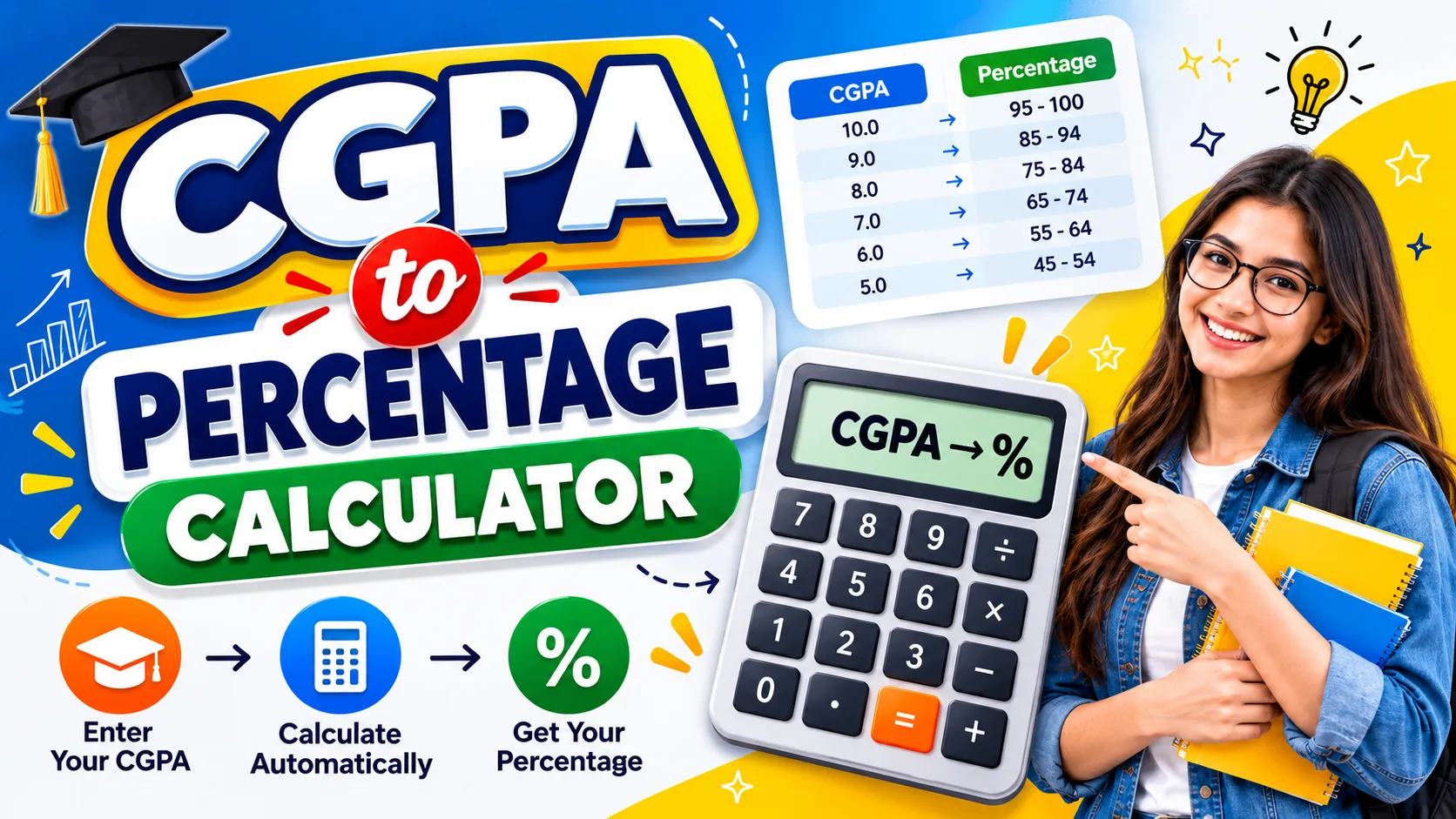
CGPA to Percentage Calculator: Formula, Conversion & Examples
Study AbroadCGPA to Percentage Calculator: Formula, Conversion & Examples

A CGPA to Percentage Calculator is a tool or formula used to convert a Cumulative Grade Point Average (CGPA) into a standard percentage. The most common standard formula multiplies the CGPA by 9.5, used by CBSE (Central Board of Secondary Education) or by 10, though exact rules depend on your specific school or board.Students receive their higher academic results in CGPA rather than percentage. However, many colleges, universities, scholarship providers, and employers ask candidates to provide their marks in percentage. That’s why understanding the calculation of CGPA conversion to percentage is important.This guide will let you know about the meaning of CGPA, the CGPA-to-percentage formula, conversion table, and more.Check Your CGPA PercentageWhat Is CGPA?CGPA stands for “Cumulative Grade Point Average”. It is a number used by schools and colleges to show your overall schoolwork score. It adds up your grades from all your terms or years. This gives one clear score instead of a long list of marks. Some common conversion formulas used by schools and authorities include:CBSE/Standard Scale: Percentage = CGPA × 9.5Direct Scale: Percentage = CGPA × 10UGCAlternative: Percentage = (CGPA - 0.75) × 10What Is a CGPA to Percentage Calculator?A CGPA to percentage calculator is a tool that helps students determine the percentage equivalent of their CGPA using a specified conversion formula. There are multiple conversion formulas available; you just need to enter your CGPA, select the specified conversion formula and click the submit button. Your percentage will be calculated in seconds. Let’s understand this with an example.For example, if the applicable formula is:Percentage = CGPA × 9.5and your CGPA is 8.0:Percentage = 8.0 × 9.5 = 76%Therefore, 8.0 CGPA would correspond to 76% under this particular formula.CGPA to Percentage FormulaTo convert your Cumulative Grade Point Average (CGPA) into a percentage on a standard 10-point scale, you

October 14, 2026
Education VibesEducation Scholar

Get Expert Guidance to Reach Your

Dream University