Study Abroad

Best Universities in USA for MS in Computer Science: Fees, Eligibility & Career Prospects

Kabbyik Mitra
· Senior Content WriterUpdated at - September 16, 202612 Min Read52 views
Best Universities in USA for MS in Computer Science: Fees, Eligibility & Career Prospects

Table of Contents

Reviewed by expert study abroad counsellors, this comprehensive guide tells you about the best Universities in USA for MS in Computer Science, using verified tuition fees at top institutes per year, eligibility, admission, and career prospects.

An MS in Computer Science in the United States for international students remains the premier post-graduate degree in global tech careers. In accordance with official U.S. Department of Homeland Security (DHS/SEVIS) data, students enrolled in MS computer science programmes in various institutes in the USA reached 91,083 in 2022, 108,438 in 2023, and 118,137 in 2024, making it one of the most popular STEM choices for international students.

With a standard 1.5- to 2-year program or a thesis-based 2.5- to 3-year programme, world-class faculty, state-of-the-art laboratories, and direct connections to Silicon Valley and major tech hubs, choosing one of the best universities in USA for MS in computer science determines your global career prospects and return on investment.

This guide will help you cut through the marketing noise and will give you a clear picture of the top computer science universities in USA, eligibility criteria, tuition fees, admission, career prospects, and return on investment.

Tier-1: Top Universities for MS in CS in USA

Tier 1 Universities in the USA feature elite colleges like Carnegie Mellon University and Stanford University. Tier 2 or 3 include top public powerhouses and strong regional options.

University

US News CS Rank

QS World Rank for CS

Top Specialisations

Average Annual Tuition Fees in USD

Massachusetts Institute of Technology

1

1

AI & ML, Quantum Computing, Computer Systems

63,250

Stanford University

1

2

Artificial Intelligence, Theoretical CS

62,500

Carnegie Mellon University

1

3

Software Engineering, Robotics, NLP

58,900

University of California, Berkeley

1

6

Systems & Networking, Database Systems, Computer Vision

54,000

Univ. of Illinois Urbana-Champaign

5

19

Parallel Computing, Cybersecurity, Data Mining

36,000

Note: The acceptance rate is below 8 per cent for the MS in CS programme.

Tier-2: Top CS Universities in USA

Normally, the tier-2 universities in the USA are considered the second powerhouse of return on investment after tier-1. These are the top state and private institutes in the country.

University

US News CS Rank

QS World Rank for CS

Top Specialisations

Average Annual Tuition Fees in USD

University of Texas at Austin

7

30

ML, Computer Architecture, Systems

26,000

Georgia Institute of Technology

8

28

Information Security, Robotics

31,000

University of Washington

6

14

Big data, software systems, NLP

38,500

University of Michigan

11

31

AI, ML, Bioinformatics

52,000

University of California, San Diego

15

36

Computer Architecture, Bioinformatics, ML

33,500

Note: The acceptance rate is below 18 per cent in these tier-2 universities for the MS in CS programme.

Tier-3: Top Computer Science Universities in USA

Tier-3 institutes in the United States of America are considered strong, reputable regional or mid-tier public research or private universities. These universities typically rank 50 to 100 in the USA for computer science programmes.

University

US News CS Rank

QS World Rank for CS

Top Specialisations

Average Annual Tuition Fees in USD

Northeastern University (Khoury)

34

130+

Software Development, Data Science

30,000

Arizona State University

46

150+

Big Data Systems, Software Engineering

34,000

University of Texas at Dallas

64

200+

Software Engineering, Intelligent Systems, Networks

29,500

Stony Brook University

40

150+

Systems & Architecture, Graphics

23,100

San Jose State University

Unranked

350+

Software Engineering, Cloud Computing

18,500

Note: The admission acceptance rate of these best universities in usa for an MS in computer science is between 25 and 45 per cent. If you are planning to build hands-on skills, choose any one of these institutes for your further studies in computing.

Comprehensive MS in CS Fees Breakdown And Total Cost of Attendance

Understanding the tuition fees for the MS in computer science programme in the United States is only half the equation. You should calculate the TCOA, i.e., Total Cost of Attendance, for a standard 2-year MS programme.

Here, total cost of the programme = (Total tuition fees x duration of the programme) + cost of living + any hidden costs

Let’s see the 1-year and full 2-year tuition fee comparison

Tier 1: Private Universities

  • Tuition fees per year: USD 60,000

  • Total tuition fees: USD 120,000 - USD 130,000

Tier: 2 - Public State Universities

  • Tuition fees per year: USD 28,000 - USD 34,000
  • Total tuition fees: USD 56,000 - USD 84,000

Tier: 3 - Public and Regional Universities

  • Tuition fees per year: USD 18,000 - USD 30,000
  • Total tuition fees: USD 36,000 - USD 60,000

Breakdown of Mandatory and Hidden Costs

Apart from the tuition fees, there are mandatory costs associated with your studies in the USA, which will add between USD 20,000 and USD 32,000 per year. These are:

  • Mandatory University Health Insurance: USD 2,500 – USD 4,500 per year.
  • Campus and Tech Fees: USD 1,200–USD 2,500 per year, which typically cover laboratory upkeep, software licenses, and student activities.

Cost of Living, such as Accommodation, Food, and Utilities:

  • High-Cost Destinations, such as the Bay Area, New York City, or Boston: USD 1,800 to USD 2,500 per month or USD 21,600 to USD 30,000 per year.

  • Mid- or Low-Cost Destinations, such as Arizona, the Midwest, or Texas: USD 1,000 to USD 1,400 per month or USD 12,000 to USD 16,800 per year.
  • Books and Course Materials: USD 800 - USD 1,200 per year.
  • SEVIS (Student and Exchange Visitor Information System) and Processing Fees: The processing fee is usually a one-time charge of USD 185, plus USD 350 for SEVIS.

Eligibility and Admission Prerequisites

Academic Requirements

  • 4-year bachelor’s degree in Computer Science, Information Technology, Software Engineering, or a related STEM (Science, Technology, Engineering, and Mathematics) field

  • 3-year degrees, like a Bachelor of Science, may require a WES evaluation or a 1-year bridge course, depending on the institute.

CGPA Requirements

  • For Tier 1 Universities: A minimum of 3.7+/4.0 scale or >88%/8.5+ CGPA

  • For Tier 1 Universities: 3.2–3.5/4.0 scale or 78% – 84%
  • For Tier 3 Universities: 3.0/4.0 scale or >70%/7.0 CGPA

Core Prerequisite Courses

If you are an undergraduate and your degree is outside of the traditional computer science programme, then you must show an accredited course in any one of the following:

  • Data Structures and Algorithms
  • Computer Architecture and Operating Systems
  • Discrete Mathematics and Linear Algebra
  • Object-Oriented Programming, like C++, Java, or Python

Test Requirements

GRE General Test:

Universities like the Massachusetts Institute of Technology, Columbia, and Northeastern consider the GRE optional or waived, but highly recommended if your CGPA is low or if you are applying to Tier 1 or Tier 2 public and private state universities.

A quantitative score of 165+ out of 170, a verbal score of 153+, and an Analytical Writing score of 3.5+ are desirable if you want admission to one of the best universities in the USA for an MS in computer science.

English Language Proficiency Requirements for International Students

  • Minimum Requirement for IELTS Academic: 7.0 – 7.5 overall

  • Minimum Requirement for TOEFL iBT: 90–100+ (Subscores of 22+ per section)
  • Minimum Requirement for Duolingo English Test: 125–135+ range

Brief, Step-by-Step Admission Process

Top Universities for an MS in CS in USA follow the admission process given hereunder.

  • Phase 1 - Preparation and Testing > May to August
  • Phase 2 - Documentation and Drafts > September to November
  • Phase 3 - Submissions > December to February
  • Phase 4 - Visa and I-20 > March to May

First, shortlist universities from May to August. Group your desired programmes in this way: 2 ambitious, 3 target, and 2 safe choices according to your budget and academic profile.

Second, complete standardised testing from June to September. You should take IELTS/TOEFL/GRE as early as possible to allow retakes if needed.

Third, consolidate your core admission documents from September to November. Prepare documents, such as an exclusive SOP for the USA, which typically requires 1000 words, letters of recommendation (LORs), and an updated resume.

Note:

Usually, the best Universities in USA for MS in Computer Science evaluate whether your SOP is curated as per your academic alignment, future goals, the reasons to choose this programme, university, and country.

Fourth, submit applications between December and February. Try to complete your online application before the deadline, which falls between December 1st and January 15th.

Fifth, upon receiving your acceptance letter, process your visa and I-20 between March and May. Submit proof of funds to get your I-20 Form. Then, schedule your F-1 visa interview and arrange for accommodation.

The Insider’s Playbook: Important Details That Others Miss

The TA/RA Funding Loophole

Let’s see how to slash the costs by 50 to 100 per cent. You should not judge the tuition fees only by the sticker price. Yes, you heard it right. At top public state universities, for example, Stony Brook or Georgia Tech, if you can land a Teaching Assistantship or Research Assistantship, preferably in your 2nd semester, it can help you get:

  • 100 per cent Tuition Fees Waiver
  • USD 1,800 to USD 2,800 per month stipend to cover your Cost of living in USA

Strategy: Try to send an email to professors two to three months before you arrive on campus. The email should contain a concise summary of your skills that match your active research grants.

Brand Name vs. Location: The Northeastern Anomaly and The SJSU

There is a myth that all Tier 1 institutes are the best universities in usa for ms in computer science and lead to top-tier salaries.

San Jose State University is one of those institutions in the entire country that provides more engineers and software professionals to Silicon Valley Companies, such as Apple, Meta, Cisco, IBM, or Google, than any Ivy League school because of its geographical proximity, strong local alumni networks, and targeted career fairs.

Northeastern’s Co-op Programme is considered one of the best in this domain, which allows students to work full-time for four to six months at blue-chip companies during their MS degree, sometimes converting directly into a full-time job offer with a huge salary margin before graduation.

CPT Vs. STEM OPT Work Authorisation

CPT/Curricular Practical Training offers off-campus internships to students who are studying at the best universities in usa for ms in computer science. So choose a programme that allows CPT after the 2nd semester as opposed to specialised programmes.

Computer Science or its related fields are STEM-designated programmes. It provides 12 months of initial work authorisation with a 24-month STEM extension, for a total of 36 months. Needless to mention, this opportunity will give you 3 attempts at the H-1B lottery without requiring an immediate visa sponsor.

Professional MS in CS Vs. Thesis-based MS in CS

A non-thesis-based MS in Computer Science programme, often called a professional MS CS programme, focuses on hands-on coding, software engineering, system design, etc., with a standard 1-year to 1.5-year duration. This will allow you a faster entry into the job market.

On the other hand, a thesis-based MS in Computer Science programme is the best if you plan to pursue a doctorate (PhD) after completing your studies, or opt for specialised roles in artificial intelligence or Robotics. It is tougher to get admitted but smoother to secure RA (Research Assistantship) funding.

Job Prospects After MS in Computer Science in the USA

When you graduate with an MS in Computer Science from one of the top universities in the USA, you will have a plethora of job opportunities not only in the USA but also throughout the world. You will be able to work in sectors like Artificial Intelligence, Cloud Computing, Cybersecurity, Software, and Information Systems. If you become eligible as an international student, you can use the three-year STEM OPT extension as discussed before to gain invaluable work experience. Here are the top jobs you can get after your MS in CS.

Job Role

Average Annual Salary in USD

Software Engineer

115,000 - 135,000

AI or ML Engineer

125,000 - 150,000

Data Scientist

110,000 - 130,000

Cloud Solution Architect

120,000 - 145,000

Cybersecurity Specialist

105,000 - 128,000

Choosing the best universities in usa for an MS in computer science is about more than tuition fees or global ranking. Your academic profile, thesis or non-thesis-based programme, budget, future goals, location, and funding opportunities are all factors. This guide will surely prove to be a starting point for your academic journey in the USA. Compare your options carefully. Always verify tuition fees, University-specific eligibility, and the admission process by clarifying the official website before applying.

We hope you found this guide useful. Share it with other aspirants who plan to study an MS in Computer Science programme in the USA. Don’t forget to bookmark it for your next application decision!

FAQs

Which are the top Universities in the United States for an MS in CS?

The top-tier universities in the USA for studying an MS in computer science programme are: University of California, Berkeley, University of Illinois Urbana-Champaign, Georgia Tech, University of Washington, etc.

How much does an MS in Computer Science cost in the US?

The average cost of studying an MS in CS in the USA for international students can be between USD 40,000 and USD 120,000 for the full-time programme for a 1.5-2-year duration.

What are the basic eligibility requirements for an MS in Computer Science in the USA?

A 1st class bachelor’s degree with higher than 80 per cent marks in Computer Science, Information Technology, or its related fields. IELTS 7 to 7.5, GRE optional, and other qualifications set by the Universities.

Is the GRE mandatory for studying for an MS in Computer Science in the USA?

No, the GRE is not mandatory for studying for an MS in CS in the US. Many top universities have made this test optional.

How long does it take to complete an MS in Computer Science in the US?

An MS in Computer Science programme is classified into two types: one is thesis-based, the other is non-thesis-based. A standard thesis-based programme takes 1 to 1.5 years to complete.


Tags:best universities in usa for ms in computer sciencetop cs universities in usatop computer science universities in usatop universities for ms in cs in usabest universities for ms computer science in usa

Our Newsletter

Stay updated with the latests news and exclusive content by and subscribing to our newsletter for education vibes.

Related Blogs

See All
Top 10 Toughest Exam in World in 2026: Rankings, Success Rates & Difficulty
Study AbroadTop 10 Toughest Exam in World in 2026: Rankings, Success Rates & Difficulty

The Gaokao exam in China is widely considered the Top 10 Toughest Exam in World because of its sheer scale and career-oriented pressure. Close behind are UPSC and JEE Advanced in India, also known for their intense competition, vast syllabus, and limited number of seats. But there is no official global ranking system for exam difficulty.Across the globe, millions of ambitious students push themselves to change their lives. They work tirelessly to secure a seat at a world-class university, land a prestigious government job, or earn a global professional qualification. Many cities in China pause their construction work for 13 million Gaokao applicants; over a million Indian aspirants burn the midnight oil for the UPSC and JEE exams. And in Oxford, only 150 elite graduates compete for a fellowship given to just one or two candidates.Now the question is ……Explore the Top 10 Toughest ExamsWhat Makes an Exam the Toughest in the World?If you judge the hardest exam in the world only by its pass rate, you'll create a huge misconception. Yes, you have heard it right. When we discuss which is the toughest exam in the world, like searching for the toughest exam in the world on Quora or any other popular platforms, a majority of candidates sometimes confuse low selection rates with paper difficulty.But the low selection rates sometimes measure applicant volume rather than the difficulty of the paper. A paper can be tough in any exam, and that depends on the exam authority and the standard of the exam, but that does not mean that it will differentiate the pass rate higher or lower.Competition, Curriculum, and Success Rates DifficultyThe Depth of Syllabus and Conceptual UncertaintyNormal tests check known concepts, which are easier or moderately difficult. The hardest exams feature a vast syllabus, where questions are much more

October 26, 2026
Student Visa Rejection Reasons and How to Avoid Them
Study AbroadStudent Visa Rejection Reasons and How to Avoid Them

Student Visa Rejection Reasons and How to Avoid ThemGetting the official university offer letter is a big step towards your dream of studying overseas, but it doesn’t guarantee that you will securely get through the visa process. Some of the common student visa rejection reasons include insufficient or inaccurate information, a poorly written statement of purpose (or one flagged as AI-generated or plagiarised), and a weak visa interview. Country-specific factors can also leave the visa officer doubting whether you are a genuine student who will benefit from the course and comply with the visa conditions. Financial factors such as insufficient funds or the UK’s “28-day” holding period, or geopolitical factors such as fractured bilateral relations with a country, can also reveal why student visa gets rejected.As we analyse the student visa rejection reasons, we find that visa outcomes across the applicants vary significantly based on destination country, chosen institution, and the applicant’s own admission profile. We understand that it can be frustrating and disappointing when you have secured a conditional or unconditional offer letter from your chosen university, but you fail to obtain a student visa. The entire process and your invested time and money go down the drain. Immigration policies across major countries have become stricter in recent years. We are here to help you understand and, in the process, find the best possible ways to avoid a visa rejection.A Look at the Global Visa Landscape: Student Visa Trends and Rejection StatisticsIdentifying possible student visa rejection reasons through the lens of an immigration officer can be challenging for a student but entirely possible by understanding trends and statistical references. Over the past two years, several countries’ governments have implemented strict immigration policies to align international student intake with the available local capacities.No country wants an immigrant who consumes its

October 17, 2026
TOPIK Levels Explained: A Korean Language Guide for International Students
Study AbroadTOPIK Levels Explained: A Korean Language Guide for International Students

South Korea is becoming a popular destination for international education, with 253,434 international students enrolled in its higher education institutions in 2025, according to South Korea's Ministry of Education. For students planning to study in Korea or work there, learning Korean can help improve communication and meet programme-specific language requirements.Getting to know TOPIK levels explained is essential for international students who want to prepare for university admission, scholarship applications, or career opportunities in South Korea. The Test of Proficiency in Korean (TOPIK) is an official examination that assesses Korean language proficiency across six levels, from beginner to advanced.This guide covers TOPIK levels, TOPIK I vs TOPIK II, scoring requirements, registration, and preparation strategies to help you choose the right proficiency target.What Is TOPIK?TOPIK (Test of Proficiency in Korean) is an official, standardised exam that measures the Korean language skills of non-native speakers. It is managed by the National Institute for International Education (NIIED) under the South Korean Ministry of Education.Purpose of the Test of Proficiency in KoreanKorean language proficiency test is administered by South Korea's National Institute for International Education (NIIED), under the Ministry of Education. It evaluates the Korean language skills of non-native speakers and provides standardised results for academic and professional purposes.TOPIK scores are used for university admission, employment applications, certain visa procedures, and Global Korea Scholarship (GKS) applications. However, the requirements differ depending on the institution, programme, and purpose.Who Should Take the TOPIK Exam?TOPIK suits international students, foreign nationals, and overseas Koreans who need formal proof of Korean language proficiency. Students applying to Korean-taught undergraduate or postgraduate programmes may need a recognised TOPIK score. It can also benefit scholarship applicants and job seekers who want to demonstrate their language skills.However, TOPIK is not compulsory for every international student. Applicants to English-taught programmes may be required to submit

October 15, 2026
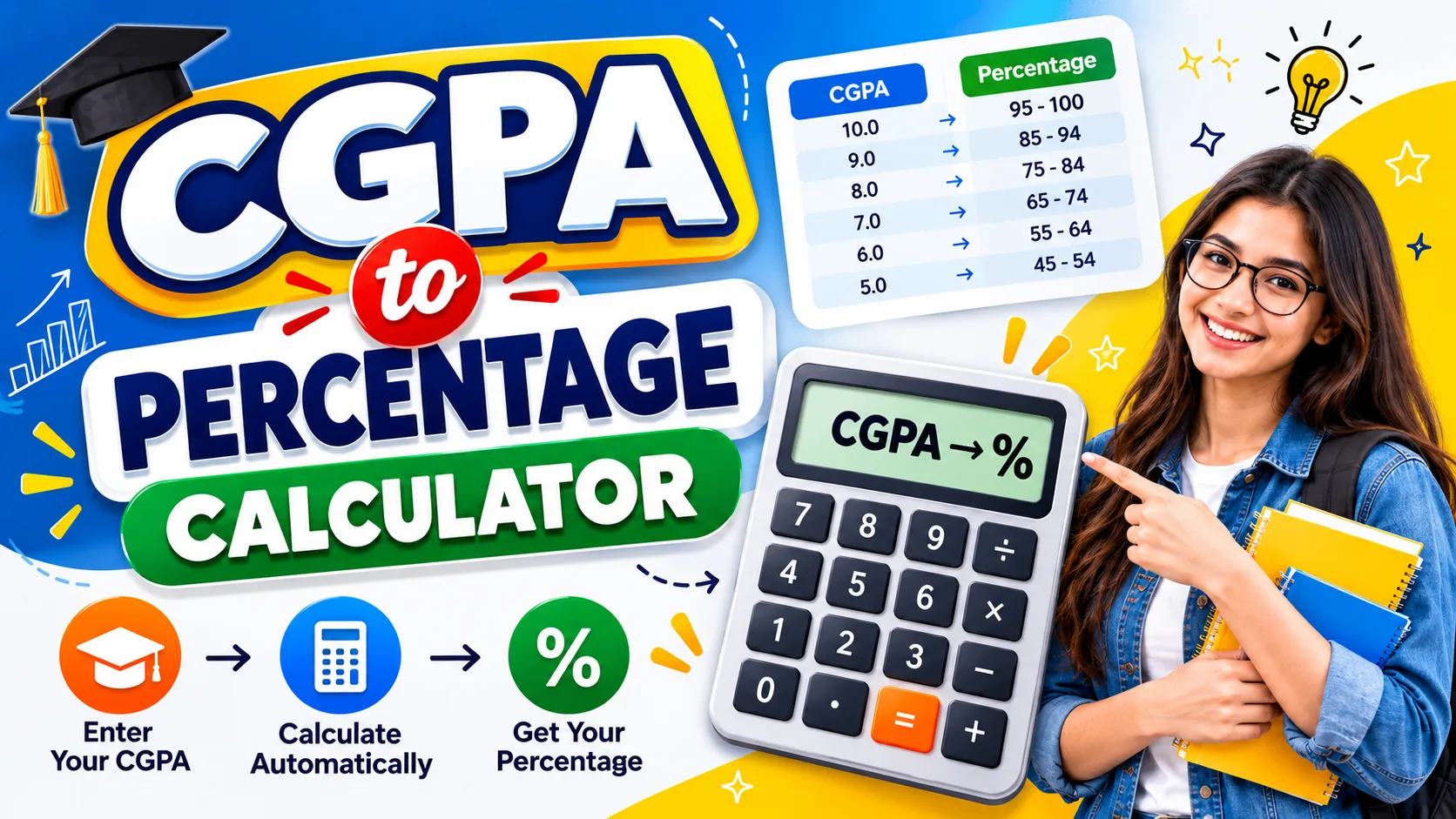
CGPA to Percentage Calculator: Formula, Conversion & Examples
Study AbroadCGPA to Percentage Calculator: Formula, Conversion & Examples

A CGPA to Percentage Calculator is a tool or formula used to convert a Cumulative Grade Point Average (CGPA) into a standard percentage. The most common standard formula multiplies the CGPA by 9.5, used by CBSE (Central Board of Secondary Education) or by 10, though exact rules depend on your specific school or board.Students receive their higher academic results in CGPA rather than percentage. However, many colleges, universities, scholarship providers, and employers ask candidates to provide their marks in percentage. That’s why understanding the calculation of CGPA conversion to percentage is important.This guide will let you know about the meaning of CGPA, the CGPA-to-percentage formula, conversion table, and more.Check Your CGPA PercentageWhat Is CGPA?CGPA stands for “Cumulative Grade Point Average”. It is a number used by schools and colleges to show your overall schoolwork score. It adds up your grades from all your terms or years. This gives one clear score instead of a long list of marks. Some common conversion formulas used by schools and authorities include:CBSE/Standard Scale: Percentage = CGPA × 9.5Direct Scale: Percentage = CGPA × 10UGCAlternative: Percentage = (CGPA - 0.75) × 10What Is a CGPA to Percentage Calculator?A CGPA to percentage calculator is a tool that helps students determine the percentage equivalent of their CGPA using a specified conversion formula. There are multiple conversion formulas available; you just need to enter your CGPA, select the specified conversion formula and click the submit button. Your percentage will be calculated in seconds. Let’s understand this with an example.For example, if the applicable formula is:Percentage = CGPA × 9.5and your CGPA is 8.0:Percentage = 8.0 × 9.5 = 76%Therefore, 8.0 CGPA would correspond to 76% under this particular formula.CGPA to Percentage FormulaTo convert your Cumulative Grade Point Average (CGPA) into a percentage on a standard 10-point scale, you

October 14, 2026
MBA in HR in UK : Best Universities, Tuition Fees, Eligibility, Career & ROI
Study AbroadMBA in HR in UK : Best Universities, Tuition Fees, Eligibility, Career & ROI

Imagine you invest hundreds of thousands of pounds in a master’s programme, packing your bags for the United Kingdom, only to realise that organisations in Manchester, London or Birmingham are asking for professional certifications you have never heard of during your classroom lectures at the University.That is the hidden reality a lot of international students face every year. Most guides on the internet will give you normal advice, which you have already come to know: a list of top Universities to study an MBA in HR in UK, tuition fees, cost of living, basic entry requirements, etc. But studying for an MBA in human resource management in the United Kingdom is no longer just about getting a master’s degree. It is about giving you the right career direction, the right accreditation, the right mastery of HR software/tool, and navigating the real-world visa rules.So, if your objective is to turn an MBA in HR into a global career in people management, you should look beyond the college prospects. This comprehensive guide will tell you the programme options, cost of studying and living, career paths, professional certifications, return on investment, and visa considerations before you make a decision.Book a Free MBA in HR in UK Counselling SessionWhy Choose An MBA in HR in the UK?The United Kingdom remains one of the most trusted destinations for business education. Choosing to pursue an MBA in HR in the UK opens doors to multinational organisations, excellent workplace culture, and global networking opportunities. Business schools in different regions offer diverse formats tailored to your budget, timeline, and career goals. Let's see the advantages of studying a human resource management programme in the United Kingdom.Fast-Track Learning Opportunity: You can finish your MBA in 1 year by studying full-time at the University of Hertfordshire or any other top university,

October 12, 2026
How to Study in Korea for Free: Complete GKS Scholarship Guide for Indians
Study AbroadHow to Study in Korea for Free: Complete GKS Scholarship Guide for Indians

Studying in South Korea can be expensive for international students, but the GKS scholarship for Indian students provides a government-funded route to pursue an undergraduate degree with substantial financial support. The Global Korea Scholarship (GKS) is offered by the Korean government to international students seeking higher education in South Korea.For 2027, the GKS Undergraduate Programme (GKS-U) will select 286 scholars worldwide, including applicants through the Embassy Track and University Track. Indian students can apply through the applicable route if they meet the nationality, age, academic and other eligibility requirements. The latest 2027 guidelines were released by the National Institute for International Education (NIIED) in September 2026.What is the GKS Scholarship for Indian Students?The Global Korea Scholarship (GKS) (formerly KGSP) is a government scholarship program that covers most major costs (though not every personal expense), administered by the National Institute for International Education (NIIED) to help international students who want to study abroad pursue undergraduate and graduate degrees in South Korea. It covers tuition, a one-year Korean language course, airfare, health insurance and a living allowance; the full breakdown is in the benefits table below.Can Indian Students Study in Korea for Free?Yes, eligible Indian students can apply for the GKS scholarship, and if they are selected, they receive significant financial support for their studies in South Korea. However, study in Korea for free can’t be interpreted as meaning all your expenses will be covered. GKS includes a living allowance (about KRW 1.13 million/month in the language year and KRW 1.20 million/month in the degree years) specifically designed to cover personal living expenses.The 2027 GKS package includes tuition support, Korean language training, airfare and an annual allowance. You need to bear all your personal expenses by your own.GKS Scholarship Benefits for Indian StudentsStudents get multiple benefits through the GKS scholarship. A dedicated

October 12, 2026
Study Abroad Without IELTS for Indian Students: A Complete Guide
Study AbroadStudy Abroad Without IELTS for Indian Students: A Complete Guide

Indian students want to study abroad without IELTS. Is it possible to study without IELTS? Yes, students can use a Medium of Instruction (a signed letter from a previous academic institution proving that their education was conducted in English), alternative tests (submitting documents of the Duolingo English Test, TOEFL, or PTE), or qualify for an internal assessment conducted by the chosen academic institution. With several countries without IELTS for Indian students, the doors are open to pursue overseas studies.Numerous universities today have recognised that Indian students can study abroad without IELTS, as graduates of English-medium schools and universities/institutions acquire sufficient academic English comprehension skills. By providing an alternative to proof of English proficiency, Indian students can secure admission to prestigious universities without IELTS. Let’s look at the robust ways to bypass the IELTS requirements, starting with a major alternative option. Moving forward, we will look at different countries and what pathways they offer for IELTS waivers, followed by top universities without IELTS, and much more.IELTS: A Common and Globally-Recognised English Language TestThe dream of pursuing study abroad often comes with the prerequisites of English language proficiency, especially for popular Western countries with a high English-speaking population, like the USA or the UK. Indian students wonder if they can study abroad without IELTS, since many foreign institutions require proof of standardised English language proficiency tests, one of which is the International English Language Testing System (IELTS). It assesses a student’s ability to read, write and speak, as well as listen/comprehend English. It is one of the most popular and important language tests.However, many factors propel students to find alternative MOI-accepted countries or accept other language test scores. Some of the stressors related to the IELTS for Indian students are high registration fees, tough preparation, maintaining schedules, and meeting test deadlines. Standardised

September 30, 2026
How to Get into Ivy League Colleges from India: Complete Guide 2026-27
Study AbroadHow to Get into Ivy League Colleges from India: Complete Guide 2026-27

Getting into an Ivy League college from India is a dream for many ambitious students, but it takes much more than securing excellent marks in Class 12. The Ivy League comprises eight highly selective US universities, including Brown, Columbia, Cornell, Dartmouth, Harvard, the University of Pennsylvania, Princeton and Yale. Each institution evaluates applicants differently, but academic performance, intellectual curiosity, extracurricular achievements, essays, recommendations and overall personal impact can all influence the admission decision.For Indian students, understanding how to get into Ivy League from India early can make the application more strategic. There is no fixed CBSE percentage or SAT score that guarantees admission. Instead, students need to build a compelling academic and personal profile while carefully following each university's requirements.What Are the Ivy League Colleges?The term began as an athletic conference formed in 1954, though it now universally represents academic excellence and high selectivity. The Ivy League consists of eight private universities in the United States:Ivy League CollegeLocationBrown UniversityProvidence, Rhode IslandColumbia UniversityNew York City, New YorkCornell UniversityIthaca, New YorkDartmouth CollegeHanover, New HampshireHarvard UniversityCambridge, MassachusettsUniversity of PennsylvaniaPhiladelphia, PennsylvaniaPrinceton UniversityPrinceton, New JerseyYale UniversityNew Haven, ConnecticutHow to Get into Ivy League from India: Admission RequirementsThere is no single set of Ivy League admission requirements for Indian students because every university establishes its own application policies. However, most applicants should prepare the following components.1. Strong Academic PerformanceIvy League universities consider your secondary-school record, courses taken and academic performance in context. For CBSE students, this means maintaining strong results across Classes 9–12 while taking the most challenging courses available within your school and curriculum.Students should not focus only on their Class 12 percentage. A consistent academic trajectory can demonstrate sustained effort and intellectual ability.2. SAT or ACTStandardised testing policies can differ between Ivy League universities and may change from one admission cycle to another. Students

September 25, 2026
Study in Europe Without IELTS 2026-27: Countries, Universities & Requirements
Study AbroadStudy in Europe Without IELTS 2026-27: Countries, Universities & Requirements

Studying in Europe is a popular study abroad option for Indian students looking for internationally recognised degrees, diverse academic programmes and exposure to different cultures. Eurostat reported that 1.83 million students from abroad were studying at tertiary level across the EU in 2024.A major question students always ask is: does studying in Europe always require IELTS? No, IELTS is not a universal admission requirement across Europe. Depending on the university and programme, students may be able to demonstrate English proficiency through an MOI certificate, previous English-medium education, or a university-specific assessment.In this blog, we will cover the key elements to study in Europe without IELTS for Indian students, including top countries, universities, and requirements.Is it possible to study in Europe without IELTS?Yes, studying in Europe without IELTS is very much possible with alternative proofs of language proficiency and university-specific waivers. There are some other alternatives to IELTS, which are:Medium of Instruction (MOI): An official letter from your previous school or college confirming that your prior education was taught entirely in English.Alternative Tests: Scorecards from the Duolingo English Test, PTE Academic, or TOEFL.Internal Assessments: University-administered video interviews or written English evaluations.Prior English-Medium Schooling: Proof of completing high school or a degree in an English-speaking environment.Benefits of Studying in Europe Without IELTSStudying in Europe without the International English Language Testing System (IELTS) significantly lowers the barrier to entry for international students, allowing you to bypass a highly stressful standardised exam. For eligible students, an IELTS exemption can provide several practical advantages:Saves IELTS examination and preparation costsAvoids additional test preparation timeAllows students to use existing academic English credentialsCan simplify the application processUseful for students who have already completed an English-medium degreeProvides another pathway for students who do not have an IELTS scoreImportant: Students should not choose a university solely because it advertises “IELTS-free

September 24, 2026
Fully Funded Scholarships for Indian Students: Eligibility & How to Apply
Study AbroadFully Funded Scholarships for Indian Students: Eligibility & How to Apply

Every year, thousands of Indian students are seeking to pursue higher studies abroad. This is a good decision for gaining international experience and boosting career prospects, but it can be expensive as well. Here, Fully Funded Scholarships for Indian Students can reduce or eliminate tuition, living, travel, and other costs. For the 2026–27 intake, students can explore popular government and foundation scholarships across the world. Go through this latest blog that covers all the major fully funded scholarships that make your study abroad experience better. Apply for Scholarships Fully Funded Scholarships for Indian Students to Study Abroad 2026-27 A fully funded scholarship covers major costs, including tuition fees, living expenses, airfare, health insurance, and accommodation allowances. However, "fully funded" does not always mean every personal expense is covered. Top options are Fulbright-Nehru Master's Fellowships in the USA, Chevening Scholarships and Commonwealth Scholarships in the UK, DAAD Scholarships in Germany, and the MEXT Scholarship in Japan. Indian students must check the eligibility criteria, courses, age limits, academic requirements, work experience, English-language requirements, and application deadline before applying. The most competitive applications show academic performance, leadership, relevant experience, community involvement, a clear career plan, and a convincing reason for selecting the course and country. Top 10 Fully Funded Scholarships for Indian Students Listed below are some of the most popular fully funded scholarships for Indian students to study abroad in 2026-27. The eligibility criteria and value of the scholarships vary, so applicants should review the latest official announcement. Chevening Scholarships Chevening Scholarships are UK Government-funded awards for professionals pursuing one-year master’s degrees in the UK. It is a fully funded scholarship that allows students to live and study in UK for a year. The scholarship covers tuition fees, an arrival allowance, a monthly personal living allowance, travel to and from the UK,

September 21, 2026
Education VibesEducation Scholar

Get Expert Guidance to Reach Your

Dream University