Table of Contents
Is a Russian MBBS Degree Valid for an International Medical Career?
Scroll HereGlobal Licensing Pathways for Russian Medical Graduates
Scroll HereUnited States: USMLE and ECFMG Certification
Scroll HereUnited Kingdom: PLAB and GMC Registration
Scroll HereAustralia: AMC Exams and AHPRA Registration
Scroll HereGulf Countries: DHA, DOH, MOHAP, SCFHS and QCHP
Scroll HereGermany: FSP, Kenntnisprüfung and Approbation
Scroll HereSalary of Doctors Abroad: Earning Potential by Country
Scroll HereNon-Clinical Careers in Global Health Organisations
Scroll HereFinal Thoughts
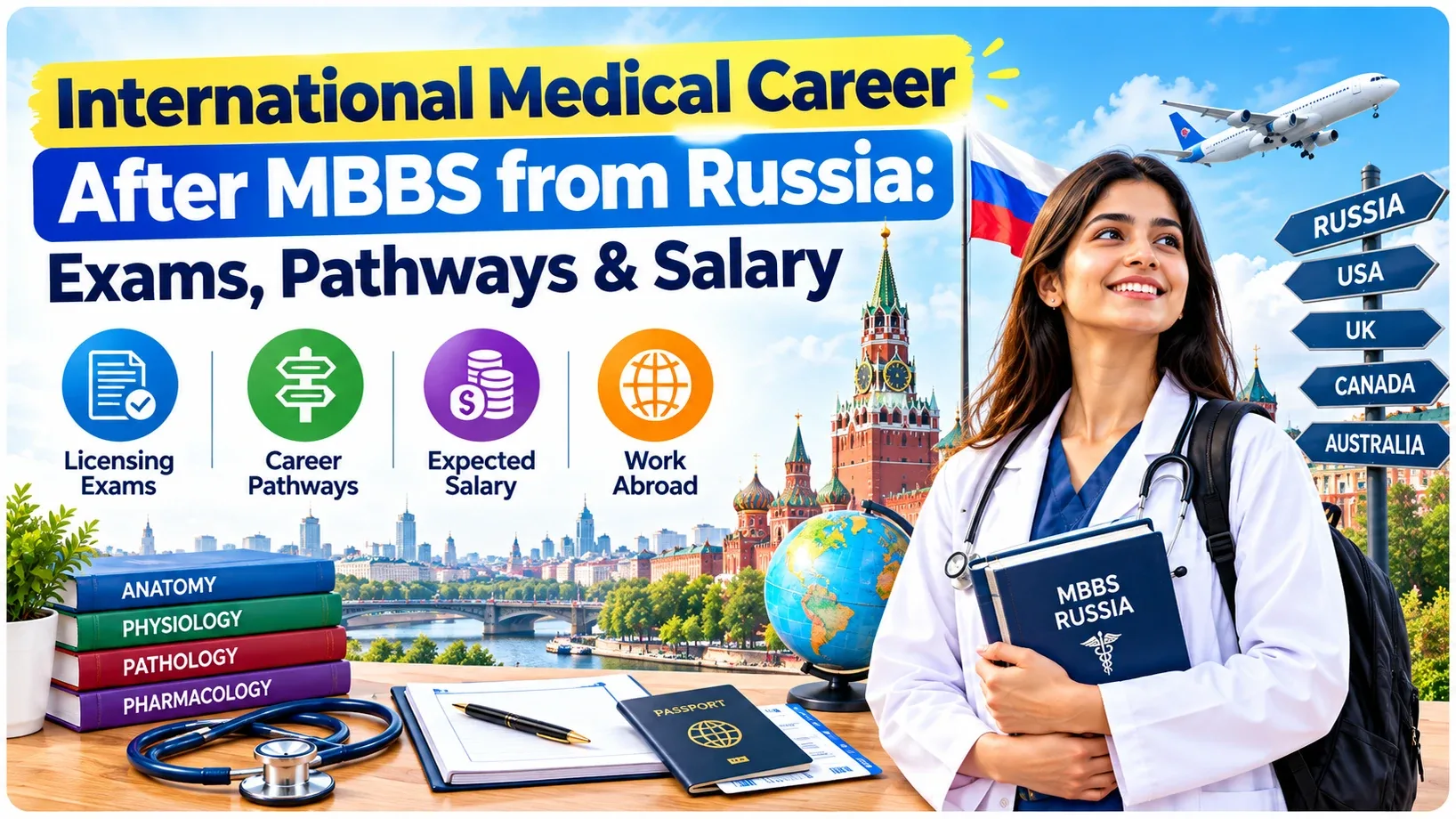
Scroll HereIf you are planning an international medical career after MBBS from Russia, the path is clear: clear the licensing exam of the country you want to work in, register with its medical regulator, and then complete residency or specialty training. You can also build a non-clinical career with global organisations such as the WHO, UNICEF or Médecins Sans Frontières. The right route depends on your career goals, budget and the country where you want to settle.
This guide explains how a Russian medical degree supports a global career, the licensing pathways in the USA, UK, Australia, the Gulf countries and Germany, the salaries you can expect in each, and the non-clinical roles open to medical graduates.
Is a Russian MBBS Degree Valid for an International Medical Career?
Yes, provided your university meets international and Indian regulatory standards. For admission details, fees and universities, see our complete guide on MBBS in Russia. Russian universities award an MD/Specialist degree in General Medicine, which is equivalent to MBBS. Before you plan a career abroad, check that your degree meets these requirements:
| Requirement | Why It Matters for a Global Career |
|---|---|
| Listed in the World Directory of Medical Schools (WDOMS) | Required to apply for ECFMG (USA), GMC (UK), AMC (Australia) and most Gulf licences |
| Compliant with NMC FMGL Regulations 2021 | Course of at least 54 months plus a 12-month internship at the same university, so you stay eligible to practise in India as well (read more: is a Russian MBBS degree valid in India) |
| English-medium instruction | Accepted by most foreign licensing bodies; you still need IELTS/OET or language exams where required |
| Clinical training in Russian | Local language skills help during patient interaction and clinical rotations |
Source: National Medical Commission (NMC), FMGL Regulations 2021, and WDOMS.
Global Licensing Pathways for Russian Medical Graduates
Every country has its own licensing exam and registration process (see our overview of medical licensing exams in different countries). Once you pass the exam and register with the regulator, you can legally practise as an international medical graduate (IMG) in that country.
United States: USMLE and ECFMG Certification
To enter a residency programme or treat patients in the USA, you need certification from the Educational Commission for Foreign Medical Graduates (ECFMG). You register with ECFMG to take USMLE Step 1 (pass/fail) and Step 2 Clinical Knowledge (CK), and you must also clear the Occupational English Test (OET) Medicine. Learn more about the stages of the USMLE.
After ECFMG certification, you apply through the National Resident Matching Program (NRMP) for residency positions in US teaching hospitals. USMLE Step 3 is usually taken during residency, and full licensure is granted by individual State Medical Boards, whose rules vary from state to state.
United Kingdom: PLAB and GMC Registration
To work in the National Health Service (NHS), you need registration with a licence to practise from the General Medical Council (GMC). The steps are:
- Meet the English language requirement (IELTS Academic or OET Medicine).
- Verify your primary medical qualification through EPIC (Electronic Portfolio of International Credentials).
- Pass PLAB 1 (written exam) and PLAB 2 (OSCE clinical exam).
- Apply for full GMC registration once your internship is complete.
Most IMGs start in non-training posts such as Clinical Fellow or Trust Grade roles, then apply for specialty training. Note that PLAB is the exam itself, while the Medical Licensing Assessment (MLA) is the framework that PLAB is now aligned with.
Australia: AMC Exams and AHPRA Registration
To practise in Australia, you must register with the Australian Health Practitioner Regulation Agency (AHPRA) through the Medical Board of Australia. The standard pathway for Russian graduates is to clear the Australian Medical Council (AMC) exams: AMC MCQ (computer-based) and AMC Clinical. After this, you complete a period of supervised practice before general registration.
Without AHPRA registration, it is illegal to treat patients, prescribe medicines or work as a doctor in Australia. The AMC exam proves your knowledge and skills, while AHPRA registration is your licence to practise.
Gulf Countries: DHA, DOH, MOHAP, SCFHS and QCHP
The Gulf Cooperation Council (GCC) countries offer well-paid, often tax-free roles, and most of them accept Russian medical degrees. The usual process is Primary Source Verification (PSV) of your documents, a Prometric licensing exam (computer-based MCQs), a job offer, and then a country-specific licence. The regulators are:
- UAE: Department of Health (DOH) in Abu Dhabi, Dubai Health Authority (DHA) in Dubai, and Ministry of Health and Prevention (MOHAP) for the other emirates
- Saudi Arabia: Saudi Commission for Health Specialties (SCFHS)
- Qatar: Qatar Council for Healthcare Practitioners (QCHP)
- Oman: Ministry of Health (MOH) and Oman Medical Specialty Board (OMSB)
- Bahrain: National Health Regulatory Authority (NHRA)
- Kuwait: Ministry of Health (MOH)
Germany: FSP, Kenntnisprüfung and Approbation
To practise medicine in Germany, you need a permanent state licence called the Approbation, issued by the state licensing authority (Approbationsbehörde). First, you must prove your German skills with a B2 general language certificate and pass the Medical German Language Exam (Fachsprachprüfung or FSP), conducted by the State Chamber of Physicians (Landesärztekammer).
If your degree is not found fully equivalent to a German degree, which is common for non-EU graduates, you must pass the Kenntnisprüfung, an oral-practical knowledge exam in German. While preparing, you can work under a temporary permit (Berufserlaubnis) to gain clinical experience. After you receive the Approbation, you can start specialist training (Facharzt) in German hospitals.
Salary of Doctors Abroad: Earning Potential by Country
Comparing salaries helps you understand the long-term return on your medical education. For a wider comparison, read our guide on average doctor salary after MBBS abroad. The table below shows the licensing route and the typical salary range for doctors in each country.
| Country | Pathway | Licensing Exam | Regulator | Avg. Starting Salary (INR) | Avg. Senior/Consultant Salary (INR) |
|---|---|---|---|---|---|
| United States | Residency / Attending Physician | USMLE | ECFMG, State Medical Boards | ₹55 lakh – ₹70 lakh (residency stipend) | ₹2.2 crore – ₹4.5 crore+ |
| United Kingdom | NHS Foundation / Specialty Doctor | PLAB | GMC | ₹38 lakh – ₹52 lakh | ₹90 lakh – ₹1.8 crore |
| Australia | Medical Officer / Registrar | AMC | AHPRA, Medical Board of Australia | ₹50 lakh – ₹68 lakh | ₹1.5 crore – ₹3.2 crore |
| Gulf Countries | General Practitioner | Prometric / country-specific exams | DHA, DOH, MOHAP, SCFHS, QCHP | ₹42 lakh – ₹65 lakh (tax-free) | ₹1.1 crore – ₹2.5 crore (tax-free) |
| Germany | Resident Physician (Assistenzarzt) | FSP and Kenntnisprüfung | Approbationsbehörde, Landesärztekammer | ₹45 lakh – ₹60 lakh | ₹1.1 crore – ₹2 crore |
Note: Data compiled from the National Resident Matching Program (NRMP), NHS pay circulars, the Australian Medical Association (AMA) and the Dubai Health Authority (DHA). Salaries vary by specialty, experience, designation and location.
Non-Clinical Careers in Global Health Organisations
A medical degree from Russia also opens doors to roles beyond patient care, in international public health, medical research and health policy. Global organisations regularly hire qualified medical graduates for roles such as:
- World Health Organization (WHO) and UNICEF: Global Health Officer, Epidemiologist, Immunisation Consultant and Public Health Specialist
- Médecins Sans Frontières (MSF / Doctors Without Borders): Humanitarian relief, managing field clinics during emergencies, and tropical disease programmes
- Clinical Research Organisations (CROs) and Pharmaceutical Companies: Clinical Trial Manager, Drug Safety (Pharmacovigilance) Officer and Medical Advisor
- Global Health Policy and Digital Health: Healthcare Economist, Digital Health Specialist and Healthcare Consultant with bodies such as the World Bank and World Economic Forum
Final Thoughts
An MBBS from a recognised Russian university can lead to a rewarding international medical career, whether you choose clinical practice in the USA, UK, Australia, the Gulf or Germany, or a non-clinical role in global health. Your early years abroad may involve exams, language preparation and lower starting pay, but with experience and specialisation, your earning potential grows significantly. Pick your target country early in your course and start preparing for its licensing exam while you study. Here is how to prepare for USMLE and PLAB while studying.
Want expert guidance on planning your medical career after MBBS from Russia? Register with Education Vibes today and talk to our counsellors.