Table of Contents
Overview of the GMAT Exam Pattern in 2026
Scroll HereSection-wise Breakdown of the GMAT Exam Syllabus
Scroll HereQuantitative Reasoning
Scroll HereQuantitative Topics to Focus on in Quantitative Reasoning
Scroll HereVerbal Reasoning
Scroll HereCore Topics and Categories of Questions in Verbal Reasoning
Scroll HereData Insights
Scroll HereFormats of the Questions in Data Insights
Scroll HereGMAT Scoring Mechanism & Major Test-Taker Features
Scroll HereThe 205-to-805 Scale
Scroll HereFlexible Section Order
Scroll HereReview and Edit Feature
Scroll HerePreparation Strategy for GMAT 2026 Aspirants
Scroll HereConclusion
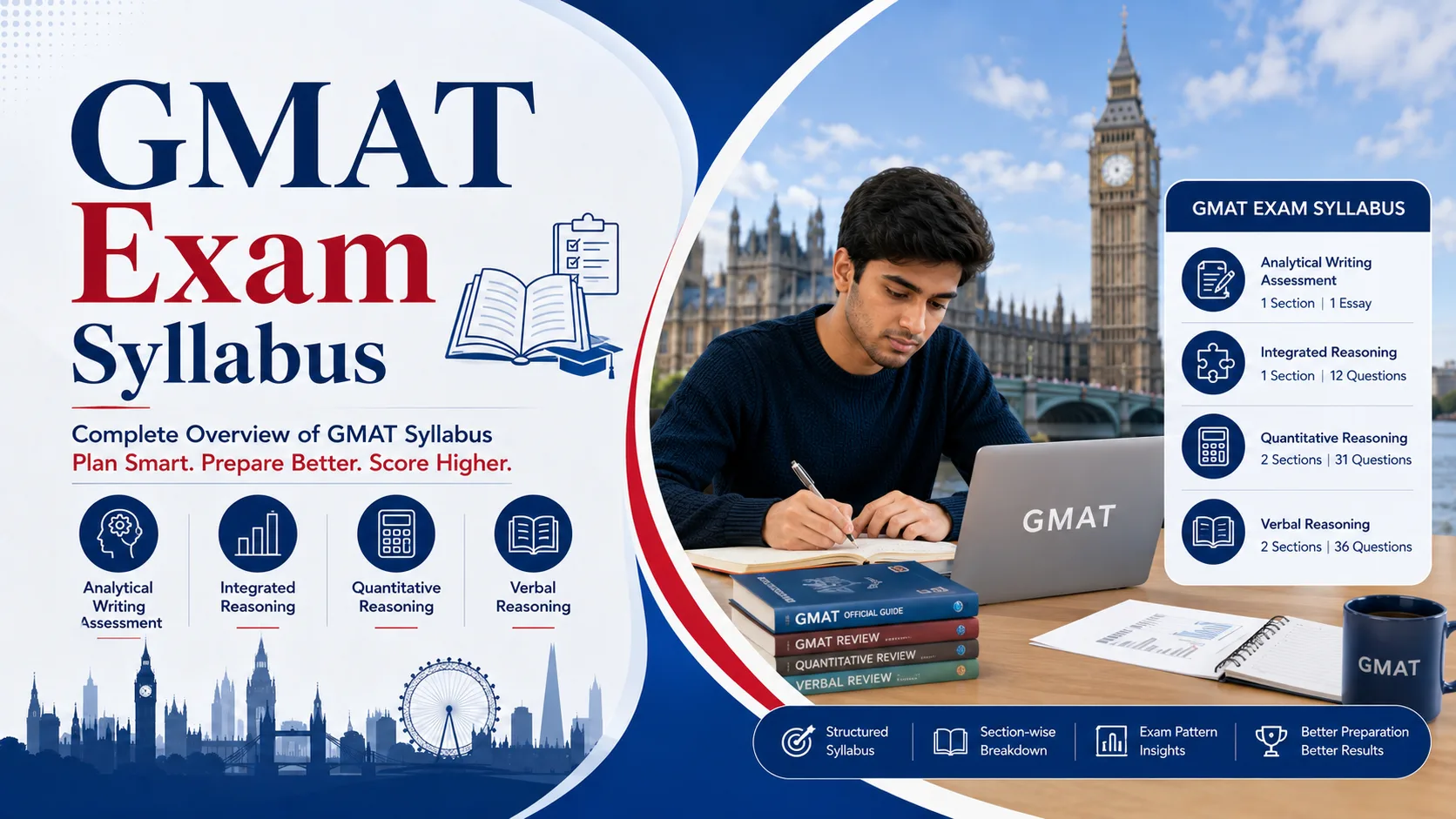
Scroll HereThe GMAT exam syllabus consists of three sections, each taking 45 minutes, which include Quantitative Reasoning, Verbal Reasoning, and Data Insights. The total number of questions is 64, completed in 2 hours and 15 minutes, and scored on a scale of 205-805. The Graduate Management Admission Council (GMAC) continuously administers and refines the GMAT exam pattern and syllabus to align with the dynamically changing business environment. In 2026, GMAT candidates will take the test, which will focus on real-world applications and business skills, such as data analysis, critical thinking, and mathematical reasoning.
Since the GMAT exam is the first step for enrolling in top-tier universities and business schools across the globe, understanding the complete GMAT exam syllabus becomes essential so that candidates can create a focused study plan and achieve high scores. Harvard, INSEAD, ISB, London Business School, or any other business school – they all consider the GMAT scores for admission; hence, we have prepared a brief guide providing comprehensive information on the GMAT syllabus and practical tips to score high.
Overview of the GMAT Exam Pattern in 2026
Before introducing each topic individually, familiarise yourself with the overall GMAT exam pattern. Designed to be more efficient and relevant for candidates, the current test takes only 2 hours and 15 minutes to complete (with an optional 10-minute break).
The total duration of the exam is divided equally into three sections. When you review the updated GMAT syllabus, you will notice that some of the sections, such as the Analytical Writing Assessment (AWA essay) and the Sentence Correction section, have been removed.
Candidates' evaluation for the test relies on a total of 64 tasks. Knowing how these tasks are distributed across the GMAT total questions can help you manage your pace during the test. GMAC evaluates candidates on core business skills and foundational theories across three main GMAT subjects.
Each section carries equal weight toward your total score, making balanced preparation vital across all GMAT exam subjects. Here is the overview of the exam pattern for 2026:
Total Duration of the Test |
2 hours 15 minutes (135 minutes) |
Number of Sections in the Syllabus |
3 (Quantitative Reasoning, Verbal Reasoning, Data Insights) |
Total Questions in the Test |
64 (Multiple-choice Questions) |
Optional Break Duration |
Single 10-minute break |
Overall Score Range |
205-805 (10-point increments) |
Score Range for Each Section |
60-90 per section (1-point increment) |
Conducting Mode of the Test |
Computer-Adaptive Test (centre-based or online) |
Section-wise Breakdown of the GMAT Exam Syllabus
The GMAT exam syllabus for 2026 is divided into three sections with 45 minutes each. These sections are, namely, Quantitative Reasoning, Verbal Reasoning, and Data Insights. We have provided a detailed breakdown of each section, discussing its topics and skills.
Quantitative Reasoning
The Quantitative Reasoning section tests your ability to logically solve mathematical questions, foundational arithmetic, and reasoning for algebra. One thing to note here is that the GMAT syllabus in this section does not include traditional geometry. However, the basic concepts of geometry are still part of the syllabus, including lines, angles, triangles, and circles. Data Sufficiency was previously a part of this section, but has been moved to Data Insights. Here is a quick breakdown of what this section entails for a candidate:
- Number of Questions: 21 Questions
- Allotted Time: 45 Minutes
- Question Format: Problem-Solving
- Calculator Rule: No calculator allowed (however, a scratch pad is provided)
To truly understand and excel in this section, candidates should master mental math and the manipulation of algebra. Candidates must thoroughly understand and familiarise themselves with foundational core concepts across the main GMAT subjects to effectively complete this section. Problem-solving questions require students to conduct quick logical subtraction rather than doing calculations with brute force.
Quantitative Topics to Focus on in Quantitative Reasoning |
|
|---|---|
Arithmetic & Number Properties |
|
Algebraic Concepts |
|
Applied Business Words Problems |
|
Verbal Reasoning
The Verbal Reasoning section evaluates your ability to analyse arguments, read complex business-related prose, and extract the main ideas from a piece of text/information. When reviewing the GMAT exam syllabus, pure grammar testing (sentence structure and correction) is not available. The entire verbal score is determined by critical reasoning and reading comprehension skills. Here is a quick breakdown of what this section entails:
- Number of Questions: 23 Questions
- Allotted Time: 45 Minutes
- Types of Questions: Reading Comprehension and Critical Reasoning
Understanding the structure of the GMAT exam pattern is essential. Pace is the key to getting through this section of the exam, as reading comprehension is critical to reading dense passages under a limited amount of time (45 minutes) and skimming through and analysing them all. Preparing for these GMAT exam subjects develops the exact verbal analysis skills required in the MBA case study discussions.
Core Topics and Categories of Questions in Verbal Reasoning |
|
|---|---|
Reading Comprehension |
|
Critical Reasoning |
|
Data Insights
The Data Insights section is a main component of the GMAT exam syllabus, reflecting today’s data-driven business landscape. This section evaluates the candidates’ ability to analyse charts, tables, text snippets, and numerical sources to solve complex problems.
This section combines quantitative logic with verbal reasoning (2nd section), enabling candidates to review the complete GMAT syllabus and allowing them to practise bouncing seamlessly from one tab to the next while analysing charts well ahead of the exam day.
Allocating equal effort across all the GMAT subjects ensures that you won’t be caught off guard by Data Insights, which now carries equal weight in the overall test score. Here is a quick breakdown of what this section entails for a candidate:
- Number of Questions: 20 Questions
- Allotted Time: 45 Minutes
- Question Format: Data sufficiency, reasoning from multiple sources, table analysis, graphics interpretation, two-part analysis
- Calculator Rule: An on-screen digital calculator is provided
Formats of the Questions in Data Insights |
|
|---|---|
Data Sufficiency |
Moved from Quant to Data Insights, it evaluates the given statements to answer a mathematical or logical question. |
Multi-source Reasoning |
Analyse information from multiple sources (tabs containing text summaries, tables and graphs) to evaluate answers. |
Table Analysis |
Determine statistics, percentages, and conditional logical truths by sorting spreadsheet-like interactive tables. |
Graphics Interpretation |
Complete fill-in-the-blank statements by using and learning bar charts, line graphs, scatter plots, and Venn diagrams. |
Two-part Analysis |
Solve complex problems with multiple variables where candidates must choose two answers from a grid. |
GMAT Scoring Mechanism & Major Test-Taker Features
Understanding the updated GMAT exam syllabus also means understanding how the performance of the candidates is evaluated. Here are two scoring mechanisms for it:
The 205-to-805 Scale
The total score of the GMAT ranges from 205 to 805, always ending in a 5 (645, 695, 715). Each of the three sections (Quantitative Reasoning, Verbal Reasoning, and Data Insights) is scored on a scale of 60 to 90 with a 1-point increment. Since all three sections contribute equally to the overall GMAT score, Data Insights is just as important as the first two.
Flexible Section Order
Little do candidates know this, but they have total control over the test order. Before starting, you can choose any of six possible sequences, attempting to cover all three sections:
- Verbal Reasoning → Quantitative Reasoning → Data Insights
- Data Insights → Quantitative Reasoning → Verbal Reasoning
- Quantitative Reasoning → Verbal Reasoning → Data Insights
- Quantitative Reasoning
Review and Edit Feature
Unlike older adaptive tests, where answers were final, the current GMAT exam pattern allows candidates to bookmark as many questions as possible, allowing them to review the submitted answers and change their answers up to 3 per section. Knowing the count of GMAT total questions (64 MCQs) allows candidates to plan their time efficiently and save 2-3 minutes at the end of each section.
Preparation Strategy for GMAT 2026 Aspirants
- Take a practice exam and pinpoint weak areas
- Give 4-6 weeks to master all the core concepts
- Review Data Sufficiency to improve performance
- Simulate real conditions with a full-length practice test
Conclusion
Conquering the GMAT exam syllabus is all about a thorough understanding and strategic preparation. Instead of rote learning and memorisation, candidates can understand the syllabus and its structure section-wise and practise with the official GMAC (Graduate Management Association Council) materials and leverage features like question edits or following a different section order. With no geometry theorems or grammar rules, the exam will yield high scores for analytical skills, data interpretation, and time management. By understanding the GMAT syllabus and exam pattern, while practising mindfully, candidates can confidently reach their target score and secure their spot in a top business school.
If you need any further information on cracking the GMAT exam, contact us and talk to our experienced counsellors. They will assist you in enrolling in the top business schools.