Table of Contents
Why Does the US Embassy Reject Student Visas?
Scroll Here6 Common US Student Visa Rejection Reasons
Scroll Here1. Immigrant Intent (Section 214(b) Denial)
Scroll Here2. Weak or Unclear Financial Documentation
Scroll Here3. Incomplete or Inconsistent Documents Required for a US Student Visa
Scroll Here4. Passport Validity Issues
Scroll Here5. Poor Performance in the Visa Interview
Scroll Here6. Choice of University or Course Doesn't Match Academic Background
Scroll HereHow to Strengthen Your F1 Visa Application Before the Interview
Scroll HereHow to Reapply After an F1 Visa Rejection
Scroll HereFinal Thoughts
Scroll HereFrequently Asked Questions
Scroll HereWhat is the difference between Section 214(b) and Section 221(g)?
Scroll HereCan I reapply immediately after an F1 visa rejection?
Scroll HereIs an education loan accepted as proof of funds for a US student visa?
Scroll HereDoes an F1 visa rejection automatically ruin my chances of getting a US visa in the future?
Scroll HereHow much liquid money should I show as proof of funds for a US student visa?
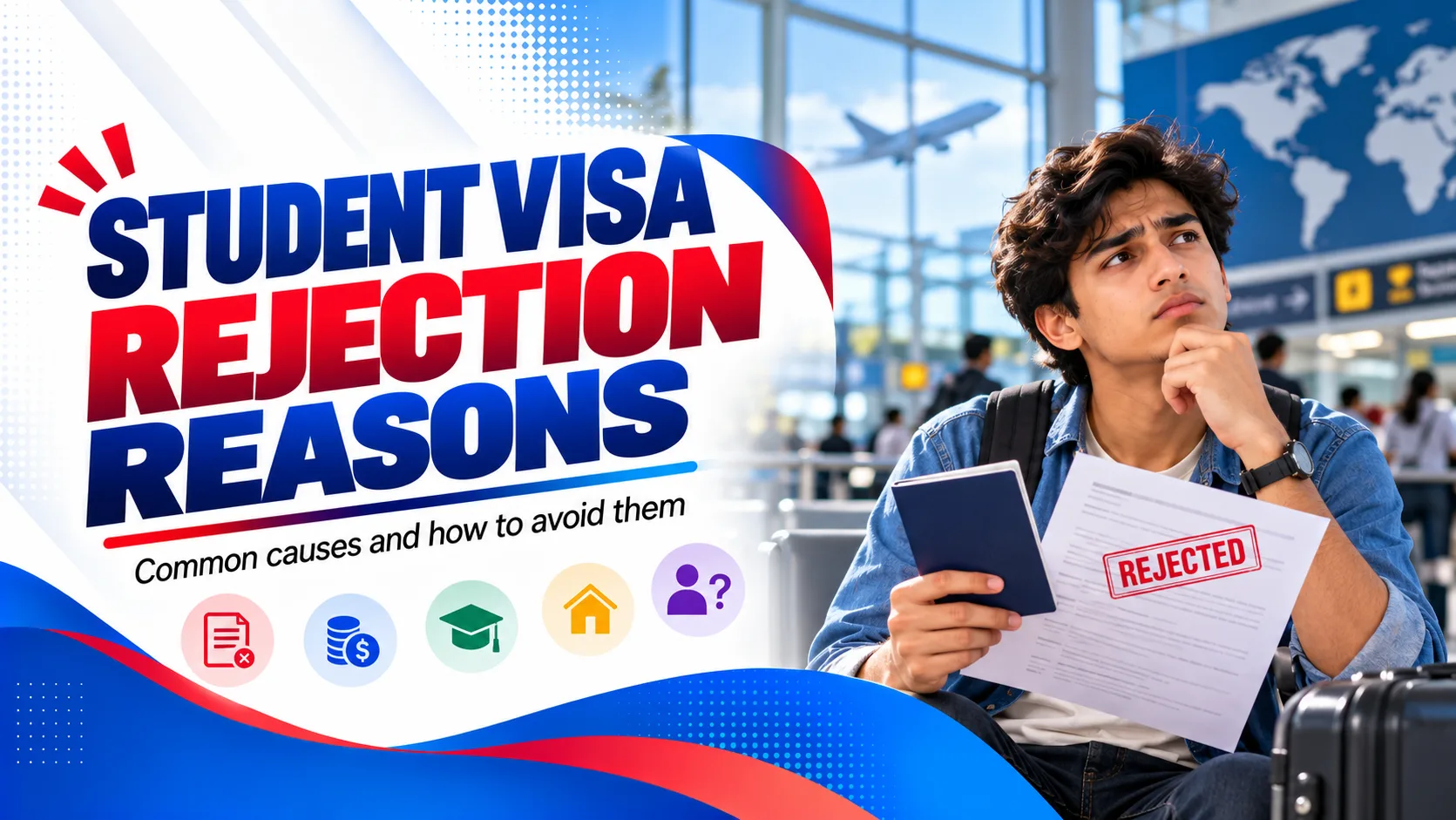
Scroll HereIt is often the hardest part of your study abroad preparation to get a visa interview appointment at the U.S. embassy-until the officer looks at your documents, then looks at you, and finally utters the words, "I'm sorry, I cannot issue you this visa today." Tens of thousands of competent and educated students leave the American Consulate every single year, empty-handed and confused, with only a little blue slip in their hands. The most critical piece of advice you will receive is the only way you can avoid this pitfall: Learn the US student visa rejection reasons.
In this guide, we will look into the exact reasons for refusing the student visa, the actual criteria consular officers look at, and how you can build up your profile to get an F1 before your interview!
Why Does the US Embassy Reject Student Visas?
Visa officers at the US Embassy interview literally hundreds of people a day. An interview lasts typically two to five minutes in duration. It is the duty of the officer during this time to judge essentially one thing above all else: Are you going to return to your home country after your studies are completed? Every refusal hinges upon this fact.
Under US immigration law (INA section 214(b)), every applicant has immigrant intent unless he is able to demonstrate the contrary. That one single presumption of immigrant intent causes all F1 visa rejection reasons that you find on the internet.
6 Common US Student Visa Rejection Reasons
The Visa officers review applicants according to the Immigration and Nationality Act (INA). The rejections are mostly due to some relevant legal section or common administrative issues.
1. Immigrant Intent (Section 214(b) Denial)
A leading reason for US student visa refusal is not showing substantial ties to your home country. Immigration officers want to see you have a substantial reason to return; this can be family, property, a job offer waiting for you, or very definite long-term career goals in your country. If your answers suggest you plan to stay in the US permanently, or you can't clearly articulate your post-graduation plans, expect a denial. The concern of immigrant intent F1 visa are on refusal notices.
2. Weak or Unclear Financial Documentation
Applicants must prove that they can afford tuition, living expenses, and health insurance while not participating in unlawful employment in the U.S. Unclear or unstructured financial transfers arouse immediate suspicion.
Common issues with financial documents for F1 visa applicants include:
- Large, unknown lump sums received just before the interview.
- Sponsors who allege personal savings, yet have no registered annual income or returns filed.
- Having multiple unrelated, third-party sponsors who provide no commitment.
Insufficient or weak proof of funds for US student visa is one of the leading causes of application denial after immigrant intent.
3. Incomplete or Inconsistent Documents Required for a US Student Visa
There are some essential documentation requirements every applicant should meet, specifically an I-20 form, SEVIS fee receipt, a DS-160 confirmation page, a passport, transcripts, standardised test score results and proof of funds. A denied application may occur when any of these documents are missing or show discrepancies with your DS-160 form. The consular official often denies overdate, a wrong address or study/academic gap problems.
4. Passport Validity Issues
A surprisingly common and entirely avoidable reason for refusal involves passport validity for US visa applications. It is necessary to have a passport that expires only some time after you plan to return from the US. If your passport has expired or is nearing its expiry date, the whole procedure can be halted or complicated.
5. Poor Performance in the Visa Interview
It may appear that even clearly good candidates are rejected due to their interview performance. Officers are trained to identify answers that are memorised, generic or contradictory. Common F1 visa interview questions include:
- Why did you choose this university and this specific program?
- How will this degree help your career in your home country?
- Who is funding your education, and what is their occupation?
- What are your plans after graduation?
Not being able to answer without hesitation, contradicting yourself according to your own SOP or being uninformed about the course you opted to choose are things that can ruin an otherwise bright application.
6. Choice of University or Course Doesn't Match Academic Background
The consular officer will assess if the decision to study in USA student visa logically follows your previous background. Candidates can be rejected if they shift directly across streams, for example, if they have been studying Mechanical Engineering and now want to pursue a degree in Fine Arts but have not presented a valid reason. Joining low-ranked or unrecognised universities that run an unspecialised degree at a course level that is identical to your current qualification can signal a lack of genuine academic intent.
How to Strengthen Your F1 Visa Application Before the Interview
Solid visa interview preparation for USA applicants should focus on clarity, consistency, and confidence:
- Master your program. Know what your course is, the ranking of your university and how it corresponds to your career plan.
- Arrange your F1 financial documents logically; the sponsor's letter, bank statements and proofs of income should reveal a single financial story.
- Practice answering with genuine, specific reasons, not memorised scripts.
- Emphasise ties to home country-family, jobs, real estate, intentions of long-term return.
- Make sure that each document required for US student visas matches the DS-160 form.
- Renew your passport early if it's close to expiring.
How to Reapply After an F1 Visa Rejection
Getting denied doesn't mean all hope is lost. Here's how to approach a reapply after F1 visa rejection:
- Inquire about the details, asking what immigration section the officer documented the denial under (usually 214b) on your visa refusal letter.
- Try to close the discrepancy, be it in finances with strengthened documents or intent with a clear case for returning to your home country.
- Wait for tangible changes, because reapplying straight away and still lacking the reasons for the previous denial rarely works.
- Come up with new and strong answers without using the previous exact phrasing.
- Consider professional guidance from an education consultant if you've been refused multiple times.
Final Thoughts
US student visa rejection reasons basically boil down to two problem factors: unclear intent to return home and insufficient proof of financial stability. Luckily, both issues are entirely within your control. Good documents showing you have finances, a solid explanation of why you want to study, and a well-prepared and truthful interview answer can actually get you out of the U.S. Embassy with the required Visa in hand.
So, if you’re thinking of studying at an American school with a student visa, get ready for it months in advance. Not days. A more consistent and direct application will have you in school that much quicker.
Frequently Asked Questions
What is the difference between Section 214(b) and Section 221(g)?
A 214(b) is a flat-out denial because the person couldn't show they didn't have immigrant intent and they couldn't show they had adequate funds. A 221(g) is a temporary denial until the officer can gather more information/administer further processing.
Can I reapply immediately after an F1 visa rejection?
While there is not an explicit "waiting period", reapplying immediately and without any new material information or a stronger case often results in a similar negative decision. Do not reapply until you correct what was missing previously.
Is an education loan accepted as proof of funds for a US student visa?
Yes, the sanction letter issued by a recognised bank or financial institution is considered acceptable and concrete evidence of funds when applying for a US student visa.
Does an F1 visa rejection automatically ruin my chances of getting a US visa in the future?
No, a denial of an F1 visa does not permanently block you. It implies that you did not establish immigrant intent and financial self-sufficiency. You can be approved during a second interview with the right understanding.
How much liquid money should I show as proof of funds for a US student visa?
On Form I-20, you have to prove you have liquid money to cover your total expenses for the first year, and continuing sources of income (such as a loan, family income) for other years.